SEO Content Brief: How to Brief Writers (and AI) So Pages Rank
Most pages that fail to rank were never given a job. The draft may be fluent, on-brand, and keyword-stuffed, yet it still misses what the SERP actually rewards: a clear match to intent, coverage of the entities and questions winners already answer, and a structure search engines and people can parse. That gap almost always starts in the brief, not in the writer or the model.
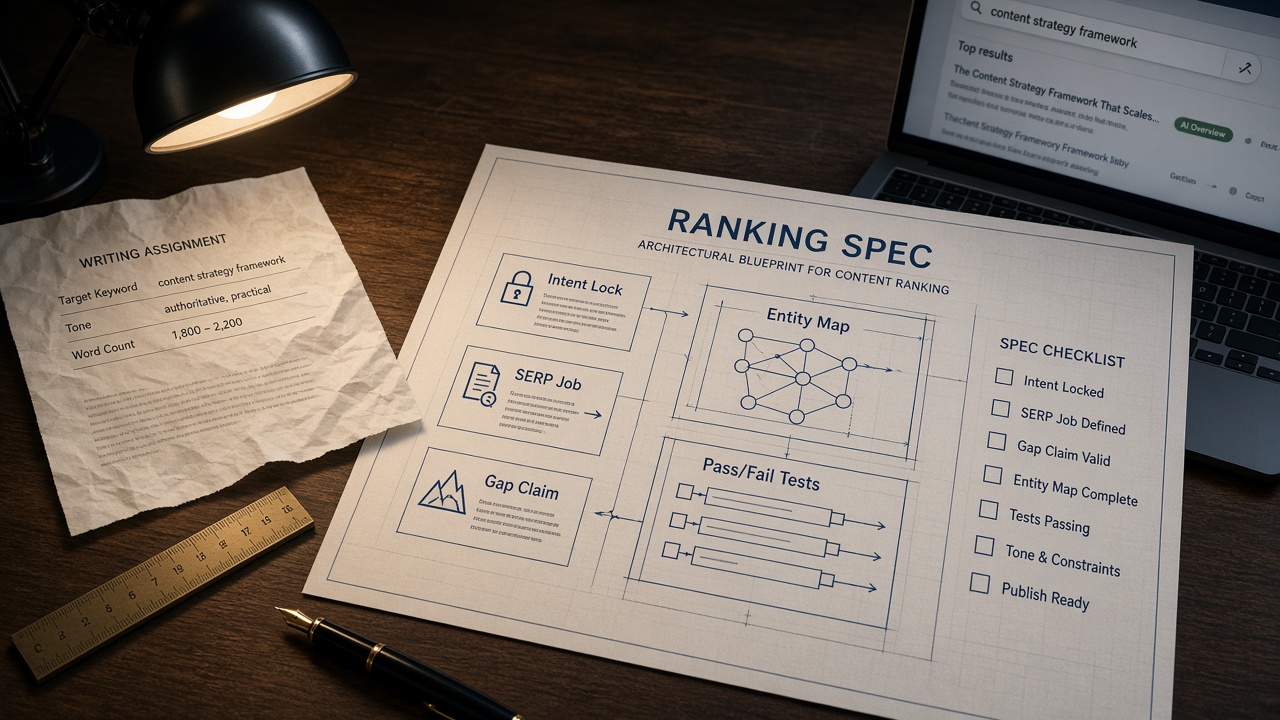
An SEO content brief is not a mood board or a list of phrases. It is a ranking spec: who the page is for, which query family it must satisfy, what the current results leave open, which facts and entities must appear, and how you will know the draft is done. Humans and AI both follow the spec they are given. Vague briefs produce interchangeable copy; tight briefs produce pages that can be evaluated against the live results.
This article walks through how to brief so the output is built to rank—whether you scale with writers, models, or both. Treat every field below as something a later editor can check, not as optional color.
- Rankings fail in the brief when intent, SERP gaps, and entities are left implied instead of specified.
- Write the brief as a pass/fail spec humans and AI must meet, not as tone notes or a keyword dump.
- Lock primary intent, competing page patterns, required entities, and acceptance tests before anyone drafts.
- The same brief works for people and models; only the enforcement of constraints changes.
- Evergreen briefs stay useful when they describe jobs to be done on the SERP, not this week’s ranking snapshot alone.
Ranking misses start before anyone writes a word
Teams still brief a keyword, a word count, and a note about “keeping it on-brand,” then later rewrite the draft for tone and length. That rewrite cannot fix what was never decided: what job the query is hiring the page to do, what angle it will take, and why it should exist next to everything else already ranking.
Ranking is constrained by choices made before drafting. The query has a job—compare, learn, buy, troubleshoot—and the SERP already shows which formats win that job: listicles, product grids, how-tos, local packs, videos. If the brief does not name the job and the format the page will compete in, the writer (or the model) will default to a generic explainer. The page also needs claims it will own—specific entities, proof, and a point of view—and a list of URLs it must not cannibalize. Those are ranking decisions, not style notes.
AI drafts fail in the same place human drafts fail. Unspecified decisions get filled with a remix of the current SERP: the same headings, the same entities, the same hedging. The output sounds finished because it is fluent. It does not rank because it never chose a gap. Fluency is cheap; uniqueness is specified.
Lock those ranking decisions in writing before anyone opens a doc: the search job, the unique claim, how the page will sit next to competitors, and the test that proves the draft passed. Tone and length come after those locks. Until they are locked, every draft is a guess dressed as content.
Before the draft — Pages lose in the brief when intent, SERP format, owned claims, and cannibalization are left open—writers and AI then fill the gaps with generic remixes that only sound complete.
Write a Ranking Spec, Not a Writing Assignment
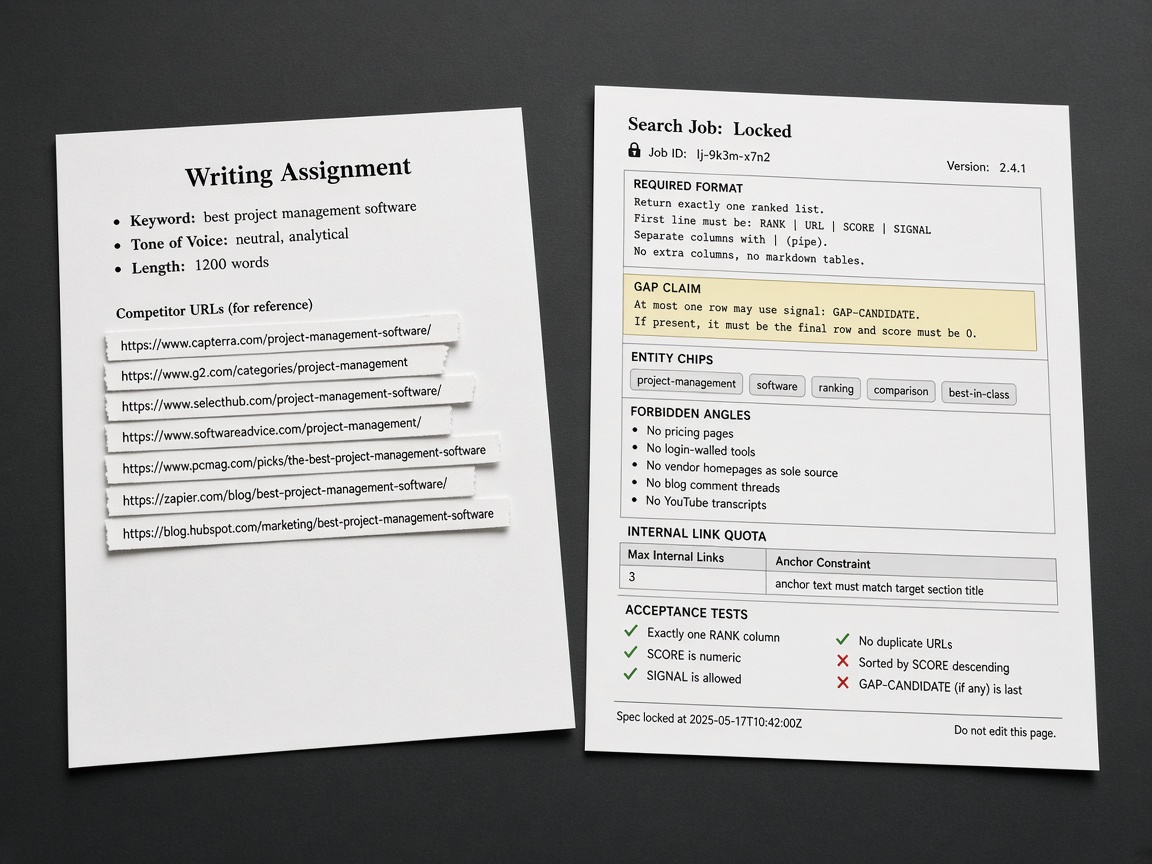
That is why the next move is not a better prompt or a longer style guide. It is to stop issuing writing assignments and start issuing ranking specs. A writing assignment tells someone how the page should sound. A ranking spec tells them what job the page must complete in the SERP, which claims it must uniquely support, and which decisions are already locked before a sentence is drafted.
Voice, audience, and word count still matter later. They do not decide whether the URL can compete. The spec does: the query job, the page type the SERP is rewarding, the gap claim this URL will own, the entities that must appear because competitors already treat them as table stakes, the internal pages this one should strengthen, and the angles that are out of scope so the draft cannot cannibalize a sibling.
What belongs in the minimum spec
The minimum spec is a short set of fields, each one a constraint on the outline. Extra paragraphs of brand color and unused research make the real locks harder to see when a writer or a model starts drafting.
- Primary query and intent lock: the job the searcher is hiring the page to finish, stated so the draft cannot drift into a neighboring intent.
- Required page type: the format the SERP is already rewarding (guide, comparison, hub, how-to), not the format the brand prefers.
- Must-own gap claim: the one assertion this URL will support that current results leave thin, vague, or missing.
- Must-cover entities: people, products, processes, and constraints that belong in headings and snippets because the topic is incomplete without them.
- Internal link targets: the URLs this page should send equity to, and the ones it must not overlap.
- Out-of-scope angles: topics that belong on other URLs so this draft cannot cannibalize them.
Cut decorative brand notes, unused competitor dumps, and keyword lists that never map to a heading or a snippet. Those extras feel thorough and they hide the ranking decisions. If a field cannot change the outline, the title, or a publish/no-publish call, it does not belong in the spec.
Spec, not assignment — A ranking spec is a set of locked SERP decisions. Anything that cannot change the outline, title, or publish call is not a spec field.
Lock the search job before you outline
Before an outline, a title, or a first draft, name the job the searcher is hiring this URL to finish. A head term names a cluster of possible jobs. The brief names one: the outcome that, if delivered cleanly, makes the visit successful and makes every competing format on the SERP look incomplete.
Write that outcome as a completed action, not as a synonym of the keyword. Someone searching a product category may be trying to shortlist, not to learn a definition. Someone searching a process may be trying to run it, not to read a history of it. If the brief only repeats the query, writers and models will default to a general explainer—the safest remix—and the page will never be eligible for the result type Google is already rewarding.
Match the format the SERP already treats as the answer
Open the live results and name the dominant page type: guide, comparison, template, definition, workflow, or a hybrid that still has a clear primary shape. That choice is an eligibility gate. A comparison outline will not compete in a SERP of how-to workflows no matter how well it is written. Put the winning format in the spec so the H2s, the lead, and the assets (table, checklist, decision tree) are decided before anyone writes a sentence.
Then specify the snippet or answer shape the page should earn. Definition, numbered steps, criteria table, or decision framework are different extraction targets. If the SERP is answering with a compact definition, the brief should require that definition in the first screen, in language that can stand alone. If it is answering with steps, the brief should require a complete, ordered path—not a narrative that buries the sequence. Eligibility is not “cover the topic.” It is “present the answer in the shape the results already prefer.”
Keep supporting jobs from swallowing the page
One URL can only own one primary job. Adjacent intents—pricing, troubleshooting, alternatives, beginner vs. expert—belong as short supporting modules or as links to other pages, not as co-equal sections. When those supporting jobs are unspecified, models sprawl: they pad for completeness, dilute the must-own claim, and produce a page that is mildly relevant to five queries and decisive for none. The brief should list supporting jobs as optional, capped, and out of scope if they would change the page type.
Locking the job this way is what makes later fields—gap claims, entities, pass/fail tests—testable. Without it, those fields become decoration on a page that was never eligible.
The job lock — Name one completed searcher outcome, match the SERP’s dominant format and snippet shape, and treat every adjacent intent as capped support—or the outline will never be eligible to rank.
Encode the gap claim, entities, and non-negotiables
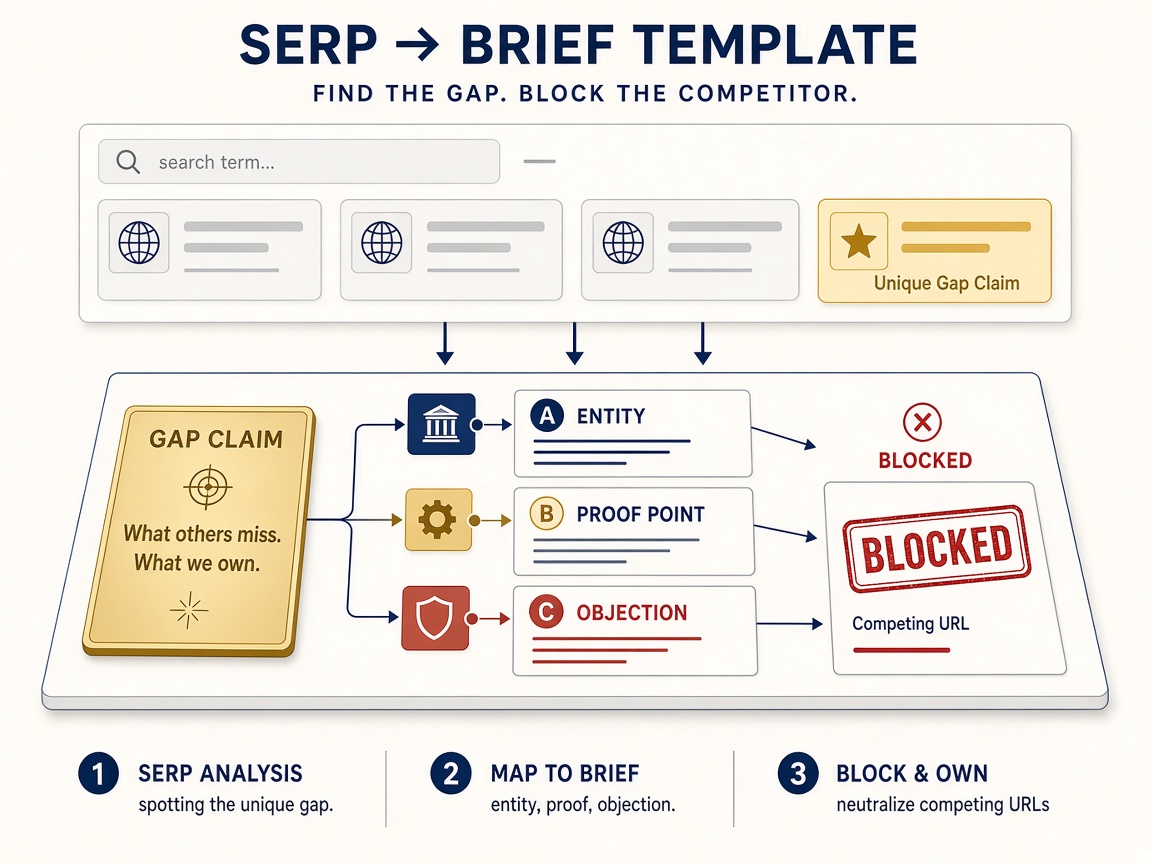
Once the search job and page type are locked, the brief still has to say what this URL uniquely owns. Without that, the outline fills the same shallow slots the SERP already covers. Require one explicit gap claim: a useful decision, proof, process, or constraint the current results treat lightly or skip. That claim is not a slogan. It is the reason a crawler and a reader should prefer this page over the pages already ranking. If you cannot write it in one sentence that a competitor would have to copy to match you, you do not have a ranking spec yet.
Topical completeness is a checklist, not a vibe. List the entities the page must name, the attributes those entities need (type, constraint, comparison, exception), and the related questions a thorough answer would settle. Then map each entity to a section so coverage is structural. Dumping names into the introduction does not count; if an entity never appears as a heading, a table column, or a defined subsection, it will be skipped under deadline and the model will treat it as optional flavor.
What must stay off the page
Non-negotiables protect the rest of the site as much as they protect the draft. State angles to avoid so the writer does not wander into a different search job. Name sister URLs that already own overlapping queries so this page links to them instead of competing. Flag claims that need sources before they can be published. And spell out offers the page must not oversell: no invented guarantees, no pricing the sales page does not support, no “we’re the only” language the SERP will immediately disprove. Humans and models both fill silence with extra scope; the brief has to close those doors in writing.
- One gap claim the current SERP treats shallowly or skips.
- Entities, attributes, and related questions mapped to specific sections.
- Out-of-scope angles, cannibalizing sister URLs, sourced-claim flags, and oversell limits.
When those three layers sit in the brief, the outline is no longer a writing plan. It is a pass/fail map: if the draft does not argue the gap, cover the mapped entities, and respect the fences, it is not ready to publish—regardless of how finished it sounds.
Own the gap — A ranking brief names one SERP gap, maps entities to sections, and writes the fences that keep the URL from cannibalizing or overselling.
Same ranking rules for writers and models
That setup only holds if the brief treats people and models as two channels that fail in different ways. A ranking spec that is silent on those failure modes will still produce two different pages: one that sounds like the brand, and one that sounds like the SERP.
Human writers typically under-cover the entity list, lean too hard on voice, and invent a clever angle that does not match the search job you already locked. The draft can read well and still miss the attributes, related questions, and gap claim that make the URL eligible. Models typically remix competitor headings, flatten the gap into a generic summary, fabricate specifics they were never given, and pad length without adding ranking evidence. Fluency is not coverage.
Write constraints as rules, not reminders
Turn the spec into executable rules both channels can follow without reinterpretation. Required H2s should be named, in order, so the outline cannot drift. Claims that need citations should be listed as claims, not as a vague “use sources” note. Facts that must not be guessed—prices, dates, product behavior, legal status, competitor claims—belong on a do-not-invent list. Examples must be original: no restating a rival’s case study as if it were yours.
- Required H2s mapped to the search job and the gap claim, not optional suggestions.
- Claims that need citations, with a placeholder if the source is not in the brief.
- Facts that must not be guessed; if unknown, omit or flag rather than invent.
- Examples that must be original, tied to the entities the page is required to own.
Give both channels the same outline skeleton, the same entity checklist, and the same do-not-invent list. If the human brief and the model prompt fork, you will publish two pages that compete with each other instead of with the SERP. One skeleton means one URL: the writer can fill voice inside the slots; the model can fill slots without rewriting the architecture. The handoff is then a completion of the spec, not a second brief.
One brief, two channels — Humans miss entities and invent angles; models remix headings and fabricate facts. One shared skeleton, entity checklist, and do-not-invent list keeps both channels on the same ranking page.
Ship only after ranking acceptance tests
Nothing is assigned, and nothing goes live, until the ranking decisions can be checked. If the brief cannot be restated, the draft will drift. If the draft is judged on voice instead of the spec, you will publish a fluent page that still cannot compete.
Test the brief before anyone writes. Hand it to a second person—or to yourself after a pause—and require a clean restatement: the SERP job this URL is hired to finish, the single gap claim it must own, and the out-of-scope list (sister URLs, angles, and offers that stay off the page). If any of those three cannot be said cleanly, the spec is not ready. Do not start drafting to “figure it out on the page.”
When a draft arrives, QA it against that spec, not against taste. Voice polish is optional; ranking eligibility is not. Check intent match (does the page finish the locked job?), format match (does the structure match the SERP page type and snippet shape?), entity coverage (are required entities and attributes in the mapped sections?), presence of the unique claim (not flattened into a generic roundup), and absence of cannibalizing angles. A well-written off-job section is still a fail.
Publish gates that actually block shipping
If a draft fails, reject or regenerate against the same spec. Do not “fix ranking” with a new creative direction that was never briefed. A second pass that changes the job, the gap claim, or the page type is a new brief—not an edit. Keep iterating until the gates pass. Only then is the page specified enough to compete rather than merely finished enough to publish.
Acceptance, not polish — A ranking page ships when the brief can be restated cleanly and the draft still matches that spec—intent, format, entities, unique claim, and publish gates—not when it merely sounds complete.
Key Takeaways
Turn your next brief into a ranking spec—intent, gap, entities, and pass/fail tests—before anyone writes a word.
Frequently Asked Questions
You Might Also Like
- Guides SEO Content Brief Template: The Complete Guide to Briefs That Rank
- Guides SEO Content Brief Examples for Product, Comparison, and How-To Pages
- Guides Free SEO Content Brief Generator: How to Brief Writers in Minutes
- Strategy Long-Tail Keyword Research: A Practical Workflow for Briefs
- Templates SEO Article Outline Template for AEO and Classic Rankings