
SEO Content Brief: How to Brief Writers (and AI) So Pages Rank
Most SEO automation fails at the brief, not the model. Autoblogging, AI blog writers, and programmatic templates can ship pages at scale, but they cannot invent the job a page must do in the SERP: the questions it must answer, the entities it must name, the claims it must not fabricate, and the format Google already rewards for that query.
A useful brief is not a writing prompt. It is a ranking-job contract: what the page must cover, what it must not invent, how it should be structured, and how you will know the draft is ready. Writers and AI both need that contract. Without it, content automation produces fluent pages that miss intent, duplicate competitors, or leak unsourced numbers.
This article walks through how to brief humans and models so the first draft is already aligned with search intent—and how that discipline is the real lever behind SEO automation that still ranks.
- Treat the SEO brief as a ranking contract, not a creative prompt for writers or AI.
- Map the SERP job first: intent, entities, format, and questions the page must close.
- Freeze facts, sources, and claims models cannot invent before generation starts.
- Score every brief for completeness so automation does not scale thin or invented copy.
- Programmatic SEO and AI writers only rank when the brief already encodes the ranking work.
Map the page’s ranking jobs before anyone writes
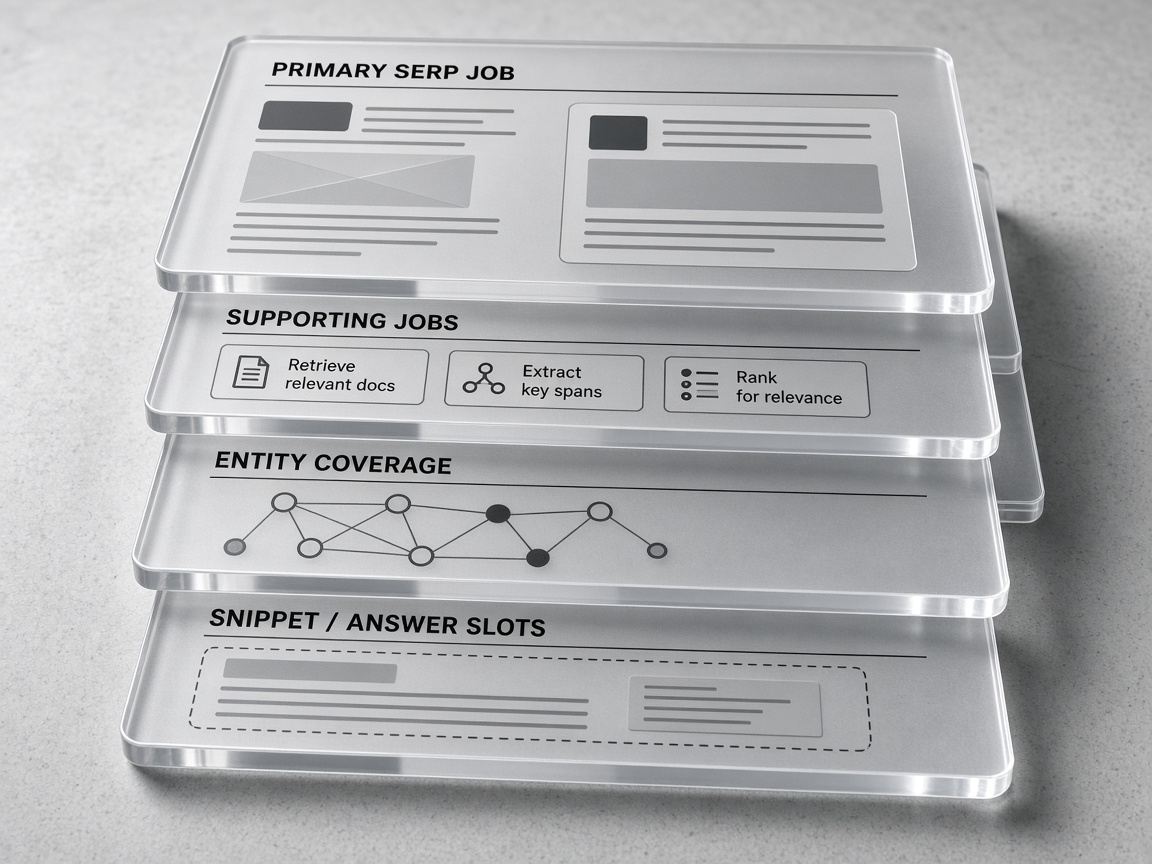
Ranking does not start with a working title or a word-count target. It starts with the jobs the query is hiring the page to do. Until those jobs are named in plain language, a writer or a model is guessing at structure, and guesswork is how you end up with another paraphrase of whatever already occupies the top results.
Treat the SERP as a stack of jobs-to-be-done: answer, compare, choose, implement. One of those is primary—the reason someone clicked. Two to four supporting jobs complete the visit so the page matches (and then exceeds) what dominant results already finish. A brief that skips this stack is not a ranking contract; it is a prompt with extra adjectives.
Write the job stack before the document exists
Refuse to open a doc or a model prompt until the stack is written so a human or an AI assistant can execute it without inventing a new purpose. Name the primary job in one sentence. List supporting jobs as outcomes the page must visibly complete. Then scan what competitors already finish—definition, comparison, pricing logic, setup—so the brief can assign a remaining job instead of restating theirs.
When the stack is on the page in that form, the rest of the brief has something to freeze: facts, entities, and SERP constraints. Voice and examples can still flex. The jobs cannot. That is the difference between briefing for rank and briefing for word count.
Job stack first — A ranking brief is a job stack first: one primary job, a few supporting jobs, each mapped to a visible on-page outcome, written before anyone drafts.
Freeze the ranking contract—leave voice and proof open
Once those ranking jobs sit in executable language, the next move is not “write a better prompt.” It is to freeze a SERP contract: the non-negotiables a draft can fail, while leaving craft—voice, examples, proof—open so a human or a model still has something real to invent.
Freeze search intent as the primary job plus its supporting jobs, not as a vague “informational” label. Freeze the angle in one sentence: who this page is for, what it will not try to be, and the distinct remaining job you assigned after calling out what competitors already finish. Freeze must-cover entities—the products, standards, features, and named steps a ranking page cannot skip. Freeze outline claims: each H2 is a statement the page will make true, not a topic bucket. Freeze internal links as destinations with a reason to click, not a dump of related URLs. Freeze the snippet or answer the page should own: the one-line result a searcher should be able to lift from the opening or a definition block.
Leave the rest as craft variables. Examples, analogies, original proof, expert asides, and how evidence is narrated are how the page sounds like an operator instead of a template. Models cannot invent those honestly if you have not collected them; humans should not be told to fill a “comprehensive guide” instead of doing that work. The brief specifies where proof may live. It does not script the sentences.
One uniqueness slot, not a longer outline
Specify a single uniqueness slot that similar pages do not hold: a data cut you actually have, a method you run, a teardown of a workflow, or an operator sequence someone can follow. That slot is a job, not decoration. Ban filler headings. Every H2 must map to a frozen ranking job or to that uniqueness slot. If a heading only exists to look complete, it is already a ranking leak.
Treat the frozen layer as a contract the draft can fail. Intent mismatch, missing entities, unclaimed snippet, skipped uniqueness slot, or an H2 that maps to nothing—these are fail states, not style notes. Inspiration is what you leave open. The contract is what you score before anyone writes.
Contract vs craft — Lock intent, angle, entities, outline claims, links, snippet, and one uniqueness slot as fail-able terms; leave examples, analogies, and how proof is told as craft.
One Brief, Two Packets: What Humans Need vs What Models Must Not Invent
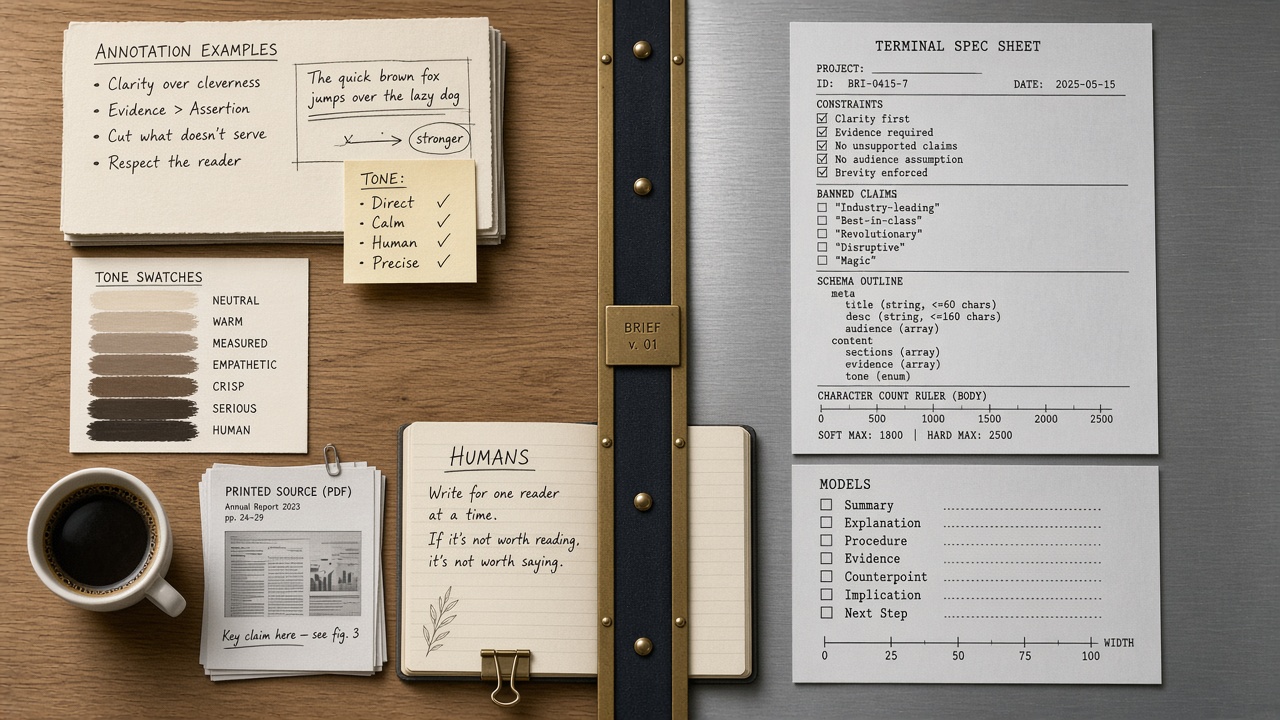
Once that ranking contract is frozen, the next failure mode is treating the brief as a single blob of prose and hoping both a writer and a model will infer the same rules. They will not. Humans fill gaps with judgment; models fill gaps with fluent invention. The same canonical brief has to render two packets so neither channel improvises what the other was supposed to receive.
Keep one source of truth. The human packet and the machine packet are views of that document, not competing briefs. If a rule exists only in a Slack note or only in a prompt, it is not a rule. When the contract changes, both packets regenerate from the same fields so outline locks, entities, and uniqueness slots cannot drift.
What the human packet must actually contain
Writers do not need another list of keywords. They need worked examples of the voice and of a finished H2 that would pass the contract. They need a source hierarchy: which owned data, which primary documents, which competitor pages are for contrast only. They need tone boundaries—what this brand never claims, never jokes about, never overpromises. They need the audience objections the page must answer in the uniqueness slot, and a clear invitation to add original judgment: which comparison, teardown, or operator workflow is theirs to own. Leave those open and you get competent paraphrase of the SERP, not a page that finishes a remaining job.
What the machine packet must lock down
Models need hard constraints, not vibes. Lock the outline so H2s cannot wander into comprehensive-guide filler. Give length bands per section so the draft cannot balloon or collapse. List banned claims, citation rules, the must-cover entity list, and negative keywords. Add explicit “do not invent” fields: numbers, product names, legal status, quotes, and anything that would require a source you have not supplied. Ask a model to be comprehensive from parametric memory and you have already authorized hallucination. Give retrieval or source slots instead—URLs, excerpts, tables, or notes the model may paraphrase, and nothing else for facts.
- Outline locks and length bands tied to frozen jobs, not a free-form heading list.
- Banned claims, negative keywords, and entity lists the draft must hit without inventing extras.
- Citation rules plus source slots so facts come from retrieval, not from the model’s memory.
- Named “do not invent” fields for figures, names, quotes, and status claims.
State who owns fact-checking in the brief itself: the writer before handoff, the editor on the first pass, or a post-generation QA step with a checklist against the frozen contract. Never leave it implied. If ownership is missing, the machine packet will ship plausible errors and the human packet will assume someone else caught them. Dual-channel rendering is how the ranking contract stays fail-able for both people and models without asking either to guess the missing rules.
Dual channel — One canonical brief, two packets: humans get examples and judgment slots; models get locks, source slots, and named fact-check ownership so neither channel invents the ranking contract.
Make Briefs Automation-Ready Without Shipping Thin Pages
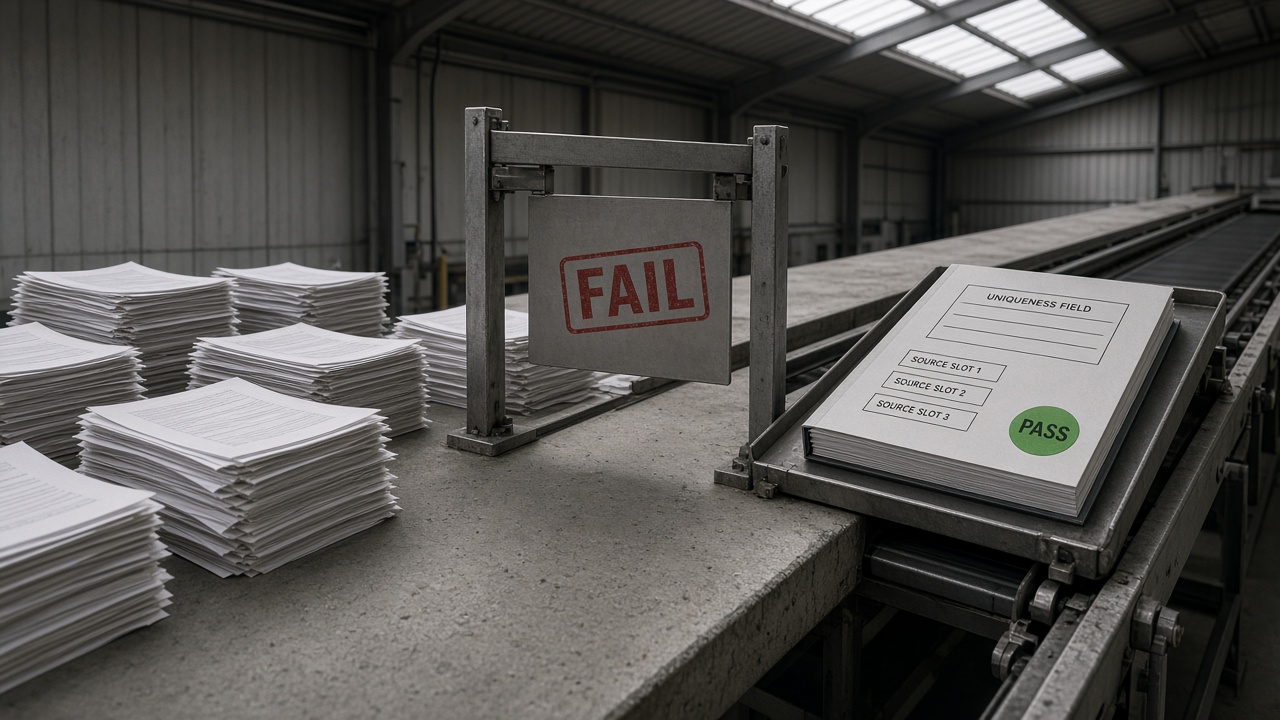
Once the human packet and the machine packet share one canonical brief, the next failure mode is scale: pipelines that treat “brief” as keyword, title, and word count. Programmatic SEO and AI blog writers will happily fill that skeleton. They will not invent a ranking job, a uniqueness slot, or a fact that was never frozen. Autoblogging that only ships volume multiplies emptiness. Automation is useful when it multiplies a ranked contract—not when it substitutes for deciding what the page must do in the SERP.
Attach quality floors to every automated brief before a model or a template cluster can run. Those floors are not style notes. They are gates: if any one is empty, the job does not enter the queue.
- A unique angle that maps to the remaining ranking job, not a synonym of the cluster’s default H1.
- Required entities the page must name and situate, so the model cannot skip the SERP’s vocabulary.
- Evidence slots with retrieval or source ownership already assigned—never a blank “add stats later.”
- A cannibalization check against live URLs and other briefs in the same job stack.
- Internal-link targets (hub, sibling, conversion) written as destinations, not “add links.”
Template clusters need one more lock: a differentiation field that cannot be identical across the set. If ten location or product pages share the same proof, outline claims, and uniqueness slot, you have not automated content—you have duplicated a thin page. Force that field to vary (operator workflow, local constraint, method teardown, owned dataset) so each URL still earns its own job.
Some page types should stay human-led even when the rest of the calendar is automated. YMYL-adjacent topics, net-new thought leadership, and queries where the SERP clearly rewards original proof do not belong in an unattended AI blog writer. The brief can still freeze jobs and entities, but judgment, first-party evidence, and liability stay with an operator. Content automation then becomes a multiplier on pages whose ranking contract is already decided—not a way to skip that decision.
Scale the contract — Automate the execution of a frozen ranking contract with quality floors and a non-identical differentiation field; do not automate the decision of the page’s jobs, and keep YMYL, thought leadership, and original-proof SERPs human-led.
Score the brief before anyone writes a draft
Once a pipeline can stamp out contracts at scale, the failure mode shifts: volume without a gate. Score the brief itself—not a draft that does not exist yet. The pass is an operator check against the ranking contract: does this document still match the SERP’s intent, cover the primary job plus supporting jobs, lock a uniqueness slot that cannot be cloned across a template cluster, name an evidence plan, own a snippet or answer slot, and clear cannibalization risk against URLs you already rank or intend to ship?
That score is binary enough to run without a committee. A brief fails if there is no primary ranking job, no uniqueness slot, no sources or retrieval fields, an outline that only restates what already occupies the SERP, or missing internal-link targets. Those are not style notes. They are missing pieces of the contract. “We’ll fix it in edit” is not a workaround: editing can tighten sentences and swap examples, but it cannot invent a ranking job, a distinct remaining job, or proof the brief never planned. Shipping a failed brief into generation just multiplies thin pages faster.
Keep the operator pass short enough to gate dozens of URLs
Lean teams do not need a scoring committee. They need a checklist an SEO or content lead can run in minutes per URL, with the same fail conditions every time. Pass means the human packet and the machine packet both inherit a contract that could rank. Fail means the brief goes back into the system—jobs restated, uniqueness rewritten, sources assigned—before a writer or model is asked for a first line.
- Intent match and job coverage: primary job plus supporting jobs still map to on-page outcomes.
- Uniqueness slot and evidence plan: one non-cloneable angle plus where facts will come from.
- Snippet/AEO slot, internal links, and cannibalization: owned answer plus no collision with live or queued URLs.
Log every score. When the same template cluster fails on uniqueness, sources, or cannibalization, the fix belongs in the brief system—the frozen fields, the differentiation requirement, the quality floors—not in one-off rewrites of a single URL. Repeated template failures are a signal that automation is multiplying an incomplete contract. Treat the log as product feedback on the briefing stack, then only generate drafts from briefs that already passed.
Gate first — A draft cannot repair a brief that never assigned a ranking job, a uniqueness slot, or an evidence plan—score and fail the contract first, then write.
Ship acceptance tests, not another rewrite round
Scoring the brief is still not the last gate. Once that contract is green, every ranking job must become a pass/fail test the draft has to satisfy—not a vibe, not “more SEO,” a binary check the page either meets or it does not ship.
Write those tests in the same language as the job stack. For each primary and supporting job, the draft must show the job on the page, cover the required entities, source every frozen claim, and, where you claimed a snippet or answer slot, leave a block that is actually eligible. If job three is “implement,” a paragraph that only describes the problem fails. If an entity is on the contract, burying a synonym once is not coverage. If a claim was locked, an unsourced flourish is a fail, not a style note.
Revision budget: what may change, what breaks the contract
Give writers and models a revision budget so they stop treating the outline as a suggestion. They may change examples, analogies, original proof, expert asides, and how evidence is narrated. They may tighten sentences and reorder supporting sentences inside a locked heading. They may not invent a new primary job, drop a uniqueness slot, add comprehensive-guide filler, unsourced claims, or internal links that were never in the brief. Those are contract failures. The budget is the difference between a useful second pass and a rewrite that quietly unwrites the ranking work.
Package the handoff as artifacts, not a chat thread: the job stack, the frozen outline, dual-channel instructions (human packet and machine packet), the source list with ownership, the brief scorecard, and the acceptance tests. That bundle is what an AI blog writer, an autoblogging pipeline, or a staff writer actually executes. Vague “optimize this” tickets are how programmatic SEO and content automation ship thin pages that all say the same thing.
In editorial QA, feedback should name the test. “Job 3 missing.” “Snippet block not eligible.” “Uniqueness slot restates the SERP.” That is usable. “Make it more SEO” is not. When a test fails, feed it back into the brief template—missing entity lists, weak evidence slots, outlines that only restate competitors—rather than burning another round of line edits on a page that never had the job. The loop closes on the ranking contract, which is the only thing automation should multiply.
Ship the test — A ranked page is a draft that passed job-level tests against a frozen contract—not a rewrite that hoped the ranking job would appear in edit.
Key Takeaways
Turn your next brief into a scored ranking contract with dual packets and acceptance tests before anyone writes a draft.
Frequently Asked Questions
You Might Also Like
- Guides SEO Content Brief Template: The Complete Guide to Briefs That Rank
- Guides SEO Content Brief Examples for Product, Comparison, and How-To Pages
- Automation How to Turn Keyword Clusters Into Briefs Automatically
- Guides Free SEO Content Brief Generator: How to Brief Writers in Minutes
- Workflows Content Automation Workflow: Research, Draft, QA, Publish