SEO Content Brief: How to Brief Writers (and AI) So Pages Rank
Autoblogging fails when the brief is a prompt, a keyword dump, or a publish checklist. Search engines reward pages that match a specific job-to-be-done, cover the entities and questions already winning the SERP, and stay inside a clear scope. Without that lockfile, writers pad, models hallucinate, and the page never earns a stable ranking.
A useful brief is not a style guide and not a CMS workflow. It is a specification: who the reader is, which query cluster you own, what must be explained, what must be cited, what must be excluded, and how success will be judged. Humans follow it as editorial law. Models follow it as constrained generation. Either way, the page is built to rank rather than to fill a calendar.
This article shows how to write that spec so automated publishing and AI-assisted drafting stay useful: intent first, entities and SERP gaps next, then structure, evidence, and hard no-gos—so content scaling does not become thin autoblogging.
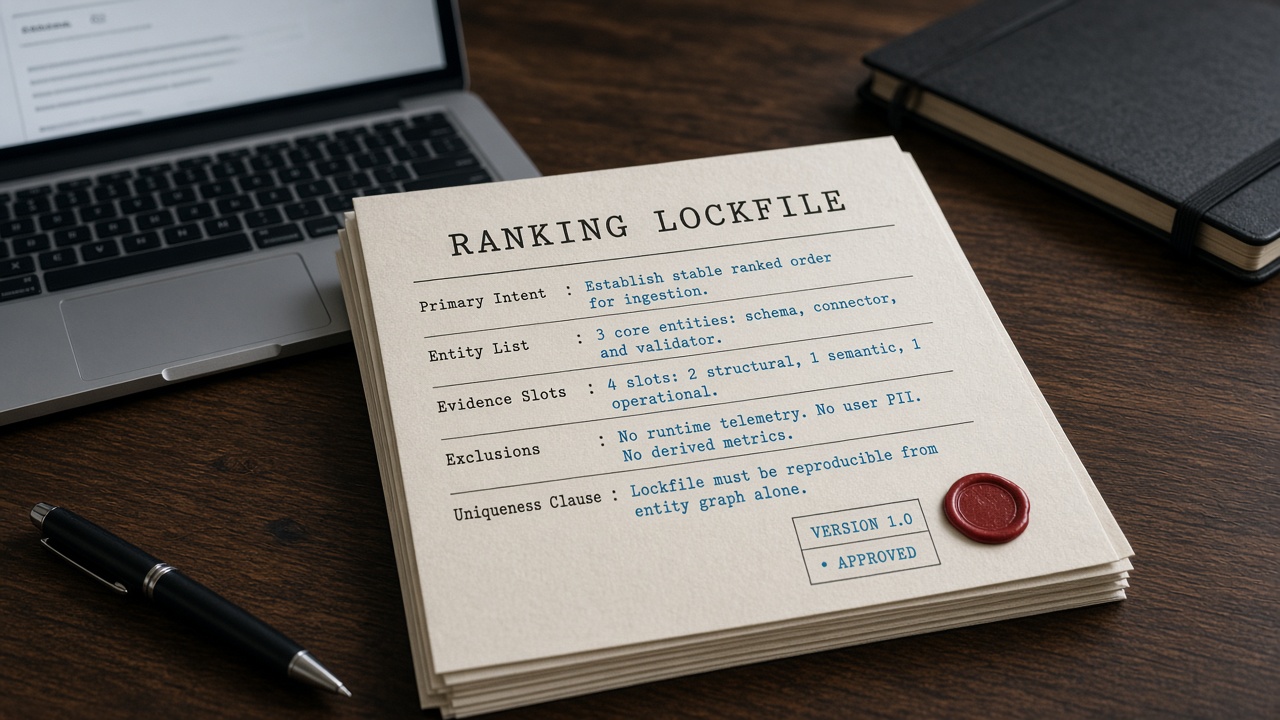
- Treat the brief as a ranking lockfile, not a chat prompt or a publish runbook.
- Lock primary intent, query cluster, and the reader’s job before any outline or generation.
- Specify entities, must-answer questions, citations, and exclusions so AI cannot invent thin filler.
- Judge the brief by whether a stranger could draft a page that could compete in the SERP.
- Automation scales quality only when the spec is tighter than the model’s default verbosity.
Autoblogging Fails in the Spec, Not in the Model
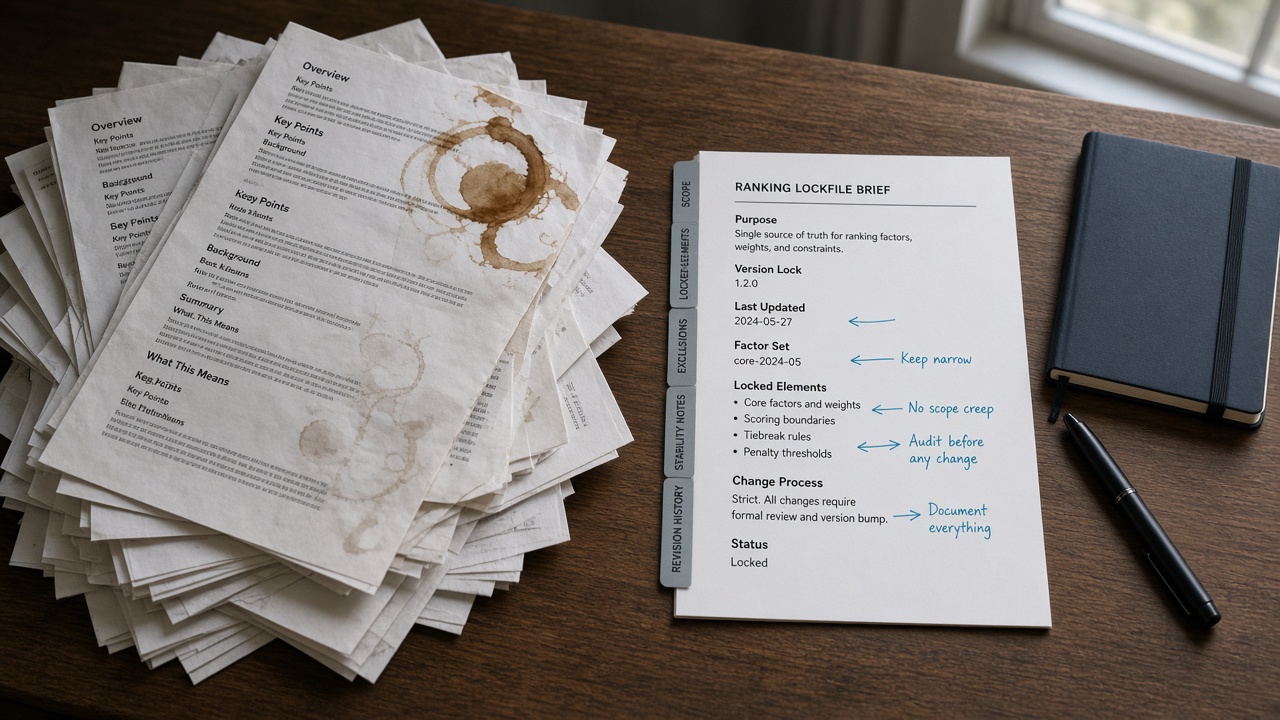
That is why the usual post-mortem is backwards. When automated pages stall, teams blame the generator: the wrong model, a stale prompt, a CMS plugin that “doesn’t write like us.” Throughput was never the bottleneck. Content automation can already emit fluent copy at a volume no editorial calendar can match. Ranking control is the missing layer—the brief treated as a lockfile, not a mood board.
An AI blog writer without locked search intent, named entities, required evidence, and explicit exclusions will still produce readable paragraphs. Fluency is cheap. What it will not produce, reliably, is a page that matches the job the SERP is actually hiring for. Off-intent angles sneak in because nothing forbade them. Entities that competitors and searchers treat as non-negotiable go unnamed. Claims float without citations because the spec never demanded sources. The result is a thin autoblogging URL: grammatically fine, commercially useless, and indistinguishable from a thousand other uncited drafts.
The brief is the control plane. Not the first draft, not the publishing queue, not whichever model version shipped this week. Humans and models both execute whatever constraints they are given; if the constraints are a keyword and a word count, they will ship keyword-shaped filler. If the constraints bind intent, entities, evidence, and what must never appear, they cannot honestly ship a page that violates them. That is the difference between a firehose of automated blog posts and a gate: a URL is not allowed to exist until the spec is satisfied.
Scale without that gate is just faster failure. SEO automation only compounds when every generated URL is forced to pass the same ranking contract before it goes live. The rest of this piece is how to write that contract so neither a freelancer nor a model can wriggle out of it.
Control plane — Ranking autoblogging is a spec problem: lock intent, entities, evidence, and exclusions before any URL is allowed to exist—the model and CMS only execute what the brief permits.
Read the live SERP as the ranking brief
The live results page is the requirements document—not a pile of seed terms. Open the query as a stranger would and write down what Google is already rewarding: the dominant intent (learn, compare, transact, or fix), the content type that occupies the top slots, how deep those pages go before they feel finished, and who they are clearly written for. That snapshot is the lockfile's first layer. If the SERP is a how-to gallery for operators, a thought-leadership essay is already out of spec, no matter how well the model writes.
Treat People Also Ask, related entities, and the questions ranking pages actually answer as named fields in the brief. They are not “extra keywords” to sprinkle later. Each one is a must-answer unit: a heading, a definition, a comparison, or a constraint the page cannot skip. Capture format as a constraint too—definition, comparison, numbered steps, or a table—so neither a human nor a model defaults to a generic essay when the SERP is clearly a procedure or a side-by-side.
Open ground is what separates a ranking brief from a keyword list. If every competitor restates the same definition and none show a worked example, the brief should require the example. If they skip exclusions, edge cases, or who the advice is not for, that belongs in the spec as work the URL must do. Autoblogging without that job description produces another thin page that looks complete and still fails to rank.
SERP as spec — The SERP is a requirements document: intent, format, must-answer questions, and thin spots become brief fields so writers and models cannot ship a generic essay.
Lock intent, entities, evidence, and exclusions into the brief
Once the live results have shown what ranking actually requires, the brief has to freeze that reading into fields a writer or a model cannot quietly rewrite. Think of those fields as a lockfile: primary query, search intent, audience, promised outcome, required H2 map, entity list, and internal-link targets. If any of them is missing, automation will fill the gap with volume instead of the job the SERP is paying for.
The primary query is the canonical phrase the URL must satisfy, not a bag of near-synonyms. Search intent is a one-line job: what the visitor must be able to do or decide when they leave. Audience names who they are in enough detail that tone and examples stay on-side. Promised outcome is the specific result the page owes them. The H2 map is ordered work, not decoration. The entity list names the people, products, standards, and concepts that must appear so the page is about the topic, not merely adjacent to it. Internal-link targets are the URLs this page must earn a click to or from, so the new URL sits in a cluster instead of as an orphan post.
Evidence slots the model cannot skip
Automated SEO article publishing fails most often by asserting without showing. Require evidence as slots: each material claim maps to a source type and a place it must appear. A definition needs a primary or standards-grade source in the opening explanation. A comparison needs a method or documented difference under that H2. A how-to step needs a constraint or failure mode, not a restated heading. Empty slots mean the draft is unfinished. The brief should say so in language a pipeline can fail on, not in a polite note someone might ignore.
Exclusions and the outline as a contract
Lock what must not ship. Ban off-intent subtopics that pad word count. Ban competitor-clone outlines that copy heading trees without matching the job. Ban claims you cannot support. Explicitly forbid invented product specs, pricing, legal conclusions, and medical or financial advice. “Do not invent” is a field, not a vibe.
Treat the outline as a contract: each H2 maps to an intent job—define, decide, compare, implement, troubleshoot—not to a synonym of the title. If a heading could be swapped for another keyword without changing the reader’s task, it is not locked. Humans and models both need that contract before the next step: briefing them as two different audiences.
Lockfile — A ranking brief is a lockfile of query, intent, audience, outcome, H2 jobs, entities, links, evidence slots, and exclusions—so neither a writer nor a model can ship a thin autoblog page.
One lockfile, two views: brief the writer and the model differently
That lockfile is still one source of truth. What changes is the view you generate from it. A ranking brief is not a paragraph you paste into Slack and into a generator. Humans and models fail in opposite directions when you treat them as the same audience.
What the writer actually needs
The writer-facing view is judgment, not syntax. It names voice, the kind of example that belongs on the page, which stakeholder quotes to chase, and where first-hand experience must appear so the URL is not a remix of the SERP. It flags the moments a human should refuse a tidy outline and go find the gap the ranking pages left thin. Length can be a range; the job is to decide what belongs, not to fill a token budget.
What the model can actually obey
The model-facing view is constraint. Hard bounds on length, an entity whitelist, required phrases versus banned phrases, citation format, and an output schema so the draft cannot invent a new outline. Evidence slots stay as claim → source type → placement. Exclusions stay as machine-checkable rules, not vibes. A model does not “get the brand”; it either satisfies the schema or it ships thin autoblogging.
Paste the same paragraph both places and you get two different wrecks. The writer treats a schema as a suggestion and under-specifies experience. The model treats a voice note as optional color and fills every H2 with generic coverage. Keep one lockfile. Generate two views. Never two conflicting briefs that drift apart after the first revision.
Two audiences — Humans need judgment and original experience; models need schema, whitelist, and bans. One lockfile, two generated views—never two briefs.
Write the uniqueness clause ranking pages leave open
Once the lockfile has one source of truth and two generated views, the brief still needs a field that stops both the writer and the model from reproducing the SERP. Require an explicit uniqueness clause: the angle, reader, or artifact this URL will own that current results do not. It is not a slogan. It is a contract that names what only this page will ship.
Ban “comprehensive guide” as a uniqueness claim. Every autoblogged URL already wants that label, and the live SERP is full of pages that already used it. Demand a concrete differentiator the top ten do not actually deliver—an operator-facing lockfile of fields, a dual-briefing pattern for humans versus models, a named exclusion list, a reusable template, a pass/fail gate before a URL exists. If you cannot point to an artifact or constraint a competitor omitted, you do not have uniqueness; you have a synonym of “we cover the topic.”
Without that clause, content automation converges on the same entity soup as the ranking ten. The model fills the whitelist, the H2 map, and the evidence slots, then interpolates the average of what already ranks. Throughput goes up; the page is still interchangeable. Autoblogging fails here the same way it fails in a thin spec: the generator has no permission to leave open ground empty.
Use a stranger test before you generate a word. Hand someone only the uniqueness clause—not the title, not the outline—and ask whether they could tell this URL from a competitor. If they cannot, fail the brief and rewrite the clause until the owned angle, reader, or artifact is obvious. Pass means a human or a model can be constrained to that ownership; fail means you are about to publish another autoblogged clone.
Uniqueness clause — A ranking brief is unfinished until it names a concrete differentiator a stranger could use to tell this URL from the rest of the SERP.
The reusable ranking brief template (and when not to generate)
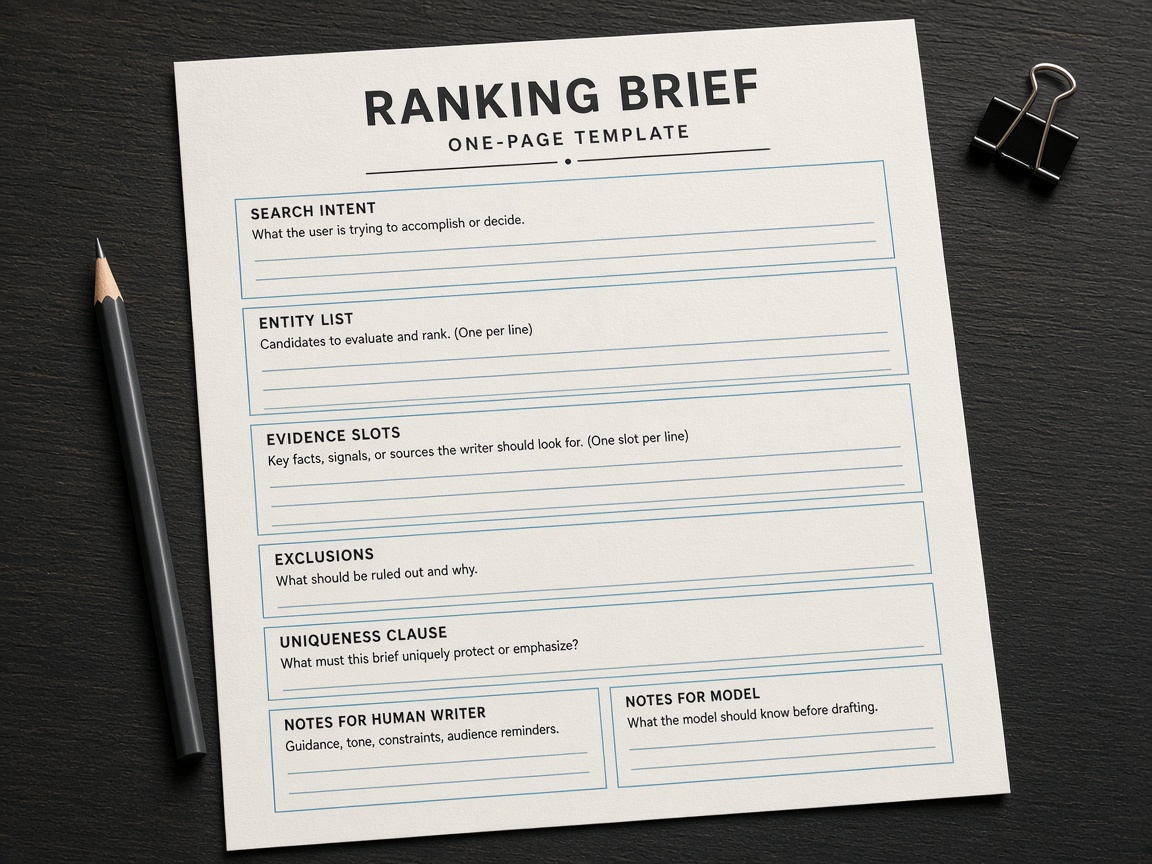
Once the uniqueness clause is written, the rest of the lockfile should be a form you fill the same way on every URL—not a new essay. Copy the same fields, read the live SERP, and refuse to invent values. The template is the artifact lean SEO teams reuse; research-to-publish orchestration lives in a separate workflow. This page is only the spec that must be complete before a writer or an AI blog writer is allowed to produce a draft.
Fields to fill once, then reuse
Keep one document. Generate the human view and the model view from it; do not fork competing briefs. Fill every block below or leave the URL unassigned.
- Intent: primary query, dominant job, audience, promised outcome, content type the SERP actually rewards.
- SERP notes: format constraints, depth the winners show, PAA and entity clusters, open ground ranking pages leave thin.
- Entity whitelist: names, products, standards, and related terms the draft must cover; nothing extra that dilutes the job.
- Evidence slots: each material claim mapped to source type and where it appears in the outline.
- Outline-to-intent map: each H2 as a job the searcher still needs done, not a synonym of the title.
- Exclusions: off-intent topics, clone outlines, banned or invented claims.
- Uniqueness clause: the angle, reader, or artifact this URL owns, visible in the H2 map.
- Writer notes: voice, examples, quotes, where original experience must appear.
- Model constraints: hard limits, required vs banned phrases, citation format, length bounds, output schema.
Acceptance checks before the draft ships
A ranking brief is useless if the draft can ignore it. Run the same pass/fail list on every URL: intent match against the lockfile job, entity coverage against the whitelist, every slotted claim cited in the required place, zero excluded topics, uniqueness readable from the H2s alone. Fail any check and the page does not publish—content automation does not get a second chance to ship thin autoblogging.
The kill switch is empty fields. If intent, entities, evidence, exclusions, or the uniqueness clause are blank, do not run the AI blog writer and do not assign the doc. Scale waits on the spec. Throughput without a lockfile is how automated blog posts fail to rank; a filled template is how SEO automation stays a control plane instead of a firehose.
Kill switch — Reuse one lockfile template on every URL, accept a draft only when it passes intent, entities, citations, exclusions, and uniqueness, and never generate or assign while any lockfile field is empty.
Key Takeaways
Lock the next ranking brief from the live SERP before you brief a writer or an AI so every page has to earn its URL.
Frequently Asked Questions
You Might Also Like
- Guides SEO Content Brief Template: The Complete Guide to Briefs That Rank
- Guides SEO Content Brief Examples for Product, Comparison, and How-To Pages
- Guides Free SEO Content Brief Generator: How to Brief Writers in Minutes
- Automation How to Turn Keyword Clusters Into Briefs Automatically
- Strategy Long-Tail Keyword Research: A Practical Workflow for Briefs