
SEO Content Brief: How to Brief Writers (and AI) So Pages Rank
Autoblogging turns RSS feeds, keyword lists, AI topics, or structured sources into posts that can go live or wait for review. The tool is not what decides whether those pages rank. Google’s guidance is plain: appropriate use of AI or automation is not against its guidelines, and using AI does not confer a ranking advantage. Automation is spam when the primary purpose is manipulating rankings, including attempts to manipulate generative AI responses in Google Search. The brief is where that line gets enforced or ignored. Scaled content abuse is generating many pages primarily to manipulate rankings rather than help users — unoriginal pages with little or no value, no matter how they are created. The March 2024 spam update expanded the old automatically generated content policy so Google can act whether pages come from automation, humans, or a mix. Its examples match ordinary autoblogging done badly: generative AI pages with nothing added, and scraped, synonymized, or translated feeds. A useful SEO content brief is the contract that stops that pattern before a draft exists. It locks one intent to one URL and gives writers and models the same pass/fail fields for accuracy, originality, and review. The first field is the URL itself.
- Treat the SEO content brief as a publish contract, not a prompt.
- Lock one search intent to one URL before a writer or a model drafts.
- Google allows helpful automation and does not give AI a ranking boost; ranking manipulation is spam.
- Scaled content abuse covers many low-value pages whether they come from AI, humans, or a mix.
- Automate clustering, drafting, and formatting; do not automate accountability, fact checks, or prune-or-merge decisions.
Stop Briefing the Writer. Brief the URL.
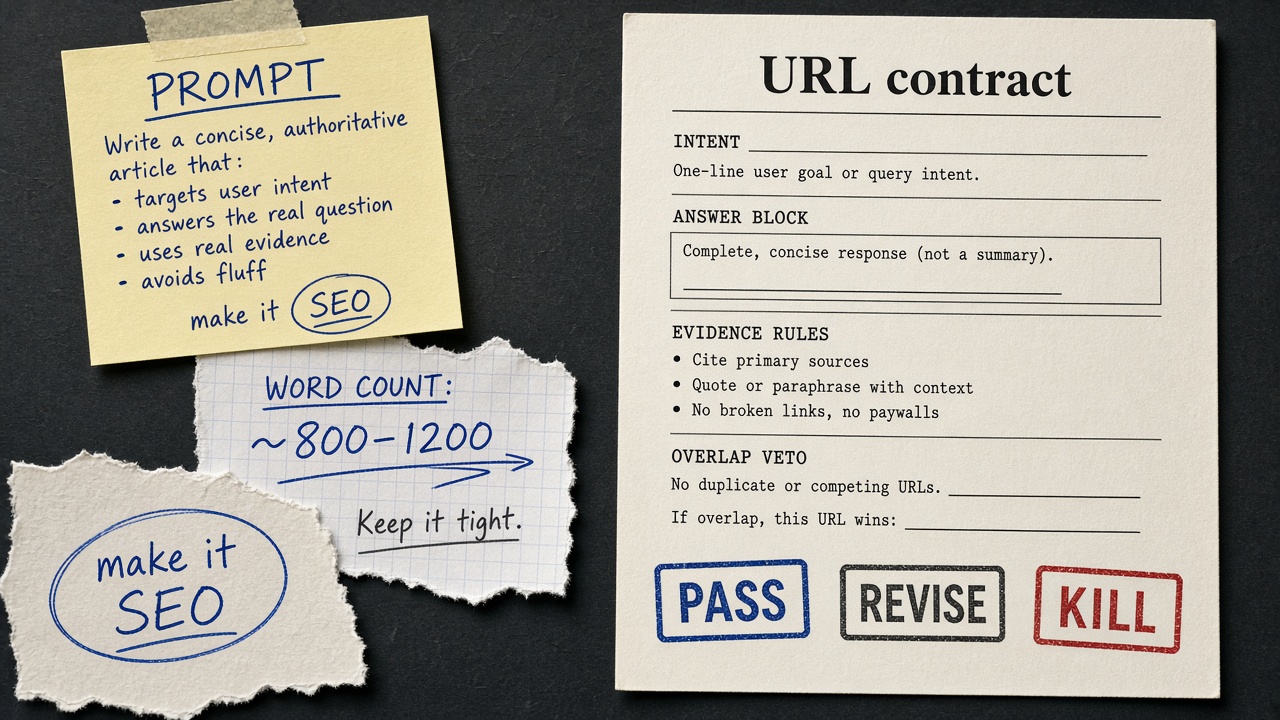
Autoblogging is the intake, not the publishing decision. In a brief that is meant to rank, only the hold is allowed. The generator may produce a draft. The brief decides whether a URL is created at all. If it cannot name the page and the fields that page must clear, the draft does not earn an address.
Run that path as fail-closed: source, generate, review, publish. Review is the contract stamp, not a courtesy edit for voice. It is also the step people skip, and skipping it is what decides whether the other three were worth running. Nothing else checks whether this URL should exist, whether it overlaps a page you already have, or whether the draft invented a second angle on the way out. A queue that imports as draft and refuses to publish until the fields pass is the minimum bar.
Drop inspiration language. Tone notes, a word-count target, and “make it SEO” tell a writer or a model to improvise. Pass, revise, or kill does not. Humans and models receive the same frozen fields, so neither side can open a new audience, a new query, or a new URL while “improving” the draft. Fail the fields and the page is revised against those fields or killed. It is not rewritten into something the brief never authorized.
Contract first — The generator only makes drafts. The brief is what creates or kills the URL, and review is the shared pass, revise, or kill stamp.
One Intent Owns the URL
The contract only holds if the first two fields are frozen before anyone writes. Name the job the reader is trying to finish, in plain language, not as a keyword cluster. Then name the single live URL that already owns that job — or state, in the same field, that no such URL exists.
If that page can be expanded, updated, or merged to cover the job, refuse the new URL. A second address for the same task is overlap, not coverage. An automated pipeline will still turn a feed, a keyword, or a generated topic into a draft; the brief is what stops that draft from becoming a page.
Sprinkling phrases to a word count is a task list. An intent contract instead locks the job, the URL not to duplicate, the answer block the page must deliver, the sources behind claims, the hub link required before publish, and the kill criteria that revise or drop the draft. Writers and models get the same fields. Only those fields decide whether a URL ships.
That refusal is how a lean team stays clear of scaled content abuse without waiting for a sitewide pattern. You decline the page one URL at a time, whenever the job is not distinct.
Do not treat length as the quality bar. A 2,000-word draft that repeats obvious points, skips examples, or never answers the question is still thin, and it still fails the contract.
Refuse the duplicate — A new URL is allowed only when no existing page can be expanded to do the reader's job. Length does not override that lock.
Turn Spam Rules into Fields the Brief Can Fail
An intent lock only holds if the brief can fail the page before a model drafts it. Put that line in the brief as a field, not a footer disclaimer: the page must help someone finish a job, and it must not exist to steer rankings or generative answers. Success is the reader's task completed, not an appearance in an AI Overview.
Two lines the generator cannot skip
- A one-sentence user job: what the person came to do, and what a useful page lets them leave with.
- A banned goal line that names what this URL is not for — rankings, overview capture, or a keyword quota.
A human edit does not clear the brief. An AI draft does not clear it either. Production method is not the pass: the field fails the page when manipulation is the purpose, whether a person, a model, or both produced it.
State the allowed case in the same field, plainly: the job, the sources, and the value this URL adds. That record is what a reviewer can check. Reciting policy language a generator can paste and ignore is not.
Fail the page — A brief passes only when it records a user job and bans rankings, overview capture, and keyword quota as the goal. Human edit, AI draft, or a mix never clears a page written to manipulate Search.
Name the Input, Then Demand a Value the Sources Don't Have
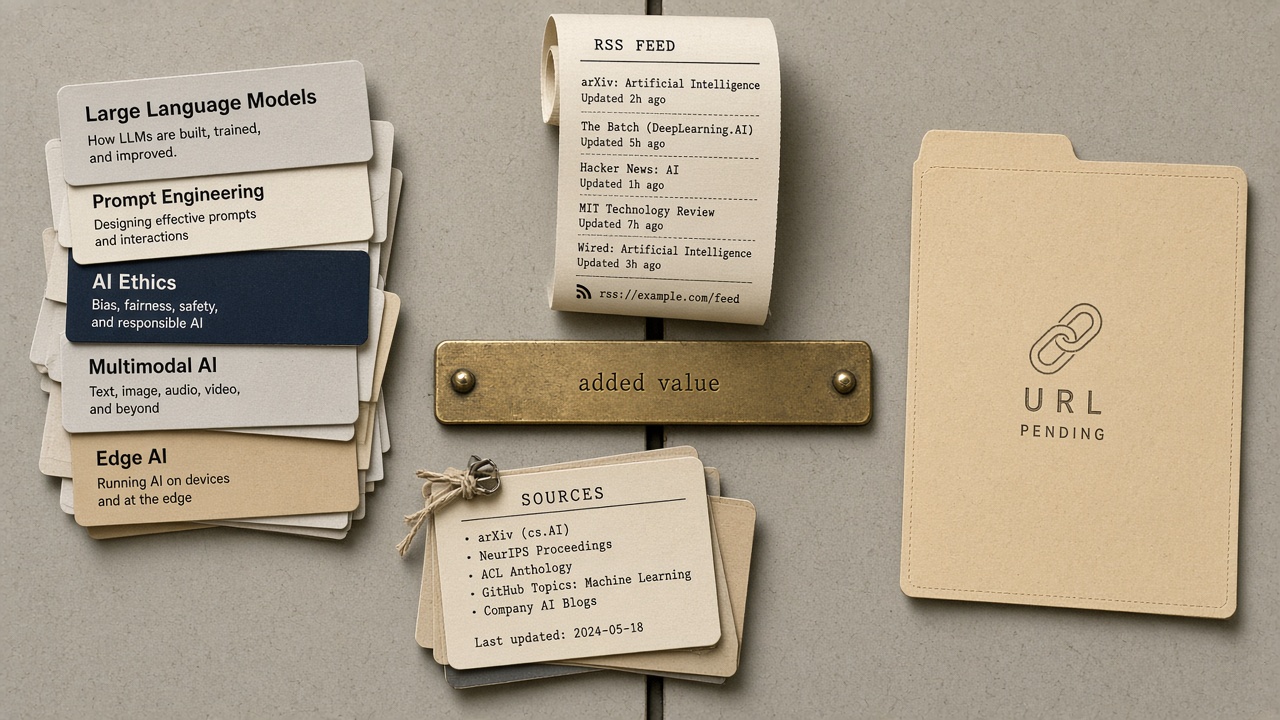
With the user job and the banned goal already locked, name the input in the brief before anyone drafts. Generative tools and scraped, synonymized, or translated feeds are not neutral source material. Unless the brief states the value those sources do not already provide, the URL is a scaled-abuse match, not a draft waiting for polish.
The default is do not create the URL. Google's generative-AI guidance says generating many pages with AI or similar tools without adding user value may violate scaled content abuse. The value-add line is the exception that opens the gate, not a footer someone fills in after the draft exists.
Copy the pattern Google already treats as helpful automation: sports scores, weather forecasts, and transcripts. Each serves a defined, repeatable user need with a clear data job. A brief that only names a topic list stretched across many subjects fails that pattern. It has subjects, not a job the source cannot finish alone.
Write the add in language a reviewer can fail. First-hand evidence, a synthesis the sources do not contain, or a maintained data field counts. "Unique intro" does not. If that line is blank, vague, or already true of the feed, kill the URL before anyone generates it.
Gate — Do not create the URL unless the brief names the input and states, in terms a reviewer can fail, the value those sources do not already provide.
Unchecked Drafts Don't Hold the Ranking
A setup line is not a reason to publish. Once the brief has named the input and the value the sources do not already have, do not expect an unchecked draft to hold a click just because it was generated.
The brief is a pass/fail contract, not a forecast. It cannot promise a boost for automated drafts: helpful, original content that satisfies E-E-A-T may do well, and content that does not may not, but the model itself confers no ranking advantage.
What follows is third-party reporting, not Google data. BlogPros cites a secondary analysis of 42,000 blog pages in which purely AI-generated content held the number-one spot 9% of the time, versus 80% for human-written content. The same write-up reports a 16-month Search Engine Land experiment: fully AI-generated pages in Google's top 100 fell from 28% in month one to 3% by early 2025.
Read those figures as an argument for a signed brief, not a ban on models. Decay shows unchecked generation loses the position it briefly held. It does not prove that a reviewed, evidenced page—written by a person, a model, or both—cannot rank. The contract still has to name the job, the URL, the value-add, and the kill criteria before anything ships.
No boost — AI confers no ranking advantage. Third-party reports show unchecked drafts losing position; a signed review is what keeps automation from treating a short-lived ranking as a reason to skip the contract.
AI Content vs Human Rankings
Machines Fill the Queue. A Person Signs the Veto.
That decay is not a reason to ban the model from the queue. It is a reason to split the publish contract so a person still owns the lines that decide whether a URL should exist.
Clustering, drafting, formatting, link suggestions, scheduling, and the CMS push may run unattended. Distinct intent, fact checks, higher-risk claims, money-page language, and merge-or-kill may not. A safer auto-publishing system can automate keyword research, drafting, formatting, internal linking, scheduling, and CMS publishing, and still leave the veto unsigned by any machine. As that guidance puts it, it does not automate accountability.
One cluster, not a topic spray
Google treats extensive automation across many topics as a warning sign of search-engine-first content — the question it asks is whether you are using extensive automation to produce content on many topics. The control on the brief is a topic fence: one cluster, not a sitewide spray. If the next item cannot stay inside that fence, the queue stops, even when every draft looks tidy.
Write cadence as a ceiling, not a target. Conservative starts are 1 to 3 posts a week for a new site, 3 to 10 for a growing site, and 10 or more only when an established site is governed. Raise the cap only after indexation looks clean. The signature block is the point: accountability stays with a person even when the draft did not.
Veto stays human — Unattended work may fill the queue. Intent, facts, money-page language, and merge-or-kill stay on a human signature, inside one cluster and under a cadence ceiling.
Publish Checks the Contract. It Does Not Rewrite It.
A signed veto only holds if publish cannot quietly rewrite the page. When generation is automatic, freeze accuracy, quality, and relevance in the brief before a draft exists. Google’s guidance is to focus on those qualities especially when content is generated automatically, and that includes the title, meta description, structured data, and image alt text. Publish checks those fields against the URL that was approved. It does not invent a headline, a snippet, markup, or alt text at the last minute.
Treat the hub link as a publish blocker of the same kind. A new URL that cannot point to its cluster hub does not ship. That single gate keeps automation from opening orphan pages that never join the structure a person already signed.
Put a sunset clause in the same contract, before the first draft rather than after indexation disappoints you. If the URL earns no impressions in the window the brief already set, refresh, merge, or removal is already authorized. Pruning is not a later cleanup project. It is a pass, revise, or kill decision the fields named in advance.
Writers and models receive those frozen on-page fields together. Formatting automation can lay the page out, schedule it, and push it to the CMS. It cannot drift the intent that was signed, because the fields it is allowed to fill were locked before drafting began. The queue can run unattended. The contract cannot.
Ship rule — Publish only executes fields the brief already froze—on-page copy, the hub link, and a sunset that authorizes refresh, merge, or removal—so automation cannot invent intent after the signature.
Key Takeaways
Write the next brief as a publish contract—one URL, one intent, and the same pass/fail fields for writers and models—before automation is allowed to ship the page.
Frequently Asked Questions
You Might Also Like
- Guides SEO Content Brief Examples for Product, Comparison, and How-To Pages
- Guides SEO Content Brief Template: The Complete Guide to Briefs That Rank
- Templates SEO Article Outline Template for AEO and Classic Rankings
- Workflows Content Automation Workflow: Research, Draft, QA, Publish
- Guides Free SEO Content Brief Generator: How to Brief Writers in Minutes