AI Automation
Setting Up Your First SEO Agent Workflow
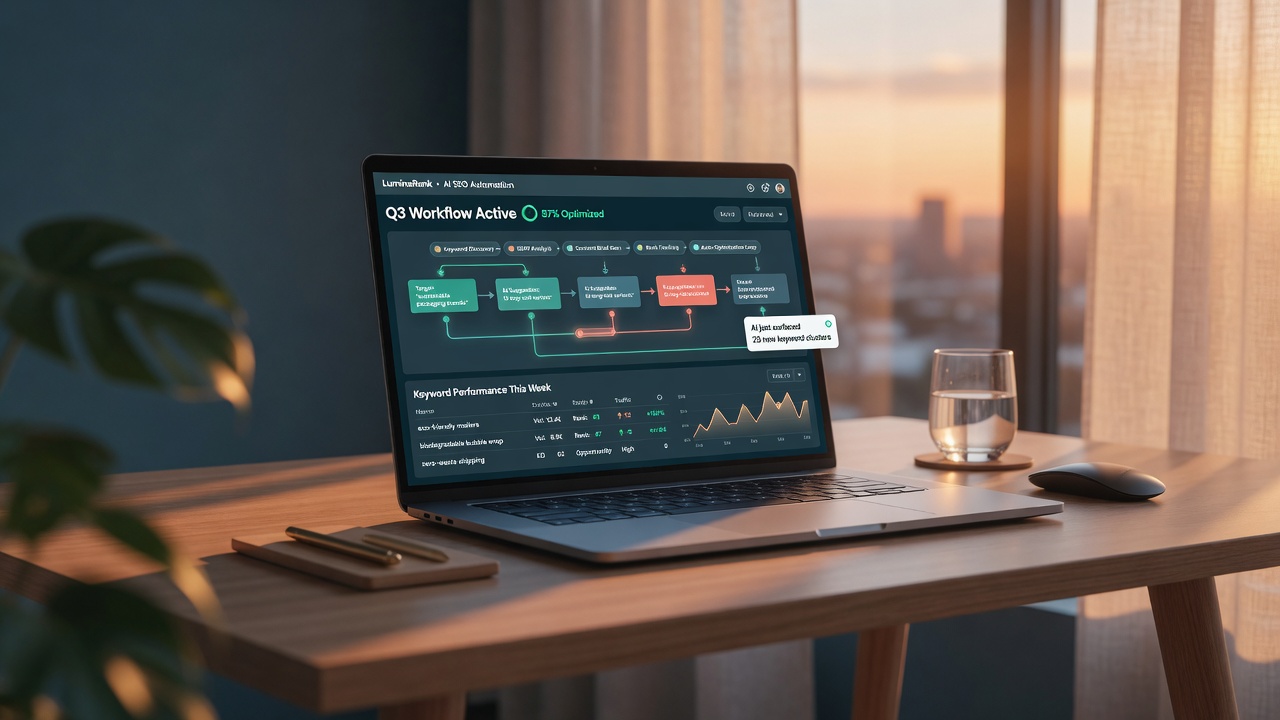
For years, the biggest bottleneck in digital marketing hasn't been a lack of ideas, but the sheer manual grind required to execute them. Between keyword research, competitor analysis, and drafting briefs, the time between a strategy's conception and its publication can feel like an eternity. This is where SEO agents change the game, moving beyond simple chatbots to become autonomous workers that handle the heavy lifting of your search strategy.
Setting up your first workflow might sound intimidating, but it is essentially about teaching a machine to follow the same logical steps you already take every day. By automating these repetitive cycles, you free yourself to focus on high-level strategy while your agents ensure that content production and optimization never stop. In this guide, we will walk through the exact steps to build a functional, reliable workflow that turns your SEO expertise into an automated engine.
Before you can start building, you need to understand exactly which parts of your current process are ready for an upgrade.
TL;DR
- Identify repetitive SEO tasks like keyword mapping and brief generation to target for automation.
- Map your manual workflow into discrete, modular steps before choosing your automation tools.
- Integrate live data sources such as Google Search Console to ensure your agents work with accurate information.
- Begin with one high-impact workflow to prove ROI before expanding to a multi-agent system.
- Focus on saving time and increasing content output as your primary success metrics.
Identifying the High-Impact Tasks Ready for Automation
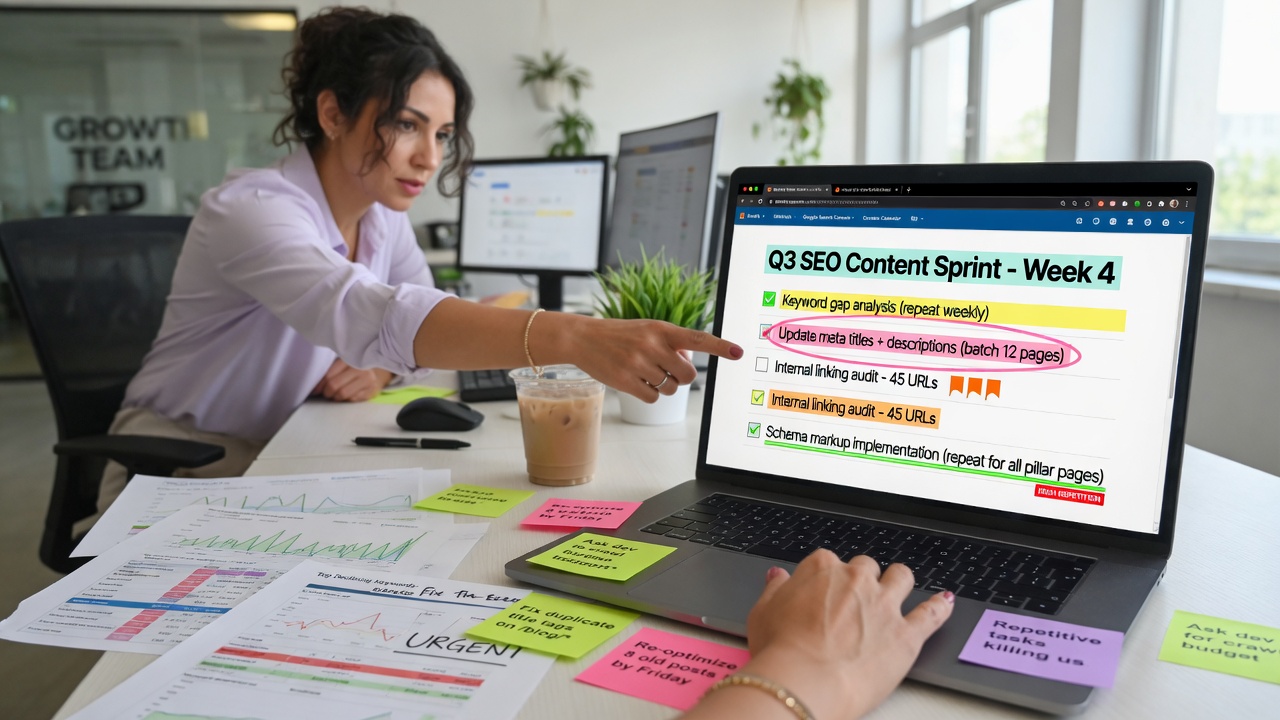
Automation doesn't mean replacing your strategy; it means offloading the chores. To build a workflow that actually saves time, you have to start by looking at the tasks that eat up your calendar every Monday morning. We’re looking for "high-frequency, low-variance" work—the kind of things you do so often you could do them in your sleep.
Spotting Your Best Candidates
Think about the daily or weekly SEO chores that follow a predictable pattern. If a task requires 80% data gathering and only 20% creative decision-making, it’s ready for an agent. Common examples include:
- Running keyword discovery and filtering by search volume or difficulty.
- Analyzing the top 10 search results to extract common subheadings.
- Drafting SEO-friendly meta titles and descriptions for a bulk list of URLs.
- Checking for broken internal links or missing alt text across a new batch of content.
By defining clear automation goals during this audit, you ensure you aren't just "using AI" for the sake of it, but solving a specific bottleneck. Once you’ve identified a repetitive task that follows clear rules, you have the foundation for your first agentic system. The next step is to break that task down into a language the machine understands.
Audit First — Focus on automating high-frequency, rule-based tasks like keyword research and brief generation to establish clear goals before you touch any code.
Deconstructing the Workflow: Turning Expertise into a Modular Map
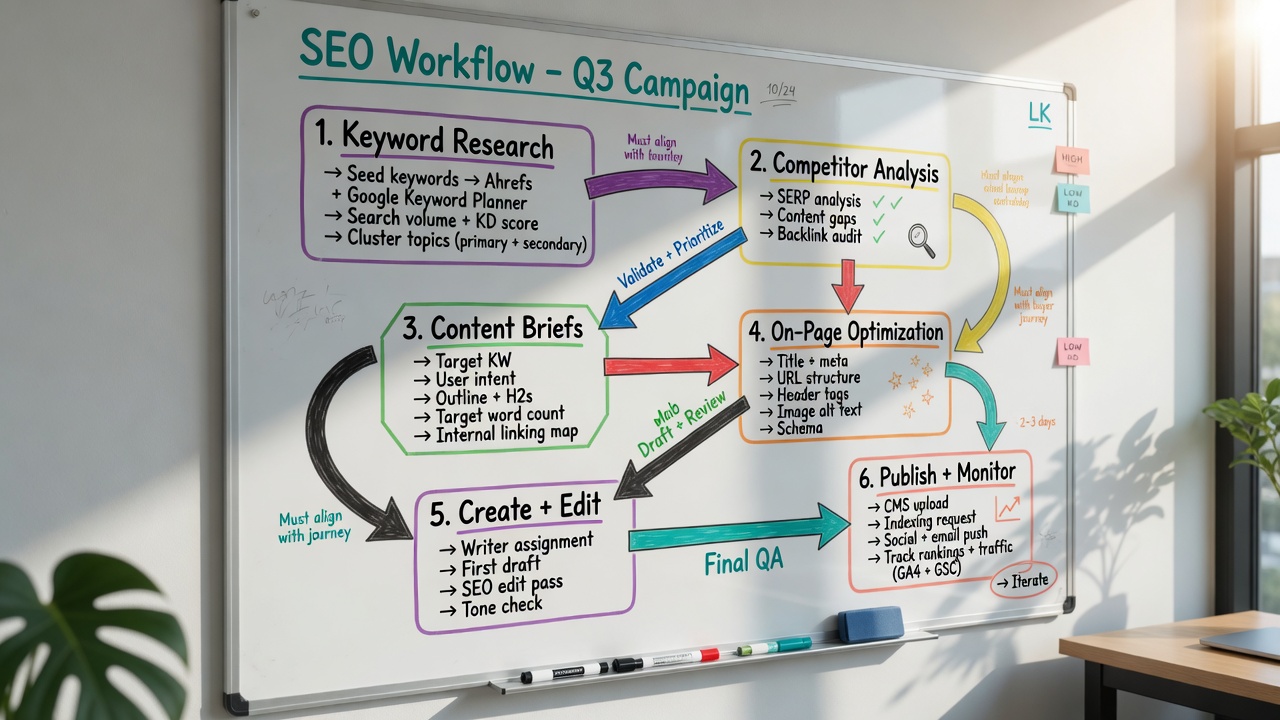
Translating human expertise into an agentic workflow isn't about writing code; it's about defining the logic of your own success. To a machine, a vague instruction like 'do keyword research' is a black box. To make it work, you have to treat your SEO process like a recipe where every ingredient and preparation step is explicitly defined. This mapping phase is where you turn a manual habit into a scalable system.
By breaking your workflow into these discrete 'modules,' you create a system that is infinitely more flexible. If you build a high-quality Intent Analyzer module, you don't have to recreate it every time you start a new campaign. You simply plug that existing module into your next workflow, whether you're building a blog post generator or a landing page optimizer. This modularity ensures that as your SEO strategy grows, your automation doesn't become a tangled mess, but rather a library of reusable assets. With your logical map in hand, you're ready to choose the digital environment where these steps will live.
Modular Mapping — Breaking SEO tasks into discrete inputs, processing steps, and outputs allows you to build flexible, reusable workflows that can be repurposed across multiple campaigns.
Selecting Your Stack and Plugging in the Data
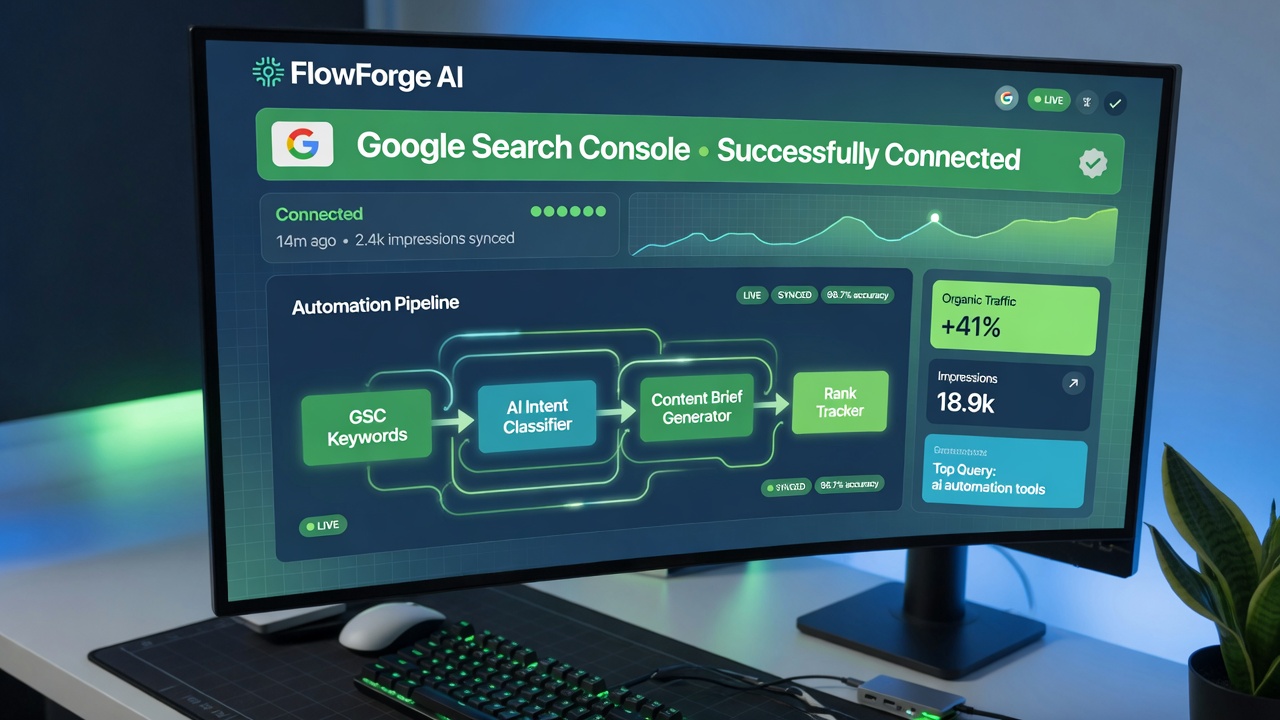
Selecting the right environment isn't about finding the most complex software; it’s about finding the one that gets out of your way. For most SEOs, the goal is to bridge the gap between a spreadsheet and a finished piece of content without needing a computer science degree. Accessible platforms like n8n or Flows are designed for this exact purpose, allowing you to drag and drop your logic into a functional system.
Prioritizing Time to Value
When you're starting out, your tech stack should prioritize simplicity. You want a tool that lets you connect your existing data sources—like Google Search Console or your internal content databases—in minutes, not days. Look for these three features:
- Ease of integration: Does it connect to GSC and your CMS?
- Visual builder: Can you see the path your data takes?
- Speed: Can you stand up a basic workflow in under 30 minutes?
Connecting your data is the 'fueling up' phase. By linking your Google Search Console account, your agents gain real-time insights into what’s actually ranking. This transforms your workflow from a generic content generator into a data-informed SEO powerhouse. Most modern tools use standard API connections that make this setup a 15-to-30-minute task, ensuring you spend your time refining strategy rather than troubleshooting code. With the data streaming in, it's time to assemble the components and see your creation in action.
Tool Accessibility — Prioritize platforms that offer quick API integrations with Google Search Console to move from setup to execution in under 30 minutes.Launching and Refining Your First Agentic Workflow

With your data connections live, the first step in seeing that creation in action is launching a "Minimum Viable Workflow." Instead of building a complex web of bots, start by pairing research with brief generation. This simple link—where an agent pulls keywords from your data source and hands them to a second agent to outline a post—serves as your proof of concept. It is far more effective to have one reliable, time-saving loop than a brittle, multi-layered system that breaks under its own weight.
Test Small, Scale Smart
Before jumping into multi-agent swarms, run your basic workflow through several iterations. Check the output: are the briefs actually useful for a writer, or just generic AI fluff? Adjust your prompts and data filters based on these early results. Once the logic holds up, you can introduce more layers, like automated internal linking or social media snippet generation.
To further bridge the gap between your automated content and your readers, consider integrating interactive features. Tools like Flows allow you to embed an AI chat directly into your published articles. This doesn’t just help readers navigate complex topics; it provides you with a direct feedback loop on what information they are still searching for, which can then be fed back into your research agent for future content iterations.
- Track time saved per content piece to quantify immediate ROI.
- Monitor organic traffic gains specifically for agent-assisted pages to justify scaling.
- Use reader interaction data from AI chat components to refine your keyword targeting.
Iterative deployment — Start with a basic research-to-brief workflow to ensure logic is sound before scaling to complex multi-agent systems and adding interactive reader tools to close the feedback loop.
Key Takeaways
Ready to reclaim your time and scale your organic growth? Start building your first automated SEO workflow with Flows today.
Frequently asked
An SEO agent is an AI-powered tool designed to perform specific search engine optimization tasks autonomously, such as keyword research, content drafting, or technical auditing, based on a predefined set of instructions.
No, most modern SEO automation platforms like Flows offer no-code or low-code interfaces that allow you to build complex workflows using visual builders and simple logic.
Most users see a 70-80% reduction in the time spent on the research and drafting phases, allowing them to scale their content output without increasing their headcount.
Not if the output is high-quality and provides value to the reader. Search engines prioritize helpful content; agents should be used to enhance your expertise, not replace the need for quality control.
The best starting point is usually the keyword-to-brief pipeline, as it involves clear inputs and outputs that are easy to verify and provide immediate value to your content team.