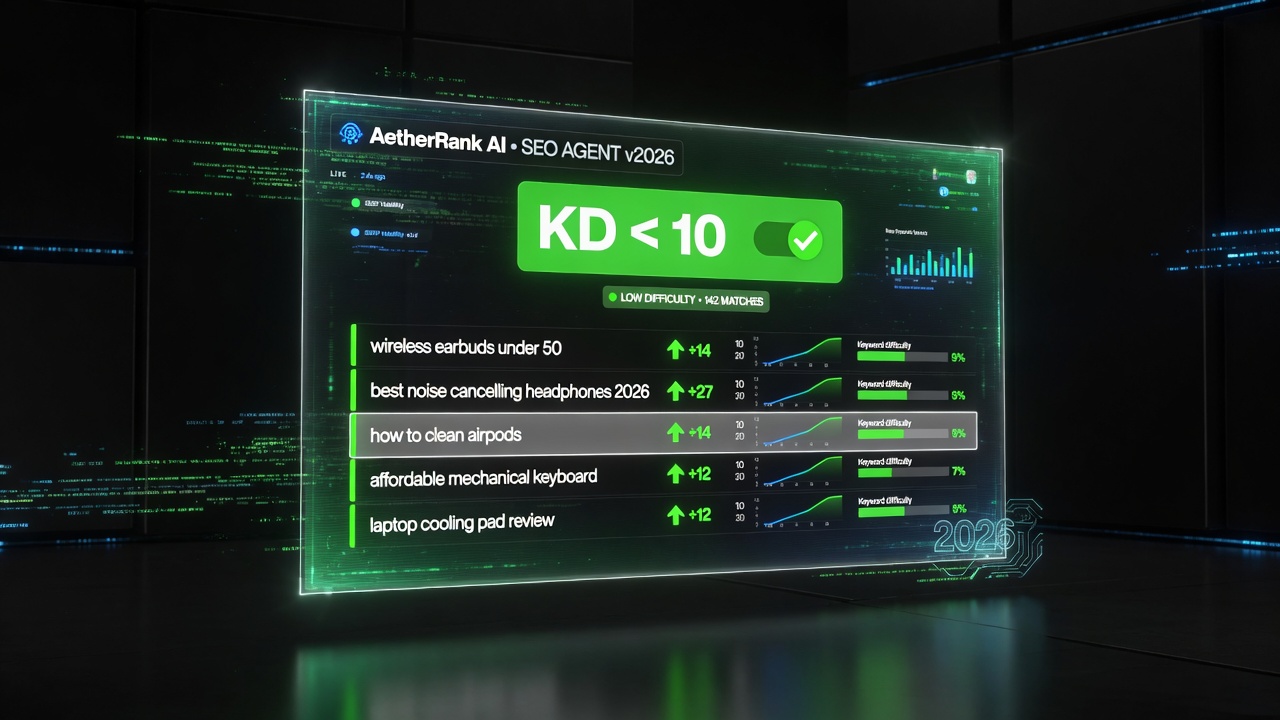
Step-by-Step SEO Agent Setup for KD Under 10 Keywords

Most SEO teams spend hours filtering spreadsheets, looking for that elusive low-hanging fruit keyword. But in a fast-moving digital landscape, manual keyword research is a bottleneck your business cannot afford. By automating this process with specialized SEO agents, you can hunt down ultra-low competition terms while you sleep, turning keyword discovery into an autonomous pipeline.
While low-competition keywords are typically defined as having a difficulty score below 20 or 30 in most SEO tools (7 Ways To Find Low Competition Keywords), focusing your agents on a Keyword Difficulty (KD) under 10 yields the fastest rankings with the least resistance. This strategy is especially critical for newer domains; for example, a site with a Domain Rating (DR) under 20 should target KD 0-15 to ensure realistic first-page ranking potential (How to Find Low-Competition Keywords in 2026 (6 Steps)). By setting up automated agents with precise filters—such as targeting terms below KD 40 while prioritizing healthy search volumes (AI SEO Agent: Build vs Buy Guide for 2026)—you can build an automated engine that consistently drives organic traffic.
To make this system work, you need to configure your agents with the right guardrails, APIs, and filtering logic. Let us look at exactly how to configure these agents to discover, filter, and queue up these high-yield, low-difficulty targets for your site.
- 1
SEO agents automate the tedious process of finding and writing for ultra-low competition keywords.
- 2
Targeting KD under 10 allows newer sites with lower domain authority to rank quickly on the first page.
- 3
Setting up specific filters ensures your agents only queue up high-intent keywords with viable search volume.
- 4
Human oversight remains crucial to verify search intent and validate the agent's content strategy before publishing.
Why KD Under 10 is the Ultimate Playground for SEO Agents
Before diving into the technical setup, it is crucial to understand why targeting keywords with a Keyword Difficulty (KD) under 10 is such a game-changer for automated campaigns. By shifting the focus to these ultra-low difficulty terms, you can secure quick, compounding wins that completely bypass the traditional, months-long wait for organic search rankings.
The Compounding Power of Low-Competition Wins
Traditional SEO often targets high-volume, high-competition keywords. For an AI-driven agent, however, the strategy flips. Because keywords with a KD under 10 have virtually no competition, search engines can index and rank your content almost immediately. When scaled across dozens or hundreds of pages, the combined traffic from these long-tail terms quickly rivals—and often surpasses—the volume of a single competitive head term, all without the need for expensive link-building campaigns.
This is where automated agents outpace manual keyword research. An SEO agent can continuously scan keyword databases, analyze competitor gaps, and detect emerging search trends in real time. It uncovers valuable topic gaps that a human analyst might overlook. By the time competitors notice the trend, your agent has already drafted, optimized, and queued the content.
While tools like Ahrefs or SEMrush are excellent for filtering targets with a KD under 10 and healthy search volume, human oversight remains essential. Automated difficulty scores are valuable guideposts, but a quick editorial check ensures the search intent aligns perfectly with your business goals.
Velocity over volume — Targeting KD under 10 keywords with automated agents allows you to stack quick, low-competition ranking wins that compound into massive search traffic without the typical manual delays.
Aligning Your Agent: Matching Domain Strength to Realistic KD Targets
To make your automated SEO agent truly efficient, you must feed it realistic parameters. If you instruct an agent to target keywords that are far too competitive for your website's current authority, you will waste valuable processing cycles, API budget, and content creation resources. This is where domain-level calibration becomes critical.
For instance, domain rating (DR) dictates your site's ranking gravity. If your site is relatively new or has a DR under 20, your agent should target keywords with a KD of 0-15 to stand a realistic chance of reaching the first page of search results. Feeding an agent a blanket "KD under 30" rule on a brand-new domain leads to a backlog of content that sits on page four of Google, generating zero ROI.
By matching the agent's keyword difficulty filters directly to your domain's actual strength, you ensure that every piece of content the agent generates has an immediate path to traffic. SEO agents can automate this discovery by continuously analyzing competitor gaps and identifying SERP weaknesses where lower-authority sites are already ranking in the top positions.
When you configure your agent, you can set dynamic rules. For example, as your DR grows, the agent can automatically adjust its KD ceiling upward. But in the early stages, prioritizing long-tail and emerging topics ensures quick, zero-competition wins. This allows your agent to build a foundation of compounding traffic without hitting a wall of high-authority competitors.
Once these domain-level boundaries are established, the next step is translating them into exact tool filters so your agent knows exactly which search volume and difficulty metrics to harvest.
Calibrate by authority — Always match your SEO agent's KD thresholds to your site's actual Domain Rating to avoid wasting computational power and content budget on unreachable search terms.
Configuring the Filters: How to Set Your Agent's Search Parameters
To make this translation seamless, you must program your agent with precise, rules-based filters that bypass manual guesswork. While many standard SEO tools generally define low-competition keywords as having a Keyword Difficulty (KD) below 20 or 30, targeting keywords under 10 requires an even tighter filter set to capture the absolute lowest-hanging fruit.
When setting up workflows in platforms like Ahrefs, configuring your agent to filter for a KD below 40 is a common safeguard that prevents teams from wasting resources on highly competitive terms. For this hyper-focused strategy, however, you will want to instruct your agent to cap the KD filter at 10, while prioritizing terms with at least 500+ monthly searches to ensure the traffic volume justifies the automated publishing process.
Automating Long-Tail and Zero-Competition Discovery
Beyond basic metrics, your agent can be configured to hunt for specific SERP weaknesses that signal zero-competition opportunities. You can program the agent's workflow to prioritize these high-value signals:
- Forum domination: Keywords where discussion boards like Reddit or Quora rank in the top three positions.
- Competitor gaps: Search terms where your direct competitors rank poorly (positions 11-50) despite the low difficulty score.
- Long-tail modifiers: Informational queries containing high-intent phrases like 'how to fix' or 'best budget alternative' that larger sites often overlook.
By automating these filtration rules, your agent continuously unearths emerging topics before they gain mainstream traction. With these parameters locked in, you can now connect this data-harvesting engine to a broader system that turns these raw keywords into fully optimized articles automatically.
Precision filtering is key — Setting strict agent parameters for KD under 10 paired with moderate search volume filters allows you to systematically harvest zero-competition keywords that are ripe for rapid ranking.The Multi-Agent Assembly Line: Turning Low-KD Keywords into Live Content
To scale this without creating a chaotic mess of duplicate content and off-brand drafts, you need a specialized assembly line. Instead of relying on a single, overburdened AI to handle everything from research to publishing, the most efficient setups deploy a multi-agent system. Each agent has a single, highly focused job: one finds the low-KD gems, another structures the briefs, and a third handles the actual drafting and optimization.
When you scale this across multiple web properties, coordination becomes your biggest challenge. Without clear boundaries, agents working on related niches might target the same low-difficulty keywords, leading to self-cannibalization. To prevent this, you must partition your agent instances using a centralized database of targeted keywords and strict domain-level rules.
By dividing the labor this way, your SEO engine runs continuously in the background. The beauty of this multi-agent architecture is its modularity. If you want to change how your articles are formatted or adjust your internal linking strategy, you only need to update the publishing agent's instructions, leaving the discovery and writing pipelines completely untouched.
This automated assembly line allows you to dominate hundreds of low-competition search terms simultaneously. However, even the most sophisticated multi-agent pipelines shouldn't run entirely on autopilot forever. To maintain quality and ensure long-term ranking stability, you must integrate strategic human touchpoints into the workflow.
Segment your agents — Dividing discovery, writing, and publishing into specialized, domain-isolated agents prevents keyword overlaps and allows you to scale automated SEO safely across multiple sites.
Keeping the Machine Honest: Human-in-the-Loop Validation for AI SEO
This is where the "Human-in-the-Loop" (HITL) model becomes your unfair advantage. While an AI agent can scan thousands of low-difficulty keywords in minutes, it operates on raw data. It cannot feel the subtle shifts in search intent or fully grasp your brand's unique voice without human guidance.
Why You Cannot Rely Solely on Automated KD Scores
Keyword difficulty metrics are incredibly useful guidelines, but they are still just estimates. A keyword with a KD under 10 might look like an easy win on paper, but a quick manual scan of the search engine results page (SERP) could reveal that the top spots are locked down by massive, authoritative brands or answered entirely by Google's rich snippets. By inserting a quick human review step before the agent begins writing, you protect your content pipeline from chasing ghost opportunities that look easy but are practically unrankable.
Building a Continuous Feedback Loop
Setting up these validation touchpoints also creates a powerful feedback loop. When you reject a keyword or refine an automated draft, you aren't just fixing a single piece of content—you are training your agents to be smarter. Over time, you can feed these manual corrections back into the system's prompt templates and filtering rules. This continuous optimization ensures your automated SEO engine becomes highly attuned to your specific niche, driving higher conversion rates and stronger rankings with less manual effort.
Human validation is non-negotiable — Combining automated keyword discovery with manual review prevents wasted effort on misleading metrics and continuously refines your AI agent's accuracy over time.
Key Takeaways
Let Flows automate your entire SEO pipeline from finding easy-to-rank keywords to publishing high-quality content with interactive AI chat features built right in.
Frequently Asked Questions
Keywords with a KD under 10 represent search queries with minimal competition, allowing new or low-authority sites to rank on the first page almost immediately. Automating this process with agents helps you capture these quick wins at scale.
You can set up your agent to connect with SEO APIs like Ahrefs or SEMrush, applying filters for keywords with a difficulty score under 10 and a minimum search volume. This ensures the agent only focuses on highly winnable, active search terms.
Websites with a Domain Rating under 20 benefit the most from targeting keywords with a KD under 10, as they lack the authority to compete for high-difficulty terms. Focusing on these low-competition targets provides a realistic path to first-page rankings.
Yes, human oversight is essential to review the agent's output, verify search intent, and ensure the content aligns with your brand voice before it goes live. This prevents automated errors and maintains high-quality standards.