Search Console for Content Ops: Queries That Should Become Briefs
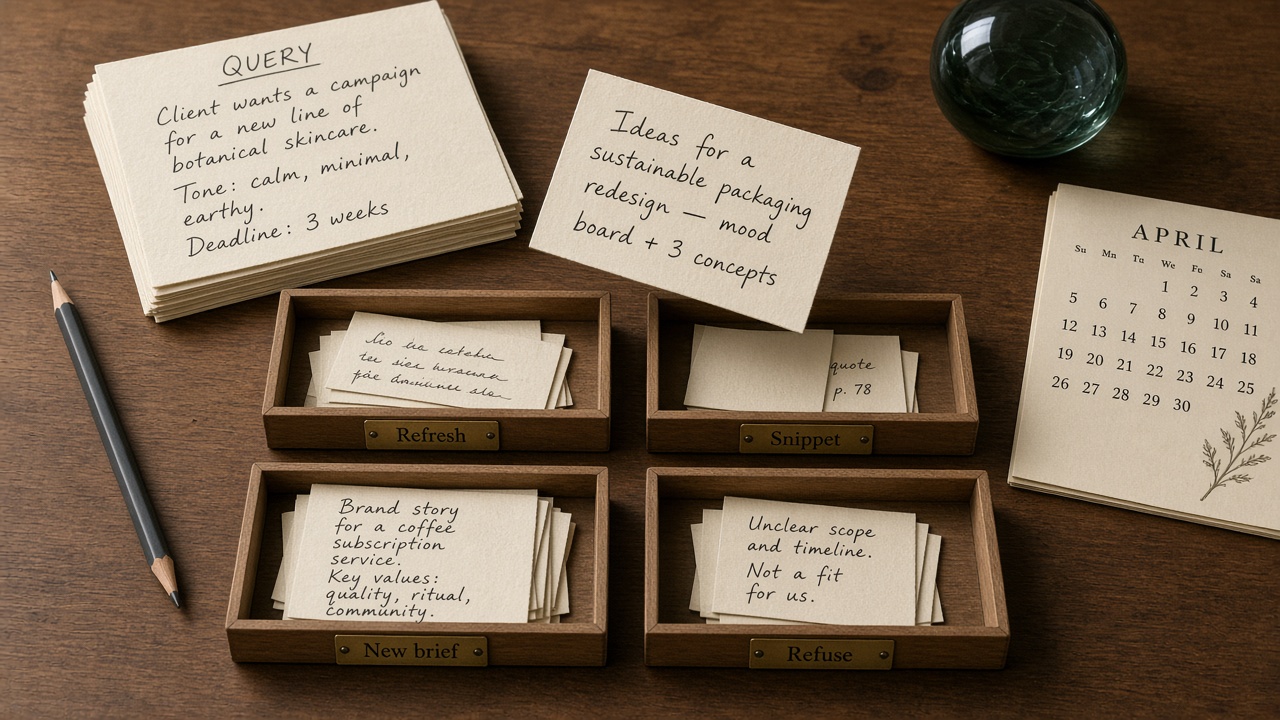
Content ops does not need another keyword list. It needs a starting position. Google Search Console already shows the queries a site appears for, with the landing page, average position, impressions, clicks, and click-through rate. Many sites appear for 5x to 10x more queries than they deliberately targeted, and data-driven briefs are most useful when they optimize existing content—described as about 90% of cases (SEOcluster.ai).
That does not mean every query becomes a post. Pages in positions 1 through 3 capture roughly 55% of clicks, while positions 8 through 10 get about 2–3% each and page 2 gets almost none (Content Raptor). Moving a page from position 12 to position 6 can multiply traffic by 5 to 10 times (Content Raptor). The first queue is striking distance: average position greater than 4 and less than 21, on at least three months of data, sorted by impressions (Content Raptor)—not every impression, and not a guessed keyword.
Impressions are not demand. Across 415 sites, median Google impressions grew 2.18× from October 2025 to August 2026 while clicks grew only 22% and median CTR fell 40% (Outrank). A query therefore gets exactly one action: update an existing URL, publish a new page, merge overlapping content, or leave it alone (RightBlogger). The scorecard below is how that call is made before anyone writes a brief.
- Search Console supplies the starting position a brief should name, instead of a guessed keyword.
- Most GSC-backed work refreshes an existing URL; a new page is the exception.
- Prioritize positions roughly 5–20, especially 8–15, with high impressions and CTR under about 2%.
- Impressions without clicks can be a snippet problem, ranking depth, AI-answered demand, or noise—not automatically a content gap.
- Each accepted row gets one action, then wait 2–6 weeks before judging the change.
Which Search Console Queries Should Become a Content Brief?
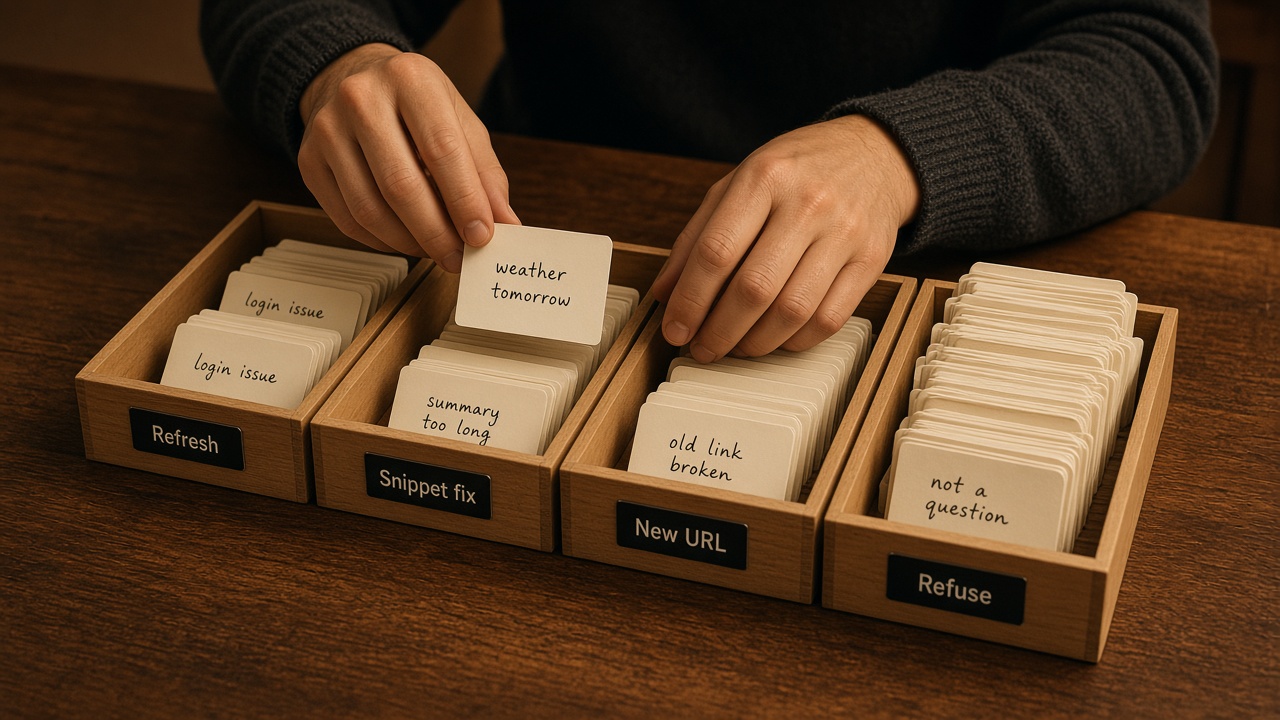
A Google Search Console query should become a content brief only after one call: refresh the ranking URL, rewrite the snippet, commission a new URL, or refuse. Until that call is made, the row is a measurement, not a writing job.
Search Console is the missing input for content ops because it shows queries the site already appears for, with position, impressions, clicks, and CTR, so a brief can name a starting position instead of a guessed keyword. Many sites appear for 5x to 10x more queries than they deliberately targeted. Data-driven briefs are best when they optimize existing content, which is the job in about 90% of cases. Do not brief the long tail of accidental visibility. Showing up is not the same as owning an intent you chose to serve.
Every query group gets exactly one of those outcomes: update an existing URL, publish a new page, merge overlapping content, or leave it alone. If two URLs split the same intent, merge them into the page that should rank and stop. A second brief for the losing URL just recreates the overlap.
Accepted rows go into the existing brief and rank-contract workflow, not a new format. Hand them to the brief generator and the attribution guide. Those hubs already know how to specify the page and how to judge whether the change worked. Inventing Search Console fields here only splits the operating system.
One call — A query earns a brief only when one action is named—refresh the ranking URL, rewrite the snippet, open a new page, or refuse—and most of the time that action is an existing page, not a new post.
What Position Range Counts as Striking Distance?
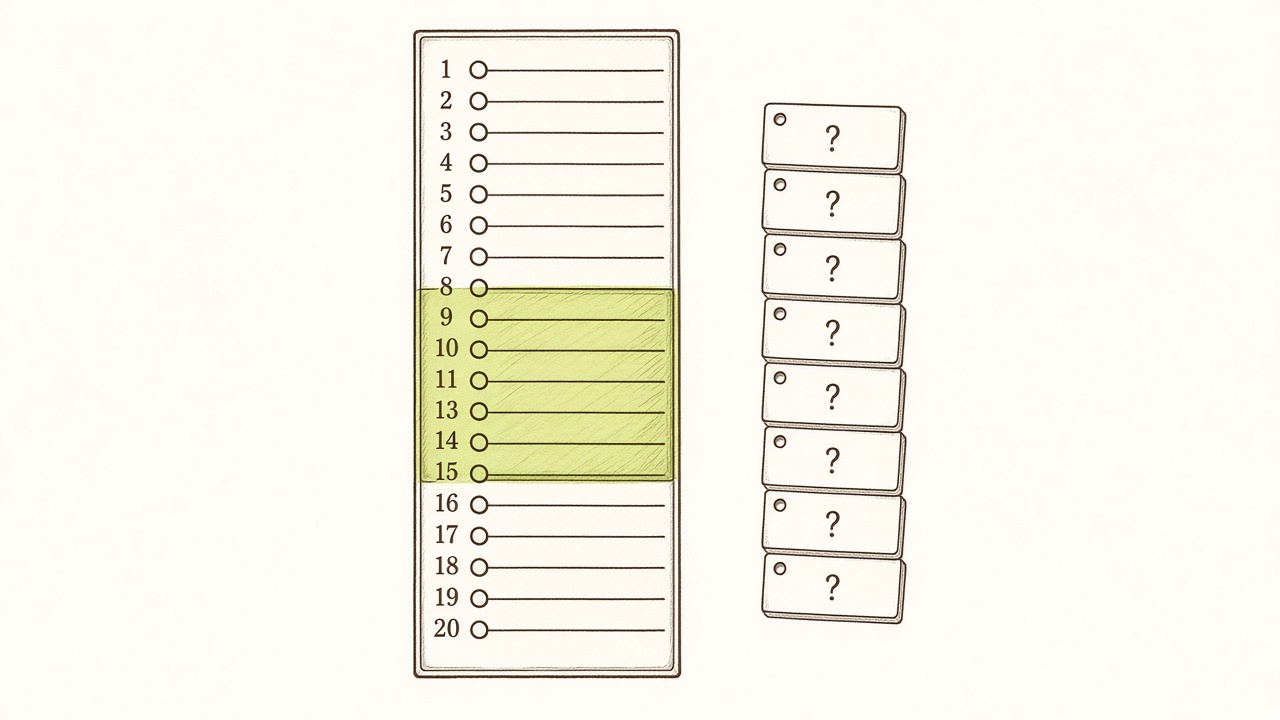
Striking distance for a content refresh is average position greater than 4 and less than 21, on at least three months of data, sorted by impressions—not every page-2 query that happens to show up in the export. A one-person operator works 5 to 10 of those rows at a time, finishes the batch, then opens the next.
That band is the filter, not the queue. The first pass is tighter: positions 8–15, more than 1,000 impressions, and CTR below 2%. Pages in positions 1 through 3 already capture roughly 55% of clicks, so those rows rarely need a new brief. Positions 8 through 10 get about 2–3% each, and page 2 gets almost none. The page is already in the results; almost nobody is choosing it. A short date range or a thin impression count does not earn the same call.
The payoff is a move on the URL that already ranks, not a new post. Moving a page from about position 12 to position 6 can multiply its traffic by 5 to 10 times. A position-8 query with 2,400 monthly impressions and a 1.2% CTR yields about 29 clicks. The same query at position 3, at roughly 7% CTR, would yield about 168 clicks—about five times the traffic—without commissioning another page.
Dozens of open refreshes is how the queue dies. Nothing ships, the next export looks the same, and the four-way call never gets made. Close the 5 to 10, then pull the next impression-sorted slice from the same greater-than-4, less-than-21 filter.
Queue rule — Score striking distance as average position greater than 4 and less than 21 over at least three months, then work only the tight first queue—positions 8–15, more than 1,000 impressions, CTR below 2%—five to ten queries at a time.
When a Query Should Get a Refresh Instead of a New URL
A striking-distance row is not a license to commission a new page. Refresh the URL that already ranks when that page matches the query's intent and is only thin, outdated, or losing the click in the snippet. Open a new URL only when no page on the site can honestly own the query.
Check for cannibalization before you commission a page
Before a new-page brief, filter Search Console to that query and list every URL that already earns impressions for it. One URL with a clear lead is a refresh candidate. Two competing URLs means merge them or pick one canonical page. A third URL only splits the same demand again.
Then collision-test the live results the way a long-tail field check does. Search the query and see whether a page you already publish is what those results are rewarding. If it is, stop. The action is an update to that URL, or a refusal if the page is sound and the row is not a real gap.
That is why the default is refresh. A new brief is the exception that survives both checks: page-fit, meaning nothing already published can own the query, and overlap, meaning no second URL is already collecting impressions for it.
Default — Refresh the ranking URL unless page-fit and overlap both fail — then, and only then, open a new URL.
What Impressions Without Clicks Mean for a Page You Already Rank

Once the ranking URL is the page worth keeping, impressions without clicks are not a content gap and not a reason to commission a new URL. An impression means a user saw the link or could have seen it; it is not a visit. Click-through rate is simply clicks divided by impressions. On a page that already matches the query, a weak rate is a presentation problem on that result, not proof the site is missing a page.
How to tell a ranking problem from a title problem
Position is what separates the two. A query near positions 8–20 with weak CTR is a snippet or depth problem on the page you already have: the result is visible enough to be counted, and the title—or the answer under it—is not earning the click. Average position around 50 or worse is usually noise. Those rows do not earn a brief.
Read the row against a position benchmark before you change anything. Around position 5, expect roughly 5–7% CTR. Around position 10, expect roughly 1–2.5%. Well below that benchmark, the page is already ranking; the title is the problem, not the rank. If CTR sits near the benchmark and the query is still outside the first few results, the constraint is rank and depth on that same URL—the refresh already queued—not a second page.
A practical monthly check is the same cut used for the striking-distance queue: high impressions and CTR under 2%. The page is ranking, and the title is not earning the click. Rewrite the snippet, and tighten the on-page answer only if the title was honest but the page was thin, before you commission anything new.
Snippet first — Impressions without clicks on a URL you already rank mean rewrite the snippet or deepen that page—not open a new one—unless position is so weak the row is noise.
How Long a Date Range Should You Use Before Briefing a Query?
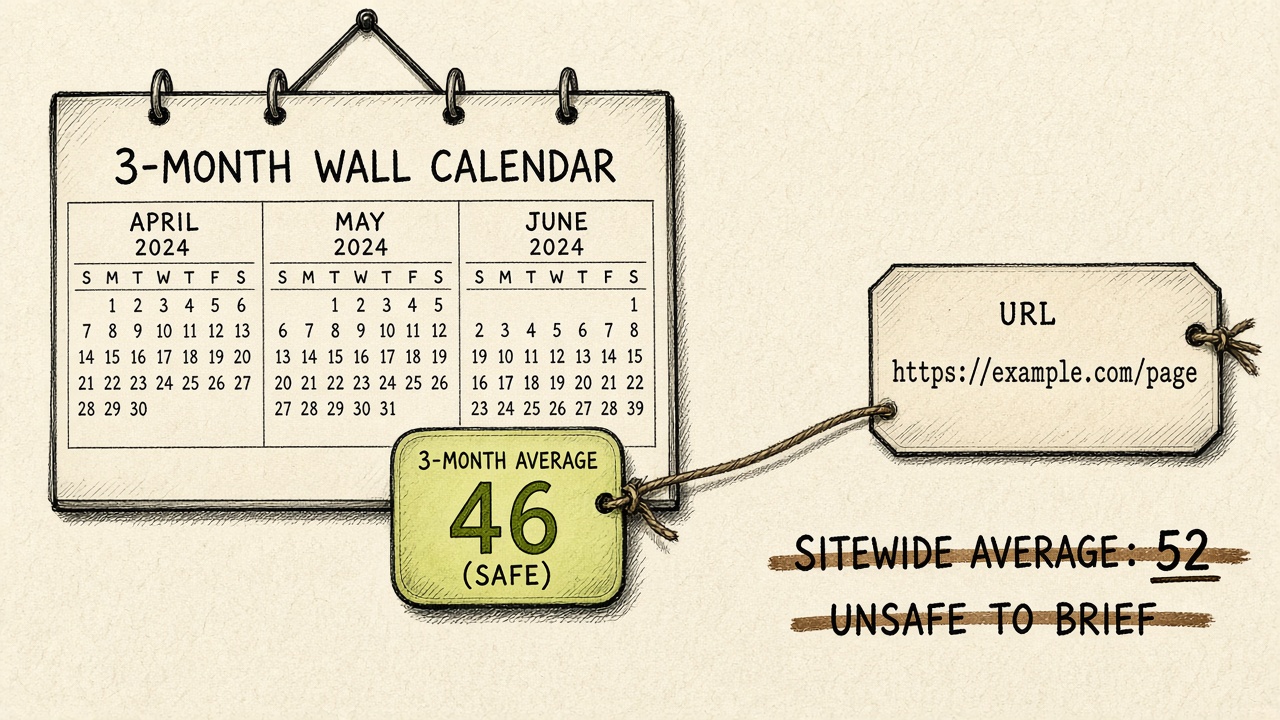
Once a high-impression row looks like a snippet or depth problem, the date range decides whether it is a brief or a blip. Use at least three months before you brief a query. The striking-distance filter already requires that window; a one-week bump is not a content plan.
Read average position so you do not brief the wrong page. It is the topmost position of a link to your property, averaged only across impressions. A result nobody saw does not get a position. If the property appears twice and the higher link is in position 2, that impression counts as 2, not as a blend of both listings. A sitewide average is not a target.
Map the query to the landing page before writing a brief. The number on the query row can belong to a different URL than the one you meant to improve. Open the pages tied to that query, confirm which URL earned the impressions, and refresh that page—or refuse the row if it cannot honestly own the intent.
Ignore fake movement from measurement changes. When Google dropped the num=100 parameter in September 2025, the median of 1,503 sites lost 33% of impressions within days while clicks moved +4%, and average position improved from 29 to 13 for 99% of sites without rankings actually changing. A sudden climb after a reporting shift is not a reason to commission copy.
Wait — Brief a query only after at least three months, on the landing page that actually earned the impressions, and only if the position move is not a reporting artifact.
How to Export Search Console Queries into a Brief Queue Without BigQuery
Once a query has cleared the three-month window, the next step is not a warehouse. Search Console’s interface export is the operating system for a monthly brief queue: the report hides long-tail demand under a 1,000-row ceiling, and history stops at 16 months unless bulk export to BigQuery is already on. That ceiling is enough to run the queue. BigQuery is only a durable archive, not the system you brief from.
Export the query report, then apply the same position, impression, and CTR filters that define striking distance. Paste only the survivors into the scorecard. A full property export is a dump, not a content calendar—most of those rows will fail the four-way call and should never become briefs.
Cluster before you write one brief
Related queries have to be grouped before anyone writes, or three pages get commissioned for one intent. The clustering method itself lives in the keyword-research automation guide; this step only decides whether the cluster earns work.
- One cluster maps to the landing page that already earned the impressions.
- That page gets exactly one allowed action: refresh the URL, rewrite the snippet, open a new page, or refuse.
- Overlapping queries stay on that same row instead of spawning extra briefs.
One cluster, one job — Export the filtered query report, cluster by intent, and let each cluster carry exactly one landing page and one allowed action—never a calendar built from the raw 1,000-row dump.
What Fields Belong on a Brief That Starts from Search Console?
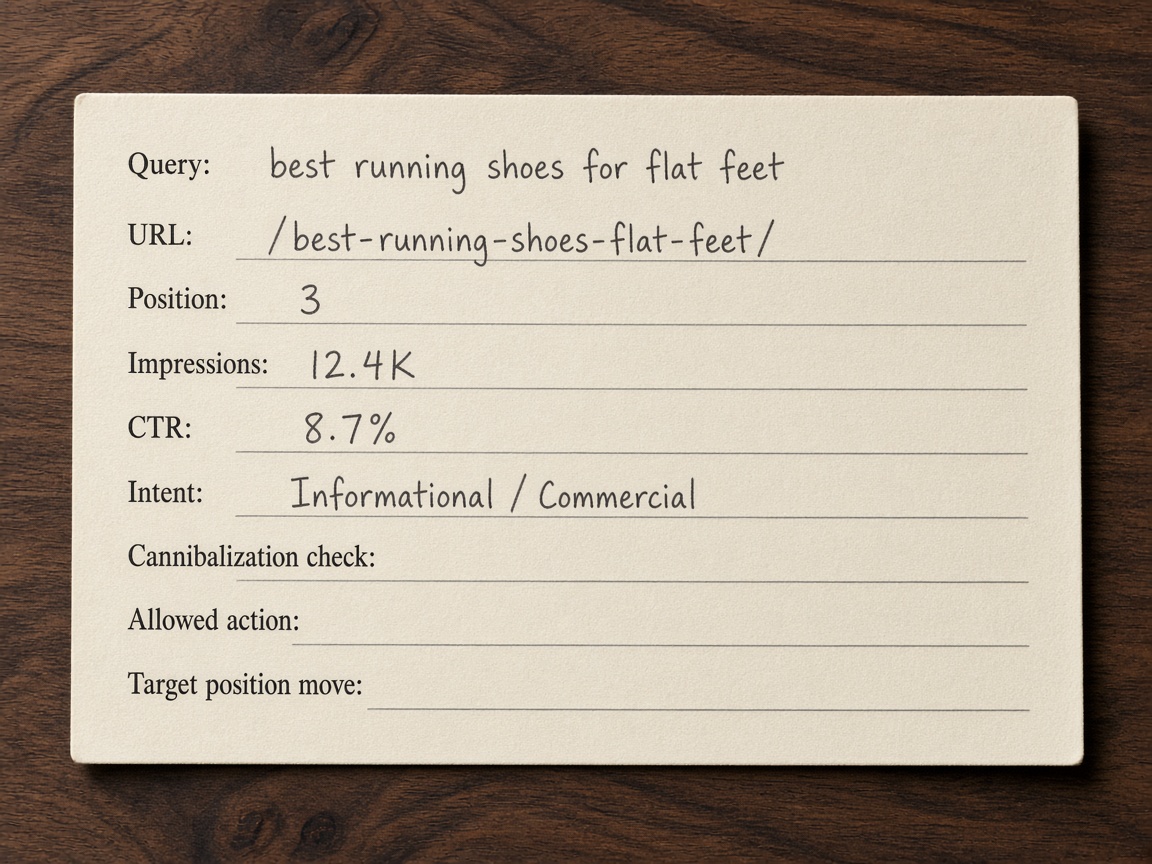
Once a cluster has survived the export filters, the brief is the row itself, not a keyword wish list. A useful brief states a measurable move—move this page from position 12 to position 5 for these 14 keywords—rather than only naming a target phrase. That starting position, taken from the filtered Search Console row, is the rank contract. Later gains and misses are judged against it.
Keep the fields tight. Each accepted row should carry the query (or the cluster it stands for), the landing page that earned the impressions, position, impressions, CTR, intent, the cannibalization check, the allowed action, and the starting position frozen as that rank contract. Intent is what the searcher expected to find. The cannibalization check is the list of URLs already earning impressions. The allowed action is still one of four calls: refresh the ranking URL, rewrite the snippet, open a new page, or refuse.
Do not invent a new brief schema around those fields. Pass accepted rows to the existing generator, and use the page-type examples already written for product, comparison, and how-to pages. Search Console supplies the starting facts and the one allowed action; the generator still writes the brief.
When the page ships, credit later movement to the brief ID through the attribution workflow, not only to the URL. A URL keeps collecting queries the brief never owned. The ID is what ties the new position back to the contract you froze.
Rank contract — A Search Console brief is a frozen starting row—query, page, position, impressions, CTR, intent, cannibalization check, and one allowed action—plus a measurable move such as position 12 to position 5, passed into the generator you already use.
Should Zero-Click or AI Overview Queries Still Get a Brief?
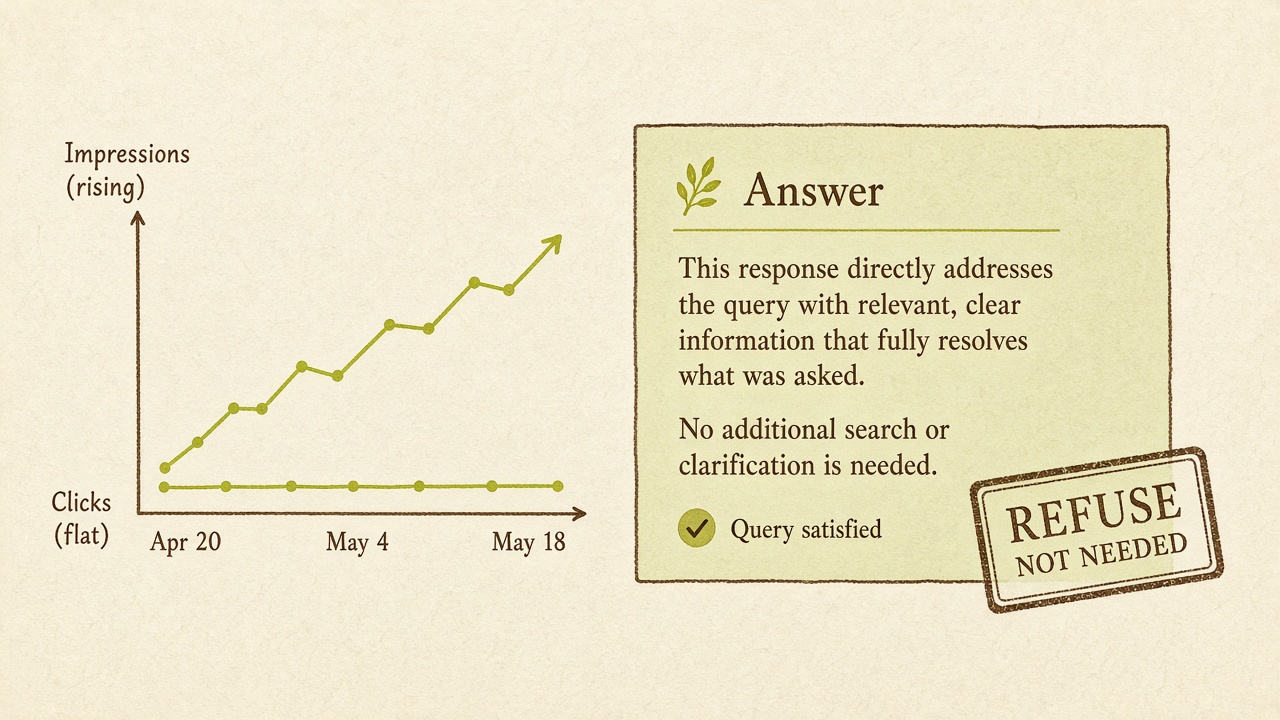
Not by default. A frozen scorecard row still has to survive the same fail-closed call—refresh, snippet rewrite, new URL, or refuse—and high impressions are not demand you can capture. Across 415 sites, median Google impressions grew 2.18× from October 2025 to August 2026 while clicks grew only 22%, and median CTR fell 40%. The query can look busier every month and still be a worse brief than it was a year ago.
Flat rankings no longer protect clicks. Even 129 sites whose average position moved by two places or less still lost 31% of CTR, and 77.5% of them lost CTR. Marketing and advertising sites lost 52% of click-through in that window, the steepest niche drop in the 415-site panel. A page that holds position 12 while impressions swell is often feeding an answer, not a visit. Treat that row as a refuse unless the remaining click, or a citation, is still worth the page.
What the Generative AI report cannot do
Since June 2026, Search Console reports AI Overview and AI Mode appearances. The Generative AI report, rolled out worldwide on August 31, 2026, shows impressions only—no clicks and no queries. Without a query and a click, there is no row to map to one landing page and one allowed action, so that report cannot seed a brief. Use it as a warning light on pages already in the queue, not as a keyword list.
Still brief a zero-click query only if the ranking page can be the cited source, or the click that remains is large enough to justify the work. Otherwise refuse it, even when impressions look like demand.
- Branded noise and navigational queries the site already owns.
- Accidental or mismatched queries that do not match the page’s intent.
- Questions an AI Overview already answers cleanly, unless this URL can be the cited source.
Refuse the impression — Impression growth is not a brief. Refuse zero-click and AI-answered queries unless the page can be the cited source or the remaining click is still worth the page.
CTR decline by cohort (%)
How Long to Wait After a Refresh Before Judging the Query
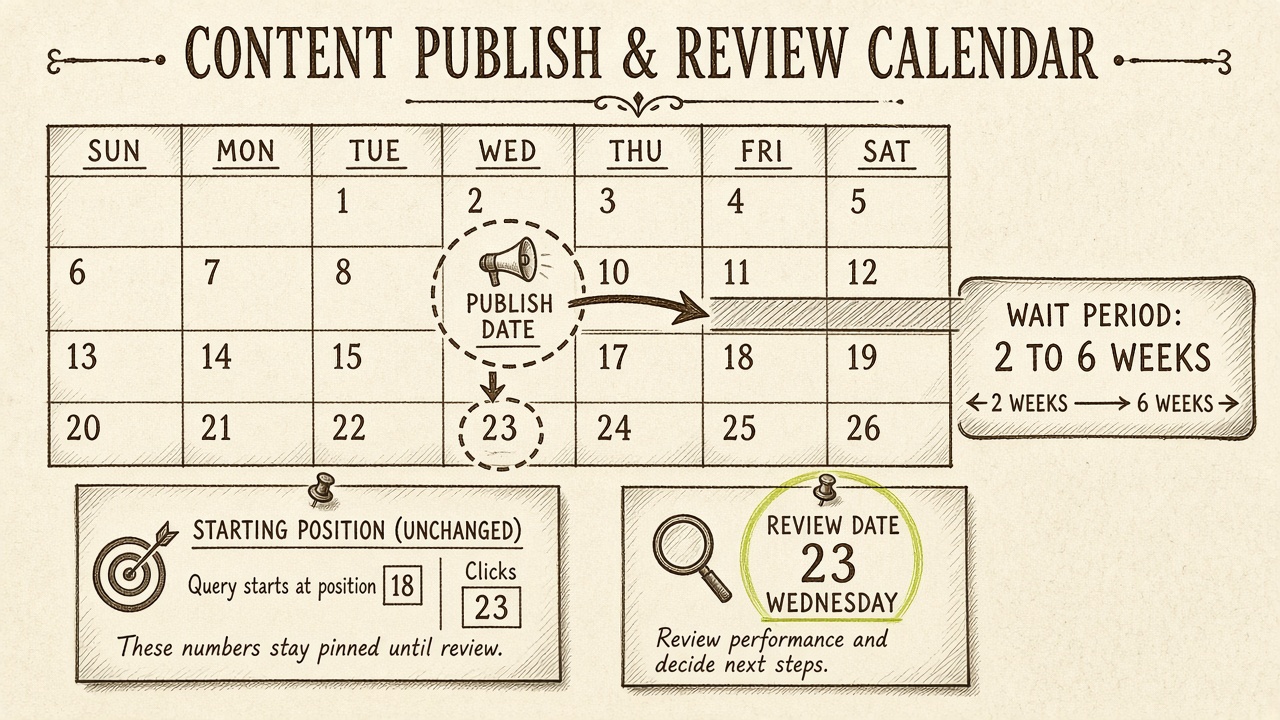
After a refresh, wait before you score the row. Content changes typically take 2 to 6 weeks for Google to process, and position and clicks should be compared only after that window. Judging earlier briefs the wrong next action: a short dip is recrawl noise, not proof the page failed.
Compare the same query, the same URL, and a like-for-like date window of equal length. Do not judge the refresh against a sitewide average, and do not compare a period before a measurement-definition shift with a period after it. Those comparisons move the numbers without moving the page.
If the row still has not moved once the wait is over, the next call is a snippet rewrite, a merge, or a refuse—not an immediate second rewrite of the body, and not a new URL. The scorecard stays fail-closed: one row, one action, then a pause long enough for the data to mean something.
Judge later — Wait 2 to 6 weeks, then compare the same query and URL on a like-for-like window. No movement means snippet, merge, or refuse—not another rewrite or a new page.
Key Takeaways
Run this month’s Search Console export through the scorecard and send only the surviving rows into your existing brief generator.
Frequently Asked Questions
You Might Also Like
- Measurement Content Decay Signals: What to Check Before You Rewrite a Ranking Page
- Measurement Traffic Drop vs Content Decay: What the Brief Should Capture
- Measurement How to Attribute Rankings to Briefs, Not Just Posts
- Measurement How to Prioritize a Content Decay Audit When You Publish Weekly
- Measurement AI Assistant Analytics: Which Unanswered Questions Become Articles