
Quality Checklist for AI-Generated SEO Pages
Google does not ban pages because a model wrote them. It treats automation used primarily to manipulate rankings as spam, and it treats generative tools that mass-produce pages with no user value the same way. Appropriate AI use is allowed; the failure mode is thin, interchangeable copy that exists to occupy keywords. If you run an ai content generator, automated blog posts, or an SEO automation stack, the job of a quality checklist is to stop those pages before they publish. Detectors are not a ranking proxy. They only flag unreviewed passages. The gate that matters is whether the URL adds original information, reporting, research, or analysis versus the current SERP, whether every statistic is real, and whether Who, How, and Why are clear. Fully AI-written URLs can still rank: Ahrefs found 5.3% of top-3 pages were 100% AI-generated. Pages that are not heavily AI-written still account for 82.2% of top-3 rankings, and low- and moderate-AI pages received 2–3x the organic impressions of high-AI pages. That is why this article frames a pass/fail checklist mapped to scaled-content abuse, not a “human-sounding” score.
- Google allows appropriate AI use and bans scaled, low-value pages meant to manipulate rankings.
- Do not treat detector scores as a ranking proxy; use them only to queue human edit.
- Hunt information gain: original data, first-hand proof, or a framework competitors do not already have.
- Fact-check every number and named source; fabricated claims are the highest-trust failure.
- Make the gate binary for money/YMYL pages and sampled for high-volume programmatic drafts.
What Google actually flags on AI-generated SEO pages

Appropriate use of AI or automation is allowed. What search treats as spam is using generation primarily to manipulate search rankings—volume without a people-first reason to exist.
That line is spelled out in spam policy: if you use automation, including AI-generation, to produce content for the primary purpose of manipulating search rankings, that is a violation. Scaled content abuse is the pattern that follows—using generative AI tools or other similar tools to generate many pages without adding value for users, regardless of which writer or publishing stack you chose.
Quality raters are instructed the same way. The use of generative AI tools alone does not determine the level of effort or page-quality rating. What they evaluate is effort, originality, and added value in the main content—not whether a detector fired.
This piece is the page-level gate you run before a URL goes live: information gain, sourced facts, purpose, and scaled-abuse patterns. It is not a stack-design guide on when an AI article writer is enough versus a full publishing system. Those choices sit upstream; this checklist asks whether this page should ship.
The flag — Google allows appropriate AI; it penalizes ranking-first mass generation and thin, low-effort pages—not the mere fact that a model drafted the copy.
Why fully automated posts rarely own the SERP
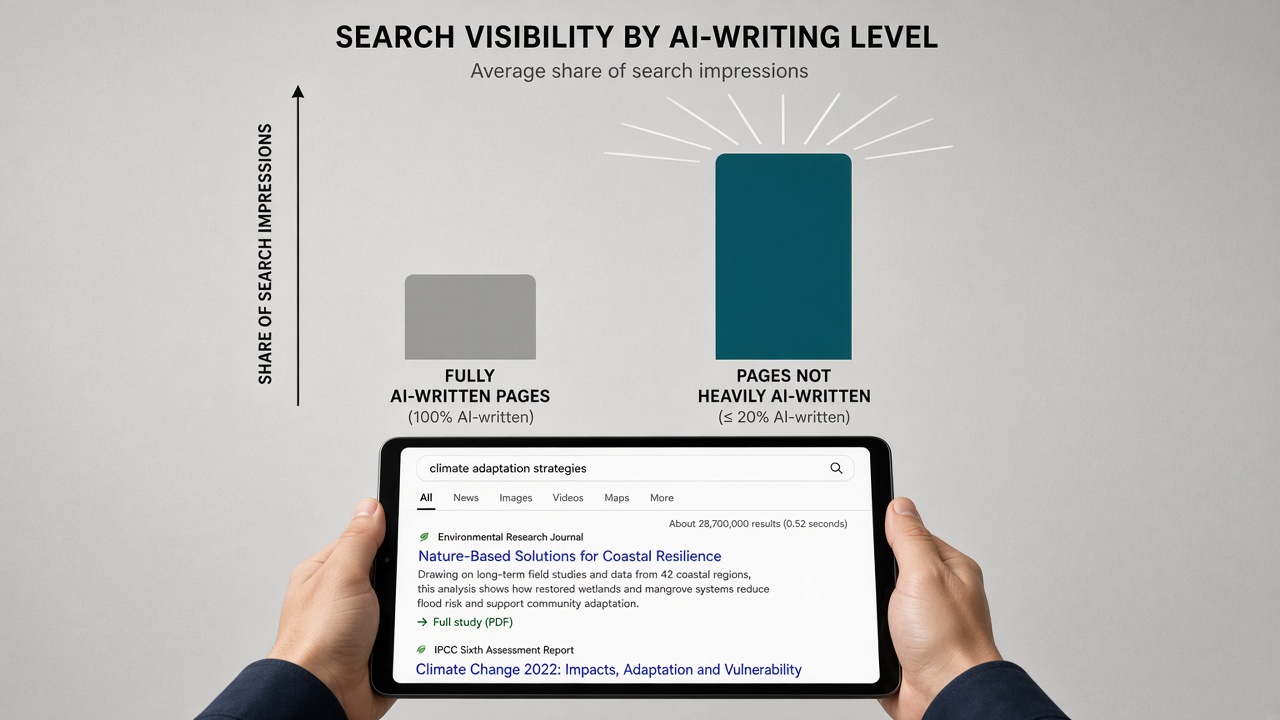
That gate only matters if ranking reality is more nuanced than “AI equals death.” Ahrefs’ June 2026 SERP study found 5.3% of top-ranking (positions 1–3) pages were 100% AI-generated, so a fully automated URL is not an automatic death sentence.
Lightly AI or human-led pages still dominate the top. Pages that are not heavily AI-written account for 82.2% of those top-3 rankings, and low- and moderate-AI pages received 2–3x the organic impressions of high-AI pages in Ahrefs’ Search Console sample.
There is no cliff-edge deindex of very-high-AI URLs either: those pages still had an average indexation rate of 40.35%. Hoping Google silently deletes junk is not a publishing strategy. Pew found significant AI-authorship signals on 10% of sampled pages, and Ahrefs’ April 2025 crawl of new English pages found 74.2% contained some AI. Some AI in a draft is normal; unreviewed volume is the operational problem.
SERP reality — A fully AI-written URL can rank, but lightly AI and human-led pages still take most top-3 slots and far more impressions—so the gate must test value, not hope for mass deindexing.
A binary pass/fail gate for every AI-generated page
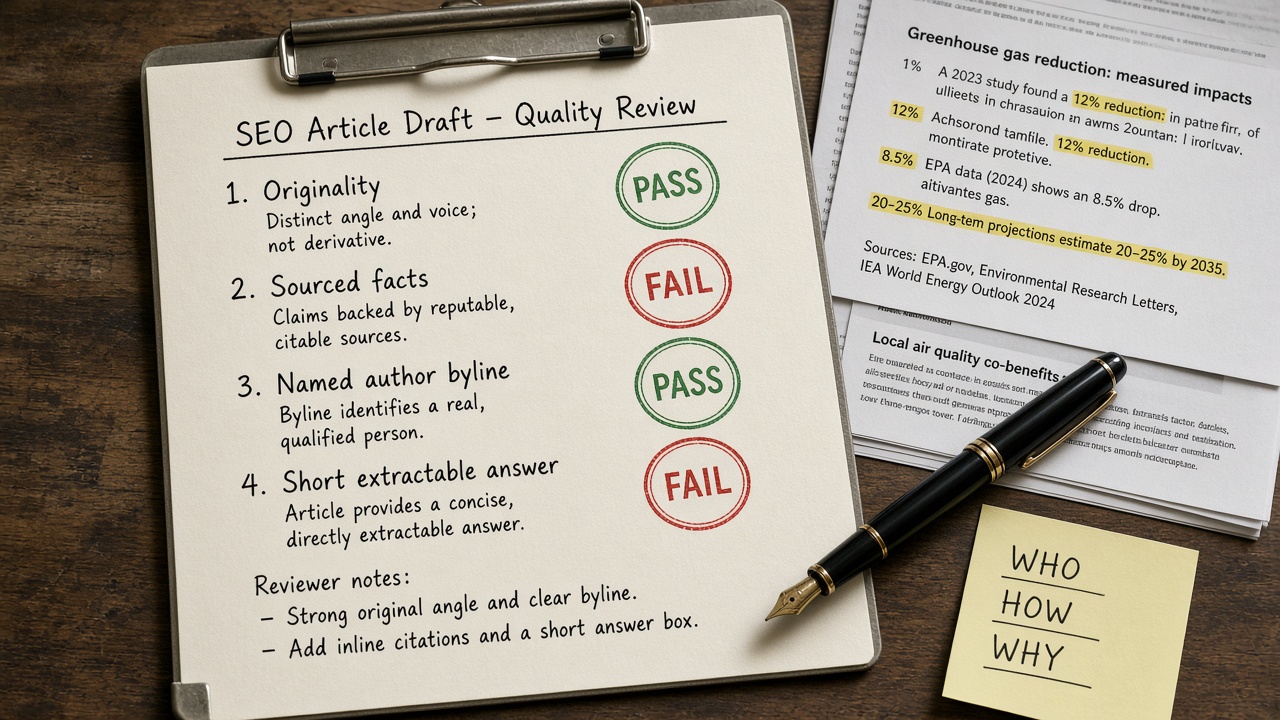
That volume problem is why the pre-publish gate has to be binary. Detector scores do not decide rank; information gain does. Google’s first self-assessment question is whether the page provides original information, reporting, research, or analysis. If the draft adds none of those—and no first-hand proof or a framework a model cannot lift from competitors—fail it. A grammatically clean recap of ranking pages is still a fail.
Fact-check every statistic, named source, and URL before the page ships. Unsourced or fabricated claims are an automatic fail; they are the highest-trust failure mode on AI drafts. Remove the number or replace it with a sourced one. Do not let a fluent paragraph paper over a made-up figure.
Satisfy Who, How, and Why on the same pass. Require a named accountable author and a people-first purpose. When substantial AI generation would make readers ask how the page was made, disclose it. Google asks publishers whether the use of automation, including AI-generation, is self-evident to visitors through disclosures or in other ways, and to explain why automation was useful.
For extractable answers, pass AEO only when a question-led subhead opens with a self-contained answer in the first 40 to 60 words plus unique proof—not a paraphrase of the current SERP. Treat original research and unique data as the citation magnet. Marketers in an NP Digital survey ranked original research as the content type most likely to earn AI-search citations, at 82%. Generic AI recaps fail information gain even when they read cleanly. Use detectors only to flag unreviewed passages for a human edit, never as a ranking proxy.
Pass/fail — Fail any AI-generated page that lacks original information, sourced facts, a named author, and a 40–60 word extractable answer with unique proof—regardless of how “human” a detector scores it.
Automation patterns that read as scaled abuse

That same binary gate is where automation either stays useful or starts looking like spam. Generative tools are fine for research and structure. What fails is mass generation that ships many pages with no incremental value for the person who landed there. The production method is not the issue. The missing user value is.
Fail the cluster the moment you see keyword-swapped templates, unreviewed location variants, or competitor rewrites that swap entities and leave the proof untouched. Identical outlines across a niche cluster are a system fail, not a copy-edit. Those patterns are how autoblogging lines drift into scaled abuse even when each URL looks “unique” in a CMS. Adjacent guardrails for those pipelines belong in the publish contract, not as a detector score after the fact.
Gate the pattern — Allow AI to research and outline; fail any line that multiplies pages without new proof, original analysis, or a reason a reader would choose this URL over the rest of the SERP.
Encode the QA gate in publish—not after it

Those system-level fails only stay out of the index if the same binary test is wired into how a page ships. Treat money and YMYL URLs as a hard stop: a named subject-matter expert must pass every checklist item, and nothing on those URLs auto-publishes. High-volume programmatic or AI drafts can be sampled on a fixed cadence, but every number on a sampled page is either sourced or removed before it goes live. Detectors never become a ranking proxy; they only highlight unreviewed passages for a human edit.
Put the gate in the path itself so volume cannot skip it.
What belongs in the stack is speed: clustering, briefs, and drafts. What must stay a human gate is information gain, sourced claims, and the decision that a URL is not scaled abuse. That is the whole pre-publish contract—pass or hold, never detector-score your way around it.
Publish path — Wire a binary human gate into brief → draft → checklist → CMS: SME pass on money/YMYL, sourced-or-removed numbers on sampled volume, detectors only for unreviewed copy.
Key Takeaways
Run every AI-generated SEO draft through this binary pre-publish gate before it reaches the CMS.
Frequently Asked Questions
You Might Also Like
- Automation Automated Blog Posts: Quality Guardrails That Prevent Thin Content
- Workflows Content Automation Workflow: Research, Draft, QA, Publish
- Automation Programmatic SEO: How to Scale Pages Without Thin Content
- Strategy How to Scale Content Marketing Without Diluting Quality
- Automation Content Automation: What to Automate in Your Publishing Stack