Penalty-Proof AI Content Scaling: Quality Control, E-E-A-T, and Safety Systems for Programmatic and Autoblogged SEO in 2026
Scaled AI publishing rarely fails because a model cannot write a sentence. It fails because generation is treated as a publishing system: thin templates, no originality floor, no entity or fact gate, and no way to stop the machine when a niche starts shipping lookalike pages. Search systems still reward people-first value and still suppress scaled, unoriginal, or unhelpful URLs—regardless of whether a person or a model produced the draft.
If you came here for AI content quality control, the useful frame is not a better prompt. It is how to run programmatic and autoblogged SEO as a site-level risk budget: decide how much duplication, thinness, and unverified claims the domain can absorb, then install gates that refuse to publish when a page would spend that budget. The rest of this article is that operating system—tiered QC, agent gate contracts, fail-closed templates, verifiable E-E-A-T artifacts, monitoring, and kill switches—so scale stays inside the line helpful-content and spam policies actually enforce.
We start where most autoblogging stacks skip: defining what “safe enough to ship” means before a single URL goes live, then wiring that definition into templates, hybrid review, and recovery loops instead of waiting for traffic to announce the damage.
- 1
Search still suppresses scaled, low-value, or unoriginal AI and programmatic pages; people-first value and E-E-A-T are the constraint, not the model.
- 2
Treat publishing as a risk budget with automated, fail-closed gates for originality, entities, facts, uniqueness, and technical fitness.
- 3
Bake verifiable E-E-A-T into every URL: author and entity signals, primary citations, experience markers, freshness, and honest human-plus-AI oversight.
- 4
Templates must force unique value—localized data, original analysis, custom media, in-article help—not spun variants of the same page.
- 5
Hybrid review at brief, draft, pre-publish, and post-publish, plus monitoring agents and kill switches, is what keeps niche-scale catalogs from becoming a site-wide problem.
Why Per-Page QC Still Fails When the Site Is the Unit of Risk
That definition cannot live in a single model prompt. Helpful-content and spam systems do not grade one URL, file it away, and ignore the rest of the domain. They read patterns: how many pages share the same skeleton, how thin the entity coverage is, whether experience ever shows up as something a practitioner could have written, and whether the site exists to satisfy a template rather than a reader. A draft that would pass a “good enough” checklist still feeds a site-level fingerprint of scaled, low-value output when every neighbor is the same shape. Isolated pass/fail on individual posts cannot see the pattern those posts create together.
Throughput stacks treat quality as optional
Most autoblogging and programmatic SEO stacks still optimize for throughput. Generation is the default path. Quality lives in optional prompts, a uniqueness slider someone can lower, or a reviewer who can be skipped when the calendar is full. Nothing in the architecture is allowed to refuse publish. If the model returns words, a URL goes live. That is not control. It is a suggestion sitting on a firehose.
Adjacent guides are not wrong about principles—people-first value, E-E-A-T, originality—but they stop at lists. They almost never name who owns risk when a cluster starts to look thin, how many URLs a given template is allowed to produce before it must be retired, or the condition under which the pipeline must stop. Without those contracts, QC is theater: you can score every draft and still ship a domain the systems will treat as unhelpful at scale.
How penalty risk actually compounds
The damage is rarely one embarrassing article. It accumulates from leaks that isolated QC almost never measures together:
- Template sameness — page after page with the same section order, the same claim structure, and no forced unique value.
- Thin entity coverage — definitions and recaps that never add original analysis, local data, or a reason this URL should exist.
- Weak experience signals — authority asserted in a byline instead of demonstrated in the work.
- No post-publish loop — rankings, engagement, and generative citations never write back into the generator, so the next batch repeats the same failure.
Each leak looks small at the draft desk. Together they are the pattern those systems are built to suppress. A site that scales them is not “a few thin pages.” It is a risk budget already overdrawn.
Site-level risk — Helpful-content and spam systems judge patterns across the domain, so optional per-page QC still looks like scaled low-value output. Penalty-proof scaling starts with a risk-budget operating system: ownership, hard gates, volume caps, and kill switches.
Score Every Draft Against Gates Agents Must Honor
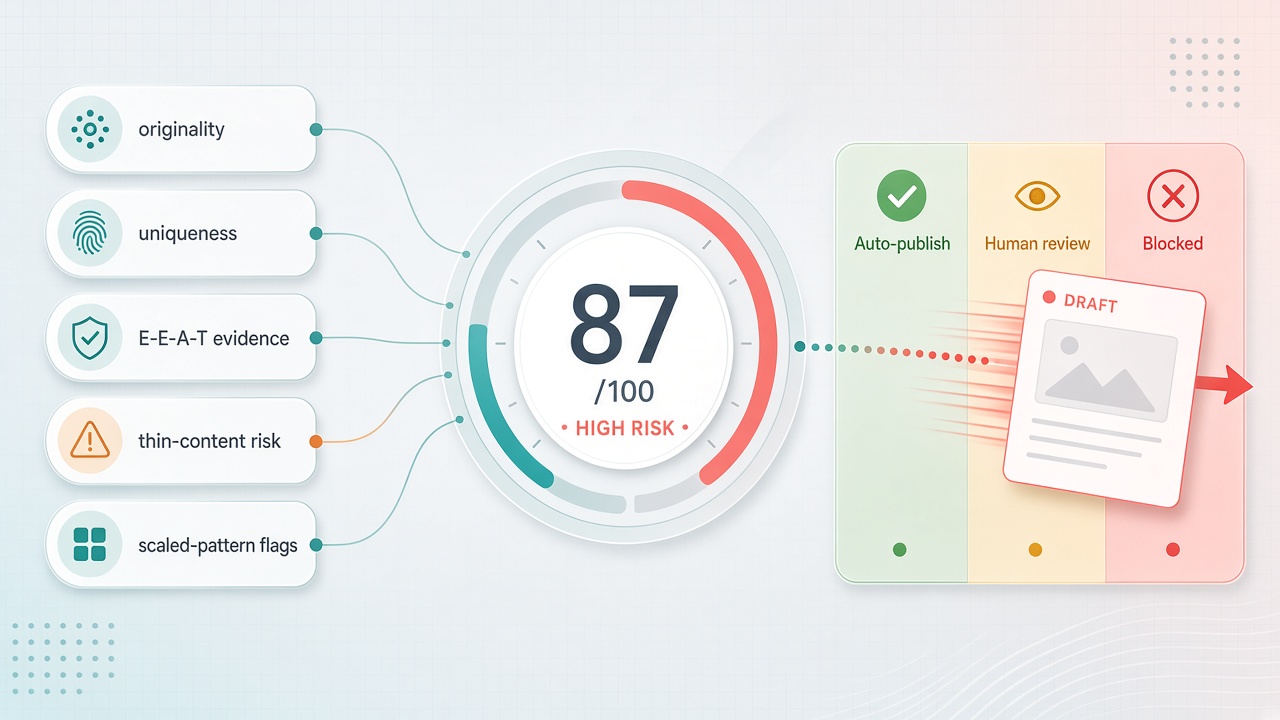
That scoring step is the first hard contract. A draft does not “feel ready.” It earns a pre-publish score from checks that either returned data or they did not—and missing data is a fail, not a skip. That is what turns an AI publishing quality control checklist into quality gates for high-volume AI publishing that agents can enforce instead of authors interpreting.
The score is a stack of independent, measurable inputs, not a single helpfulness slider. Each input has a threshold and a known failure mode so the pipeline can refuse the URL instead of shipping a page that looks complete and is still thin.
The inputs that actually move the score
- Originality and uniqueness — distinct from the rest of the site and from near-duplicates in the same template family, not just from the open web.
- Entity and intent coverage — the page treats the query’s entities, attributes, and job-to-be-done, rather than repeating the head term.
- Primary-source citation density — claims point at primary or first-party sources, not a chain of summaries of summaries.
- Template-variance score — structure, examples, and media actually diverge from sibling URLs in the same class.
- Factual-check flags — contested or checkable statements are verified or removed; unresolved flags block publish.
- CWV and schema readiness — the rendered URL is technically eligible to compete, not a content-only blob waiting on a later pass.
- Monetization and thin-affiliate patterns — offer modules, outbound density, and comparison layouts that read as scaled affiliate filler get penalized in the score, not excused because they convert.
Those draft-level signals never start at zero. Programmatic pages inherit a baseline risk from the template class—localized inventory, comparison grids, thin-affiliate layouts, FAQ expanders—before a single sentence adjusts the score. A distinctive paragraph cannot rescue a template that already looks like scaled low-value output. The class sets the floor; uniqueness, citations, and factual flags only move the needle from there.
Four bands, no exceptions
Once the inputs are in, the composite lands in a band the publishing agent is contracted to honor: auto-publish, human spot-check, full review, or kill. Bands exist so people stop negotiating exceptions one URL at a time. Policy lives in the threshold, not in a last-mile Slack thread.
That mapping only holds if the sequence is fixed and every checker is required to speak.
Fail-closed is the inversion most generate-and-publish stacks still get wrong. If originality never returned a value, the factual checker timed out, or schema validation did not run, the draft stays unpublished. The kill band is not a moral judgment; it is the contract saying this URL is not worth the risk budget it would consume. Those bands also decide where scarce human minutes go next—onto spot-check and full-review URLs, not onto pages the gates already cleared or already refused.
Fail-closed scoring — every draft inherits template-class risk, then earns an agent-enforced band from measurable gates. Missing gate data is a kill, not a skip, so policy is executed instead of negotiated.
Ration Expert Minutes by URL Tier, Not by Volume
Those bands only protect the site if the remaining human time is treated as a budget, not a virtue. A small team cannot fully edit a program that runs from a hundred pages into the high hundreds or a thousand; the attempt either stalls the calendar or turns review into a checkbox nobody has time to honor. Penalty-proof scale means rationing expert minutes to high-risk and high-value URLs only, and letting the gates already decide everything else.
Label the URL before you spend a minute on it
Not every URL deserves the same editor. Sort the inventory into classes before a draft exists, and attach a human-touch rule to each class so agents know what they are allowed to request.
- Money pages — commercial hubs, comparisons, and offer-led landers. They carry conversion value and brand risk together, so they never ride auto-publish even when a draft looks clean. A human owns the brief and the final ship.
- New templates — the first URLs off a fresh pattern. These teach the generator what unique value looks like and set the baseline risk the rest of that class will inherit, so an editor stays on brief, sample drafts, and ship until the pattern earns a lower-touch band.
- YMYL-adjacent URLs — health-flavored, finance-flavored, or legal-toned advice even when you are not a clinic or a bank. They default to full review because an accuracy or experience miss is a site-level trust event, not a single-page miss.
- Long-tail cluster fillers — pages that exist to complete an entity neighborhood. They should consume almost no senior time. If they clear a light band they ship; if they hit kill they stay unpublished.
Hybrid gates, not a human in every loop
Agents do the work that does not require judgment about brand or lived experience. On every URL—including pages no editor will open—they own linting, entity and intent checks, citation-density flags, template-variance, and internal-link suggestions. Humans own two moments on money pages and new templates: the brief (what unique value this URL must add, which primary sources are allowed, which experience claims are honest) and the final ship (whether the page still matches that contract). Spot-check URLs get a time-boxed skim against a short failure list: thin affiliate pattern, invented first-hand experience, template echo. Full-review URLs get the leftover expert hours. Auto-publish and kill consume none.
That model sits between two pieces of advice that both fail at volume. Blanket “always human review” sounds responsible until the week fills; the review becomes ceremonial and the site still ships scaled sameness. Zero-human autoblogging does the inverse: it treats the generator as the publisher and invites the site-level pattern helpful-content and spam systems are built to find. The hybrid contract is narrower and stricter. Humans decide what a template is allowed to claim and whether the highest-stakes URLs may go live. Agents enforce that contract everywhere else, and they fail closed when they cannot.
Set the weekly publish cap from review hours, not from the model
Invert the planning order before you hire or add another generation slot. Count the expert hours you actually have this week. Reserve the largest block for money-page briefs and ships, plus the first samples of any new template. Leave a thinner block for YMYL-adjacent full reviews and a thinner one still for spot-checks. Whatever capacity remains after those commitments is the only honest ceiling for long-tail volume—not how many drafts the model can emit. When the full-review and spot-check queues exceed those hours, you do not promise to catch up later. You cut generator output, tighten the template class, or send more URLs to kill. A site that publishes only what its human budget can underwrite stays inside the risk envelope; a site that publishes to the model’s throughput is already spending next month’s risk budget this week.
Human minutes are a risk budget — spend them on money pages, new templates, and YMYL-adjacent URLs; let agents lint and link everywhere else, and let kill refuse the rest.
Fail-Closed Templates That Cannot Ship Thin Pages
That underwriting only works if the pages themselves cannot collapse into doorway variants. Once weekly caps are set from review hours, the leftover risk is structural: a location or attribute template that can still emit near-duplicate HTML will spend the human budget on URLs no editor would have commissioned. Tightening volume without tightening the template just produces a smaller pile of the same thin pattern.
Unique value is a required slot, not a rewrite pass
The classic programmatic move—swap a city, a SKU attribute, or a “best X in Y” phrase into an otherwise identical skeleton—is the scaled low-value signature site-level systems already treat as a cluster. A template that can ship without localized or proprietary data, original comparison logic, custom visuals, or a user-specific outcome is not a growth asset. It is a doorway generator wearing schema.
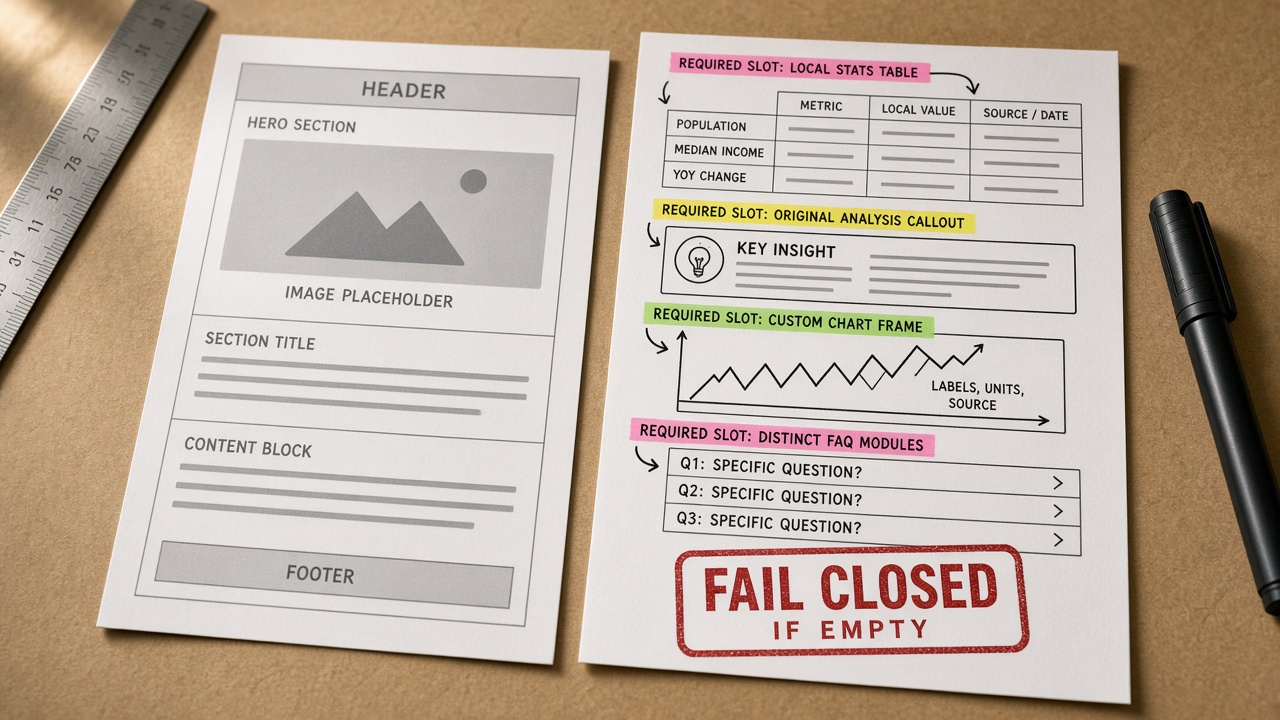
Move the design past synonym variation. Each URL class should declare the unique inputs it cannot invent. If those inputs are missing, there is no page to write.
- Localized or first-party data that stays empty unless a source feed actually filled it
- Original comparison or scoring logic computed from those inputs, not a rewritten roundup
- Custom visuals or structured modules bound to that entity, not stock decoration
- A reader-specific outcome or in-article chat hook that changes with the URL
Encode the contract as schema the agent must satisfy
Authors and agents ignore prose guidelines when a deadline or a throughput target appears. Encode the unique-value template as a schema the CMS and the publishing agent must honor: typed slots, minimum fill, a nearest-neighbor uniqueness check against already-live siblings, and an explicit list of allowed fallbacks—almost always none. The agent does not “do its best” with a blank slot. The job errors.
Fail closed is the whole point. Blank required fields, scores below the uniqueness threshold, or markup that is too close to the nearest neighbor should stop the pipeline before render. Near-duplicate HTML never reaches the CDN, never enters the internal-link graph, and never consumes a review minute reserved for a money page.
The structural gap is easier to see than to describe. Slide between a thin location or attribute variant and the same intent after unique slots are forced—the difference is architecture, not vocabulary.
The thin version is a heading, a restated intro, three generic benefits, and a CTA. Change the city or the attribute and you have the next URL. The value-forced version carries the same query with a data module that only exists because the feed filled it, a comparison the template computed from those rows, a visual bound to that entity, and a chat entry that answers that reader’s configuration. Nothing that matters is a synonym of the sibling page.
Uniqueness should thicken the cluster, not the doorway
Wire those thresholds to internal linking and cluster strategy. A URL that clears uniqueness earns links from the hub and from adjacent siblings, so each new page adds topical depth. A URL that fails is not “close enough to interlink.” Linking near-duplicates is how doorway patterns form. The agent should kill the job and, if the cluster still has a coverage gap, request a richer data row rather than a rewrite of empty slots. Scale that behaves this way grows a topic; scale that interlinks thin variants spends the site’s risk budget on a pattern the systems already know how to discount.
Fail-closed templates — Unique value is a typed contract. If required slots are empty, weak, or duplicate a neighbor, the job errors instead of publishing thin HTML.Ship Checkable E-E-A-T, Then Earn Trust on the Page
Those unique-value slots only protect you if the page that ships can also prove who stands behind it. After a template refuses thin HTML, the next leak in the risk budget is borrowed authority: a recycled staff bio, a house byline, a last-updated stamp that ticks without a check. Helpful-content and spam systems do not grade that theater. They look at whether expertise, experience, and accountability are inspectable on the URL itself.
Treat E-E-A-T as fields an agent can refuse
Think of expertise the same way you already think of unique-value slots: artifacts the CMS and agents can validate, not a paragraph on an About page. Every publishable URL should carry a named reviewer—not a brand mascot—plus credential fields that resolve to a real person or organization entity. Primary-source links belong in the body, next to the claims they support. A last-verified date should be tied to an actual check, not a nightly cron. A change log should record what was re-checked and why. When those fields are empty, stale relative to how fast the topic moves, or pointed at a generic staff page, the agent kills the job. Same contract as a blank data row: no artifact, no ship.
- Named reviewer who is a real person, not a house brand
- Credential fields that resolve to a person or organization entity
- Primary-source links sitting next to the claims they support
- Last-verified date tied to a check, not a timestamp job
- Change log of what was re-checked and why
First-hand markers you can actually defend
Where the work is first-hand, put the proof on the page: process photos, methodology notes, tool outputs, anonymized client patterns, the decision that changed after a test. Where it is not, do not invent a workshop, a lab visit, or a decade of practice. Fake experience is its own risk class. Once a reviewer—or a system—can see the claim is ornamental, the whole cluster starts to read as scaled unoriginal content. A clearly synthesized explainer with primary sources is safer, and more useful, than a first-person anecdote nobody on the byline can stand behind.
Disclose AI help without legal theater
A short, specific note is enough: what the model drafted, who reviewed it, and what they signed off. If the workflow is the same across a tier, say so once in the byline block and keep the change log honest. Readers came to understand the topic. Oversight belongs next to the reviewer fields, not as a preamble that crowds out the explanation.
Let a page-specific chat layer do what bios cannot
This is the trust surface pure generate-and-publish tools skip. An in-article assistant that answers questions about this page—clarifying a method, jumping to the comparison the reader actually needs, taking a correction—does three jobs at once. It helps the reader finish the job they opened the URL for. It captures engagement and, when you choose, a conversion path that lives inside the article rather than a sidebar. And it surfaces factual misses back into the same scoring stack that gated the draft, so the next refresh is not guesswork. Chat on the page is not a widget bolted on after publish. It is part of the quality contract: if the assistant cannot ground an answer in the article’s sources and reviewer fields, it should say so rather than improvise.
Brand citations in generative engines and eligibility for AI Overviews are secondary outcomes of that substance. You do not chase them as tricks. You make the page the clearest, most checkable explanation in the cluster, keep the artifacts fresh, and let mentions follow the work. Once those layers are on the URL, the remaining risk is what happens after publish—whether engagement, citations, and volatility say the page is still earning its keep.
Checkable E-E-A-T — named reviewers, credentials, primary sources, last-verified dates, and change logs, plus a page-grounded chat layer, turn trust into something agents can refuse to ship without, instead of a bio no system can audit.
Close the Loop After Publish: Indicators, Kill Switches, and Recovery Agents

That verdict does not arrive as a traffic chart. Rankings and sessions lag, and by the time they look sick the generator has already shipped another week of the same pattern. The risk-budget operating system treats the live site as a sensor network: it watches leading signals, trips kill switches before a cluster becomes a pattern a helpful-content or spam system can name, and sends a recovery crew with jobs instead of a panic rewrite.
Leading indicators, not vanity publish counts
Pages shipped, words generated, and sitemap growth only prove the pipeline is busy. They do not prove the site is still people-first. After a URL is live, watch the signals that tell you whether readers and crawlers still treat it as worth the slot:
- Dwell and scroll quality — whether people finish the unique-value slots or bounce at the template chrome.
- In-article chat — questions asked, corrections submitted, and conversions that start on the page itself.
- Ranking spread inside a cluster — one hero rising while siblings flatten is a different story from the whole cluster sliding together.
- AI Overview citation presence or absence on the queries you actually targeted, not a sitewide vanity mention count.
- Crawl anomalies — coverage drops, soft-404s, or crawl budget concentrating on near-duplicate variants.
- Manual-action hygiene — Search Console stays clean, and you do not wait for a notice to act.
These are the same dimensions the pre-publish gates tried to predict. After publish they become the feedback that proves or falsifies the score, and they belong on the same risk ledger as draft bands—not on a separate “content marketing” dashboard.
Kill switches that actually stop the press
A warning in chat is not a kill switch. When a template class, cluster, or daily cap crosses a risk or engagement-decay threshold, agents must pause that class, cut the publish cap, or quarantine the cluster so new URLs cannot ship until a human reopens the gate. Fail-closed here means the generator idles. Missing a week of long-tail filler is cheaper than feeding a pattern that already reads as scaled low-value output.
Write the trips before you need them: decaying dwell across a template family, cluster-wide ranking compression, crawl waste on near-duplicates, or a rising share of drafts landing in kill and full-review bands. Name the unit the switch stops—template, cluster, or site-wide cap—so a thin city-page family does not freeze money pages that are still earning their keep.
A recovery crew, not a rewrite sprint
When an update or a tripped switch hits, do not improvise more variants. Treat recovery as a small crew of agents with distinct jobs, then re-score before anything returns to a live band:
- Detect which URLs, templates, and clusters moved, and whether the move is ordinary volatility or a structural drop.
- Diagnose thinness (empty unique-value slots, sameness) versus intent mismatch (right facts, wrong job-to-be-done).
- Refresh with new primary-source evidence and update last-verified artifacts so freshness is checkable, not cosmetic.
- Expand unique value inside the slots the template already requires—data, comparison logic, reader-specific outcomes—not another introduction.
- Repair internal links so surviving pages concentrate topical depth instead of doorway paths.
- Re-run the publish risk score; only a passing band puts the URL back in front of readers.
Keep a one-page post-update playbook next to those roles: what gets paused first, who owns diagnosis, which templates are ineligible for a “just ship a refresh,” and the hard rule that no new sibling URLs are generated until the cluster’s unique-value slots pass again. Solopreneurs under ranking panic create thin variants. The playbook exists so the operating system, not adrenaline, decides the next publish.
Recovery is wasted if it stays a one-off cleanup. Outcomes—what was thin, which intent was wrong, which template kept failing uniqueness—write back into template rules and risk weights. The OS gets stricter where the site was weak: higher uniqueness floors on that class, more human minutes on that tier, a lower weekly cap until leading indicators recover. That closed loop is what keeps programmatic and autoblogged SEO inside a risk budget the site can still earn.
Post-publish is still a gate. Leading indicators trip kill switches on templates and clusters, a recovery crew refreshes substance instead of spinning variants, and those outcomes tighten the same risk-budget OS that decided what could ship in the first place.
Key Takeaways
Stand up gates, fail-closed slots, and a kill switch on one template class this week, and let the risk budget—not generator throughput—decide how far you scale.
Frequently Asked Questions
Not for being AI-written. Scaled, unoriginal, or unhelpful pages still get suppressed under helpful-content and spam systems whether a person or a model produced them. The risk is the pattern—thin variants, missing expertise, and no unique value—not the tool that drafted the sentences.
Run fail-closed gates for originality and uniqueness, entity and intent coverage, factual claims against primary sources, schema and Core Web Vitals fitness, and a human or agent review of the brief and pre-publish draft. If any gate fails, the URL does not ship.
Attach a real author or entity, cite primary sources, include first-hand or first-party evidence the model cannot invent, keep freshness loops, and disclose human oversight where it is honest. Signals that can be verified beat claims that the content is “expert.”
A template that will not render a live URL unless required unique inputs are present—local or first-party data, original analysis, media, or reader-specific value. Missing fields block publish instead of filling gaps with generic copy.
Volume is not the limiter; repeatability of thinness is. Hybrid gates at brief, draft, pre-publish, and post-publish are what keep catalogs in the hundreds from turning into a site-wide quality problem. If uniqueness or usefulness drops, you cut the pipeline, not the word count.
Watch dwell and engagement, in-article help or conversion actions, citations in generative results, ranking and algorithm volatility, and the continued absence of manual actions. Traffic lagging those leading indicators is how scaled sites learn about a problem too late.
You Might Also Like