Quality Control Checklists for Automated Content

AI has completely changed how we think about content creation, making it possible to generate vast libraries of articles in a fraction of the time it used to take. But scaling up your output without a safety net is a fast track to search engine invisibility. If you want your automated content to rank, convert, and build trust, you cannot rely on raw AI outputs alone. According to Google Search's guidance about AI-generated content, "Google's ranking systems aim to reward original, high-quality content that demonstrates qualities of what we call E-E-A-T: expertise, experience, authoritativeness, and trustworthiness." This remains true regardless of whether your pages are AI-generated or human-written.
To consistently meet these standards, publishers must treat AI as a powerful engine that requires a strict steering mechanism. As noted in a quality control checklist that keeps content helpful and on brand, "Quality control for AI blogging means a systematic process of ensuring each published blog is factually accurate, authoritative, optimized for search and AI." This is where a repeatable quality control checklist becomes your most valuable asset.
By establishing a quality control framework with a 4-step validation system—encompassing pre-generation setup, real-time monitoring, post-generation review, and ongoing audits—you can confidently scale your publishing. According to The writer's guide to quality assurance in AI-generated content, "human oversight is vital" in any content creation process involving AI. Providing high-quality inputs, such as tone of voice guidelines and brand identity manuals, to the AI model ensures the output matches your brand's standards from the very first draft. Let's look at how to build this exact system so you can automate your SEO growth safely and predictably.
- 1
Google ranks content based on E-E-A-T qualities, treating AI-generated and human-written articles with the exact same quality standards.
- 2
A successful AI content program requires a structured 4-step validation framework covering pre-generation, real-time monitoring, post-generation review, and ongoing audits.
- 3
Human oversight is essential to supply high-quality brand inputs, verify factual accuracy, and polish the final output.
- 4
Repeatable checklists ensure your scaled content remains helpful, accurate, on-brand, and optimized for search engines.
Why Quality Control is the Secret to Scaling AI Content Safely
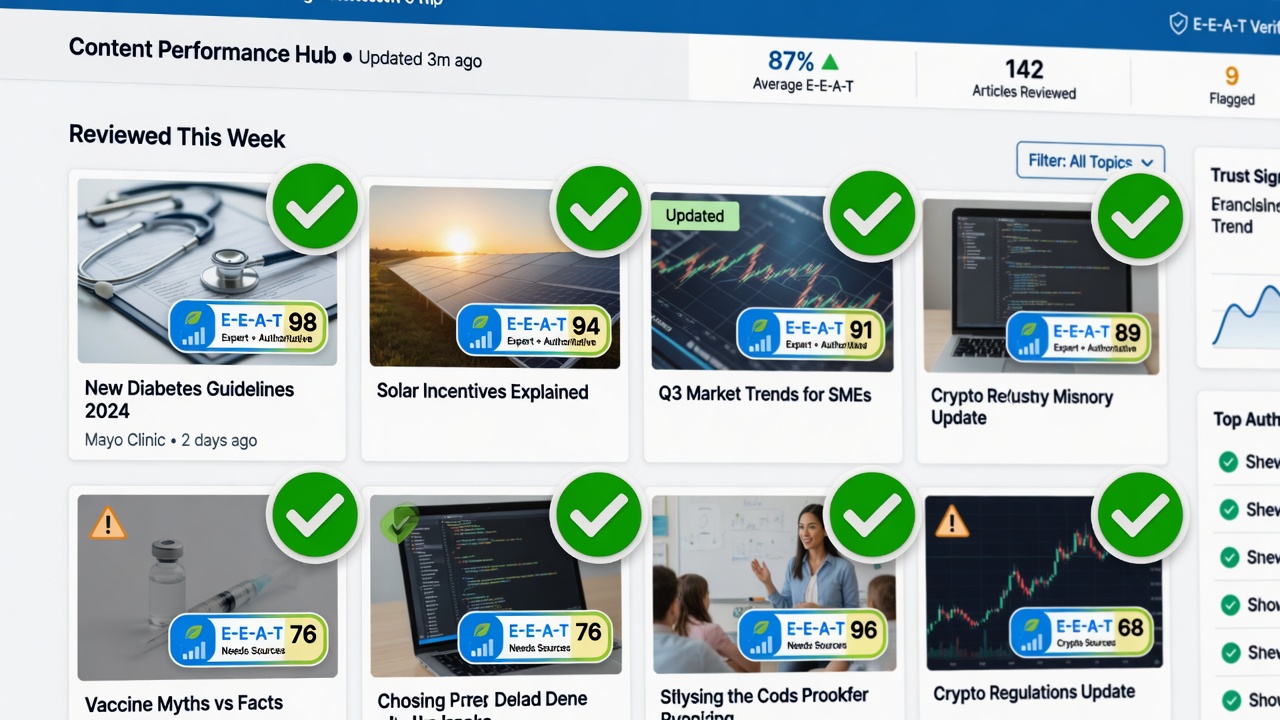
To scale your search presence, you have to treat automation as a multiplier, not a replacement for editorial standards. Publishing AI-generated drafts without a safety net is a fast track to search engine invisibility.
The good news is that search engines do not discriminate against technology. Google's ranking systems aim to reward original, high-quality content that demonstrates E-E-A-T—experience, expertise, authoritativeness, and trustworthiness—regardless of whether it is AI-generated or human-written. The algorithm cares about the value delivered to the reader, not the fingers on the keyboard.
However, unchecked automation introduces massive risks. Without human oversight, language models can easily produce duplicate, inaccurate, or low-value pages that dilute your site's authority. A systematic quality control (QC) framework acts as your shield, protecting your domain from penalties while allowing you to scale publishing volume safely.
QC is your scaling shield — Google ranks content based on E-E-A-T standards regardless of how it is made, meaning a systematic quality control process is what stands between high-volume SEO success and devastating search penalties.
The Anatomy of a Bulletproof AI Quality Control Checklist
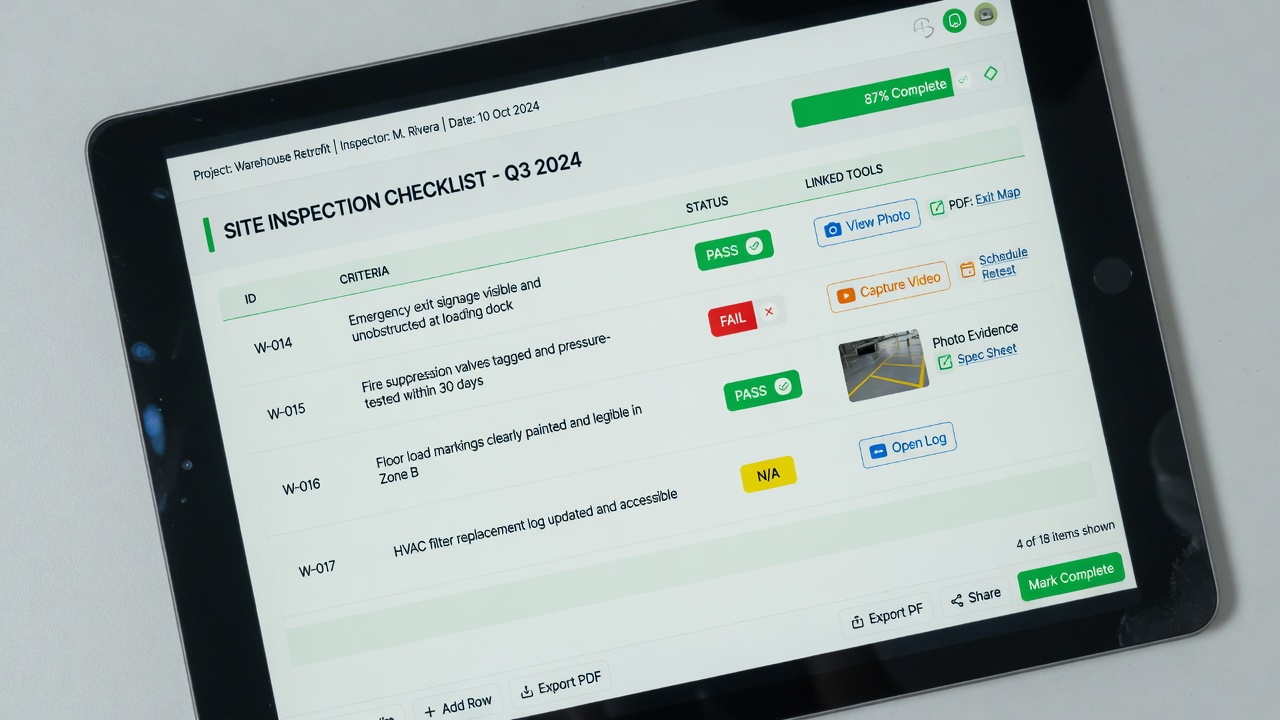
To build this shield effectively, you cannot rely on vague guidelines. You need a highly structured, repeatable document that leaves no room for error.
A comprehensive quality control checklist usually includes the product or process name and ID, clear inspection criteria or checkpoints, and specific measurement methods or tools. When scaling automated SEO content, these three pillars translate into actionable safeguards:
- Traceability details: Every draft must be logged with a unique article ID, its core topic, and its target keyword to track its generation lineage.
- Inspection criteria: This means setting strict standards for factual accuracy, structural flow, readability, and brand tone.
- Measurement tools: Rather than letting editors guess, mandate the use of readability score calculators, plagiarism detectors, and trusted primary sources for fact-checking.
Traceability drives quality — A standard QC checklist must combine clear asset identification, strict criteria for accuracy, and specific validation tools to keep scaled content safe and reliable.
The 4-Step Validation Framework: From Prompt to Publish
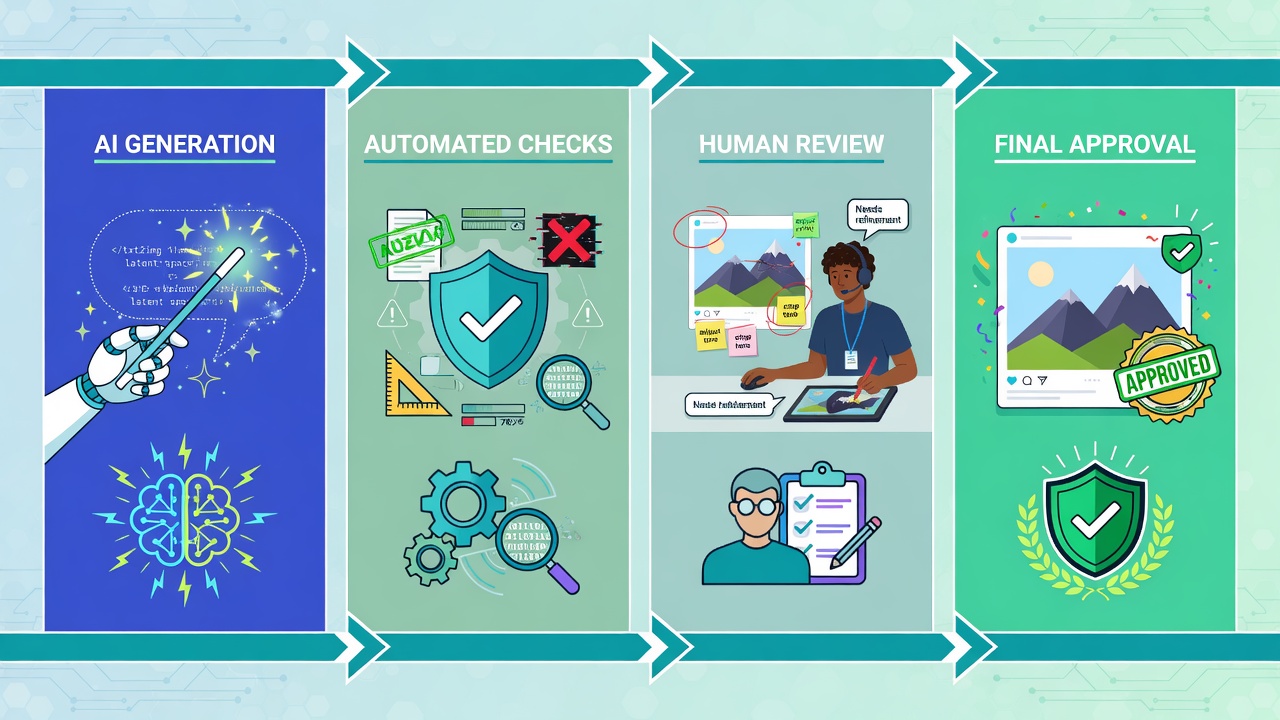
To put these tools and criteria into action, you need a structured workflow that catches errors at every stage of production. Establishing a quality control framework with a 4-step validation system ensures your content consistently meets high-quality publishing standards without slowing down your operations.
But even the best validation framework is only as good as the team running it, which is why blending automated tools with human expertise is your ultimate safeguard.
Systemize your pipeline — Implementing a 4-step validation system from pre-generation setup to ongoing audits keeps your automated content accurate, on-brand, and safe from search penalties.
Where the Machine Ends: Integrating Human Oversight into the AI Pipeline

To build a truly reliable hybrid pipeline, human oversight must begin long before the AI ever writes a word. Providing high-quality inputs to the AI model—such as your brand identity manuals and specific tone of voice guidelines—ensures the initial output aligns closely with your company's unique style. However, generating the text is only the first step.
Once the draft is generated, a human editor must step in to execute mandatory fact-checking and expertise verification. While AI excels at structuring information rapidly, it cannot replace the nuanced judgment needed to verify technical claims or inject authentic, first-hand experience. By combining AI's speed with human editorial polish, brands can establish a scalable, hybrid workflow that maintains high editorial standards without bottlenecking production.
This collaborative approach ensures every piece of content meets strict quality benchmarks before it ever goes live.
Human-in-the-loop validation — Scaling AI content successfully requires pairing high-quality brand inputs with rigorous human editing to ensure factual accuracy and brand voice alignment.From Theory to Workflow: Embedding Checklist Gates in Autoblogging
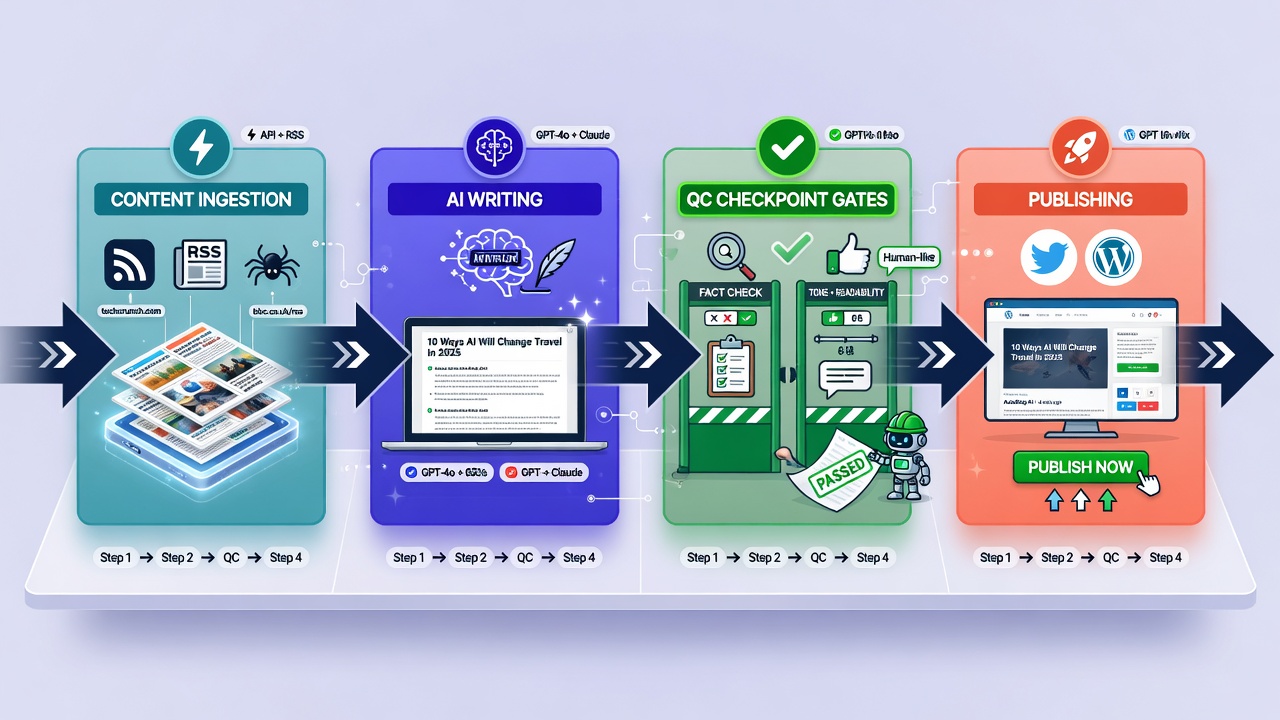
To make this collaborative approach work at scale, you need to embed checklist gates directly into every stage of your publishing pipeline. Rather than treating quality control as an afterthought, successful autoblogging workflows treat it as a continuous assembly line. This means establishing hard stops where a draft cannot proceed without meeting specific criteria.
At each gate, your system must track three critical pillars: factual accuracy, search optimization, and brand alignment. As established in industry best practices, quality control for AI blogging requires a systematic process ensuring each published blog is factually accurate, authoritative, optimized for search and AI. By using digital QC tools alongside human sign-off, you can enforce these standards consistently across hundreds of articles.
Ultimately, combining automated checks with human validation is the only way to scale your publishing volume without risking search penalties. When machines handle the heavy lifting and humans enforce the quality gates, you create a highly efficient, penalty-free engine that consistently delivers value to your readers.
Systematize your pipeline — Embed rigid checklist gates at every stage of your automated workflow, combining digital tools with human sign-off to ensure every piece is accurate, optimized, and safe from search penalties.Key Takeaways
Build a secure and scalable publishing pipeline by deploying Flows to automate your SEO content with built-in quality safeguards.
Frequently Asked Questions
No, Google does not penalize content simply for being AI-generated. Their ranking systems are designed to reward original, high-quality content that demonstrates expertise, experience, authoritativeness, and trustworthiness, regardless of how it was produced.
A comprehensive quality control checklist usually includes the product or process name and ID, specific inspection criteria or checkpoints, and the clear measurement methods or tools used to evaluate quality.
Maintaining brand voice requires providing high-quality inputs to the AI model before generation. Providing language references, such as tone of voice guidelines and brand identity manuals, ensures the initial output aligns with your brand standards.
The framework consists of pre-generation setup to define output specifications, real-time monitoring during generation, post-generation review for editing and fact-checking, and regular ongoing audits of published pages.
A systematic process ensures each published blog is factually accurate, authoritative, and optimized for search and AI, protecting your brand reputation and search rankings at scale.