
How to Evaluate AI SEO Tools for E-E-A-T and Penalty Safety
Most teams buying AI SEO software ask the wrong first question. They ask which tool writes fastest or ranks a demo article, not whether the output can survive Google’s helpful content system and spam policies once you publish at scale.
That gap is why so many sites see a short traffic bump followed by thin-content filters, duplicate clusters, or a sudden drop after a core update. The tools that look impressive in a sales demo often fail the signals search engines actually reward: first-hand experience, verifiable sources, original analysis, and clear human accountability.
This article gives you a practical evaluation protocol instead of another feature list. You will map Google’s quality systems to concrete product capabilities, run red-flag tests on real drafts, and apply a go/no-go checklist before you automate publishing. The goal is evergreen: a scorecard you can reuse whenever a new platform claims it is “penalty-proof.”
If you only remember one idea: treat every AI SEO tool as a risk-transfer decision. Speed is worthless if recovery from a helpful-content or spam action costs more than the time you saved.
- 1
Use a weighted scorecard covering E-E-A-T injection, originality, factual grounding, schema, human gates, and post-publish monitoring.
- 2
Map helpful-content and spam policies to tool features such as citations, experience signals, thin-content detectors, and refresh loops.
- 3
Test on low-competition topics for hallucination rate, duplicate risk, and how much rewrite work remains.
- 4
Prefer multi-agent quality gates and in-article assistance over generate-and-publish pipelines.
- 5
Run a 10–20 sample go/no-go audit before you scale volume or automation.
What E-E-A-T and Penalty Safety Actually Mean in a Buying Decision
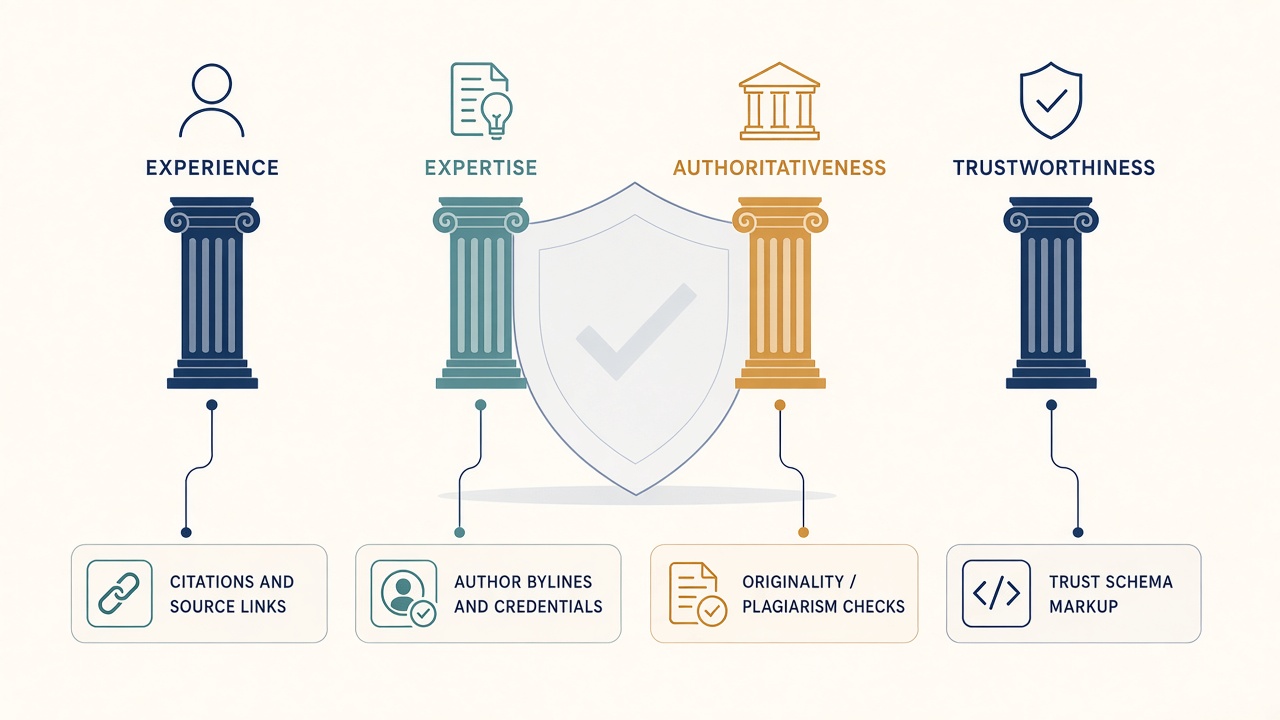
That risk-transfer lens is the right place to start. When you evaluate AI SEO tools, E-E-A-T is not a vibe check on how polished the draft sounds. It is a set of vendor capabilities you can inspect: source logging so every claim has a trail, author and entity signals that attach a real person or brand to the page, citation gates that refuse to publish ungrounded statements, and verifiable claims rather than fluent filler. A tool that only produces readable paragraphs is not injecting experience, expertise, authoritativeness, or trust—it is producing surface language.
Penalty safety is the other half of the same decision. It means the platform resists the patterns Google’s helpful-content and spam systems actually punish: thin or scaled pages, unoriginal bulk output, hallucinated facts, and pages that ship without trust markup. Generation speed and ranking durability are different products—a fast draft pipeline still fails the buy if the platform cannot keep pages out of the patterns that trigger quality or spam actions.
This article is a pre-purchase framework—how to choose the stack before you scale—not a post-publish QC checklist or an agent-scaling protocol. Those belong later. Here the job is to turn E-E-A-T and penalty safety into features you can score before money and workflow lock in.
Buy capabilities, not fluency — Treat E-E-A-T as inspectable vendor features (sources, entities, citations, claims) and penalty safety as resistance to thin, duplicate, and ungrounded patterns. Speed is not durability.Build a Weighted Scorecard Before You Lock In a Vendor
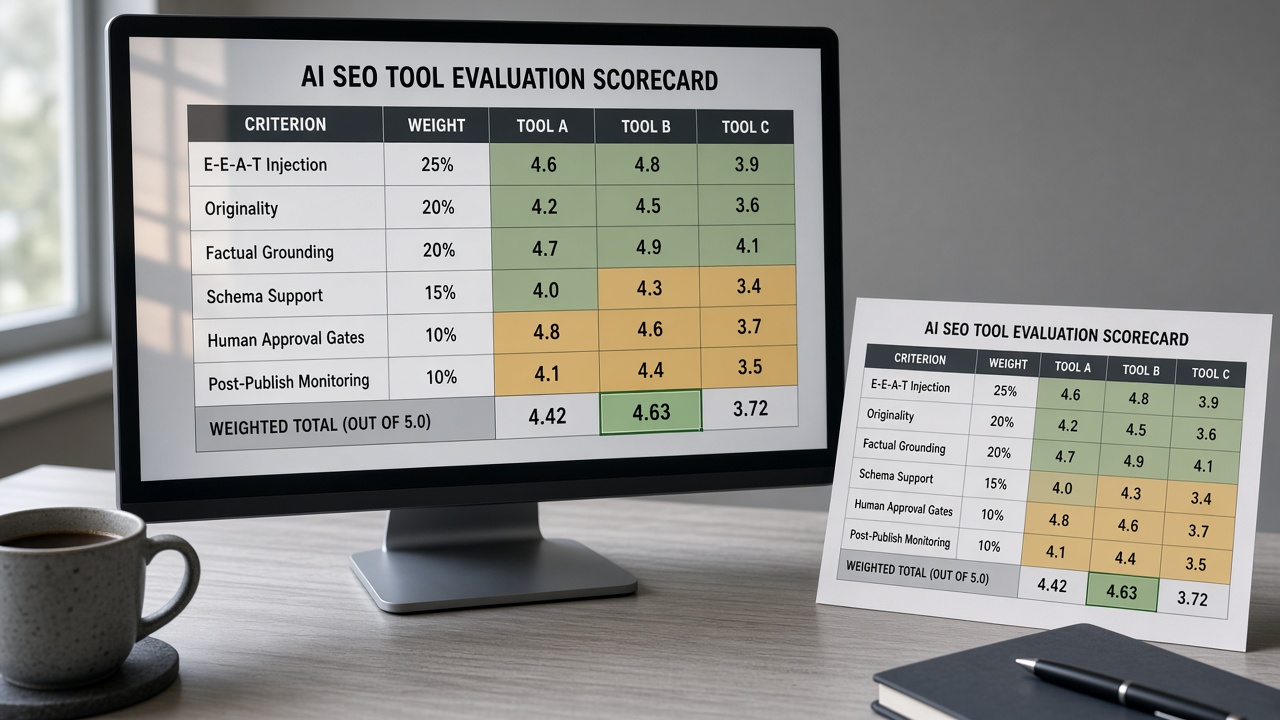
Start by turning those inspectable capabilities into a single scorecard you can fill in during a trial—not after a six-month contract. Score every platform on the same eight dimensions: E-E-A-T signal injection (author, entity, and first-hand experience fields that actually land in the HTML), originality and uniqueness checks, factual grounding with citation gates, schema and trust markup, human-in-the-loop gates, post-publish monitoring, exportable briefs and source logs, and GEO-friendly structure that AI Overviews can quote without rewriting.
Weights are not one-size-fits-all. For YMYL-adjacent niches, put the heaviest load on originality, factual grounding, and human gates—those are the dimensions that stop hallucinated medical or financial claims from ever hitting the live site. For pure informational, low-competition topics you can rebalance toward speed and automation, but never drop the originality and source-log rows to zero. Prefer multi-agent quality crews and automated QC gates over a generate-and-publish pipe that treats review as optional.
When you compare platforms, count native in-article AI chat and engagement features as trust and dwell signals, not as extras. A reader who can ask the article a clarifying question is less likely to bounce, and that interaction is part of how the page earns experience signals over time. Then price safety honestly: estimate what a thin-content or spam recovery cycle would cost in lost rankings and rebuild time, and set that against subscription savings so the cheapest generator cannot win by default.
Stress-Test Every Vendor With Your Own Sample Batch

A scorecard only becomes decisive once you run it against pages you would actually ship. Before you buy or stack tools, pick real low-competition topics from your niche and generate a representative pilot batch of drafts. Vendor demos are polished; your pilots are not. Use those samples to measure three failure modes: invented facts, near-duplicate phrasing across the set, and how much rewrite it takes to insert expertise a reviewer could verify.
Fail any system that cannot attach sources, that fabricates numbers, or that returns interchangeable thin pages whose only variation is the keyword. Those outputs are exactly the scaled, unhelpful pattern search systems are built to downrank. Check whether first-hand framing, method, and limitations can be injected without rebuilding every draft by hand. If experience has to be written in after the fact, the tool is not injecting E-E-A-T—it is leaving you to do the hard part.
What to log from the pilot
- Whether claims stay grounded or invent specifics you cannot defend.
- How similar the batch reads when you compare openings, outlines, and examples side by side.
- Hours of expert edit required before a page is publication-safe.
- Whether experience, method, and caveats can be added as structured fields rather than a full rewrite.
Write the results into the same weighted scorecard you already built. That record is what you consult when a sales call looks cleaner than the drafts. Evidence from your own pilots should outrank a demo every time.
Pilot before you commit — Generate a real-topic batch, score hallucination, duplication, and rewrite load, and let those notes override vendor theater.Turn Helpful-Content and Spam Rules into Feature Checks
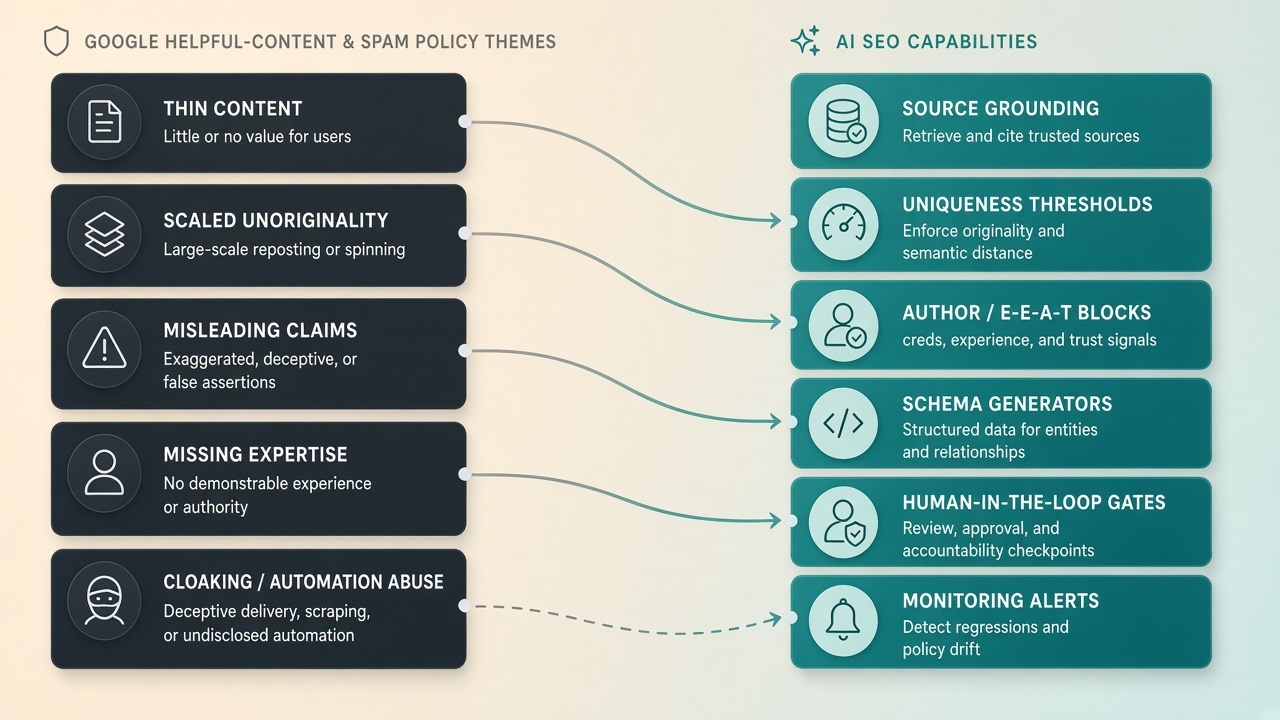
Once the pilot log is in hand, the next job is translation: every Google principle you care about has to become a checkbox on the vendor, not a hope. Helpful-content thinking shows up as people-first briefs that start from a reader job-to-be-done, experience prompts that force first-hand or attributable detail, depth controls that refuse outline-thin pages, and refresh loops that reopen a URL when facts or SERP intent shift. Keyword-stuffing templates fail this mapping on sight.
Spam and scaled-content risk map the other way. You want thin-content detectors that flag interchangeable drafts before they ship, uniqueness thresholds that compare new pages to your own corpus, site-level diversity controls so one voice and one outline cannot flood a folder, and publish caps that stay locked until a human approves. Citation requirements, claim-verification hooks, and author or entity fields only count if they survive export into your CMS—otherwise the E-E-A-T you scored in the sandbox never reaches the live page.
Technical trust is the same exercise. Templates should stay Core Web Vitals-friendly by default, and trust schema should write itself so markup is not a weekend project. If a platform cannot show those mappings, it is generating copy, not operating inside the policies that decide whether that copy lasts. Adjacent work on ranking systems and penalty-aware agent scaling goes deeper on the algorithms; here the only question is whether the feature list actually implements them.
Policy-to-feature mapping — Treat helpful-content and spam rules as a vendor spec: people-first briefs, experience and depth controls, uniqueness and publish gates, exportable citations and entities, plus CWV-ready templates with automated trust schema.Go/No-Go Checklist: Fit Winners Into a Hybrid Stack

Those mappings only matter if you treat them as a gate, not a wish list. After the sample batch and the policy-to-feature checks, decide with a short go/no-go list. Go only when originality and E-E-A-T audits on those pilot niche drafts pass, schema and Core Web Vitals automation actually fire in the template, source logs and briefs export cleanly, and monetization plus compliance controls exist before anything scales. No-go on black-box bulk publish, missing human gates, weak uniqueness, or silence after publish.
What a winning tool actually plugs into
Winners do not replace your stack; they sit inside a hybrid one. Keep research and QC specialists on briefs, experience injection, and final publish caps. Let the platform auto-publish rich pages—citations, author/entity fields, trust schema—and optionally render in-article AI chat so readers can clarify, navigate, and convert without leaving the page. Prefer multi-agent crews and that reader-facing chat over raw generation volume. For implementation depth, keep internal links natural toward quality-control checklists, E-E-A-T signal injection, and penalty-aware scaling guides. The scorecard you built is how you lock the vendor; the hybrid workflow is how you stay safe after you do.
Go only on proof — scale only after sample audits, exportable logs, schema/CWV automation, and human gates pass; then slot the tool into a hybrid crew with optional in-article chat, not a generate-and-forget pipeline.
Key Takeaways
Build the weighted scorecard, run your own sample batch this week, and only then lock a vendor into a hybrid stack that keeps humans on the gates.
Frequently Asked Questions
E-E-A-T stands for experience, expertise, authoritativeness, and trust. A useful tool must help you inject those signals—named authors, first-hand detail, citations, and transparent sourcing—rather than produce generic copy that looks interchangeable with every other AI article.
Google does not ban AI use itself. It targets unhelpful, scaled, or spammy pages. Tools that mass-produce thin, duplicated, or ungrounded articles raise the chance of helpful-content or spam-policy actions.
Generate and audit 10–20 pieces on real niche topics. Check originality, hallucination rate, E-E-A-T completeness, and how much expert rewrite is still required before publish.
It is a required review step—brief approval, fact check, or editor sign-off—before content goes live. Tools without enforceable gates push all quality risk onto your team after the fact.
Yes. Exportable briefs, source logs, and clear entity structure improve both classic rankings and the chance of being cited in AI-generated answers. Pure volume generators usually fail that bar.
Walk away if samples fail originality or fact checks, if the product cannot log sources, or if it offers no quality gates and no post-publish monitoring. Speed without those controls is a liability.
You Might Also Like