Originality Checks That Do Not Kill Useful Automation

People searching for AI content originality usually want one practical thing: a gate that stops copied or empty drafts without shutting down research, outlines, and drafts that still add something a reader cannot already get from the current results. Google does not treat AI authorship as that test. Scaled content abuse is many pages made mainly to manipulate rankings—unoriginal content that provides little to no value, no matter how it is created.
An AI-detector percentage is a probability, not a publish decision. An independent July 2026 benchmark found the top-ranked paid tool still flagged 6.2% of human-written copy as machine-made, and detector vendors themselves say drafts that AI helped generate, edit, or plan are meant to score as AI—not as false positives. Using that score as a kill switch both lets thin pages through when the number looks low and blocks useful automation when the number looks high.
The check that survives is three separate jobs. Match the draft against exact and near copies. Ask whether it adds original information, reporting, research, or analysis the results do not already say. If either fails, a named person holds the page. Automation can research, outline, and draft. Before publish, that person still fact-checks the body and the titles, meta descriptions, structured data, and image alt text—the review Google’s generative-AI guidance, last updated October 1, 2026, treats as critical.
- Google’s originality test is added value for users, not whether a page was written with AI.
- An AI-detector score is a probability with real false positives, so it should not be the publish gate.
- Hold a draft when it closely matches existing pages or adds nothing the current results do not already say.
- Keep automation on research, outlines, and drafts; keep a named human on the value test and the pre-publish fact-check.
- Pages can rank with heavy AI assistance, but volume without information gain is what scaled-content rules target.
Does Google Penalize AI Content, or Only Unoriginal Scaled Pages?

Google does not penalize AI authorship. It penalizes scaled content abuse: many pages made mainly to manipulate rankings rather than help users, no matter how they are created. Generating many pages with generative AI without adding value is an explicit example of that spam policy. Ranking systems still reward original, high-quality content however it is produced.
Fully AI-written pages can still rank if they add something new. In a June 2026 Ahrefs study, 5.3% of top-3 pages were detected as 100% AI, and 9% were at least 80% AI.
Volume without added value still loses. Pages under 50% AI made up 82.2% of top-3 rankings. Low or moderate AI pages earned 2–3x the impressions of high-AI pages, and indexation fell from 49.28% to 40.35% as detected AI rose. Average detected AI only moved from 27.1% in position 1 to 30.9% in position 10. Hold unoriginal or low-value pages. Do not stop automation only because a page is AI-assisted.
Hold the page — The publish hold is unoriginal or low-value output, not an AI-assisted draft that still adds something readers cannot already get from what ranks.
Detected AI by SERP position
A Plagiarism Match Is Not an AI-Detector Score
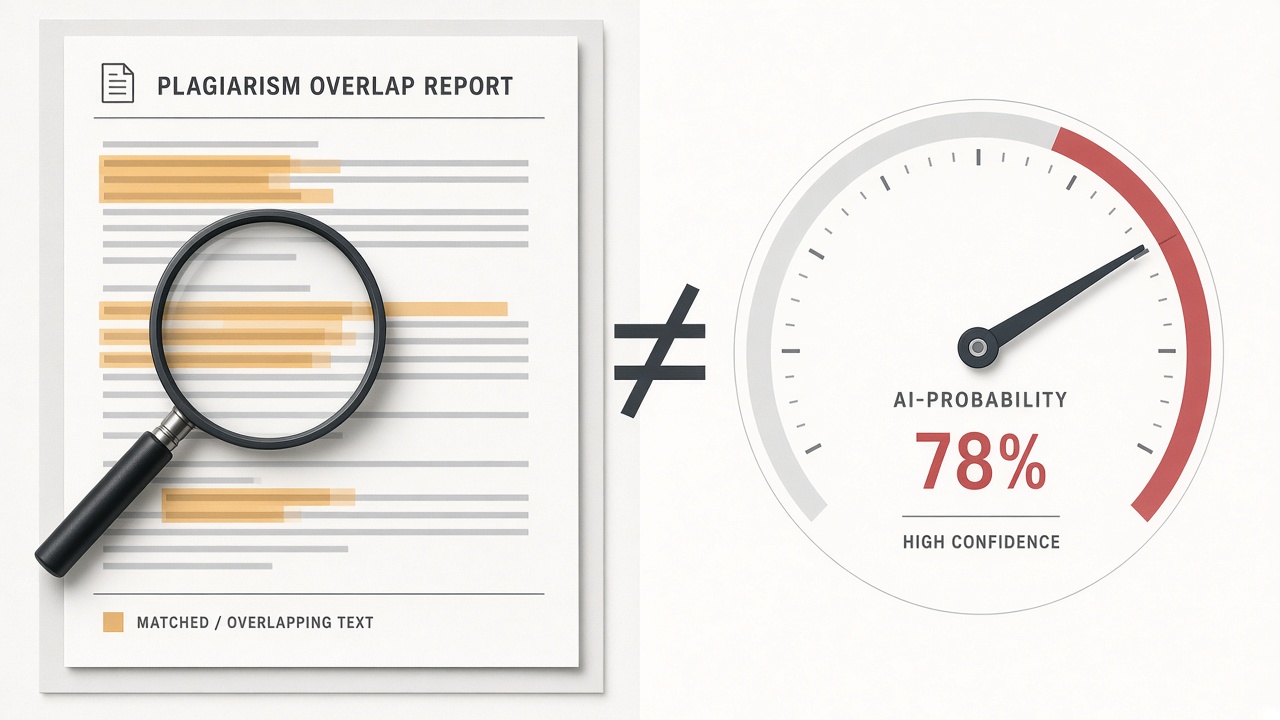
Holding a page for low value is not the same as trusting an AI-detector score. A plagiarism or similarity match is overlapping text with another source. An AI-detector score is only a probability that the writing looks machine-made. One can be high while the other is clean.
Expect a small false-positive band, not authorship proof. Originality.ai says false positives happen in about 1.56% of cases. An independent July 2026 benchmark still saw the top paid tool flag 6.2% of human writing, and a separate summary put Originality.ai at 91–94% accuracy with a 2–6% false-positive rate.
Vendors do not treat the hybrid drafts lean teams actually ship as false positives. AI-outlined, AI-edited, or heavily tool-assisted text is meant to score as AI. Formulaic expert writing can too.
Use the match report to find copied spans. Use the detector only as a hint that a draft may be generic, never as the publish decision.
Separate tests — A similarity match finds copied spans. An AI-detector score is a fallible probability, and hybrid or formulaic human drafts are supposed to look like AI, so it never decides whether to publish.
Should an Originality Score Block Publish?

That leaves the operational question: should an originality score above a set percent block publish? No. An originality or AI-detector percent above a line should not stop a page. That rule kills useful outlines, edits, and formulaic but accurate pages, while a low-scoring rewrite can still go through with nothing new to say.
Hold only when a separate check fails: a verbatim or near-duplicate match, or missing information gain against what already ranks. A high detector score can send the draft to a person. It cannot be the kill switch.
Fail closed on those two evidence checks, not on a probability. If neither check has been run, the draft is not cleared. The broader pass/fail gate is the site’s quality checklist—use that, rather than treating a score as the decision.
Not the gate — Block publish for a duplicate or near-duplicate match, or for missing information gain—not because an originality or AI-detector percent crossed a line.
What Counts as Information Gain on an Automated SEO Page?
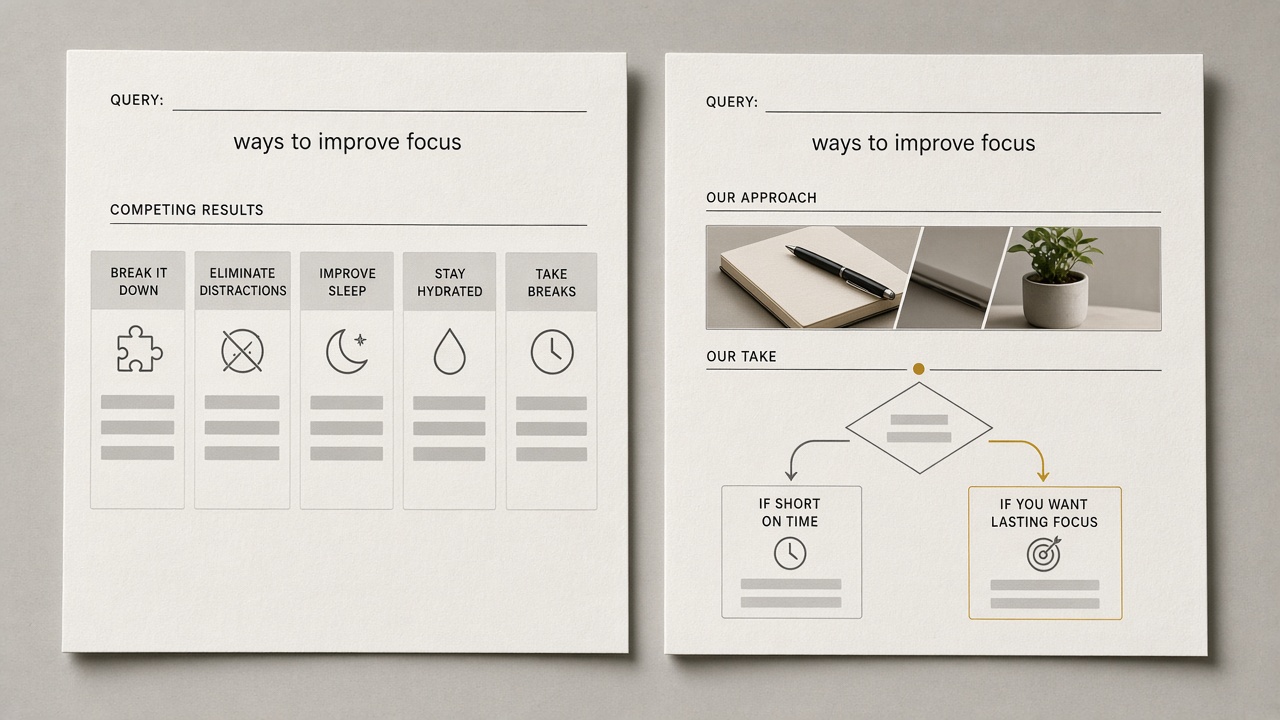
That hold is information gain, and a detector score cannot stand in for it. On an automated SEO page, information gain is original information, reporting, research, or analysis—or some other substantial addition a reader cannot already get from the pages ranking for that query. Google’s people-first questions treat originality the same way: original information, reporting, research, or analysis, and substantial additional value rather than copying or rewriting other sources.
Rewriting the top results does not count as original content. A paraphrase of what already ranks is still unoriginal, even with a clean detector score and no verbatim match. Quality-rater guidance reported in April 2025 tells raters to give the Lowest rating when almost all main content is copied, paraphrased, or auto or AI generated with little effort, originality, or added value.
The practical test before publish is to name the specific addition: first-party data, a worked example, a decision rule, or reporting the current results do not state. If you cannot name it, hold the page.
Name it or hold — Information gain is a named addition the ranking pages do not already give the reader. Rewrite and paraphrase fail that test, detector score or not.
How to Check a Draft Against Ranking Pages—and When 85% Means Hold

Once the addition is named, test it against the pages that already rank for the same query. Open the live results and list the claims, examples, and structure each one already uses, then mark what the draft only repeats. A similarity tool is the second pass, not the whole check.
Semrush Site Audit flags duplicate content when it finds 85% content similarity, including thin pages whose shared header and footer dominate the comparison, so confirm the overlap is in the main body before you kill the draft. Send sourced claims to the existing fact-check workflow. This check asks whether the page adds anything; that workflow asks whether each claim is true.
Hold trigger — About 85% similarity is a practical hold only when the overlapping text is the article itself, not shared site chrome.
Which Parts of an AI Article You Can Automate—and Which Fields Still Need Review
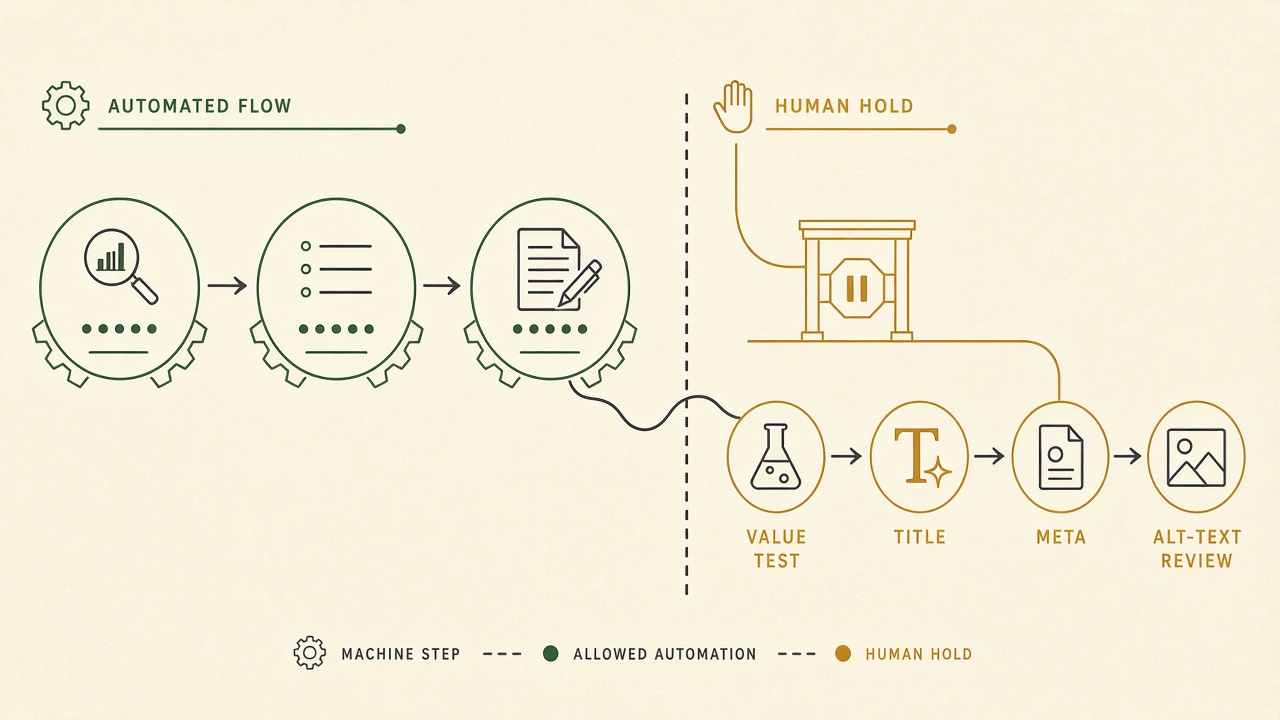
You can automate the research, the outline, and the draft without creating scaled content abuse. Google treats generative AI as useful for research and for structuring original content. What stays human is the value test: original reporting, first-party data, or a substantial addition the current results do not already say.
The abuse pattern is generating many pages without that addition, not the use of a draft tool. Google says using generative AI to generate many pages without adding value for users may violate its spam policy.
Titles, meta descriptions, structured data, and image alt text need the same manual accuracy review as the body. Guidance last updated October 1, 2026 requires that fact-check before publish. Those fields can be drafted automatically; they cannot skip the hold. A clever title on a thin page is still scaled content abuse.
The hold — Automate research, outlines, and drafts—including titles and alt text—but publish only after a person confirms the page adds something the current results do not already say.
How a Lean Team Records Hold vs Publish—and What the Concierge May Cite
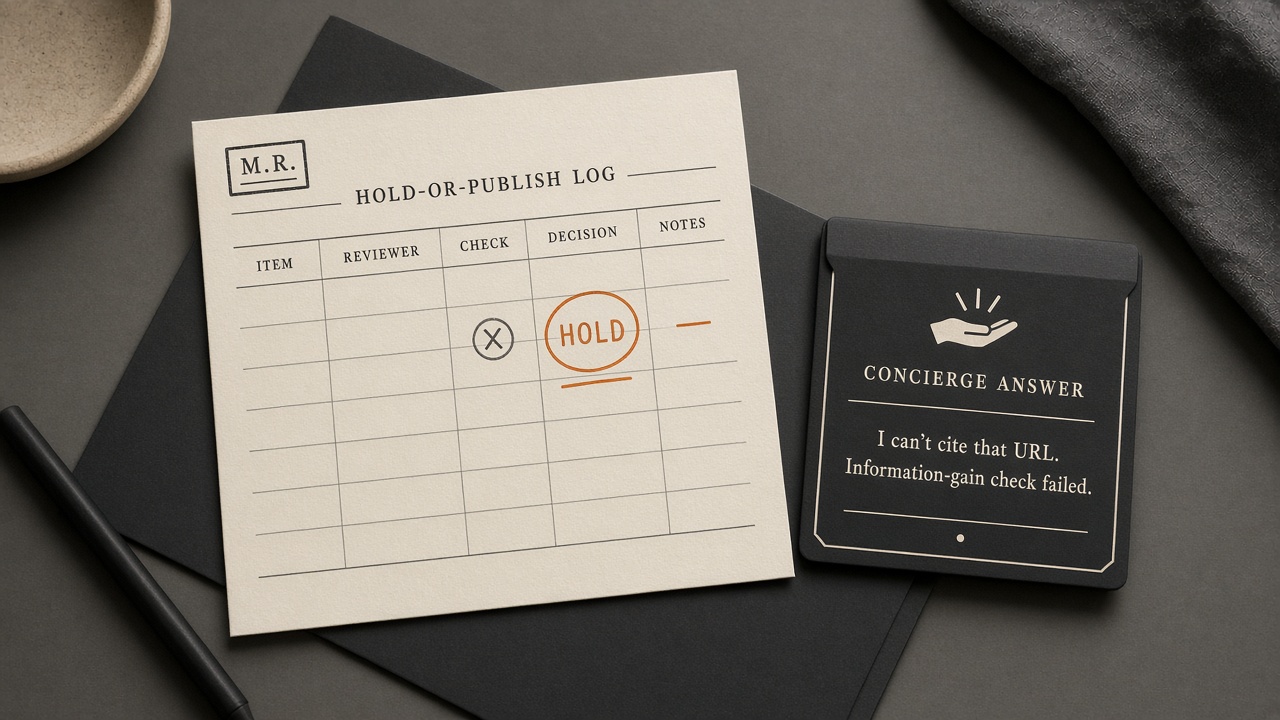
That human hold only counts if someone writes it down. Record the query, the person who decided, and which check failed or passed: near-duplicate match, information gain, or the accuracy of the title, meta description, and alt text. No record means no publish.
A September 30, 2026 Ahrefs survey found 7% of AI-using marketers publish more than three-quarters of output unedited, up from 4% a year earlier, while 89% still manually vet. The log is what makes that vetting real on a lean team.
Search originality is added value for the person running the query. Being cited in an AI answer is a second bar: another system must be able to trust and quote the page. Clearing one does not clear the other. If a page failed the originality gate, the concierge should refuse to cite it, even if the URL is already on the site. Cite only pages with a recorded publish decision.
No record — A page with no recorded pass on near-duplicate match, information gain, and title, meta, and alt accuracy is unpublished for Search and uncitable for the concierge.
Key Takeaways
Put the fail-closed log in front of the next automated publish—query, decider, near-duplicate result, and the specific information gain—or hold the page.
Frequently Asked Questions
You Might Also Like
- Automation Fail-Closed SEO Briefs: The Publish Gate Autoblogging Needs
- Automation Automated Blog Posts: Quality Guardrails That Prevent Thin Content
- Workflows Content QA for AI Drafts: The Review Checklist Before You Hit Publish
- Workflows Fact-Check Workflow for AI SEO Drafts
- Workflows Autoblogging Briefs That Rank: Decision Rights for Writers and AI