Information Gain in SEO: How to Add Something Answer Engines Have Not Already Quoted

A page that restates what the top results already say is easy for an answer engine to summarize and hard for it to cite. Information gain is the opposite of that overlap: additional information in a document beyond what other documents already contain, the idea SEOs draw from Google's patent as Ahrefs explains it. The patent is US 11,354,342 B2, Contextual Estimation of Link Information Gain, filed October 18, 2018 and granted June 7, 2022. It describes session-level scoring against documents one user has already seen, not a confirmed global novelty ranking factor. Whether Google runs a literal information gain score is still unconfirmed. What Google does say in public is comparative: helpful content should provide original information, reporting, research, or analysis, and substantial value versus other results. After the March 2024 quality update, Google said search results showed 45% less low-quality, unoriginal content than before that work. Rewording a competitor does not create that gain, because the comparison is about meaning, not wording, so covering the consensus is only the cost of entry. The practical test is fail-closed: name what the SERP already agrees on, name the one sourced block engines have not already quoted, put it near the top, and hold or delete the URL if that block is empty.
- Information gain is new, useful information beyond documents a reader or engine has already seen, as described in Google patent US 11,354,342 B2.
- Google has not confirmed a live information-gain ranking score; the patent describes session-level novelty, not a global rank factor.
- Rewrites do not count, because the comparison is about meaning, not wording.
- Quotable gain is a sourced first-party number, a named test, a limit, or an expert quote placed early.
- Ship only if that addition exists; otherwise hold or delete the URL.
What Information Gain in SEO Is — and Why a Content Score Is Not It

A higher content score is not information gain. The gain is the useful remainder: information in this document beyond what a reader or an answer engine has already seen elsewhere. Practitioners take that test from Google's patent, as Ahrefs explains it, not from how completely a page covers the same topics more cleanly.
A Surfer-style content score rewards covering the topics the results already share: the entities, subheads, and questions that show up across the top pages. That overlap is the cost of entry. It tells you the page looks complete next to the SERP. It does not tell you the page added anything those pages had not already said.
Gain is the remainder after shared meaning is subtracted. A cleaner clone of the same facts still matches documents already seen, so polish does not survive that subtraction. Ahrefs frames the reward as difference, not merely a better version of the same page.
Before the draft grows, name the consensus in one short block, then name the one addition this URL alone can defend. If that second line is empty, the page has coverage, not gain — and more words will not change the subtraction.
The remainder — Information gain is the useful remainder after the SERP’s shared facts are subtracted, not a higher content score on a better-written clone of the same page.
Is Information Gain a Confirmed Google Ranking Factor?
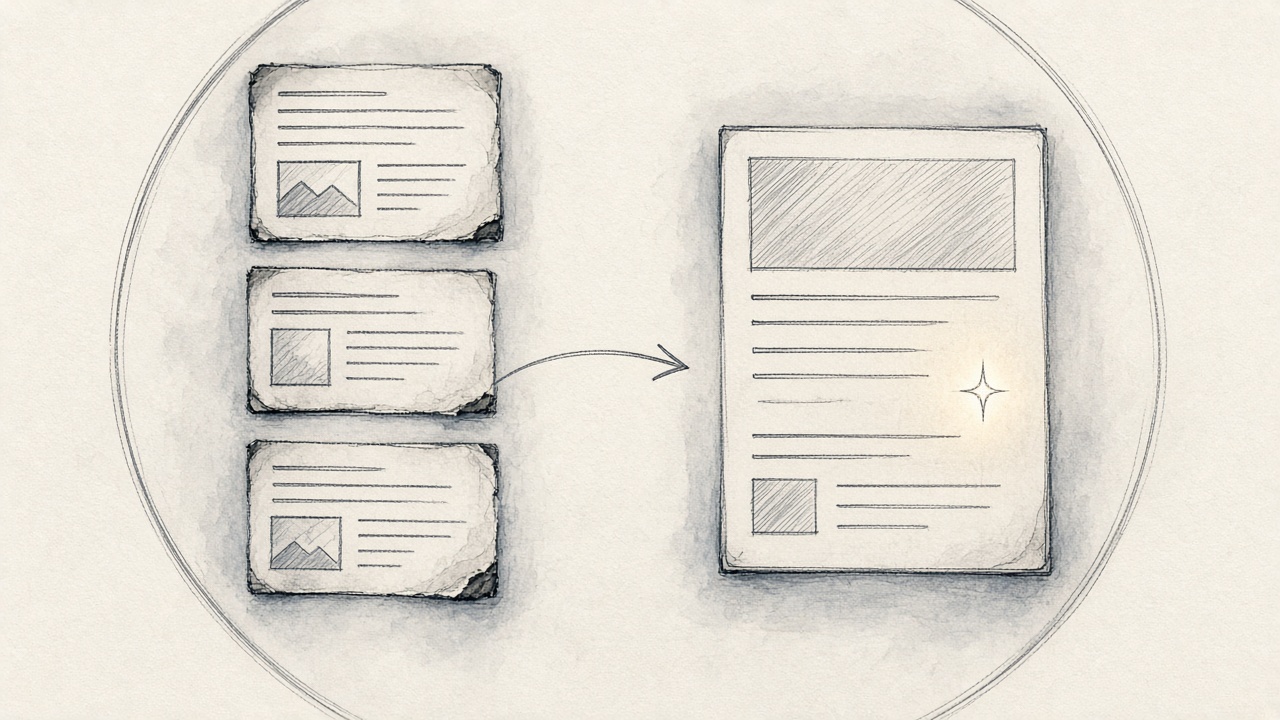
That definition raises the question operators actually care about: is information gain a confirmed Google ranking factor? It is not. Whether Google runs a literal information gain score is still unconfirmed. Treat the patent as a described capability, not proof of a live ranking weight or a global score you can optimize toward.
The document people cite is US 11,354,342 B2, Contextual Estimation of Link Information Gain. It was filed on October 18, 2018, and granted on June 7, 2022. Those dates fix the document. They do not fix a ranking system. A patent describes a capability, not a confirmed ranking system, so a grant is not evidence that a novelty score is live, weighted, or applied the same way to every query.
What the patent actually scores
What it scores is narrower than the folklore. The patent describes session-level personalization for one user: novelty against documents that user has already seen, not a sitewide originality rank and not a global novelty ranking factor. Two readers can gain different information from the same URL because the baseline is what each of them has already opened, not a universal originality leaderboard.
The operator implication follows directly. Do not chase a mythical information-gain score. Ask whether this page adds something the documents already in front of the reader do not. Covering the consensus is still the cost of entry; the addition is whatever those documents have not already supplied. A paraphrase of facts already in front of the reader is not that addition, confirmed factor or not.
Unconfirmed — Google has not confirmed a live information-gain ranking score. US 11,354,342 B2 describes session-level novelty for one user, so the useful question is whether this page adds something the documents already in front of the reader do not.
Does Rewriting the Top Results Count as Original Content?
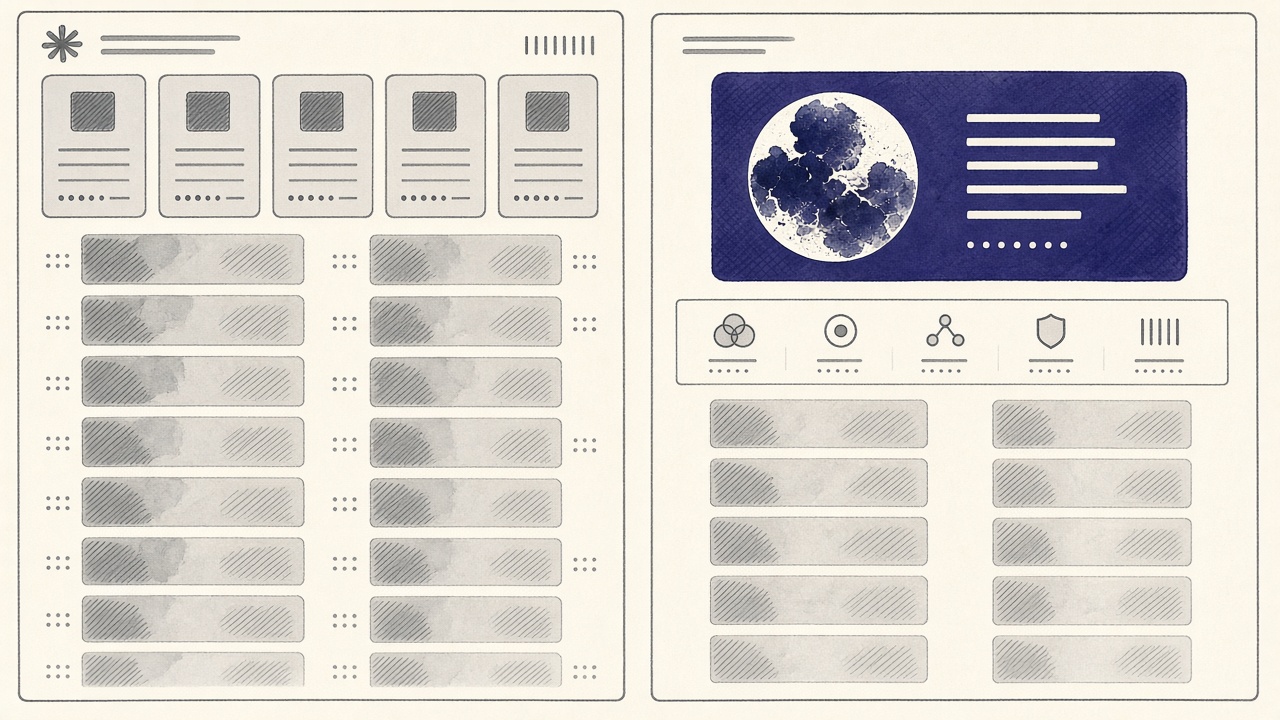
Once the topic is set up, the next test is whether a rewrite of the pages already ranking counts as the addition. It does not. The comparison is semantic, so a paraphrase of a competitor is the same information. A cleaner sentence, a new intro, or a rearranged outline still carries the facts those results already gave.
Ahrefs states the operational test directly: if you've just reworded a competitor's article, you haven't added anything new. Shared facts, even when they are well written, are not the gain. What remains after that overlap is removed is the only part that can differentiate the URL.
What the page should still cover
Consensus coverage is table stakes, and it should stay short. Define the term and answer the obvious question a searcher expects. Do not rebuild every competing heading just because it appears above you. Those points make the page complete enough to trust; they are not the reason it should exist.
Use a practical split. Keep one brief consensus block, then stop adding SERP points unless a point changes a decision the reader has to make. If it only restates what the other results already say, it is overlap, and overlap is not information gain.
Not a rewrite — A paraphrase of the top results is the same information. Keep the consensus short, then treat only what remains after that overlap as the addition this page can defend.
What First-Party Data Can a One-Person Publisher Add?
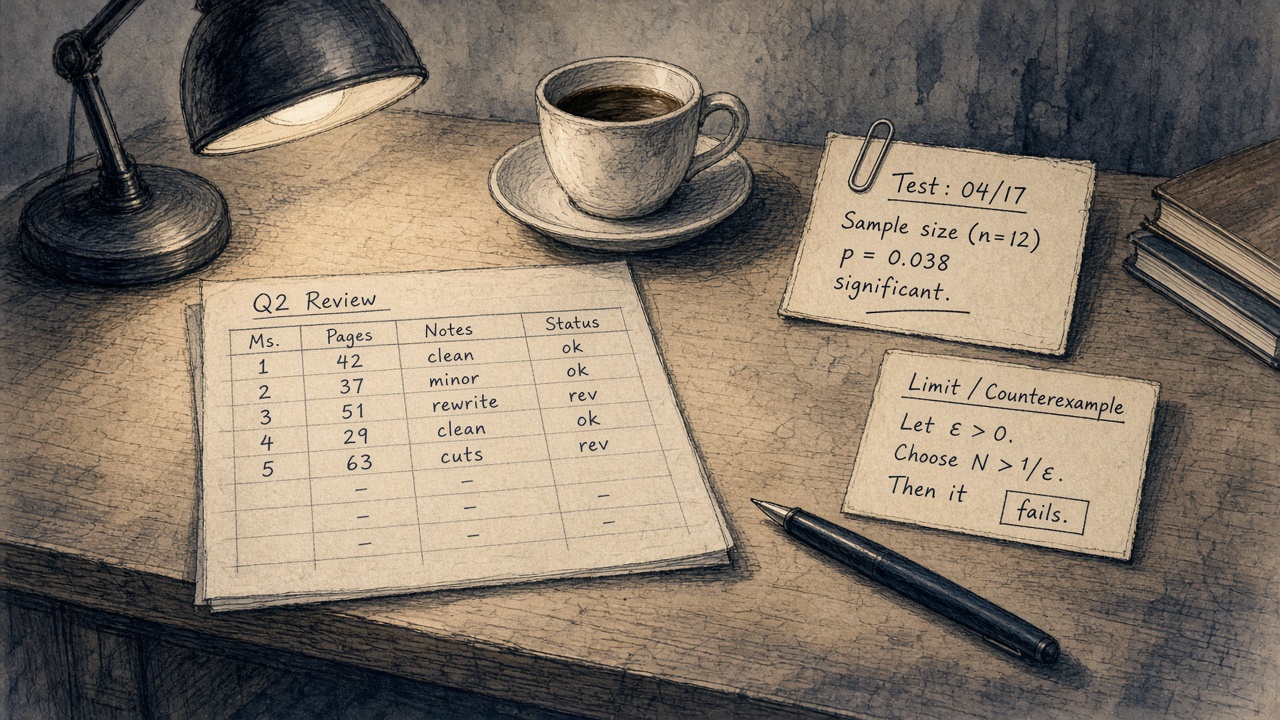
You do not need a research team. The addition this URL can defend is already in the work you do: a number from your own publishing log, a named test you ran, a limit you hit, or a counterexample that breaks the common advice. Date it, say how you got it, and stop. A restatement of what every other page already says is not in that set.
Original quantitative evidence was the strongest page-level correlate in a June 12, 2026 scan of top results. Pages with 15 or more unique figures averaged 62.1, versus 40.2 for pages with at most one. Do not treat 15 as a quota. Treat a measurement as the kind of proof that counts: one dated count you own is more useful than a longer paraphrase of the same facts.
After the December 2025 core update, Cyrus Shepard's analysis of more than 400 sites found that proprietary assets were the third strongest predictor of traffic gains. A solo publisher can own a small version of that asset: a dated count, a failed automation, or a QA reject log. It is proprietary because nobody else has that record, not because a lab produced it.
Three prompts before you ship
- What did we measure — the metric, the date range, and the method, linked so a reader can see how the number was produced.
- What failed — the named test, the automation that broke, or the limit you hit, stated as your result rather than advice copied from the top results.
- What would we refuse to publish — the claim you cannot source from your own work, which is the line that keeps the addition honest.
Link the method, not a lab study. A short note on how you counted is enough. If those three prompts come back empty, the page does not yet have something an engine has not already quoted.
Own one measurement — A dated count, a failed test, or a refuse-to-publish line is first-party data a solo publisher can defend — and that measurement, not a research team, is the addition worth placing near the top.
How Many Original Facts Are Enough Before an Article Clears QA?
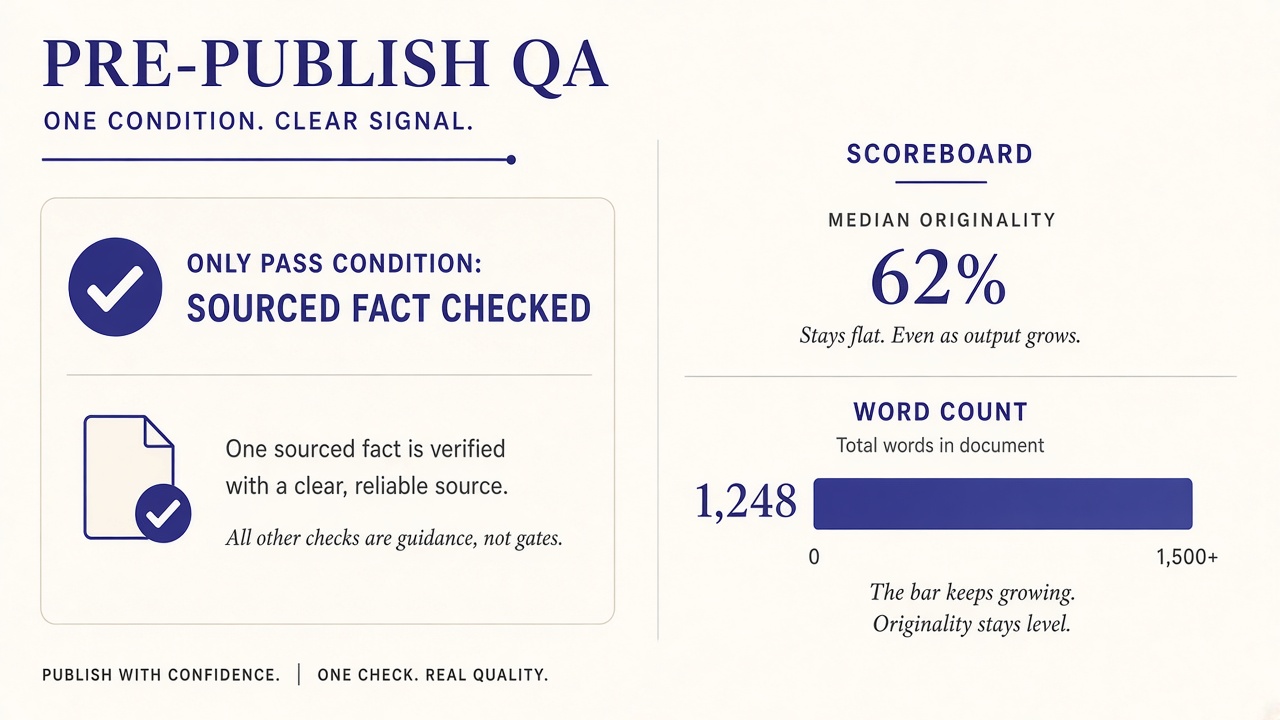
Those three prompts only matter if the draft can defend one of them. How many original facts are enough before an automated article clears QA? One sourced block that is not already in the documents engines quote. That is the fail-closed minimum. Matching the median of pages already ranking is not the gate.
On June 12, 2026, On-Page.ai scored 150 top-3 pages across 50 keywords. The median information-gain score was 52/100. Twenty-one percent graded highly original, and 24% graded mostly shared. The median top-3 page carried only four numeric data points found nowhere else in its ranking cohort. A page can sit with the leaders without a stack of exclusive figures, which is why chasing that median does not tell you whether your URL adds anything.
Rank inside the top 3 did not track originality
Position medians were 52, 51.5, and 52. Those three positions sit essentially level, so a higher rank inside the top 3 was not a more original page. Mostly shared pages were more common below the top 3: 37–40% of pages at positions 4, 7, and 10, versus 24% in the top 3. Shared coverage can still rank, but it is thinner once you leave the first three results. That pattern is a reason to refuse a rewrite, not a reason to invent extra claims until a score looks higher.
The QA rule is binary. If the draft cannot name, source, and place one fact absent from the current answers, it does not clear. Extra unsourced claims do not substitute for that block. Hold the URL until the addition is real, or delete it.
Fail closed — One named, sourced fact that current answers do not already carry is enough to clear QA. Matching a median score, or padding the draft with unsourced claims, is not.
Original vs mostly shared pages
Where Should the New Information Sit So an Answer Engine Can Quote It?
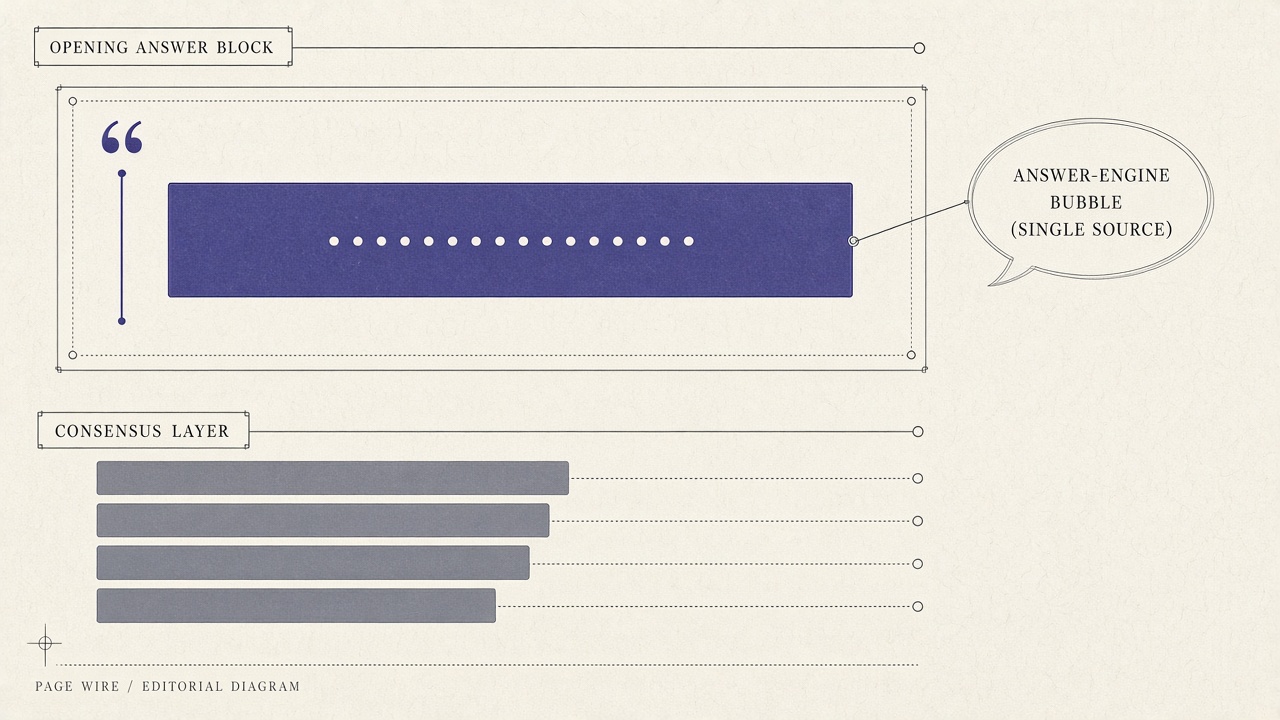
Once that one sourced block is named, put it near the top in a sentence an answer engine can lift without the surrounding recap. Consensus can follow. A longer restatement of what the results already say is easy to synthesize and hard to cite as the source.
That placement is not only a classic blue-link concern. An answer that can already compress the shared facts does not need to cite you. If the new number, named test, or limit sits under a consensus recap, the engine can answer without quoting this URL.
What the citation tests actually measured
Searchbloom's summary of the KDD 2024 GEO paper reported quotation addition as the strongest tested method, a +42.6% lift in position-adjusted word count, ahead of a +33% lift from adding statistics and a +28% lift from citing sources. Those are citation-method results on how a passage gets used, not a promise that any quote ranks.
How short and self-contained that sentence should be is the sentence contract in the site's citation-ready answers article and the AI Overviews writing piece. Here the job is placement and citability: the new fact first, the shared explanation after, and no URL shipped if that liftable sentence is empty.
Quote it early — Put the one sourced addition in a liftable sentence near the top so an answer engine has a fact it cannot compress from the SERP; consensus can follow, and a longer restatement is easy to synthesize but hard to cite.
GEO method lift (%)
Does a Longer Article Automatically Have More Information Gain?
Extra sections start to look like progress. They are not. In the same 150-page scan, information-gain scores were only weakly related to content length. A section that restates what the current results already say adds overlap, not gain — the engine has already seen that meaning, however many words you spend on it.
The useful gap is an unanswered question, not another thousand words. In 90% of those sampled SERPs, at least one generated topic question went unanswered by every scanned top-3 page. That hole is what a publisher can fill, and only with an answer those pages do not already quote.
How to tell a content gap from a keyword gap
A keyword gap is a query you do not target. A content gap is a question the current answers do not resolve. Add the unanswered question only if you can source a new answer. Do not add a heading just because a tool lists the term.
If the missing piece is only a keyword the SERP already answers, skip it. If nobody quoted an answer, that question is the candidate addition: name it, source it, and put it near the top instead of padding the draft.
Length is not gain — Scores barely tracked word count. Ship the unanswered question only when you can source an answer the top results have not already quoted.
What Should You Hold, Merge, or Delete If the Draft Only Repeats the SERP?
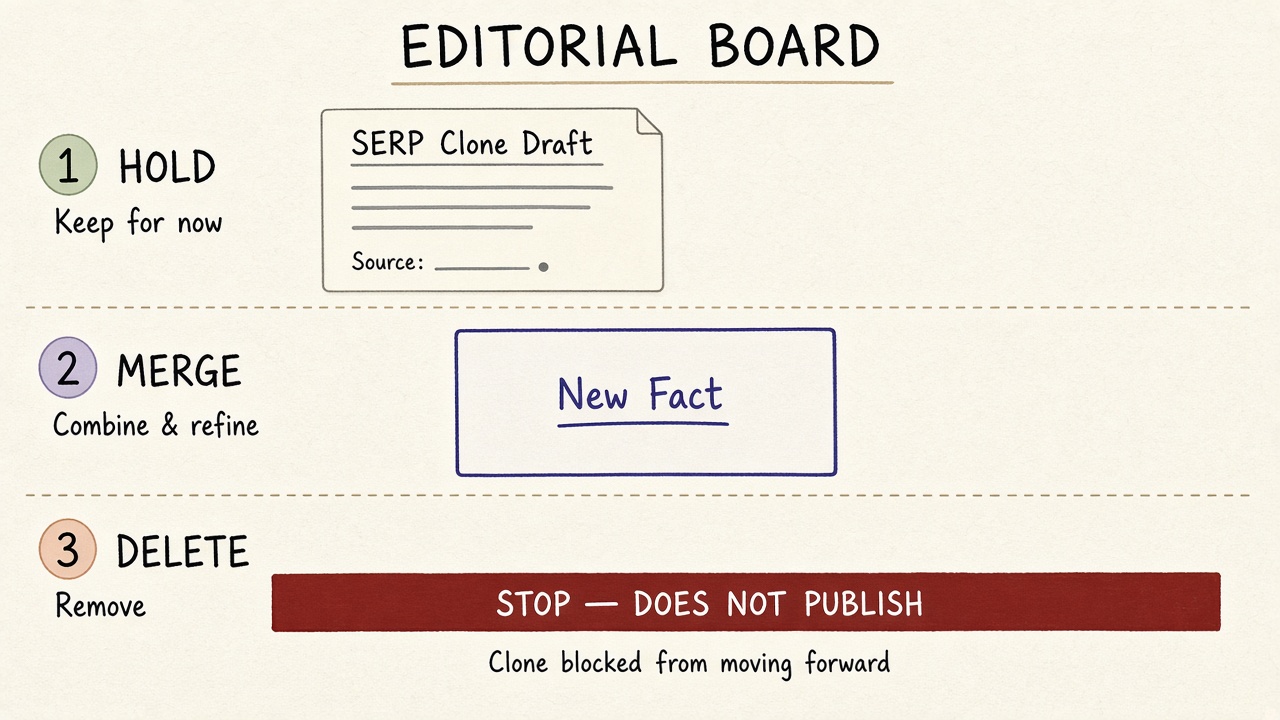
That same gate decides the whole URL, not just an extra heading. If the addition is empty, do not publish.
Hold the draft when the fact exists but is still unsourced or unchecked — a publishing-log count, a named test, a limit, or a reject log that has not been verified yet. Merge when two thin URLs share one real addition; keep the page that can defend it and fold the other into that URL instead of splitting the same novelty across two addresses. Delete when the draft only repeats documents already quoted and no first-party block is coming. A cleaner paraphrase of the SERP is still the same information.
Do not ship a second automated URL just to cover the keyword when the sourced block already lives on one page. A second address that restates the same addition adds overlap, not gain, and it splits the only quote-worthy sentence across two URLs neither engine needs to cite.
Fail closed — If you cannot name, source, and place one addition engines have not already quoted, hold or delete the draft — do not publish a second page that only repeats the SERP.
How Information Gain Answers Helpful-Content Questions — and When to Recheck
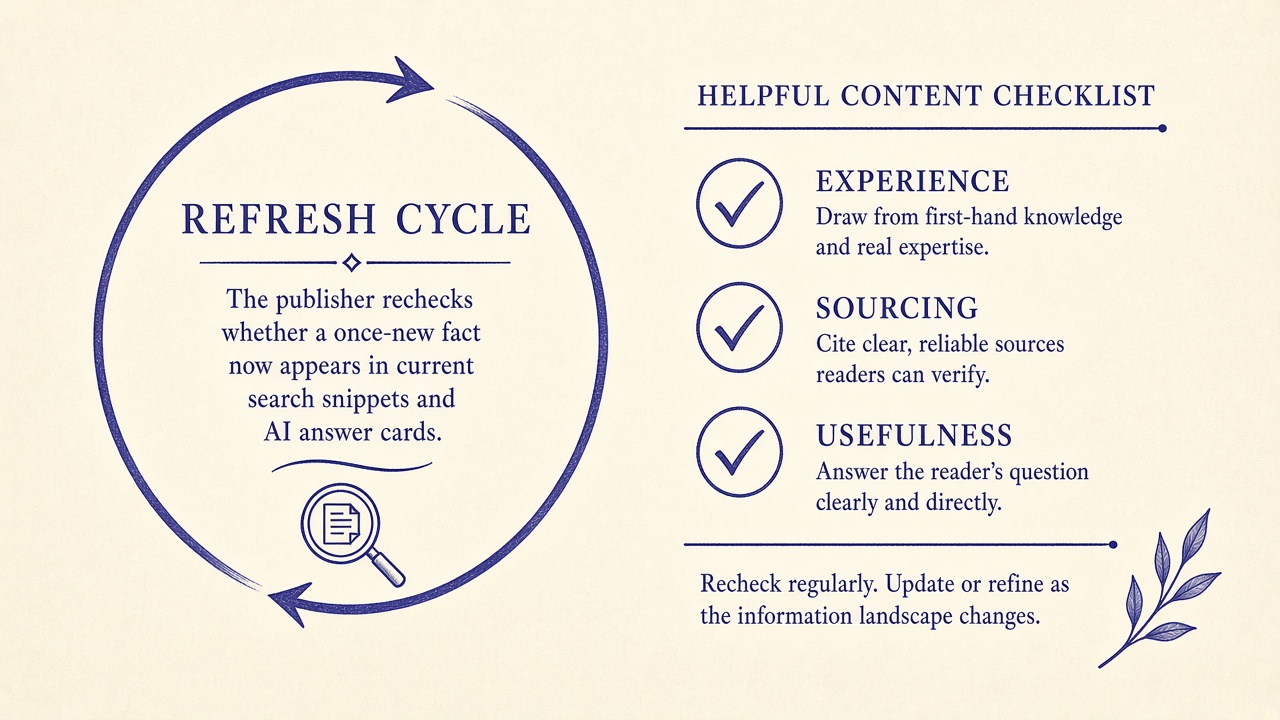
Information gain is how you answer Google’s public helpful-content questions, not a secret score to optimize. Those questions ask whether the page provides original information, reporting, research, or analysis, and whether it provides substantial value compared with other pages in the results. The one sourced block engines have not already quoted is the evidence for both.
After the March 2024 quality update, Google said search results showed 45% less low-quality, unoriginal content. The same work treats scaled content abuse as producing pages at scale to boost rankings, whether by automation, humans, or both. An automated pipeline is not exempt because a person glances at the draft.
What you measured, what failed, and what you will not claim is the first-party proof a lean publisher can attach. A longer restatement of pages already in the results does not become expertise by sounding more confident.
Recheck when the quoted set changes
Recheck whenever the documents answer engines quote change, and again before any refresh. The sources do not set a fixed interval. A fact that was new becomes consensus once those engines start quoting it, so name a different addition or hold the URL. The page stays useful only while that addition is still unquoted.
Key Takeaways
Before you publish, name the consensus in one short block, then place one sourced addition this URL alone can defend near the top—or hold the draft.
Frequently Asked Questions
You Might Also Like
- AI Search Passage-Level SEO: How to Write Blocks Answer Engines Can Lift
- AI Search AI Overview Citation Patterns: What Gets Quoted vs Ignored
- AI Search AI Overview Optimization: How to Structure Pages Google Can Quote
- Strategy Entity SEO for Publishers: What to Name on the Page So Engines Can Cite It
- Strategy Content Gap vs Keyword Gap: Which One Becomes a Brief