Hybrid Human-AI Automation Workflows for Agencies and Solopreneurs
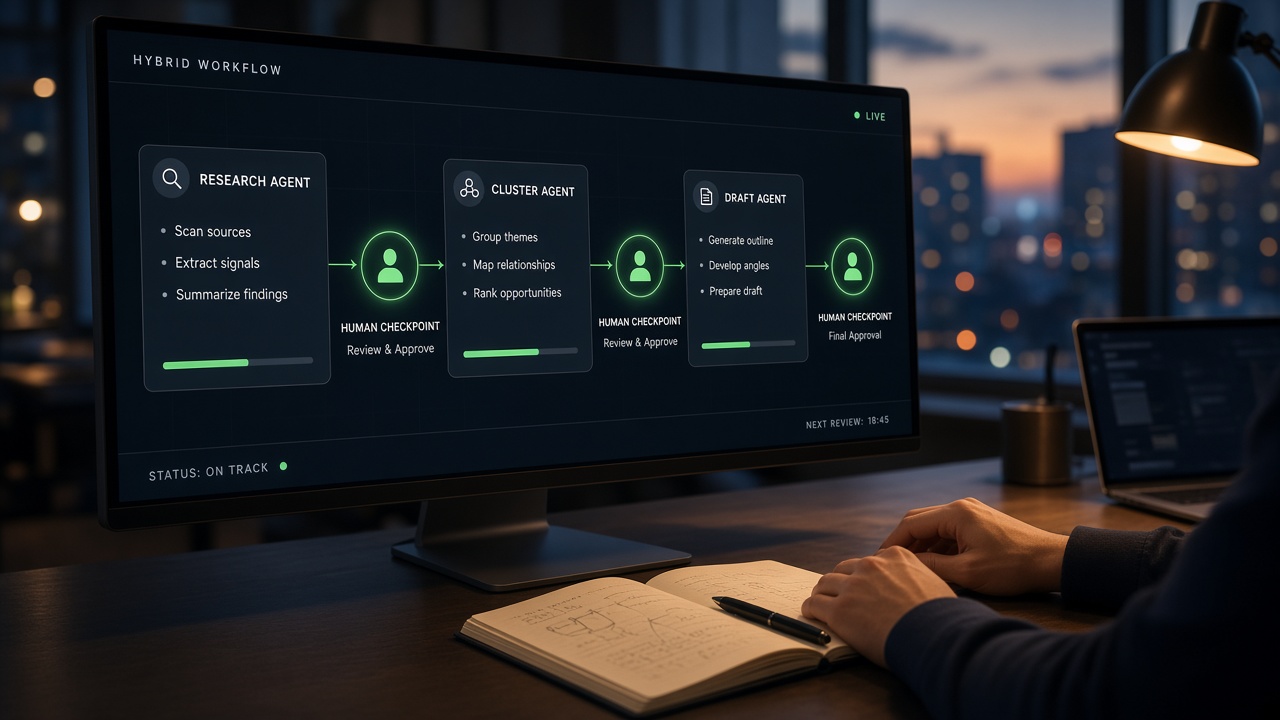
Full autopilot is a tempting SEO story: brief in, article out, rankings up. The workflows that last are hybrid. They treat AI as a crew for research, clustering, drafting, refresh, and technical checks, and they treat humans as the owners of strategy, unique value, and the last quality gate before anything goes live.
That split matters more than the brand of model you use. Search systems still reward experience, expertise, authoritativeness, and trust. Unreviewed generation can ship faster and still fail those tests. A durable system therefore defines handoff points in the brief-to-publish-to-optimize loop so scale does not quietly become thin content, stale pages, or a penalty risk.
Agencies and solopreneurs share that spine and need different operating manuals. An agency needs review queues, role clarity, and client reporting. A solopreneur needs lightweight gates that do not become a second job—and can use in-article chat as both a comprehension layer and a monetization layer. What follows maps those dual playbooks, multi-agent crews with human oversight, the technical and GEO gates that belong before autopublish, and the ROI measures that go well beyond traffic.
- 1
Hybrid SEO is designed handoffs, not full autopilot: AI scales research, drafts, clustering, and audits; humans own strategy, unique value, and final quality.
- 2
Agencies need review queues and client reporting; solopreneurs need lightweight gates plus chat as an engagement and revenue layer.
- 3
Multi-agent crews work for research, clustering, and refresh when technical SEO and GEO signals are gated before publish.
- 4
Measure time saved, ranking stability, penalty avoidance, dwell, and chat conversions—not traffic alone.
- 5
The usual failures are thin over-automation, missing freshness loops, and treating reader chat as optional.
Why Hybrid Beats Full Autopilot

Full autopilot fails for a structural reason: search still separates pages that show experience and judgment from pages that only show throughput. When every stage is model-owned, the output can look complete and still lack the distinctive angle, lived detail, and accountable voice that keep a URL out of the thin-content pile—and out of penalty range.
That split is the operating model, not a style preference. Full generators optimize for pages per hour. Closed-loop hybrid systems optimize for topical authority and reader trust: the model can draft fast, but publish stays a gated event. Nothing goes live until someone has confirmed the angle is distinctive and the page still serves a real reader.
For agencies filling calendars and solopreneurs covering a cluster without a writing bench, designed handoffs are what deliver volume without thin-content risk. The operating question is not which model drafts fastest, but where review queues, lightweight personal gates, and pre-publish checks sit so quality holds as output grows.
Hybrid, not autopilot — AI takes the scalable research-to-draft-to-check work; humans keep strategy, unique value, and the ship decision so volume never trades away trust.Who Owns What From Brief to Refresh
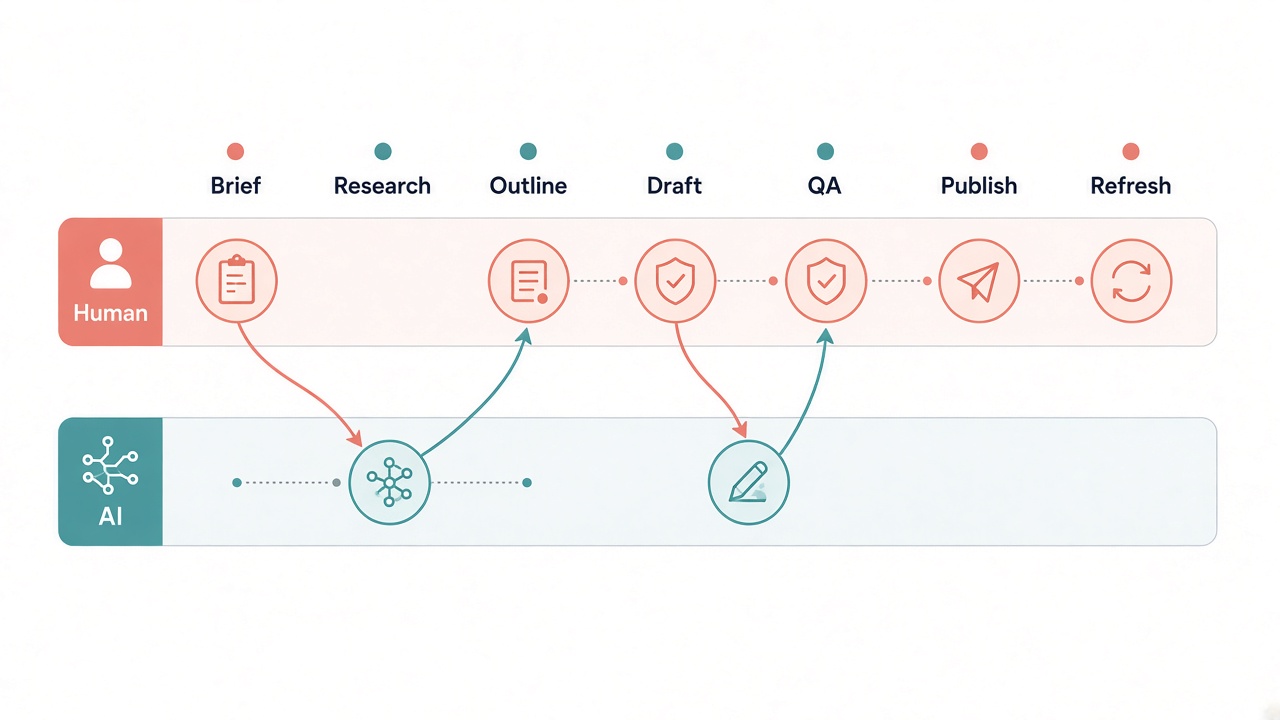
Quality holds as output grows only when every stage has a named owner. The loop runs brief → research → draft → publish → refresh, and the handoff at each gate is what stops hybrid work from sliding into autopilot.
Assign AI the scalable stretch: keyword clustering, SERP pattern pulls, outline scaffolding, first drafts, internal-link suggestions, and refresh-candidate detection. Keep people on angle selection, original insights, experience-backed claims, sensitive YMYL judgment, and final quality sign-off. If a reader would trust the page more because a person stood behind it, that step is not the model’s job.
Four gates, one owner each
Treat the loop like a lightweight RACI—even if one person wears every hat. The letters matter less than writing them down so a late-night publish cannot skip a gate.
Put those four gates in the ticket or brief so nothing moves without a name. A solopreneur collapses Responsible and Accountable onto themselves and still records the checkpoint. An agency splits the letters across strategist, editor, and account lead so the review queue has a person attached—not a shared inbox.
Named handoffs — Hybrid SEO stays trustworthy when AI owns volume work and a human owns every ship-or-kill decision, written down from brief through refresh.
Two Playbooks on One Hybrid Backbone

That staffing difference is the operating playbook, not a second engine. The research-to-draft-to-audit backbone stays shared. What changes is how many humans touch a piece, when they sit down, and what they report.
The agency queue
Agencies treat every gate as a named queue. A strategist locks the brief and angle before drafts start. Editors run a brand-and-voice checklist so clients never see a first pass. Account leads own approval and the reject path—thin or off-voice work returns to outline, not an endless rewrite. Reporting sits beside the queue: time agents absorbed, and whether rankings held after publish and refresh. Traffic is a lagging note, not the scoreboard.
The solopreneur batch
Solopreneurs keep the same checkpoints but collapse them into fewer sittings. Overnight runs still cluster, draft, and surface refresh candidates. Human work happens in one or two protected blocks a week, not a ticket stream. After publish, in-article chat handles navigation, explanations, and the monetization layer so the page keeps working when the owner has moved on. The checkpoint is still recorded; it lives on a calendar, not a multi-seat board.
Both still run daily agent passes against briefs and refresh lists, then protect a weekly human strategy block for angle, unique value, and quality. Hire or stay solo later, and the machine layer does not have to be rebuilt.
Same backbone, different calendar — Agencies staff named review queues, voice checklists, and client approval, then report time saved plus ranking stability. Solopreneurs batch human review and let in-article chat carry navigation, support, and monetization—while daily agent runs and a weekly strategy block stay shared.
Crews, Technical Gates, and GEO Before Anything Ships
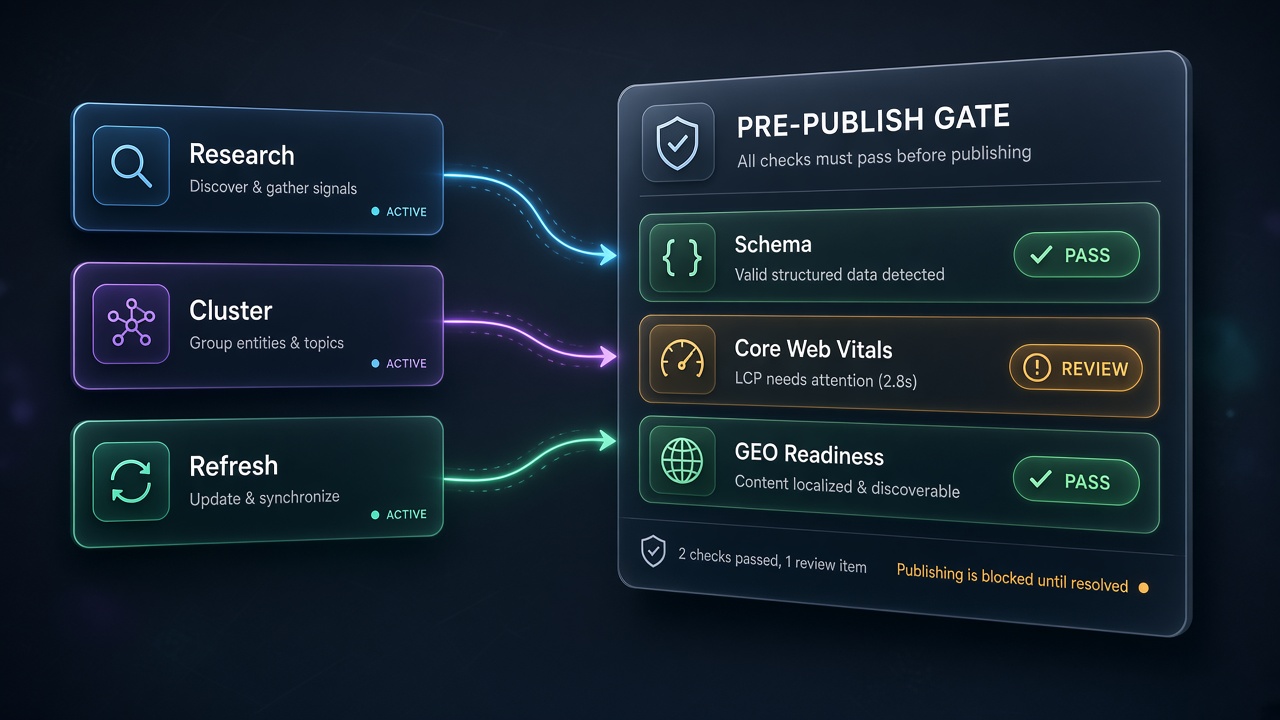
That same machine layer is not one chatbot with a publish button. It is a crew of specialized agents—each with a narrow job—and a human still deciding whether the page deserves to exist.
How the crew divides the work
Research agents pull SERP patterns, competitor gaps, and entity maps. Clustering agents group queries into briefs that already know their parent topic. Draft-assist agents write first-pass copy against the locked angle. Refresh agents flag decay and queue updates. None of them own strategy or uniqueness; those stay in the weekly human block and at the quality gate.
Before anything autopublishes, technical SEO runs as hard stops. Schema must validate. Core Web Vitals checks must pass or queue a fix. Internal-link and crawl audits run against the live site map so orphans and thin clusters never slip through. Fail a gate and the piece stays in review.
GEO belongs in the same pass
Generative engines reward pages they can quote with confidence. Build that into the same pre-publish run: unambiguous entities, answer-first structure a model can lift, and cite-worthy facts that do not need an invented source. GEO is another gate on the path to publish, not a second project.
Keep the stack you already trust. Orchestrate around best-of-breed crawlers, rank trackers, and CMS tools rather than ripping them out for one suite. Flows-style agents sit on top to brief, draft, audit, and queue; existing tools still measure, host, and ship. Treat tool-by-tool integration as adjacent reading, not a rebuild.
Crews plus gates — Agents scale research, clustering, drafts, and refresh; humans keep strategy and uniqueness, and nothing autopublishes until schema, Core Web Vitals, internal audits, and GEO signals all clear the same pre-publish path.
Score Hybrid ROI Beyond Traffic—and Catch Failure Modes Early

Those same existing tools are where hybrid ROI shows up—if you look past sessions. The loop should return time, rankings that hold, readers who stay and use in-article chat, and fewer quality or penalty scares. If those stay flat while volume climbs, automation is leaking trust, not compounding it.
A monthly scorecard both playbooks can share
Score four things every month on one card. Agencies add a client-facing note; solopreneurs skip the theater. Review it in the weekly strategy block already on the calendar—do not invent a second meeting.
- Hours returned versus last month’s production
- Ranking stability on money and hub URLs
- Dwell plus chat conversions for help, navigation, and offers
- Quality risk avoided: thin pages blocked, freshness run, gates not skipped
Hybrid fails when you autopublish thin pages, drop the weekly refresh once drafts flow, or treat chat as optional instead of engagement and revenue. Choose hybrid when the angle is known and you need scale without burning the brand. Stay fully manual for a first-of-its-kind piece, a high-stakes YMYL claim, or the one page no model could write. Measurement is how you keep that split honest.
ROI beyond sessions — Track time saved, ranking stability, dwell and chat conversions, and quality-risk avoided. Hybrid scales known angles; keep fully manual work for uniqueness, YMYL, and pages only a human should own.
Key Takeaways
Put the hybrid backbone on your next cluster this week: give AI the research-to-audit lane, keep strategy and sign-off human, and run the agency or solopreneur playbook that matches how you actually ship.
Frequently Asked Questions
It is a repeatable brief-to-publish-to-optimize loop where AI handles scalable research, clustering, drafting, and checks, and humans keep strategy, unique value, and the final quality decision. The workflow is defined by handoff points and gates, not by turning the whole pipeline over to a model.
Humans should own positioning, the angle that is actually unique, claims that imply expertise, brand voice, and the last publish or hold decision. AI can prepare the work; it should not be the sole judge of whether a page deserves to rank or represent the brand.
Agencies need review queues, named roles, and reporting that a client can trust. Solopreneurs need fewer steps, tighter personal gates, and often an in-article chat layer that helps readers and can carry monetization without a large editorial team.
Yes. Schema, Core Web Vitals-related checks, crawl and index hygiene, and generative-engine signals belong in the pre-publish gate, not as a cleanup sprint after thin pages are already live. Autopublish without those checks is how hybrid systems quietly become risk systems.
Traffic is only one line. Track time saved, ranking stability, penalty avoidance, engagement on the page, and conversions from reader chat or other on-page help. A workflow that ships more URLs while eroding trust is not a win.
Over-automating thin or interchangeable content, skipping freshness and refresh loops, and ignoring the reader who still needs a human-quality explanation. The stack is rarely the first failure; missing gates and missing ownership are.
You Might Also Like