How to Embed and Monetize In-Article AI Chat for Better SEO, Dwell Time, Navigation, and Sales
- 1
In-article chat works when it extends the article’s argument, not when it is a generic overlay.
- 2
Placement, prompt design, and page-speed discipline drive interaction without hurting Core Web Vitals.
- 3
Monetize through contextual offers, leads, and subscriptions inside a disclosed, trust-safe conversation.
- 4
Native chat seeded from the brief and brand knowledge outperforms bolt-on widgets on accuracy and attribution.
- 5
Judge success on dwell, scroll, chat-attributed conversions, and revenue per session—not raw traffic or chat volume.
The Missing Layer Between Ranked Traffic and Revenue
That distinction is not semantic. It is why an operator can ship a chat window, watch a session linger, and still have no idea whether the assistant helped someone finish the piece, captured a buying question, or simply parked them on a generic script. Existing coverage still splits the work into silos: engagement tactics in one place, embed how-tos in another, ads and affiliates in a third. Almost none of it describes one system that runs brief → article → chat → revenue → the GEO signals that make the next page worth citing. Until that loop exists, the page does the ranking work and the widget collects screenshots.
Four failure modes that look like progress
The usual implementations fail in predictable ways, and each failure masquerades as a win if you only watch vanity metrics.
- Off-article support bots live in a site-wide bubble that knows the help center, not the argument of this page. Readers leave the article to ask a question the article already answered.
- Ungrounded answers let the model improvise past the host piece and the brand’s knowledge. That is how you burn trust in public, one confident sentence at a time.
- Interruptive UI—auto-open drawers, overlays, mid-scroll hijacks—trades a spike in “interactions” for bounce, rage-clicks, and Core Web Vitals risk.
- Unattributed clicks fire affiliate links, lead forms, and upsells without session credit. Dashboards swell. You cannot tell a chat-assisted buyer from a reader who never opened the thread.
None of those are chat problems in the abstract. They are what happens when the assistant does not share knowledge, disclosure, and measurement with the article that invited it.
Chat as a conversion and navigation layer
An in-article assistant earns its place when it keeps a reader inside the piece, routes the next question to the right passage or offer, and records the path. It should be able to point to a heading the reader has not reached yet, surface a disclosed recommendation that belongs to this topic, or capture qualified intent without dumping them on a generic contact form. That only works if the chat is seeded from the same brief and brand knowledge that produced the article—not bolted on after publish as a third-party personality. Hybrid workflows matter here: drafted or autoblogged pages still need a chat trained on the finished article plus the operator’s constraints, so answers stay on-brand and on-page. Privacy, consent, and clear disclosure are not a legal appendix. They are part of the same trust surface as the byline.
Success looks like more than time-on-page
Time-on-page will move if the assistant is merely sticky. That is not the bar. Judge the layer on chat-assisted scroll paths (the reader continues because the answer pointed them deeper), qualified intent capture (a question that maps to a job, product, or next article), revenue per engaged session (not raw traffic, not unattributed clicks), and citation-worthy depth (answers grounded enough that both humans and retrieval systems can treat the page as a source). Those criteria force the closed loop this whole article is about: intent routing, quality gates, trust-safe offers, and session-level attribution. Without them you are decorating a ranking URL. With them, chat is infrastructure that turns the article into a navigable, measurable, sellable system.
Closed loop — In-article chat only lifts rankings, dwell, navigation, and sales when it shares knowledge, disclosure, and session credit with the host article—not when it sits on the page as a widget.
Map Intent Per URL Before You Touch Embed Code
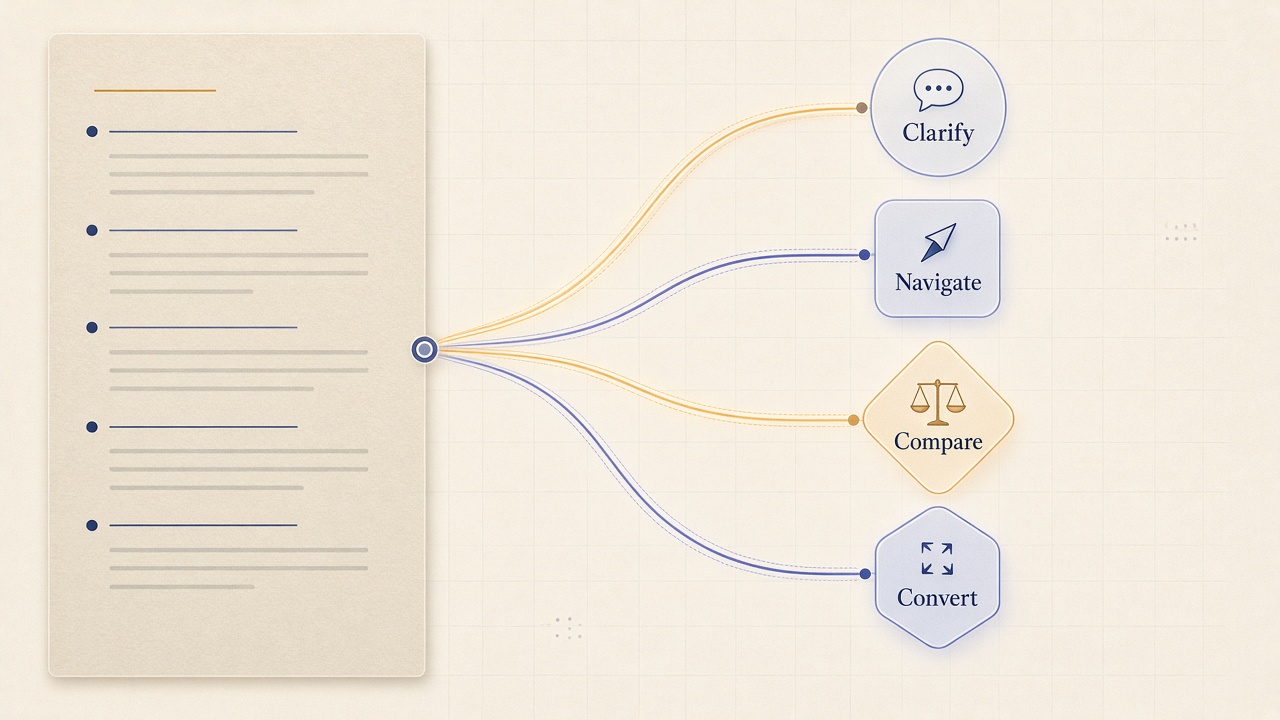
That system starts on paper, not in a script tag. Before you choose a model, a mid-article slot, or a sticky launcher, inventory what this URL is being asked to do. Ranked traffic is not one reader. It is a mix of jobs on a single page: someone wants a definition, someone is stuck on a troubleshooting step, someone is comparing options, and someone is already purchase-ready. Those are primary and secondary intents, and they belong to the URL—not to a sitewide “assistant” personality. Skip the inventory and the chat will guess. Guessing is how you recreate a siloed widget: answers that leave the article, UI that interrupts the read, and handoffs nobody can attribute.
Give every intent a job, not a personality
Each intent on the map gets one chat job. Definition should deepen understanding without restating the lede. Troubleshooting should jump the reader to the matching section or a grounded checklist already in the piece. Comparison should surface proof the article already earned—criteria, caveats, trade-offs—not a fresh product pitch. Purchase readiness should hand off to a monetized next step that still belongs to this page: a contextual offer, a lead magnet, a subscription path. The job is the contract. If a reply cannot name which job it is serving, it should not ship.
Then draw the fence. Allowed topics are the article’s knowledge plus the brand facts you will stand behind. Denied topics are everything else: off-article support tickets, account resets, claims the page never made, and any request that would force the model to invent. Hybrid setups work when the assistant is seeded from the same structured brief that produced the article, then constrained to that brief. The refusal is part of the product. A clean “this page doesn’t cover that—here is the section that does” keeps the session on-article. An eager helpdesk impression turns a ranking URL into an unstaffed ticket queue.
Turn the map into chips readers can actually use
A map that lives in a doc does not change how someone reads. Translate it into the three surfaces they touch: starter prompts, suggested chips, and escalation paths. Each chip should complete one job and then stop—deepen, jump, prove, or hand off—so the chat reduces pogo-sticking instead of opening a new dead end.
Escalation is where most embeds quietly fail. If the next step is “ask anything,” you have created a new search box on top of the one that already brought them here. Route leftover questions to a named section, a related URL you control, or a disclosed offer with a session-level hook. That is how intent routing becomes the first loop in the system—quality gates, trust-safe offers, and attribution only work if the assistant already knows which job it is in.
Intent map first — Inventory jobs per URL, assign each a chat job, fence allowed and denied topics, then express the map as chips and escalations so the embed routes readers instead of guessing.Quality Gates So Chat Strengthens E-E-A-T
Once that job is locked, quality gates decide whether the assistant is allowed to speak at all. Intent routing without those gates still lets a fluent model invent a second version of the page—wrong specs, orphan claims, a nameless voice. That split is how chat undermines E-E-A-T instead of extending it. The rule is simple: every reply must be retrievable, checkable against what the reader already sees, and attributable to the same expert who stands behind the article.
Retrieve from the live page, the brief, and the approved FAQ
Require retrieval from three locked sources: the live article body on this URL, the structured brief that produced it, and the approved FAQ set for that page. An open general model with a thin snippet of context is the wrong engine. The assistant should quote, paraphrase, and point back to passages the reader can scroll to—not synthesize a parallel article from the wider web. When verification is two screens away, extra time on the page is a trust signal rather than a confusion tax. Hybrid autoblogging plus chat stays on-brand only when both surfaces are seeded from the same brief, then kept in sync as that brief changes.
Do not launch until chat and page agree
Gate go-live on factual parity tests. Prices, specs, claims, and internal links in the thread must match the copy the reader can already see. If the article lists three seats and the model says five, the widget stays dark. Re-run the same checks whenever the article, the brief, or the offer language changes. Parity is a release criterion, not a leftover QA pass—because a ranking URL that contradicts its own assistant teaches both people and machines that the page is unstable.
Keep a name, a disclosure, and a way to correct the record
Conversational answers should reinforce experience and authority, not anonymize them. Disclose that the reader is talking to an assistant grounded in this article. Carry the author or entity into the thread—who stands behind the page, what they know, and how to reach a person. Give a visible correction path: flag the answer, request an editor, or jump to the cited section. Those cues keep expertise attached to a real publisher instead of a nameless model, which is the difference between chat that supports E-E-A-T and chat that launders it.
Auto-block when confidence, conflict, or risk shows up
Write hard stop rules before the first session. If retrieval confidence is low, if allowed sources conflict, or if the user asks for medical, legal, or financial directives the page cannot support, refuse, name the limit, and route back to a section or a human. Do not paper over uncertainty with a fluent guess. The same gate covers consent: collect only what the session needs, and never dress an offer as editorial advice. Once these gates hold, the interface can sit in the reading path as navigation rather than a floating interruption—because the answers are already safe to put in front of the reader.
Quality gates — Lock retrieval to the live article, structured brief, and approved FAQs; ship only after prices, specs, claims, and links match the page; disclose the assistant and the expert; and auto-block low-confidence, conflicting, or out-of-scope advice.
Place Chat in the Reading Path, Not Over It
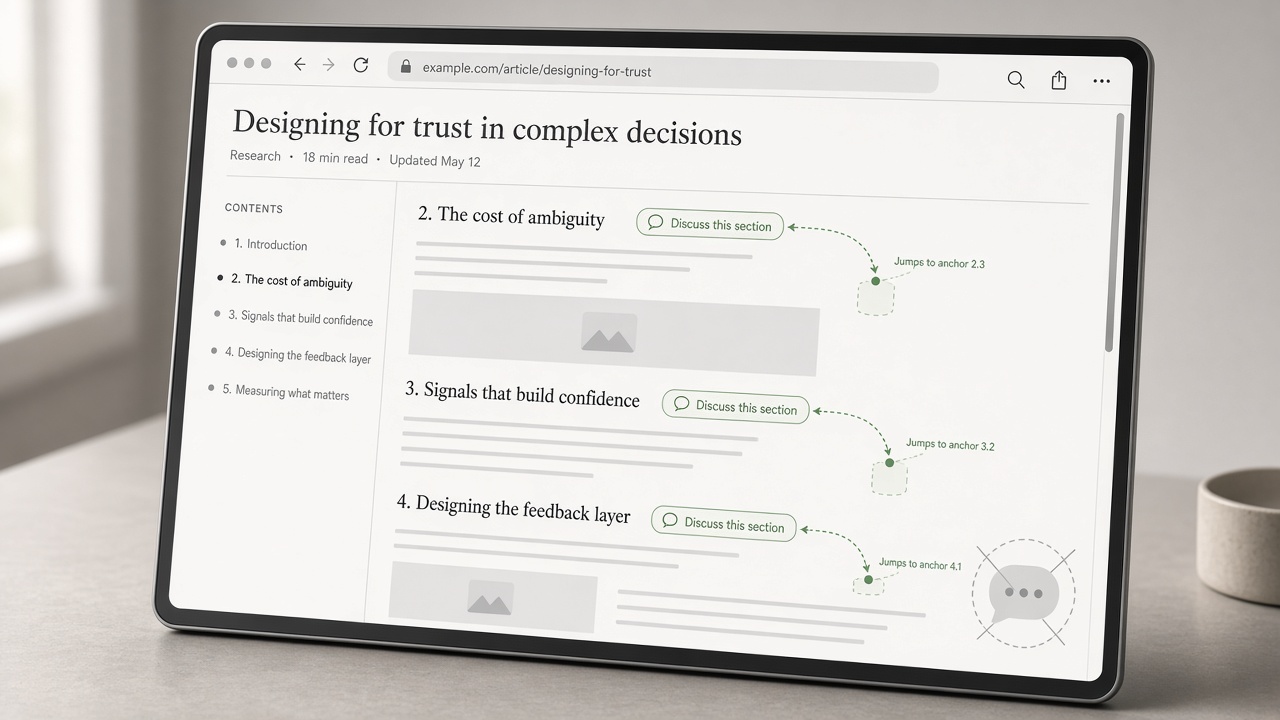
With answers already safe to show, placement becomes information architecture rather than damage control. The assistant should sit in the reading path the way a jump link does: close to the question it is allowed to answer. A section-anchored instance handles the local job—deepen a definition under that heading, surface proof next to the claim—without opening a generic thread that ignores where the reader already is. End-of-article chat is reserved for decision and next-step intents that only become honest after the argument is finished. One floating bubble that tries to do both is the interruptive widget again, wearing friendlier copy.
Anchor the assistant to the section it serves
Keep the mid-article instance in the same column and type scale as the prose. Prompt chips should echo the heading above them so a tap continues the scroll rather than abandoning it. The closing instance can be a little more spacious—still below the last proof block, still content-first—because its job is to route a formed intent: compare, choose, or move to the next URL. Do not seed both instances with the same open-ended “ask me anything.” That collapses the per-URL fences and turns navigation back into small talk.
Paint the article before you hydrate the thread
Prefer progressive load and deferred hydration. The body, headings, and primary call to action must win first paint; the chat runtime attaches after, or only when a chip is tapped or the end rail enters the viewport. Heavy third-party bubbles compete for Largest Contentful Paint and Interaction to Next Paint because they ship their own chrome, fonts, and network waterfalls. A native, content-first layout avoids that tax. If the reader never opens the thread, they should never have paid for it in layout shift or input delay.
Every useful reply is a deep link
Use the assistant to jump the reader to headings, comparison blocks, and proof sections that already exist on the page. “Where is the side-by-side?” should scroll to that block and highlight it, not restate the table in chat. That is a measurable navigation aid—a chat-assisted scroll path—not dwell invented by banter. Infinite small talk is the opposite: time on page that does not complete a path and cannot be attributed as qualified intent.
Do not steal the click you already earned
Protect the article’s primary CTA. Expanding docks, late iframes, and sticky orbs that cover a subscribe or product control create layout shift and competing clicks. Sticky chrome is allowed only when it improves path completion—typically a slim continue bar after the reader has already opened the thread—and it must recede the moment they resume reading. Done this way, local questions stay local, decisions happen at the close, and the next problem is how to put an offer in that thread without decaying trust.
In-flow placement — Section-anchored chat answers the local question; end-of-article chat handles decisions. Progressive load and deep-links protect Core Web Vitals and path completion; sticky UI only when it finishes a path the reader already started.
One Conversation Policy for Offers That Don't Decay Trust
Putting that offer in the thread is not a merchandising problem. It is a policy problem. Affiliates, trials, lead magnets, and owned products have to live under one conversation policy—the same voice, the same disclosure, the same right to decline—so the assistant never learns a sloppier register the moment money appears.
Separate tactics train spam. An ad insertion that fires mid-answer, an affiliate handler that pastes a tracking link on first mention, a subscribe prompt that cuts off a troubleshooting turn: each one tells the model that conversion is a different job from explanation. Readers feel the seam immediately. Search systems feel it later, when a page that ranked for depth starts behaving like a checkout overlay sitting on top of the article.
Diagnose, cite, then recommend
The policy enforces a value-first sequence on every commercial turn. The order does not change with the revenue type.
- Diagnose the need against the intent already mapped for this URL.
- Cite on-page proof the article already published—the spec, the comparison, the limitation.
- Recommend only after those two turns. A commission link never opens the exchange.
If the reader is still in a definition or troubleshooting job, the thread stays in deepen-or-jump mode and the offer waits for the decision surface at the close. Presentation is standardized so disclosure is not a mood. Affiliates, lead magnets, trials, and owned products wear the same sponsored label, sit in the same rec-card pattern, and—when the brief allows it—sit next to an equal-quality alternative the page already discussed. The alternative is not a legal fig leaf. It is how the assistant proves it is still answering the article, not auditioning for a merchant.
You can see the difference in a single thread. Slide between a first-message affiliate dump and a grounded, labeled rec that still lets the reader stay in the article.
On one side, the bolt-on widget treats the article as inventory and leads with the link. On the other, the offer is a late, labeled turn in a grounded conversation—optional, easy to decline, and still able to send the reader back to the section that justified it. That is the commercial difference between a conversion layer and a spam layer.
Cap density, ban urgency, log the why
Density is capped so the thread cannot become a catalog. One commercial recommendation per mapped job—or one per session unless the reader asks to compare more—is enough. Fake scarcity, countdown language, and “act now” pressure are banned outright. Every recommendation writes a rationale into the session log: which on-page claim it cited, which topic fence allowed the offer, and which alternative was shown. That log is what keeps sales lift from trading away rankings. It is also the raw material session-level attribution will need next.
If an offer cannot be labeled, sourced to the live page, and declined without breaking the answer, it does not belong in the thread.
One conversation policy — every commercial path uses the same value-first sequence, sponsored label, density cap, and logged rationale so sales lift cannot train spam or trade away trust.
Close the Loop: Attribution, GEO Signals, and Kill Criteria
That same standard belongs on measurement. A labeled, sourced, decline-safe offer is still a leak if you cannot say which session produced it, which heading the assistant pointed at, and whether the reader reached the proof the page already published. Attribution is not a dashboard you bolt on after launch. It is the last gate in the same loop: intent routing, quality, placement, and trust-safe offers only stay justified when session-level outcomes say they should.
Instrument the session, not the widget
Treat the conversation as a layer on this URL, not a separate product. Bind every chat event to the same session that loaded the article so you can see what changed after the first useful reply—not whether someone typed. Message volume is a vanity count. Path completion is the signal.
- Engaged time after the first meaningful reply, not time the panel simply sat open.
- Scroll depth to proof—comparison tables, specs, citations—the assistant actually deep-linked.
- Assisted conversions that finish after a recommendation, not clicks trapped inside the bubble.
- Revenue per engaged session, including the cost of refunds, unsubscribes, and support when you can see them.
- Exit reasons: answered, abandoned, offer declined, or handed off the page.
A short thread that lands the comparison section and a qualified next step is healthier than a long one that wanders and never returns to the host article.
Track GEO-relevant outcomes, not only blue-link SEO
Classic rankings still respond to completed reading paths. Generative engines respond to something adjacent: deeper unique explanations, FAQ coverage the page can stand behind, and brand-consistent answers that remain citable. Chat that restates the lede helps neither channel. Chat that unpacks the structured brief, fills gaps the article already owns, and stays on-entity is the GEO-relevant outcome—eligibility to be quoted in AI Overviews and other answer surfaces, not a spike in empty chatter. Native assistants seeded from that brief stay on-brand in a way generic widgets rarely do, which is the difference between a citation-worthy layer and a paraphrase machine.
Run small experiments against frozen thresholds
Change one variable at a time: section-anchored versus end-of-article placement, starter chips versus a blank composer, recommend-after-proof versus earlier monetization, grounded retrieval versus a looser prompt. Declare the win before you look—clearer path completion, Core Web Vitals intact, no rise in correction tickets, revenue per session that does not buy engagement with trust. A prettier variant that misses those bars does not ship.
Publish kill criteria before you scale
Permanent widgets rot. Write the shutdown rules in the same brief that launched the embed, and treat a trip as an operational stop, not a debate.
- Core Web Vitals regressions that placement or deferred hydration cannot absorb.
- Complaint or correction rate that quality gates fail to contain.
- Any hallucination on prices, specs, claims, or internal links.
- Negative revenue per session once refunds, unsubscribes, and support load are in the picture.
When a rule trips, pause the thread, leave the article up, and restore chat only after the loop is repaired. That is how in-article AI stays a system under control rather than décor that happens to talk.
Run this way, chat is no longer a bolt-on. It is the conversion and navigation layer this piece described from the start: routed by URL intent, gated for E-E-A-T, placed in the reading path, monetized under one conversation policy, and kept honest by attribution you are willing to kill. Readers came to understand the topic. The article—and the assistant sitting inside it—should remain the clearest next step on the page, or the loop should stop.
Closed-loop attribution — Instrument engaged path, GEO-citable depth, and revenue per session, and publish kill criteria so chat remains a system you can stop—not a permanent overlay.
Key Takeaways
Map one high-intent URL, wire this closed loop, and only then embed chat so the assistant and the article operate as one measured system.
Frequently Asked Questions
It can, when it keeps readers engaged with on-topic answers and clearer navigation. Search systems reward useful time on page and satisfaction signals; they do not reward a slow, off-topic, or undisclosed widget. Treat chat as part of the page’s helpfulness, not as a ranking trick.
Mid-article, end-of-article, and a restrained sticky control each serve a different moment: clarify a dense section, recap next steps, or stay available without covering the text. Test placement against interaction rate, scroll depth, and Core Web Vitals rather than copying a default bubble.
Offer only what the current question and article already support—contextual affiliates, a relevant lead magnet, a subscription, or a product that matches stated intent. Disclose commercial relationships, let the reader decline, and never let the assistant invent a recommendation the page cannot stand behind.
Collect only what you need, obtain consent where required, and tell readers they are talking to AI. Ground answers in the article and verified brand knowledge so you do not invent facts or medical, legal, or financial advice the site cannot own. Weak disclosure and hallucinated claims damage E-E-A-T faster than any dwell-time gain can repair.
A native assistant is trained on the structured brief, the live article, and brand rules, so it can navigate this page and stay on-voice. A generic widget answers from a broad corpus, cannot attribute the session cleanly, and often fights the article instead of completing it.
Track time on page, scroll depth, interaction rate, chat-attributed conversions, and revenue per session. Message count without those outcomes usually means curiosity, not value. Optimize the loop when answers fail quality gates or when offers appear without matching intent.
You Might Also Like