E-E-A-T for AI-Written Pages: What a Lean Publisher Must Show Before Publish

Readers searching for E-E-A-T SEO are usually trying to answer a practical question: can an automated publishing stack go live without looking like scaled filler? Google’s own guidance treats that as a quality and spam question, not a score you can dial in. Of the four aspects—experience, expertise, authoritativeness, and trustworthiness—trust is the one that matters most. Content does not have to show all four, but systems give more weight to strong E-E-A-T on YMYL topics that can affect health, financial stability, safety, or societal well-being. Using generative AI is not the violation. Publishing many pages that add nothing for the reader is scaled content abuse no matter how the pages were made, and Google says sites should keep that content out of Search. Models do not retrieve facts; they predict a likely sequence of words, so a fluent draft can still be wrong. Google’s generative AI guidance, updated 1 October 2026, is blunt: publishers must manually fact-check and review all AI-generated content for accuracy and trustworthiness before publishing—including titles, meta descriptions, structured data, and image alt text that can appear in results. The gate this article uses is a proof card, not a content score. Before an AI draft ships, a lean publisher needs a real person who can be named, a first-hand or original note the model could not invent, claims and metadata a human has checked, an honest account of how automation was used, and a hold or refusal when the operator cannot stand behind the page.
- E-E-A-T is not a ranking score; trust is the most important of the four aspects, and it weighs harder on YMYL topics.
- AI drafting is allowed; publishing many pages without added value is scaled content abuse regardless of how they were made.
- A human must fact-check the body and the metadata that can show in Search, because models predict words rather than retrieve facts.
- A real byline to a real person is encouraged; fabricated profiles are deception.
- The publish gate is proof: accountable human, original value, checked claims, honest disclosure, and a refuse-or-hold when you cannot stand behind the page.
What E-E-A-T Means in SEO — and Why It Is Not a Ranking Factor
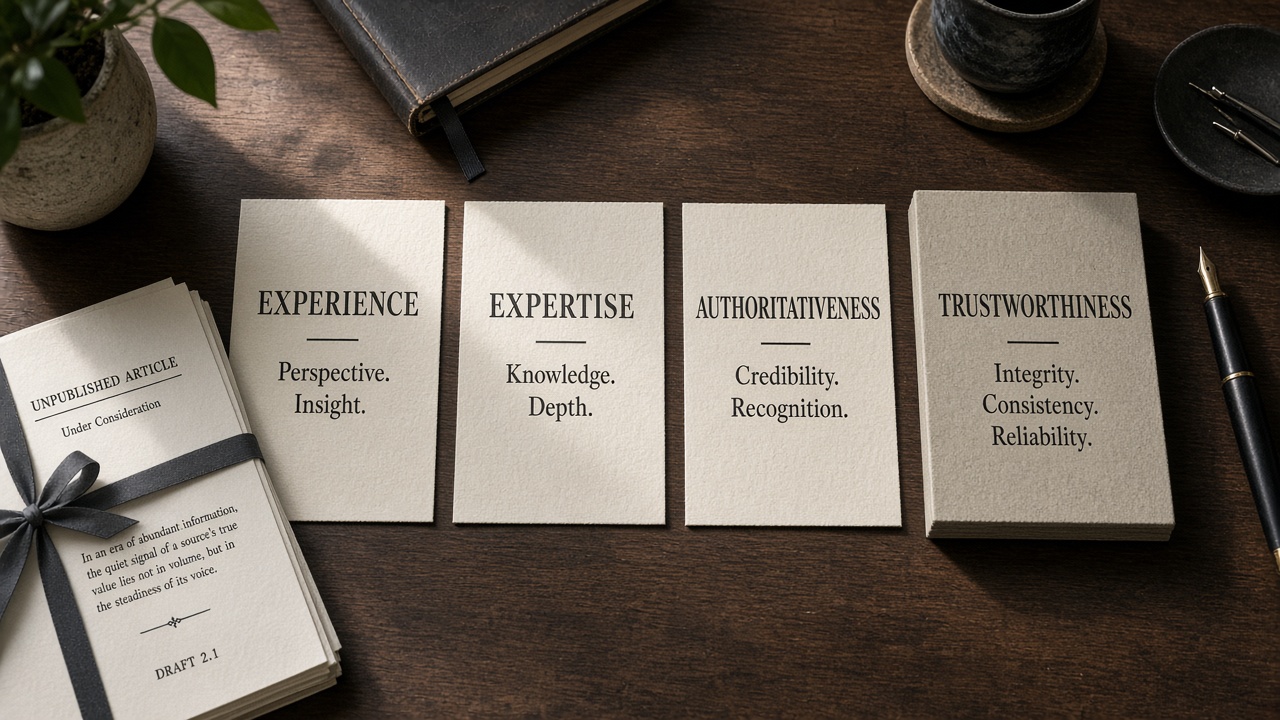
E-E-A-T means experience, expertise, authoritativeness, and trustworthiness. It is not a specific ranking factor. Systems may use a mix of signals that can identify content with good E-E-A-T, but there is no E-E-A-T score you can optimise into a rank.
Of the four, trust is the most important. A page does not have to demonstrate all four. What a reader needs is enough of the right signals to rely on the page for the decision it is asking them to make.
That bar is higher on YMYL topics — pages that can affect health, financial stability, safety, or societal well-being. Systems give more weight to strong E-E-A-T there than on topics where a weak page is unlikely to cause real harm. Hold that distinction: later sections apply it to the pre-publish check without restating it.
Experience is the newest letter. Google added it to E-A-T on 15 December 2022 so raters could look for actual use of a product, a visit, or something the person lived — not a badge a drafting tool can award after the page is generated.
For the source language, start with rater guideline sections 4.6.5 and 4.6.6. Those guidelines are used by search raters; they are not a guide to ranking first, and rater ratings do not directly influence ranking. A content score, an AI detector reading, or a side-by-side of two generated drafts is not E-E-A-T either. None of those outputs show first-hand experience, a named person who can stand behind the claims, or trust a reader can check.
Not a score — E-E-A-T is experience, expertise, authoritativeness, and trustworthiness, with trust first — not a ranking factor, a detector score, or a tool badge. Systems weight it harder on YMYL topics, and rater ratings do not set rank.
Five Proofs a Lean Publisher Must Show Before an AI Page Goes Live

An AI-written page may go live only when five proofs exist: a named accountable human, a first-hand or original note that person can stand behind, claims a human has checked, snippet fields included in that same check, and an honest account of how the page was made. Missing any one of them means the draft stays unpublished. Treat that set as a fail-closed proof card, downstream of whatever a generator scored. A content score, an AI detector, or a comparison of drafts is not a substitute for the card.
The card is what a reader can see, not only what lives in an internal log. The live page needs a byline that leads to a real person, the original note in the body, the sources that were actually checked, and a disclosure of how the page was made. A name that goes nowhere, an invented credential, or a note that exists only in a private file fails the card even if the draft reads cleanly.
This card is not the existing line-item gate. The companion checklist at /quality-checklist-for-ai-generated-seo-pages walks the operational items a lean team still has to tick; it does not replace the five proofs, and completing it without those proofs does not clear the page to publish.
Using a model to draft does not clear this card, and it is not the spam question taken up next. Citing sources does not replace the human check or the original note. If the operator cannot produce all five proofs, the right action is to keep the draft off the site.
Fail closed — A lean publisher publishes an AI-written page only when all five proofs are visible and true. One missing proof keeps the draft unpublished, regardless of how the page was generated or how well it scored.
Does Google Penalize AI Content, or Only Scaled Abuse?
The five proofs decide whether a page is ready. They do not answer a sharper question: does Google penalize AI-generated content? Spam policy answers that by what the pages are for and how many of them exist, not by whether a model drafted them.
Google’s spam policies describe scaled content abuse as many pages generated primarily to manipulate rankings rather than help users, and the rule applies no matter how the content is created. The first listed example is using generative AI tools to generate many pages without adding value for users, and Google says to exclude that content from Search. The generative AI guidance adds that this use may violate the scaled content abuse spam policy.
On a one-person autoblog, the risk is volume, a shared template, and no original effort on each URL. A model in the workflow is not what makes the pattern abusive. Run a simple test before you publish: if you turned the automation off and the page would still be a mass rewrite of what a reader can already find, do not publish that URL. Do not look for a way to keep thin pages indexed while hiding how they were made. Exclude them from Search, rewrite them so they carry real added value you can stand behind, or do not create them.
The line — AI drafting is not the spam violation. Many pages with little or no user value can be scaled content abuse however they were made, and the remedy is to exclude them, rewrite them with real added value, or not create them.
Why AI Output Must Be Fact-Checked by Hand

Clearing the abuse test still does not make a draft publishable. Google’s generative AI content guidance, last updated 1 October 2026, says a human must manually fact-check and review all AI-generated content for accuracy and trustworthiness before publishing. Generative models do not retrieve facts. They predict a likely sequence of words, so a fluent page can still hallucinate.
That review is not a detector score and not another generation pass. It is the operator reading what will actually go live and refusing anything they cannot defend.
Does the fact-check cover titles, meta descriptions, schema, and alt text?
Yes. The required review also covers metadata that can appear in Search: title elements, meta descriptions, structured data, and image alt text. A searcher can meet a wrong claim in a result or an image label without ever opening the article.
Work in this order so the visible layer is not left to the model:
- Claims in the body, including numbers, names, and causal statements.
- The title and meta description a searcher would see.
- Schema fields that restate those claims in structured data.
- Image alt text, checked against what is actually in the image.
A correct article still fails if the title invents a statistic, schema asserts something the page does not support, or alt text describes something that is not in the image. Any one of those is an unchecked claim in a place Search can show.
Hold the URL — Models predict words; they do not retrieve facts. If the body, title, meta description, schema, or alt text has not been checked by a human who can stand behind it, the page is not ready to publish.
What Counts as Little Effort, and How Do You Show Experience You Did Not Live?

A careful fact-check is necessary, and it is still not enough. Little-to-no effort includes using generative AI to produce large amounts of text without manual oversight or curation. Attribution, or a source list under the draft, does not replace original effort.
People-first content should clearly demonstrate first-hand expertise and a depth of knowledge, such as having used a product or visited a place. That is the bar for originality, not a longer paraphrase of pages already on the web.
If you did not live the event, do not invent a test, a visit, or a result. The minimum proof is a real check you performed, a limitation you state plainly, or a hold until someone who did the thing can add the note. Fabricated experience is banned, even when the surrounding claims were checked.
What does not count as original effort
- Swapping synonyms on a generated draft
- Adding more citations to a summary you did not originate
- Padding a commodity listicle so it looks longer or more complete
None of those moves is oversight, and none of them is first-hand expertise. For how to write an extractable answer that still carries human proof, use /how-to-add-citation-ready-answers-without-keyword-stuffing as the writing companion — not as a substitute for the originality test on this page.
Minimum proof — Little effort is mass AI text without manual oversight or curation. A source list does not replace original effort, and experience you did not live must be a real check, a stated limitation, or a hold — never an invented test, visit, or result.
Are Fake Author Profiles a Problem If the Article Is Accurate?

That same line—do not invent a life you did not live—applies to the person named on the page. Yes. A correct article does not make a fake author acceptable. Fabricating creator profiles, such as AI-generated headshots, made-up names, or false credentials used so the page looks as if a human expert wrote it, is deception. It is a low-quality signal to readers and to automated quality systems even when the body facts check out.
Google strongly encourages accurate authorship information, such as bylines where readers would expect them. A real byline should lead to a real person, not a persona invented to fill an author slot.
What an author page must prove
Skip the bio template. The page has to show a person the publisher can identify, only credentials that person can stand behind, and a visible path from the article byline to that page. Name that same person consistently on the article and the site. The note at /entity-seo-for-publishers-what-to-name-on-the-page is only for that consistent naming of the real person and the site, not a fill-in author biography.
What must stay human
- The name
- The photo
- The credentials
- The accountability
Automation may draft the article. It may not invent the author. Block publish when the byline is a persona, a stock identity, or a credential the operator cannot verify. If you cannot stand behind the person on the page, the page is not ready.
Hold the byline — An accurate article still fails if the author is fabricated. The name, photo, credentials, and accountability stay human, and publish stays blocked until the byline leads to a person you can identify and stand behind.
When a Topic Is Too Sensitive or YMYL to Autoblog — and Whether to Disclose AI

That accountability has a hard stop. If a wrong page could affect health, money, safety, or society, and no qualified human can stand behind every claim, the autoblog does not publish it. Systems already give YMYL topics heavier weight; this is the operational rule that follows, not a fresh argument about whether E-E-A-T is a ranking factor.
Health, financial stability, safety, and societal well-being are the stakes that trigger it. A general explainer the operator has personally checked can be held until that check is finished rather than refused outright. Advice that tells a reader what to do with their health, money, or safety cannot ride on an unreviewed draft.
Should you disclose that automation or AI was used?
Yes. Share how the page was created, including background on how automation was used. Google encourages that transparency.
Disclosure does not replace the fact-check, the real byline, or the decision to refuse a topic the operator cannot stand behind. A line a reader can find without hunting is enough — place it under the byline or in a short note at the end of the article: “A named editor reviewed this page. Automation helped draft it; claims and metadata were checked by hand before publish.”
The line — If no qualified person can stand behind a YMYL claim, do not publish it. Saying AI was used never substitutes for that check, that byline, or that refusal.
Does E-E-A-T Affect AI Overviews and Citations — and What Should the Gate Refuse, Hold, or Delete?

Citation in an AI Overview is not a separate scoring system and not a reason to lower the bar. The question is still whether the page carries a viewpoint a named person can stand behind.
Google's guide to generative AI features draws that line directly: a first-hand review is a unique viewpoint, while a summary of existing content restates what is already available, and commodity listicles add little unique insight. That viewpoint is the original note on the five-proof card, not a new score and not a reason to invent a test the operator never ran.
This gate does not re-teach extractable-answer writing. How a page survives AI Overviews, what still matters when answer engines differ from classic SEO, and how to add citation-ready answers without keyword stuffing are the adjacent hubs: /how-to-write-seo-articles-that-survive-ai-overviews, /aeo-vs-seo-whats-different-and-what-still-matters, and /how-to-add-citation-ready-answers-without-keyword-stuffing. Use those for the writing. Use the actions below for the publish decision.
What the publish gate should refuse, hold, or delete
| Action | Use it when | Proof it enforces |
|---|---|---|
| Refuse | Fake authorship, invented experience, or a YMYL or sensitive topic the operator cannot stand behind | Named accountable human, a note they can stand behind, and the refuse rule |
| Hold | Missing fact-check; unchecked title, meta description, schema, or alt text; or no original note | Checked claims, snippet fields in that check, and the first-hand or original note |
| Delete or exclude from Search | Pages already live that are scaled, valueless, or published without the proof | All five proofs, including an honest how-it-was-made disclosure if the page can be repaired |
Each action is a decision against those five proofs, not a new theory. Refuse what no named human can own. Hold what is not yet checked or still lacks an original note. If a live page cannot be brought up to that standard, exclude it from Search rather than leaving a valueless URL in the index.
Disclosure, a real byline, and a qualified hold still sit inside that same close. An AI-written page is ready only when a named human can show the note, the checked claims and metadata, and an honest account of how it was made — or when the gate has already refused or removed it.
The close — The proof that makes a page worth citing in AI Overviews is the same five-proof bar: refuse what you cannot stand behind, hold what is unchecked, and exclude live pages that never earned it.
Key Takeaways
Run the next AI draft through the five-proof card and the companion quality checklist before it is allowed to publish.
Frequently Asked Questions
You Might Also Like
- Governance Publishing Governance Checklist Before an Automated Article Goes Live
- Workflows Fact-Check Workflow for AI SEO Drafts
- Guides Quality Checklist for AI-Generated SEO Pages
- Governance AI Content Governance Policy: A One-Page Rule Set for Lean Teams
- AI Search AI Overview Optimization: How to Structure Pages Google Can Quote