Content Ops Metrics That Survive a One-Person Review

Content ops metrics measure the machine that produces the work, not the traffic, leads, or revenue that work might later earn. If one person still holds approve, edit, or kill, a metric is worth keeping only when you can log it on the draft before you close the tab.
That filter is stricter than a team dashboard. Lead time—days from an approved brief to publication—usually shows whether review, not drafting, is the wait. First-pass or hold, revision rounds, and a small fact-check sample fit the same sitting. Share of pages with clicks, content-attributed revenue, and an autonomy rate with zero human intervention do not. Those belong on a later sheet.
Faster drafting does not raise publish capacity if the single review slot is already full. In Orbit Media’s 2026 survey of 1,042 marketers, average writing time fell to 3 hours 20 minutes and 92.4% used AI for blogging, yet only 13.9% reported strong results—and AI use correlated with nothing. Count elapsed production and a quality floor, not hours saved in the draft.
- Content ops metrics track the production machine; traffic, leads, and revenue are marketing outcomes.
- A one-person review survives only if each number is countable from the draft log in one sitting.
- Lead time, first-pass, revision rounds, and edit ratio are the operating set; autonomy rate and attributed revenue can wait.
- Volume without a quality floor is vanity: widespread AI use has not tracked with strong results.
- Keep the review small and fixed, and fix one bottleneck at a time.
Content Ops Metrics vs. Content Marketing Metrics
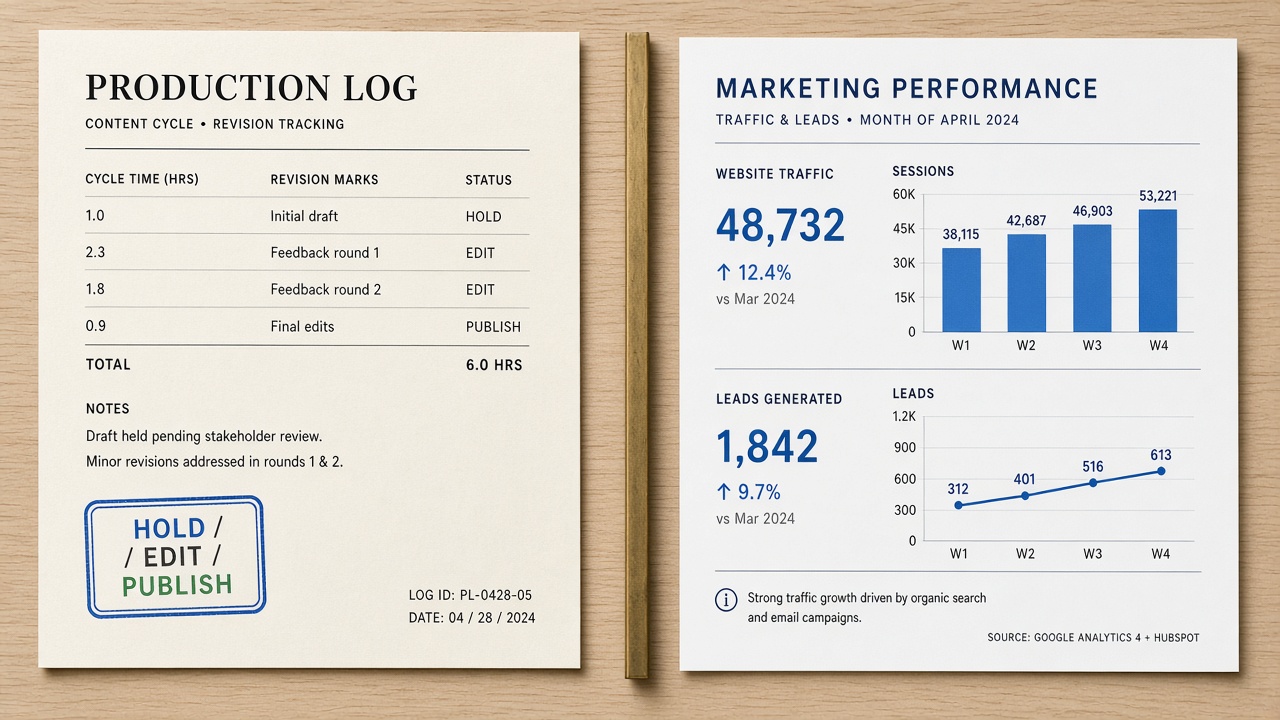
The first filter is the split. Content ops metrics measure the production machine. Content marketing metrics measure traffic and leads. Outcomes belong on a later sheet, not in the review pass.
The machine is lead time, throughput, on-time rate, and revision rounds. It excludes sessions, leads, revenue, and citation share. If you need the outcome scorecard, use the existing SEO ROI article—do not rebuild it here.
When throughput becomes a vanity metric
Throughput becomes a vanity metric when volume has no quality floor. Faster drafts are not a healthier line.
Orbit Media's 2026 survey found the average content marketer spends 50 fewer hours writing than in 2022, while the share reporting strong results fell from 26% to 14%. Treat that speed-up as a warning, not a target.
Keep the sheets apart — Count the production machine in the review pass, and leave traffic, leads, and revenue for a later sheet. Volume without a quality floor is not a healthier line.
AI Use vs Strong Blog Results
Which content ops metrics can one person log without a dashboard?
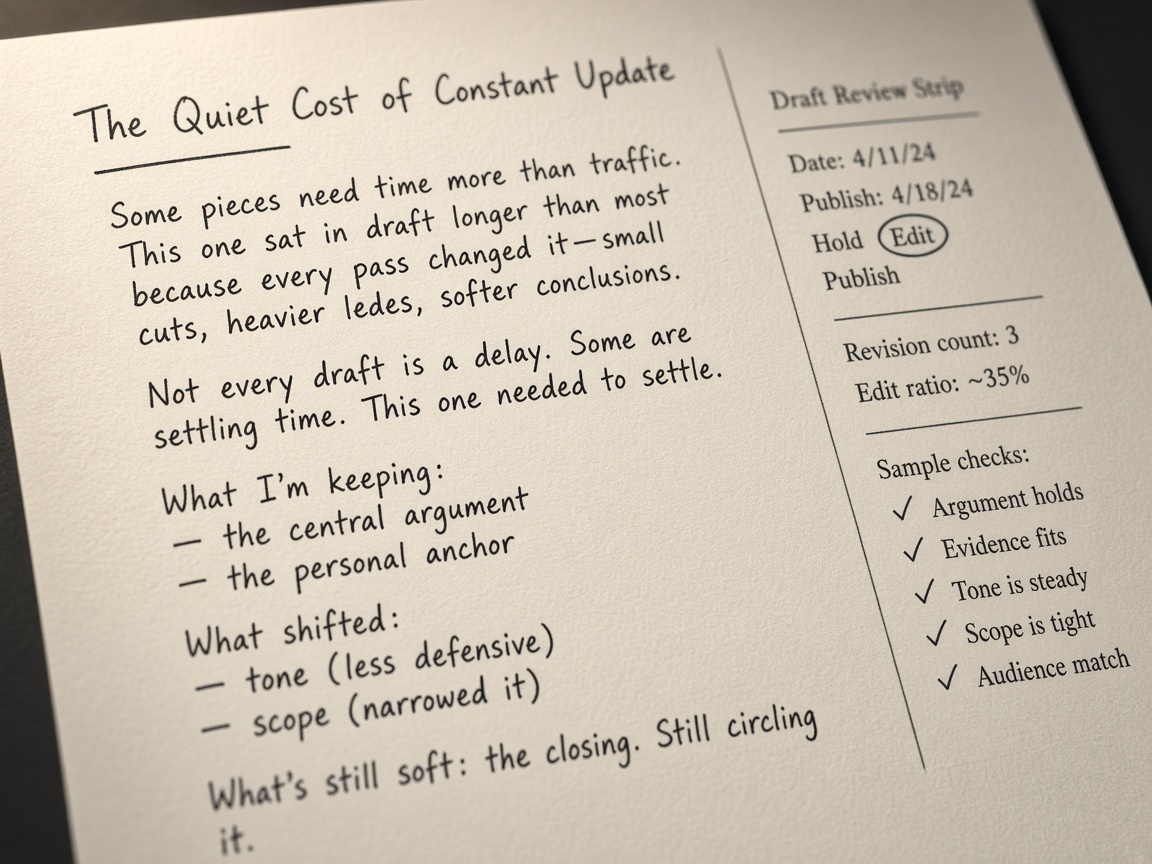
Log only what the open draft already shows. A solo reviewer does not need a dashboard or a BI tool to record lead time, whether the piece shipped on time, and how many revision rounds it took.
Sorank’s content-ops set is lead time, throughput, on-time rate, cost per article, revision rounds, update rate, and the share of pages with Search Console clicks. Keep cost and traffic share off this pass. Lead time—days from approved brief to publication—is the field that usually exposes the review bottleneck. Throughput and update rate can wait until the same log has enough rows to mean anything.
What fields belong on a one-pass review log
Fill these before the tab closes, from the draft and the brief only:
- Approved-brief date and publish or hold date
- Hold, Edit, or Publish decision
- Revision count and edit ratio
- A five-claim fact-sample result
- One blocker note
If a field cannot be filled from the draft and the brief, it does not belong on the log. This sheet feeds the monthly review. It does not replace a monthly KPI article or an autoblogging one-pager.
One sitting — A one-person content ops metric is whatever you can count from the open draft and the brief before the tab closes—lead time, on-time or hold, and revision rounds—not cost or Search Console share.
What cycle time is realistic for a solo automated publisher?
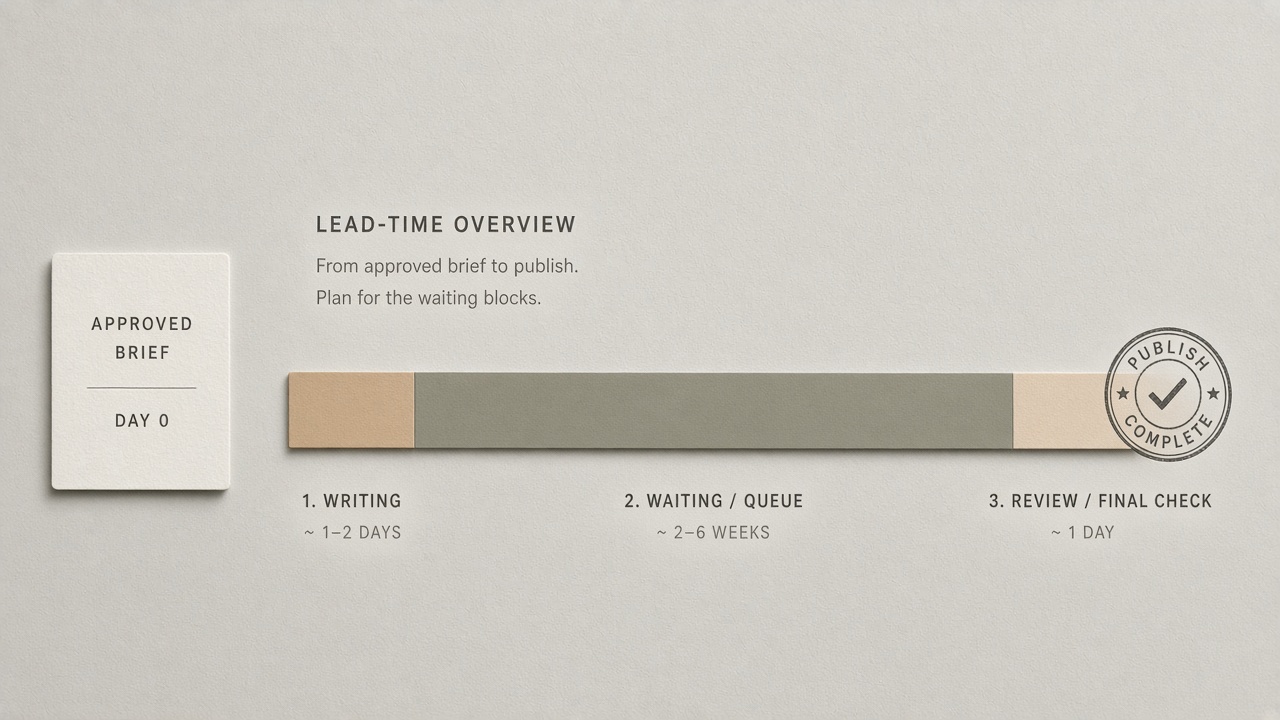
Those dates already sit on the draft log. For one person, a realistic cycle is a median of 3–5 days: 1–3 posts a week, 1–2 substantive refreshes, a quality composite of 80+, and an edit ratio under 35%. That is a published solo band, not a survey. Outcome KPIs stay weighted lower because attribution is noisy on a small catalog.
Cycle time above 14 days is a structural problem, not a headcount excuse. A single quality grade collapses within two quarters, so cycle time cannot stand in for a score.
Publish capacity is the smallest stage limit
Cutting draft hours does not raise finished output if the only review slot is full, so track elapsed lead time apart from touch time. Three hours 20 minutes to write a post in 2026, down from a 4 hour 10 minute peak in 2022, is touch time—not lead time.
On the log, waiting is the gap and writing is the touch. Stamp four moments:
- Brief-approved date
- First draft done
- Review started
- Decision recorded
Separate the clocks — A 3–5 day median is the realistic solo cycle; writing hours are only touch time, and a full review slot—not slow drafting—is what caps finished output.
How Do You Score First-Pass Quality When You Are the Only Reviewer?

The decision you record on that draft is the first-pass score. Publish with no substantive rewrite is a pass. You do not invent a second reviewer.
Do not treat a feeling as the grade. Among marketers using AI for content creation, 58% said quality improved and 12% said it decreased. Those are self-reported, not measured production gains, alongside 95% organizational use of AI-powered applications.
What edit ratio means the brief failed, not the draft?
If most of the change supplies an angle, audience, or sources the brief never named, the brief failed. If the brief was complete and the draft ignored it, the draft failed. Word-tweak versus substance is the test. Send brief failures back to intake, not into a rewrite score.
How the mark connects to hold, edit, or publish
The ops metric is the Hold, Edit, or Publish mark itself. Follow the existing one-pass approval article for the fail-closed rule; do not rewrite that workflow here. Silence is not a pass. Hold and Edit are scores, not delays to hide. A pass rate that never holds anything is not quality.
The mark — A solo first-pass score is the Hold, Edit, or Publish mark on that draft. Brief failures go back to intake, and a pass rate that never holds is not quality.
How Often Should a One-Person Stack Review Content Ops Metrics?

A recorded Publish, Hold, or Edit only pays off on a fixed cadence, not a live dashboard. Lean practice is one visible workflow and one weekly review of about 30 minutes: what shipped, what is blocked, and what still needs a decision.
Where update rate and content decay belong
Update rate is refreshes of live URLs, not extra new-post throughput. Content decay is the reason for the refresh—stale claims, or a brief that no longer matches the page—not a separate vanity chart. If nothing decayed and nothing was refreshed, write zero.
Cadence — Keep the weekly sitting to five operating numbers in about 30 minutes, put update rate on the monthly line (zero if nothing moved), and use the quarterly look only to fix one bottleneck.
Why Team Averages Are a Bad Benchmark for a Solo Operator

Team ranges assume a separate reviewer with spare capacity. You are the publisher and the only approver, so those clocks are not your SLA.
Refuse the published healthy band as your scorecard: 5–10 business days to publish, a first-submission pass rate above 60%, revision cycles under 2, utilization above 85%, review turnaround under 48 hours, and quality above 75 with no dimension below 60. Under-48-hour review and a multi-day team publish window cannot both be your targets.
Org maturity is the wrong yardstick too. Content Science’s 2025 study of more than 100 content leaders found 61% of organizations at content-ops levels 2 or 3, only 5% at level 1, and a quarter at level 4. Thirty percent call themselves very or extremely successful, and 80% of the extremely successful operate at levels 4 and 5. That is a multi-person study, not a solo score.
What to refuse until the catalog is large enough
- Autonomy rate with zero human intervention
- Content-attributed revenue
- Citation-share lift
Send those to the later ROI sheet. Two posts a week can be above a solo expectation and under a five-person pod—do not average them. Keep approve, edit, or kill with a named human even after the catalog grows.
Wrong yardstick — A solo operator does not inherit team SLAs or maturity scores. Keep log-countable ops numbers, and leave autonomy, attributed revenue, and citation-share lift off the sheet until the catalog can carry them—with a named human still holding approve, edit, or kill.
How to Sample Fact-Check Quality Without Auditing Every Post
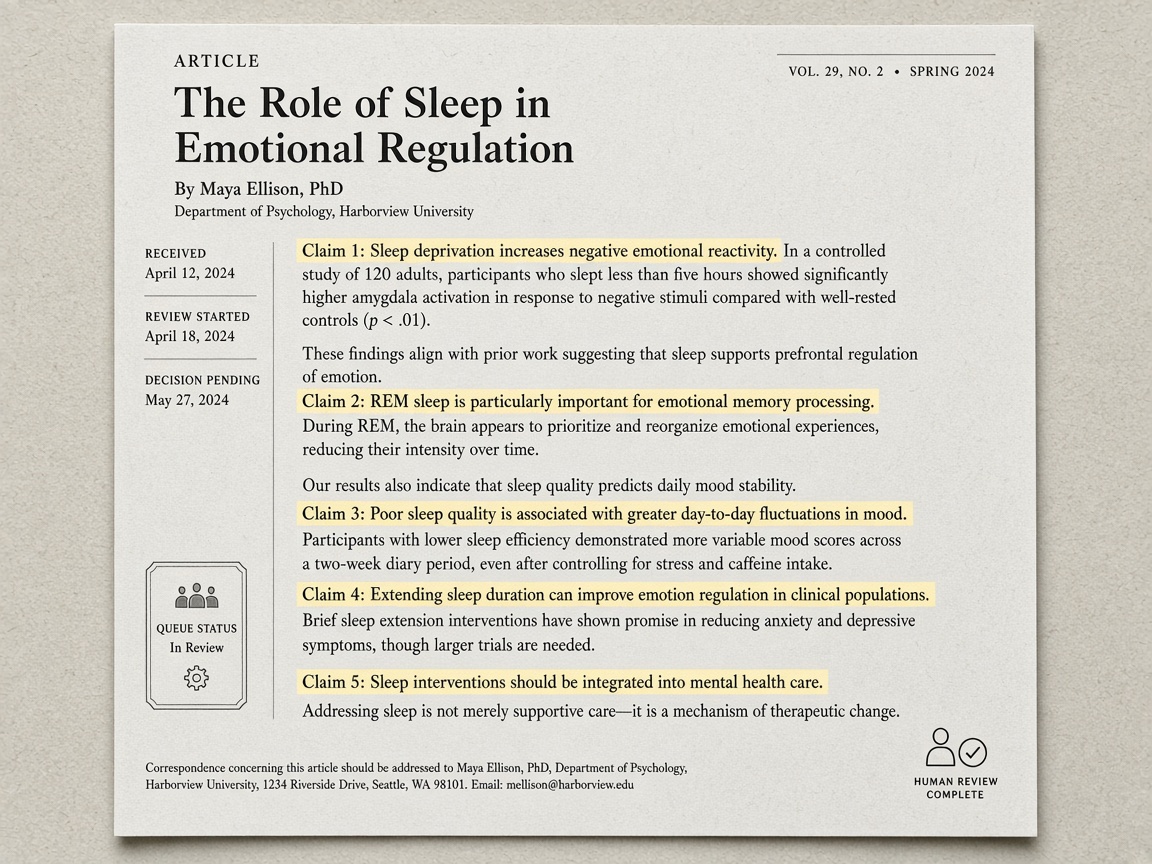
That named decision still has to be made, but it does not require auditing every post. Use a rolling sample, not a full audit.
The published design is five posts a week, four sub-scores, averaged over four weeks. Quote that as the sampling design, not your shipping quota. A solo catalog often ships only one to three posts a week, so keep the logic—rolling, multi-score, not every sentence—and size the denominator to posts that actually shipped. On the draft in front of you, check five claims and log pass or fail.
What should stay automated, and what you still score
Automate timestamps, brief-to-publish dates, word counts, and queue status. A named human must still score Hold, Edit, or Publish, the fact sample, and whether the brief failed. Never automate the kill.
AI adoption is not a quality system. In that study, 86% reported using AI in some capacity, but only 29% reported moderate or fast progress scaling that adoption. Even a team of two needs a written workflow and a named approver, with only one person Accountable per task. On a one-person stack, that person is you.
Sample, don't audit — Score five claims on the open draft, average a rolling sample against posts you actually shipped, and keep Hold, Edit, Publish, and kill with one named human.
Key Takeaways
Open this week’s draft log, score only the five numbers you can count in one sitting, and leave outcome metrics off the sheet until the catalog can support them.