Content Publishing
Content Automation Strategies for Consistent Publishing

Maintaining a consistent publishing schedule can feel like an endless uphill battle. Between keyword research, drafting, editing, SEO optimization, and distribution, content creation teams often find themselves stretched thin, sacrificing quality just to meet a deadline. Fortunately, content automation is no longer about spinning out low-quality filler text; it is about building reliable, end-to-end pipelines that let you scale your output while elevating your standards.
According to recent industry data, organizations typically experience initial efficiency gains and time savings within two to four weeks of implementing automation, with measurable business ROI following within three to six months. Even simple integrations make a massive difference, as enterprise AI chat assistants save users an average of two to three hours per user per week. By automating the mechanical aspects of SEO and publishing, your team is freed up to focus on strategy, unique insights, and brand voice.
In this guide, we will break down the exact strategies and workflows you need to build a high-performing, automated content engine. Let's start by looking at how modern automation tools are reshaping the publishing landscape.
TL;DR
- Content automation streamlines scheduling, formatting, and distribution to scale output without increasing team size.
- Teams typically see initial efficiency gains within two to four weeks and measurable ROI in three to six months.
- Modern workflows combine multi-agent AI systems for deep research and optimization with human oversight for brand consistency.
- Transitioning to automated pipelines allows brands to maintain high-quality SEO standards on a highly consistent schedule.
Breaking the Content Bottleneck: The Real Value of Automation

Every content team knows the feeling of being bogged down by administrative drag. Formatting drafts, manually hunting for internal links, uploading to CMSs, and managing metadata eat up hours of creative energy. When writers and editors spend more time wrestling with spreadsheets than refining ideas, publishing consistency collapses.
This is where content automation changes the game. By handing off these highly repetitive, administrative steps to software, you instantly free up your team’s mental bandwidth. Instead of acting as manual uploaders, your content managers transition into strategic directors. They can focus on what AI cannot replicate: deep-dive user research, original subject-matter expert interviews, and brand voice alignment.
Maintaining Brand Standards at Scale
Scaling up output shouldn't mean diluting your quality. Automation ensures that every piece of content meets your exact standards for formatting, structure, and basic SEO before it ever reaches a human editor. It acts as an automated quality-assurance gate, keeping the brand voice consistent across dozens of published pages.
This shift is driven by a fundamental change in the industry. SEO content automation tools in 2026 focus on end-to-end workflows combining AI writing, distribution automation, and performance optimization. It turns publishing from a stressful weekly scramble into an organized, predictable asset engine. But to unlock these gains, you need a blueprint. Let's look at how to wire these tools together into a seamless workflow.
Reclaim your bandwidth — Content automation eliminates administrative drag, allowing editorial teams to shift their focus from formatting to high-level strategy and quality control.
Designing the Pipeline: How to Map and Connect Your Automation Workflow
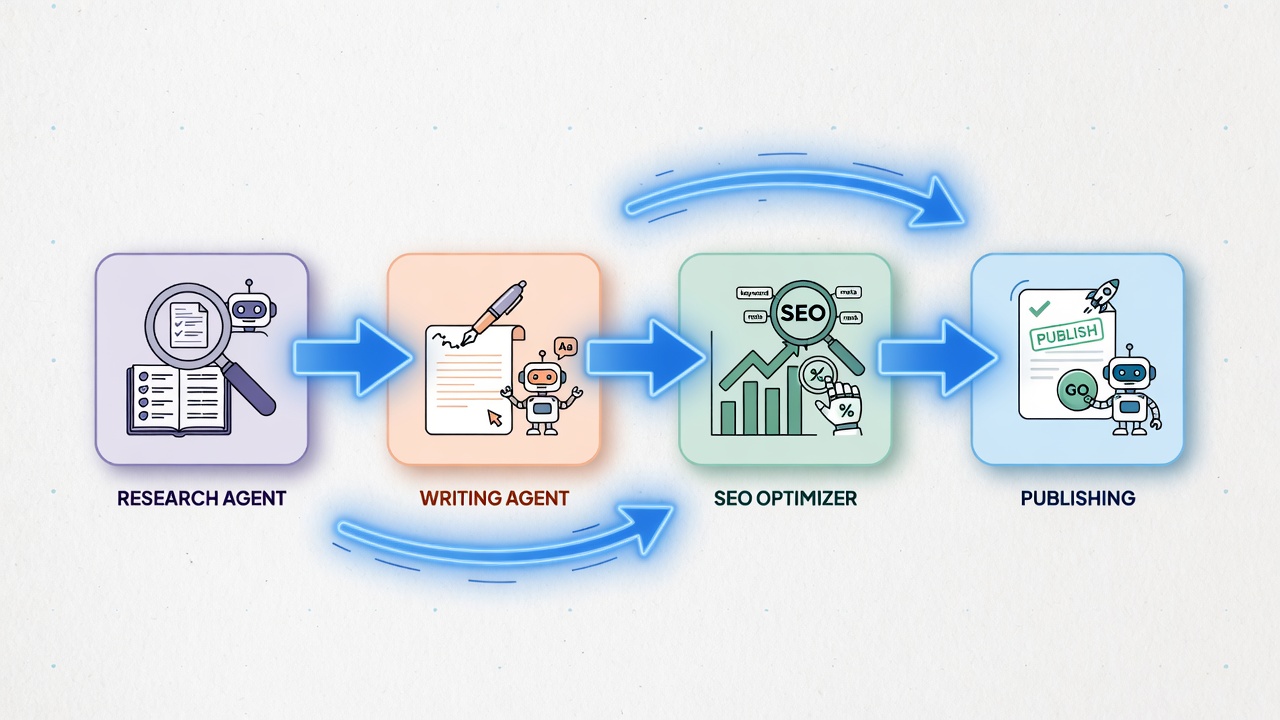
Building an automated system doesn't mean replacing your brain; it means defining your steps so clearly that software can execute them without human friction. To do this, you must map your entire content lifecycle—from the initial spark of keyword research to the final click of the publish button. When you visualize this process as a pipeline rather than isolated tasks, you can identify exactly where manual handoffs cause delays.
The magic happens when these tools talk to each other seamlessly. Instead of manually exporting a keyword list, pasting it into a writer, and then copying the draft into your CMS, a connected pipeline handles the heavy lifting. By integrating these systems, a new keyword automatically triggers a research brief, which then feeds directly into your AI generator without human intervention.
However, automation should never mean blind publishing. The most effective workflows use the draft status as a mandatory quality gate. Saving generated articles as drafts allows editors to step in at the perfect moment to inject brand voice, verify facts, and optimize for SEO before anything goes live. This balance ensures high output without sacrificing the trust of your readers.
With your pipeline mapped and safeguards in place, the next step is to look at how to make the generation process itself more intelligent. To move past simple templates, we need systems that can think, research, and optimize like specialized team members.
A connected pipeline with human checkpoints balances speed and quality by automating repetitive transfers while keeping editors in control of the final draft.
The Power of Multi-Agent AI: Orchestrating Specialized Workflows

Instead of asking a single AI tool to write an entire article from a single, broad prompt—which often results in generic, surface-level content—we can assign distinct, specialized roles to different AI agents. Think of this approach as building a virtual editorial team, where each agent is highly optimized for a specific stage of the publishing cycle:
- The Researcher Agent: Scours current web data, validates sources, and extracts key facts to build a reliable foundation.
- The Writer Agent: Translates the research brief into a cohesive, engaging narrative aligned with your brand's unique voice.
- The Optimizer Agent: Evaluates the draft against search intent, ensuring natural SEO integration without keyword stuffing.
This collaborative approach is why multi-agent setups consistently outperform single-tool setups. When agents can challenge and refine each other's work, the final draft is far more accurate, nuanced, and structurally sound. Industry trends heavily reflect this shift: 45% of organizations identify multi-agent systems as the generative AI development they are most interested in, and those leading in agentic AI achieve five times the revenue gains of laggards.
Beyond internal efficiencies, multi-agent systems enable richer reader experiences. Because the underlying research is so thorough, the content naturally answers complex user queries. Furthermore, this rich data layer allows platforms like Flows to render interactive elements—such as in-article AI chats—that let readers query the text, explore related concepts, or navigate complex topics in real time. With a multi-agent system handling the heavy lifting of creation and optimization, the next logical step is to measure the tangible impact of these workflows on your bottom line.
Multi-agent orchestration — Moving from single-prompt generation to specialized, collaborative AI agents dramatically improves content depth, resulting in significantly higher revenue performance.
The Math of Automation: Quantifying Time Savings and Real ROI
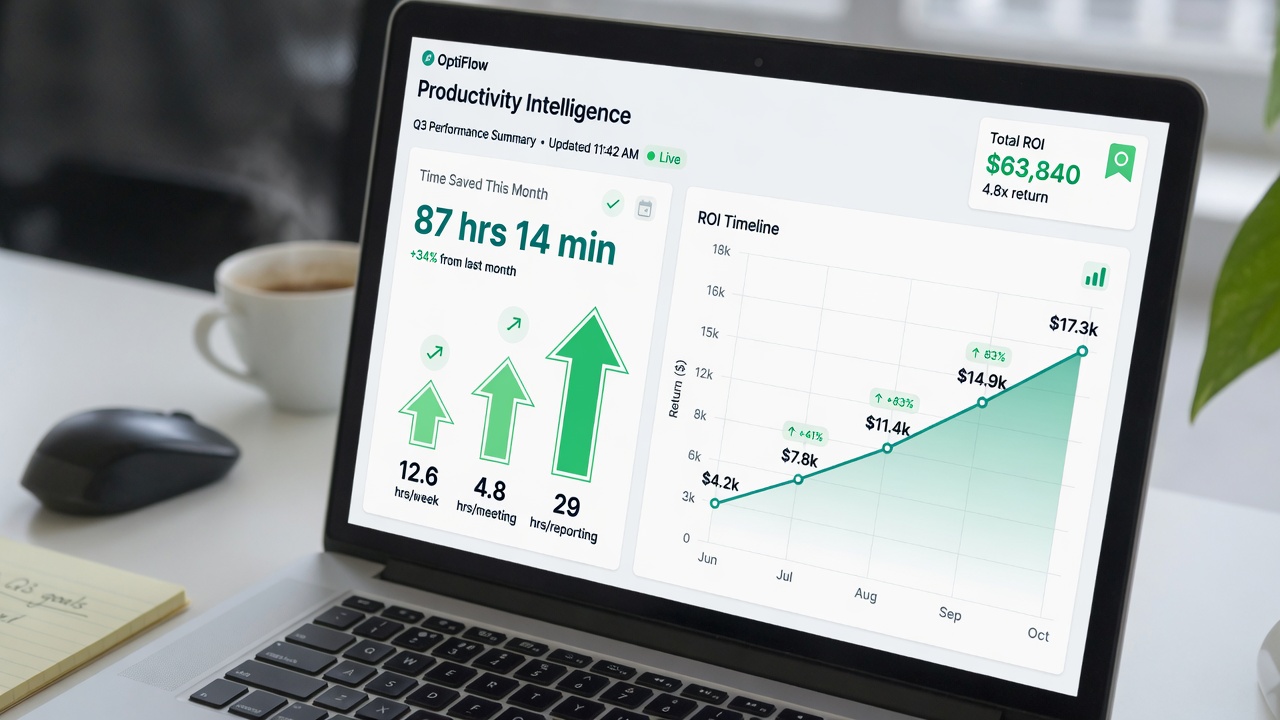
Transitioning to an automated pipeline eliminates the repetitive tasks that traditionally stall production, such as manual content formatting, initial research collection, and draft distribution. This rapid shift produces noticeable operational changes within the first month.
To understand the micro-impact on your team, look at individual workloads. For instance, enterprise AI chat assistants save users an average of two to three hours per user per week. When you look at more integrated, AI-assisted development and creation environments, teams report even larger gains, saving over eight hours per user per week. For a lean content team of five, that is equivalent to reclaiming an entire full-time employee's weekly capacity, allowing your creatives to focus on high-level strategy and brand voice.
Over the longer term, these reclaimed hours translate directly into business growth. While the immediate operational time savings show up within the first month, a measurable business ROI typically materializes within three to six months. By scaling up high-quality, SEO-optimized content production without expanding your payroll, you lower your customer acquisition cost (CAC) and accelerate your organic traffic growth. But achieving these numbers isn't just about deploying tools; it requires setting up sustainable guardrails to keep your automated pipeline running smoothly over the long haul.
Quantify early and often — Track initial efficiency gains within the first month, then leverage reclaimed hours to drive long-term organic revenue and lower customer acquisition costs.
How to Keep Your Automation Engine Running Smoothly

Establishing those guardrails means treating automation as an evolving practice rather than a set-it-and-forget-it software installation. To build a system that lasts, you need a strategic approach to scaling.
Start Small and Scale Intentionally
The most successful strategies start with narrow pilots. Instead of automating your entire editorial calendar overnight, begin by automating a single step, like keyword clustering or brief generation. Once you have ironed out the kinks and proved the value of that single workflow, you can confidently expand the automation to handle research, optimization, and drafting.
Maintain the Human-in-the-Loop Standard
Even with highly sophisticated multi-agent pipelines, human oversight is your ultimate quality filter. Keep a human editor at the draft stage to inject real-world experience, refine the tone of voice, and ensure strict editorial standards. AI accelerates the writing, but humans ensure the content truly connects with readers.
Enhance the Reader Experience with Interactive AI
Finally, look for ways to add value beyond standard prose. Integrating an interactive AI chat assistant directly into your published articles allows readers to ask follow-up questions, navigate complex guides, and get real-time help. This turns static content into an engaging, conversational resource that boosts time-on-site and conversions.
Start small, review always — Build sustainable content automation by launching narrow pilots, keeping editors in the loop for quality control, and using interactive AI chat to deepen reader engagement.Key Takeaways
Start scaling your organic growth and engaging readers effortlessly by building your automated publishing pipeline with Flows today.
Frequently asked
Content automation refers to using software and AI tools to streamline repetitive tasks in the content lifecycle, such as research, formatting, SEO optimization, and publishing. This allows teams to scale production while maintaining brand consistency.
According to industry research, organizations typically experience initial efficiency gains and time savings within two to four weeks, with measurable business ROI appearing within three to six months.
Multi-agent AI systems use specialized AI agents that collaborate on different stages of content production, such as one agent focusing on SEO research while another drafts and a third optimizes. This approach is highly effective, with 45% of organizations identifying multi-agent systems as their primary area of interest in generative AI development.
No, the most successful content automation strategies combine AI-driven workflows with human oversight. Humans ensure the final output aligns with brand voice, maintains high quality, and provides authentic expertise.