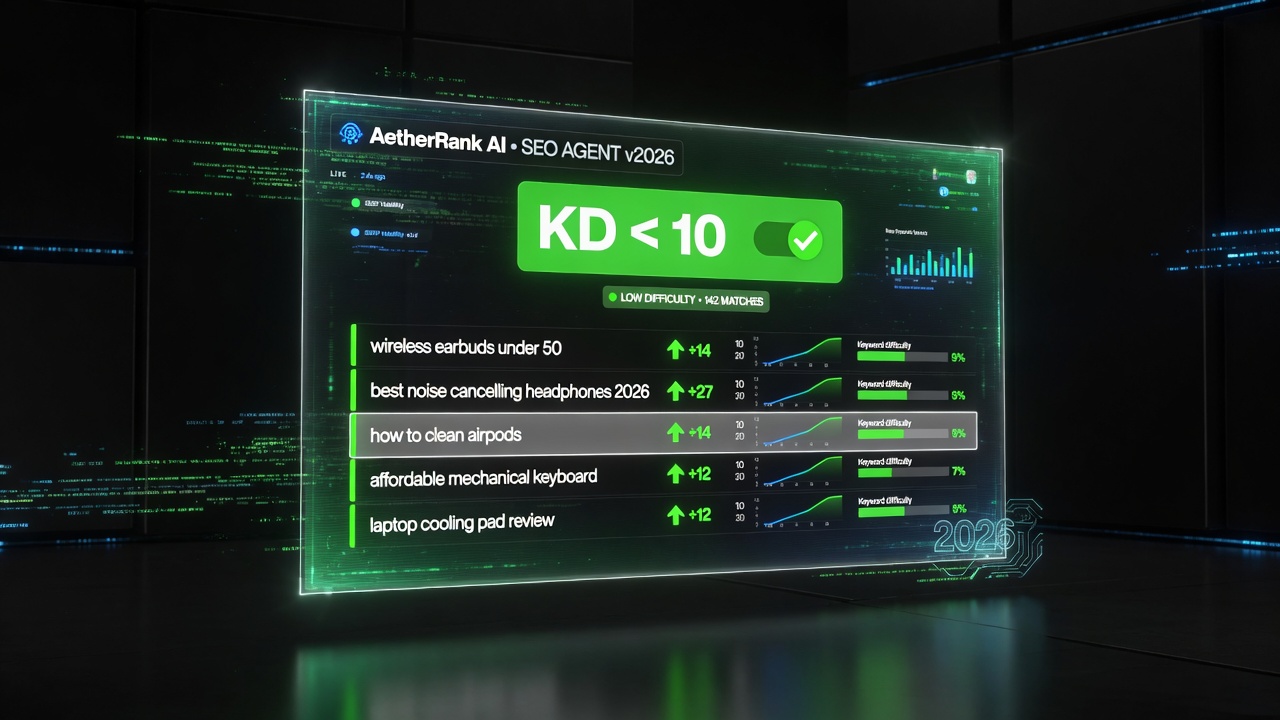
Comparing Top SEO Agents for Volume 5000+ Opportunities

Scaling organic traffic has always been bottlenecked by human bandwidth, especially when trying to capture thousands of high-volume, low-difficulty keyword opportunities before competitors catch on. Manually identifying, grouping, and writing content for keywords with over 5,000 monthly searches is slow, tedious, and prone to human error. Enter autonomous SEO agents: software designed to handle the heavy lifting of high-scale content creation and search optimization.
These agents excel because they are built for scale. SEO agents are most useful for work that is high-volume, sequential, and data-dependent, such as keyword clustering and gap analysis. Instead of a human planner spending days in spreadsheets, AI SEO agents can simultaneously analyze search volume, keyword difficulty, competition, and search intent to create precise topical clusters in seconds. This allows teams to target high-value keyword opportunities with unprecedented speed.
Not all tools are created equal, however. A recent industry report on the best AI SEO agents in 2026 ranked tools by what they actually automate, finding that Frase covers the full 6/6 pipeline stages for AI SEO automation. For teams looking to build custom setups, combining APIs is another powerful path; a workflow pairing Moz and Relevance AI enables fleets of intelligent SEO agents powered by trusted API data to run highly customized, automated workflows at scale.
To help you navigate this rapidly evolving landscape, we have compared the top SEO agents capable of executing these high-volume strategies. Let's look at how these tools stack up and how you can deploy them safely to secure major search wins without triggering search engine penalties.
- 1
SEO agents are highly effective for high-volume, sequential, and data-dependent tasks like keyword clustering and content gap analysis.
- 2
Frase leads the 2026 AI SEO agent market by automating 6/6 pipeline stages, compared to 3/6 stages automated by Surfer SEO and Semrush.
- 3
Custom fleets of intelligent SEO agents can be deployed using platforms like Relevance AI powered by trusted Moz API data.
- 4
AI SEO agents can analyze search volume, keyword difficulty, competition, and search intent simultaneously to identify low-difficulty opportunities.
Unlocking the Sweet Spot: Why 5,000+ Volume, Low-KD Keywords Are Prime Targets
To understand why we target search terms with monthly volumes exceeding 5,000 and low keyword difficulty (KD), we have to look at how modern search results are built. Traditionally, these high-volume, low-KD terms have been the "holy grail" of organic growth. They offer substantial traffic potential without requiring the massive backlink profiles needed to rank for highly competitive head terms. However, because these opportunities are highly specific and often long-tail, they remain largely underserved. Traditional marketing teams simply do not have the bandwidth to manually research, write, and optimize hundreds of individual pages to capture this fragmented traffic.
This is exactly where AI SEO agents redefine what is possible. By moving beyond simple keyword research, these autonomous systems can analyze search engine results pages (SERPs) in real-time, mapping intent and identifying content gaps across thousands of terms simultaneously. Instead of treating keyword research as a static, one-time task, agents continuously monitor performance and search trends to keep your strategy aligned with shifting user behavior.
The true power of AI agents lies in their ability to handle complex, multi-step workflows without human intervention. In fact, SEO agents are most useful for work that is high-volume, sequential, and data-dependent, such as keyword clustering and gap analysis. By automating the classification of thousands of keywords into logical topical clusters, agents ensure you build topical authority without creating duplicate content or cannibalizing your own rankings.
How SEO Agents Scale Your Keyword Strategy
- Automated Intent Mapping: Agents analyze the SERP features for each of your 5,000+ volume targets, instantly classifying whether the search intent is informational, transactional, or navigational.
- Dynamic Topical Clustering: Instead of manual grouping, agents link related low-KD keywords into cohesive content hubs, establishing deep topical authority.
- Continuous Gap Analysis: They scan competitor profiles to find exactly which subtopics are missing from your current pages, keeping your content fresh and comprehensive.
With the foundation of your keyword strategy automated, the next logical step is understanding the specific technical capabilities these agents bring to high-volume analysis.
Scale through automation — Leveraging AI SEO agents to automate sequential, data-heavy tasks like keyword clustering allows brands to dominate thousands of high-volume, low-difficulty search opportunities that are otherwise impossible to target manually.
Beyond the Spreadsheet: How AI Agents Decode High-Volume Keyword Data
Instead of treating search volume, keyword difficulty, competition, and search intent as isolated metrics to be cross-referenced manually, modern AI agents analyze them simultaneously to build highly targeted campaigns. This multi-dimensional processing allows them to instantly map out keyword clusters and identify content gaps compared to your competitors without a single manual spreadsheet in sight.
From Simple Tools to Full-Pipeline Autonomy
The core difference between traditional software and true AI SEO agents lies in the depth of their workflow integration. While popular platforms like Surfer SEO and Semrush focus largely on content optimization and tracking, leading AI SEO agents like Frase cover all 6 out of 6 pipeline stages, including the initial research and strategic planning phases.
This end-to-end coverage enables marketing teams to build sophisticated, hybrid human-AI workflows. By pairing platforms like Relevance AI with robust data sources like the Moz API, companies can deploy autonomous agent fleets. These agents don't just find low-difficulty keywords (with a KD under 10) that command over 5,000 monthly searches; they continuously monitor competitor moves and update content strategies in real time.
By automating the heavy analytical lifting, these agents ensure that your content production is guided by real-time intent rather than outdated search volume reports. This sets the stage for executing content creation at a scale that was previously impossible without a massive team of analysts.
Simultaneous multi-metric analysis — AI agents bypass manual spreadsheet bottlenecks by evaluating search volume, keyword difficulty, and search intent all at once, enabling rapid topical clustering at scale.
Head-to-Head: Which SEO Agents Actually Automate High-Volume Pipelines?
To truly understand how this works in practice, we have to look at how different AI SEO agents handle these heavy-duty workloads. When you are targeting thousands of low-difficulty, high-volume keywords, you cannot rely on tools that merely write paragraphs. You need intelligent systems that can orchestrate the entire workflow—from initial research and clustering to final optimization.
A direct comparison of the top platforms reveals a massive gap in how much of the SEO pipeline is actually automated. According to recent industry evaluations, the best AI SEO agents in 2026 are led by Frase, which covers the full 6/6 pipeline stages. This means legacy platforms still require significant human intervention to bridge the gaps between strategy, research, drafting, and publishing.
The visual difference above highlights the operational bottleneck of semi-automated tools. In a traditional workflow, your team is stuck exporting CSVs, manually clustering keywords, and copy-pasting briefs into an editor. With full-pipeline agents, those friction points disappear. The system autonomously ingests keyword data, groups intent, and generates optimized drafts in one continuous loop.
For teams targeting low-difficulty opportunities (such as keywords with a KD under 10) at scale, this end-to-end automation is a game-changer. By building hybrid workflows that pair customizable platforms like Relevance AI with robust data sources like the Moz API, you can deploy dedicated agent fleets. These agents monitor search intent, pull real-time competitive data, and execute high-volume content strategies without requiring a massive team of analysts to babysit the process.
Pipeline coverage is everything — While legacy tools only automate 3 of the 6 core SEO stages, choosing an agent with full 6/6 pipeline automation like Frase is essential for scaling high-volume, low-difficulty keyword campaigns without human bottlenecks.
However, scaling your organic footprint to thousands of targeted pages brings up a critical operational challenge: how do you ensure this massive influx of automated content doesn't trigger search engine penalties or compromise your brand's editorial integrity?
How to Deploy a Penalty-Safe SEO Fleet Without Triggering Spam Filters
To solve this, modern marketing teams avoid relying on a single, monolithic AI writer that spits out generic, repetitive blog posts. Instead, they deploy specialized "fleets" of AI agents that collaborate, check each other's work, and enforce strict editorial guardrails. By combining trusted search metrics with flexible agent platforms, you can build a system where one agent researches search intent, another drafts the content, and a third acts as a rigorous editor to flag over-optimization.
This is where integrations like Moz and Relevance AI shine. As SEO experts have noted, combining these systems results in "a fleet of intelligent SEO agents powered by Moz's trusted API data and Relevance AI's flexible and powerful platform." This integration ensures your agents are making decisions based on real-time, highly accurate domain and keyword metrics rather than hallucinated search data, minimizing the risk of generating low-quality spam.
How to Deploy a Penalty-Safe SEO Fleet
By distributing tasks across a fleet, you naturally avoid the over-optimization penalties that plague basic AI content generators. Search engines do not penalize content simply because AI helped write it; they penalize content that fails to satisfy search intent or reads like a stuffed keyword list. Monitoring your agent outputs with automated editorial checks ensures that every page published onto your site feels natural, authoritative, and genuinely helpful to human readers.
Multi-agent fleets — Combining Moz's API with Relevance AI allows you to scale SEO content safely by distributing research, drafting, and optimization across specialized, self-correcting agents.
Key Takeaways
Let Flows automate your entire high-volume content pipeline and engage your readers with built-in AI chat by starting your automated SEO journey today.
Frequently Asked Questions
Traditional tools require manual human analysis and execution, whereas AI SEO agents can autonomously analyze search volume, keyword difficulty, competition, and search intent simultaneously to execute sequential workflows like clustering and content generation.
According to industry evaluations of what tools actually automate, Frase covers 6/6 pipeline stages for AI SEO automation, outperforming other popular options like Surfer SEO and Semrush, which each cover 3/6 stages.
Yes, you can build custom fleets of intelligent SEO agents by leveraging platforms like Relevance AI integrated with trusted API data from sources like Moz to run automated, highly tailored SEO workflows.
SEO agents are most useful for work that is high-volume, sequential, and data-dependent, making them exceptionally effective for tasks like keyword clustering, content gap analysis, and rapid content generation.