Brief Queue vs Editorial Calendar: Which Artifact Prevents Bottlenecks

Teams treat a brief queue and an editorial calendar as rival tools. They are not. One holds work until the inputs exist. The other records a date, an owner, and a review window once that work is real. Filling empty cells does not move a piece that is stuck earlier in the line.
Demand makes the mismatch worse. In Contentoo’s 2026 survey of 203 B2B content and marketing leaders, 90% said content demand rose over the past year, while only 48% said headcount kept pace. The same survey found internal review and approvals the biggest bottleneck for 45% of teams, ahead of unclear briefs at 41% and first drafts at 40%. A date board cannot invent a brief, a reviewer, or spare capacity.
Start with the stage that is actually jammed—incomplete inputs, review wait, or nobody named to ship—then give that stage the artifact that matches it. The rest of this piece is that diagnosis, not a software shortlist.
- A dated calendar records commitments; it does not clear a stuck brief, a review wait, or missing ownership.
- Contentoo’s 2026 survey of 203 B2B leaders found review the top bottleneck (45%), just ahead of unclear briefs (41%) and first drafts (40%).
- Poor or incomplete briefs are a quality problem: 56% of teams cite them when quality drops, versus 7% who blame over-reliance on AI.
- Use the brief queue when writers are waiting on inputs; lock a publish date only after the brief, owner, and reviewer exist.
- Ship rules belong on the calendar: one named owner, a review SLA, and a hard cap on work in flight.
The Bottleneck Is Usually Approval, Not an Empty Date

If you are asking whether the bottleneck is usually the brief, the draft, or the approval, the answer is the approval. Internal review stalls B2B content more often than an unclear brief or a slow first draft. An empty date cell only records that the piece never became ready. It does not tell you which handoff is sitting still.
Approval delays are the number-one bottleneck in content production, and 52% of companies regularly miss deadlines because of them. Brief creation is a different stall. It runs across the pipeline when the strategist is overloaded or the brief itself is too complex, and that wait is not the editorial-review queue. Active review time and the wait for someone free to do it are different things: a short review can still sit untouched because nobody is available to look at it. That is wait time and missing attention, not a thin brief and not a blank cell.
Treating every slip as a scheduling gap sends you to the wrong fix. Approval wait is a pile of drafts with no one free to clear them, which is why deadlines slip even when a date was already on the board. Brief-creation wait is upstream of that pile: the strategist is overloaded or the brief is too complex, and that delay is not the editorial-review queue. Those are different stalls, and only the second one stays invisible on a date grid.
Stage first — Review and approvals jam more pipelines than missing briefs or slow drafts. Identify the waiting stage before you fill dates or buy a tool to schedule them.
Where content workflows actually jam
Why a Full Editorial Calendar Still Slips
That diagnosis is what a full date grid usually skips. A packed editorial calendar still misses ship because it shows a publish date with no visibility into whether legal, brand, compliance, or executive gates have cleared. One calendar row often hides many production variants, so the cell looks settled while the pieces underneath are not.
A written process does not stop those bad ships. Sixty-five percent of content teams have a documented workflow, yet 76% of those teams still sometimes or often publish work they know is not good enough. The process can sit next to the calendar and still leave the actual gate invisible.
What happens if you schedule the slot before the brief is ready
Booking the date first turns the calendar into a wishlist. Writers wait on inputs that were never locked, and reviewers spend the cycle course-correcting instead of approving. Quality then drops under volume pressure — 46% of teams cite pressure to hit volume targets as a cause of poor quality — and under too many stakeholders, which 40% point to as diluting the message.
The slip is a false commitment, not a missing date. Until the row can survive review, the cell should stay empty. Filling it early only pretends the bottleneck has already been solved.
False commitment — A full date grid still slips when it books a ship the gates have not cleared; leave the cell empty until the row can survive review.
A Brief Queue Records Readiness; a Calendar Records Commitment
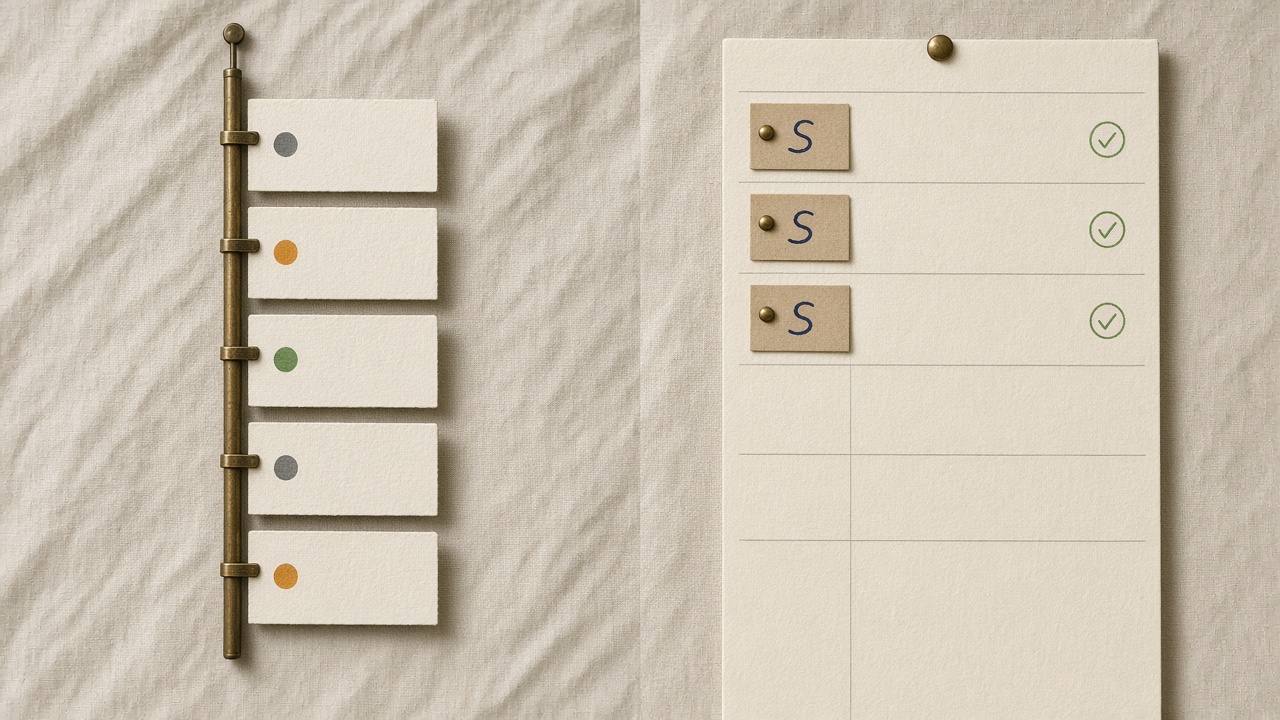
That empty cell is not a missing plan. It is the line between two jobs that get collapsed into one grid. A brief queue is a readiness record: an idea stays there until inputs, scope, and a named reviewer exist. An editorial calendar is a commitment record: it says when a ready piece publishes and who owns the handoff.
A calendar tells you when something is published. A workflow tells you how it gets from idea to published and where quality checkpoints sit. The brief queue is that checkpoint list, not a second calendar with softer dates.
Mixing the jobs is the failure mode. Dates on unready ideas look like a plan, and the team starts treating a wishlist as capacity. Scope notes on the date grid feel operational, yet they never hold a row until the brief can survive review. Use both only in sequence: the queue decides if a row may exist; the calendar decides when a qualified row ships.
Two records — The queue stops work that is not actually ready. The calendar only protects capacity and ownership after a row has cleared that gate.
Queue or Calendar: Match the Artifact to the Stall
Neither artifact prevents every content bottleneck. A brief queue stops the upstream stall—people waiting on inputs, cluster fit, or a complete SEO content brief—and it stops a false-ready date from landing on the grid. An editorial calendar prevents capacity overcommit and ghost ownership only after a row is actually ready. Use the queue when those inputs are still missing. Use the calendar when the inputs exist and the jam is handoffs, a missing review window, or too many parallel dates.
Once a row is ready, a lighter operating rule belongs on that row, not on a wishlist date. A clear brief is the upstream fix that reduces downstream course correction. Cap most content types at two approvers, and time-box standard review at 48 hours. A named owner and a hard cap on in-flight pieces belong with the publish commitment, because attention—not another empty cell—is what keeps handoffs from slipping.
Editorial calendar software helps when people stall between handoffs and the board cannot show review state. It still cannot supply a cluster home or turn an incomplete brief into a row that is ready to date. If the stall is upstream of a handoff, a cleaner grid only gives that same jam a new interface.
Match the stage — Use the queue while inputs are missing; once the row is ready, put the two-approver cap, the 48-hour review window, and the in-flight limit on the calendar row — not on a date that was never qualified.
How to Tell a Capacity Problem from an Ownership Problem
A slipped date does not tell you which stall you have, which is why capacity problems and ownership problems get treated as one calendar failure. They are not. If a ready row has no single owner, or no named reviewer, it is an ownership problem. If every owner is already at the in-flight cap and demand is still rising, it is a capacity problem. A full calendar displays both as the same missed commitment.
Demand has already outrun staffing, so a missed date is not, by itself, proof the calendar failed. Coordination already eats the week for 43% of leaders, who spend 40% or more of their time on it — about two days of a five-day week. A faster draft does not restore the ship rate. In calendars Rework audited, ghost-owned rows shipped at roughly 40–50%, while single-named-owner rows shipped at 80% or higher. Without a named reviewer and a published turnaround, a piece can disappear for eleven days after an on-time draft.
Same slip, different fix — Unnamed ready rows are an ownership failure; a full six-piece load plus rising demand is a capacity failure. Until you separate them, the calendar will keep showing both as a missed date.
Ship rate by ownership clarity
Put Scope in the Brief Queue, or Review Starts Over
Once a slip is named as capacity or ownership, the next failure is parking scope on the date board. Keyword, persona, internal links, legal flags, and the actual scope of the piece belong in the brief queue, not on the master calendar. That date board should stay at five columns: idea, owner, due date, review owner with an SLA, and status. Those columns record a commitment. They do not define the work.
An incomplete brief is a quality problem, not a cosmetic gap in the schedule. Fifty-six percent of content teams name poor or incomplete briefs as a reason quality drops, while only 7 percent blame over-reliance on AI without enough editing. A thin brief forces the reviewer to invent the angle, the audience, and the claims during approval. The review queue becomes a rewrite queue, and the original publish date was never real — it was a placeholder waiting for someone to finish the brief in the comments.
Refuse the row until those fields are filled. Extra calendar columns for keyword, persona, links, or legal flags do not prevent that restart. They only hide the missing brief inside a busier grid. The calendar is for shipping cadence. The brief is for everything else.
Refuse the row — Scope, keyword, persona, links, and legal flags stay in the brief queue; a five-column calendar cannot stop a thin brief from turning review into a rewrite.
When to Lock a Publish Date, and Where Refresh Debt Belongs
Once the scope fields are filled, the date is still not automatic. A lean team locks a publish date only as a stage exit: the brief is complete, a cluster home exists, one owner is named, a reviewer has an SLA, and the operator is still under the six-piece in-flight cap. Until every one of those is true, the date cell stays blank.
Asking for a date before that exit does not finish any of those conditions. The row stays in the queue until the exit is real, even if a stakeholder already wants the cell filled.
Refresh debt does not belong in those empty new-content slots. It sits in a parallel queue with its own share of the work-in-progress cap, not as filler dates on the new-content calendar. Mixing the lanes hides the jam: you can no longer tell whether decaying URLs or unready new briefs are what is stuck.
A same-URL update stays in the refresh lane. A new URL needs its own brief and its own stage exit before it may take a date. Do not use empty new-content slots to pretend refresh debt is already scheduled.
Stage exit — Lock a publish date only when the brief, cluster home, named owner, reviewer SLA, and six-piece cap are all clear; keep refresh debt in its own lane so empty new-content slots cannot fake a schedule.
Side Doors Recreate the Backlog a Calendar Cannot See
Ad hoc requests recreate the backlog a calendar cannot see, and editorial calendar software will not stop them if the jam is still incomplete inputs. A note in Slack, a sales ask, or an executive “quick one” never enters the brief queue, so it never earns a date. The grid stays clear. The invisible piece still consumes the work-in-progress cap, and the owner who looked free is already full.
The front door is what keeps that from happening. Kissflow, citing CMI’s 2024 enterprise research, reports that 40% of enterprise marketers route content requests through a centralized team, 30% let each department produce its own, and 23% share responsibility. Department-owned production multiplies side doors: each team invents its own intake, and none of those requests meet the refusal rules that keep unready work off the calendar.
You do not need editorial calendar software if you already run a brief queue and the stall is missing inputs. A sheet is enough until handoffs between people stall and that sheet cannot show review state. Do not buy a calendar product to fix a brief problem. Force every side-door request through the same refusal rules as the queue, or the grid will keep reporting capacity you no longer have.
Invisible backlog — Side-door work never hits the date grid, so it quietly spends the same capacity a locked calendar was meant to protect. Route every request through the queue; buy calendar software only when people-to-people handoffs, not incomplete briefs, are the stall.
What the Queue Must Refuse, and What a Human Still Judges
Forcing every side door through the same refusal rules only works if the queue knows what it is allowed to say no to. It should refuse to automate a missing brief, a missing owner, a missing reviewer, an invented publish date, and any ship that has not had a human quality pass. Those are gates, not tasks an assistant can close.
A human still reviews whether the claim is true, whether the page should exist, whether stakeholders have diluted the message, and whether brand or legal risk is acceptable. Those are judgments, not form fields a date cell can store. A calendar can record who owns the pass and when it is due; it cannot perform the pass.
AI adoption is no longer the split: 85% of B2B content teams already use it regularly, and 46% use it for briefs versus 21% for drafting. Teams that restructured workflows around AI were 20 percentage points more likely to be very confident in quality — 54% versus 34% who mainly added AI to existing tasks. Bolting brief automation onto a dated calendar does not clear review. The queue may draft a candidate brief; it may not declare that brief ready.
Refuse the unready — Automate a candidate brief if you want, but keep human judgment on truth, page existence, message dilution, and brand or legal risk — and never let the queue mark a row ready, or a date real, without that pass.
Quality confidence by AI setup
Key Takeaways
Map your next slipped date to the stage that actually jammed, then refuse the row until the brief queue says it is ready.
Frequently Asked Questions
You Might Also Like
- Publishing Editorial Calendar Software vs a Brief Queue: What Lean Teams Actually Need
- Workflows SEO Content Calendar: How Lean Teams Schedule Briefs Without a Bottleneck
- Workflows Content Refresh Calendar: When to Update vs When to Brief a New Page
- Publishing Flows for SEO Publishing: What the Stack Automates vs What You Still Own
- Workflows How to Brief a Content Refresh for Writers and AI