AI Visibility Metrics That Matter (and Vanity Numbers to Ignore)
A dashboard that jumps overnight is usually the sample, not the brand. Every reported AI visibility number is a sample estimate, not a census: in Profound tracking of 22.5 million ChatGPT Shopping offers, 95% of product titles appeared in under 30% of runs of the same prompt (Nick Lafferty, AI Visibility Metrics, 2026). An arXiv paper summarized in that same review found citation distributions follow a power law, and that many domain-level differences marketers report fall inside the measurement noise floor.
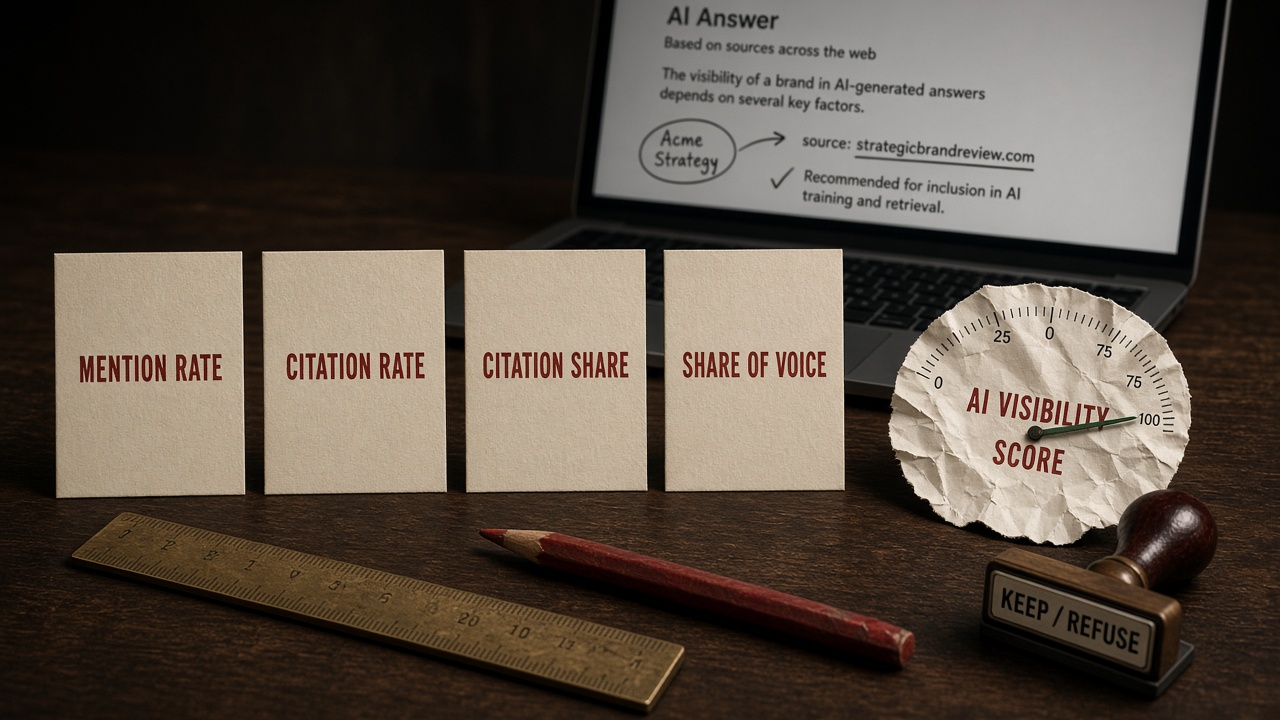
A name in the answer is not a link, and a link is not a recommendation. Mention rate, citation rate, citation share, and share of voice are four events with different denominators. Semrush’s June 2026 study of 3,981 domain appearances found 61.7% were citations without a brand mention, 25.1% were mentions without a citation, and only 13.2% were both (Arahi AI). Blending those into one 0–100 score, or collapsing Gemini, AI Overviews, and AI Mode into a single Google number, hides the move you would actually make.
This piece keeps those four rates, shows why they must stay separate, and names the vanity numbers to refuse until a frozen prompt set, reported per engine, produces an interval that does not overlap last week’s. If the intervals overlap, do not call it a trend — and do not refresh the page because a composite twitched.
- Keep mention rate, citation rate, citation share, and share of voice as four separate events.
- Refuse raw mention counts, blended 0–100 scores, and day-over-day moves on small prompt sets.
- Freeze the prompt set and report each engine; a single Google number hides a median 8-point gap across Gemini, AI Overviews, and AI Mode.
- Pair every presence metric with a quality check and a lagging business signal such as an AI referral floor.
- If this week’s interval overlaps last week’s, the change is inside the noise floor.
What an AI Visibility Metric Is, and How It Differs From a Ranking
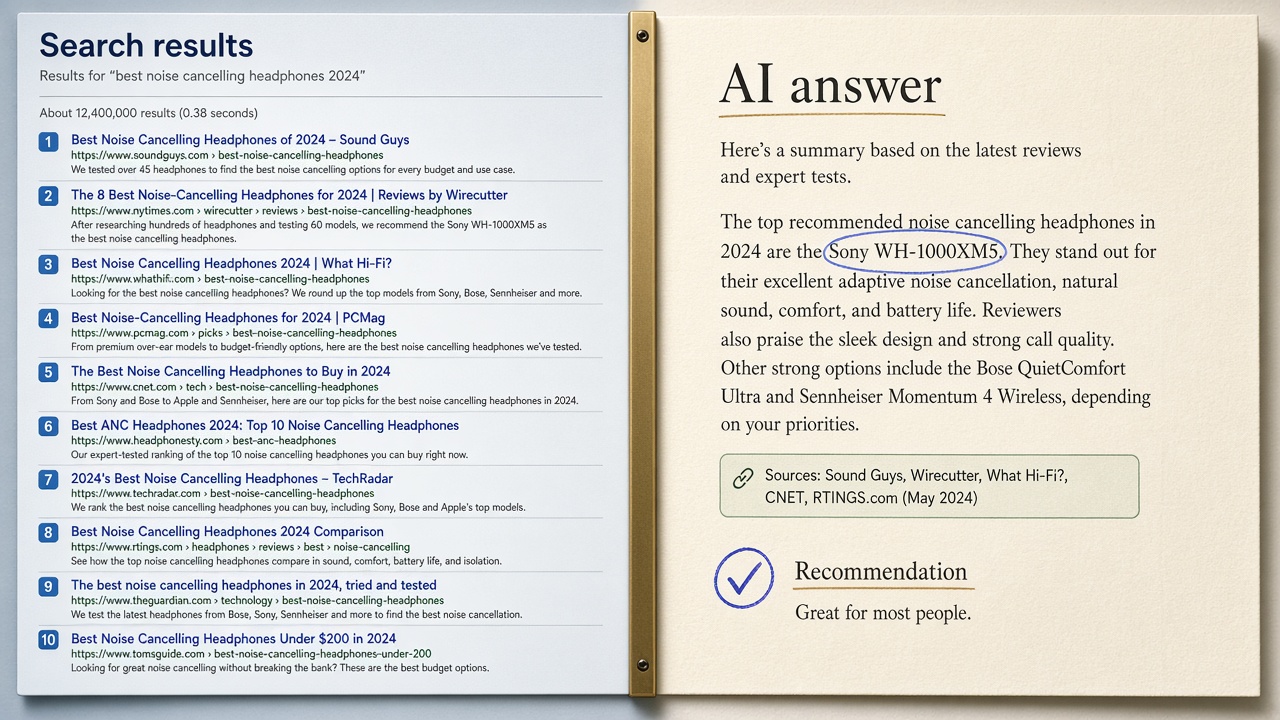
An AI visibility metric is a sample estimate of how often a brand appears in AI answers for a frozen prompt set. A ranking is a position on a results page. They are not substitutes.
They diverge in practice. Ahrefs' March 2026 study found only 37.9% of AI Overview cited pages ranked in the top 10 for the same query, and 31.0% ranked beyond the top 100. Rank can hold while answer presence erodes: Bain found about 80% of search users rely on AI-written summaries for at least 40% of searches, and roughly 60% of those searches end without a click. When a summary appeared, Pew Research found users clicked a traditional result in 8% of visits versus 15% without one, and clicked a link inside the summary in 1% of visits.
A mention, a citation, and a recommendation are different events
A mention is the brand name in the answer, a citation is a linked source, and a recommendation is an explicit endorsement. Do not score them as one event. Of 3,981 domain appearances in Semrush's June 2026 study, 61.7% were citations without a brand mention, 25.1% were mentions without a citation, and only 13.2% were both. About 85% of brand mentions come from third-party domains, and brands earning both a mention and a citation were 40% more likely to reappear.
The definition piece covers what AI visibility means, and the mention-log piece covers how to record the name separately from the link. This section only names the events the KPI sheet will accept.
Not a ranking — An AI visibility metric estimates presence in AI answers on a frozen prompt set. A name, a link, and an endorsement are separate events, and none of them is a ranking.
Click Rate With an AI Summary
How to Calculate Mention Rate, Citation Rate, and Citation Share
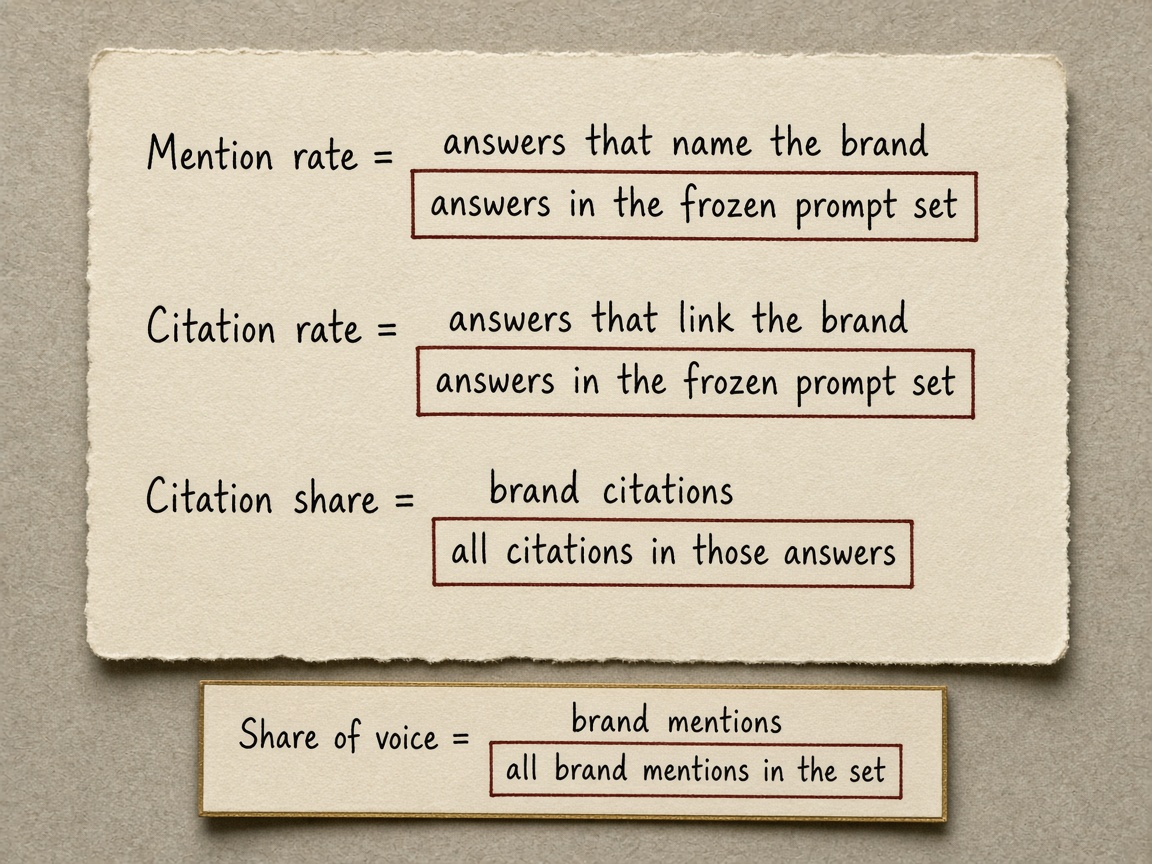
Those events become rates only when you divide them on the same frozen answer set. Mention rate is answers that name the brand divided by answers in the set. Citation rate is answers that link you divided by answers in the set. Citation share is your citations divided by all citations in the named window.
Walk the share once: 242 citations out of 48,589 is 0.50%. A share with no named denominator is marketing, not measurement.
Share of voice is a different line: answers mentioning the brand divided by all answers. A brand can be mentioned without being linked, so citation share and share of voice stay separate and are never averaged into one rate.
Do not design the prompt library here. Engines, prompts, and cadence belong in the tracking article. This section is only the arithmetic the log is allowed to publish.
The rule — A rate is real only when its denominator is named, frozen, and unchanged since the last read.
What Is a Good AI Visibility Number?
Once the denominator is written, the next temptation is a target. There is no universal good number — only a category reading on one engine.
For 200+ B2B SaaS brands across eight platforms, the medians were a 14% mention rate (strong at 45%+), a 6% AI share of voice (strong at 20%+), and a 9% citation rate (strong at 25%+). Use them as category context, not a quota.
A copied median misleads as soon as answers shrink. Between March and June 2026, average sources per answer fell from 21.4 to 12.3 on ChatGPT, from 20.6 to 9.7 on Google AI Mode, and from 4.4 to 2.5 on Gemini. Fewer slots make each citation harder, and those engines are not interchangeable.
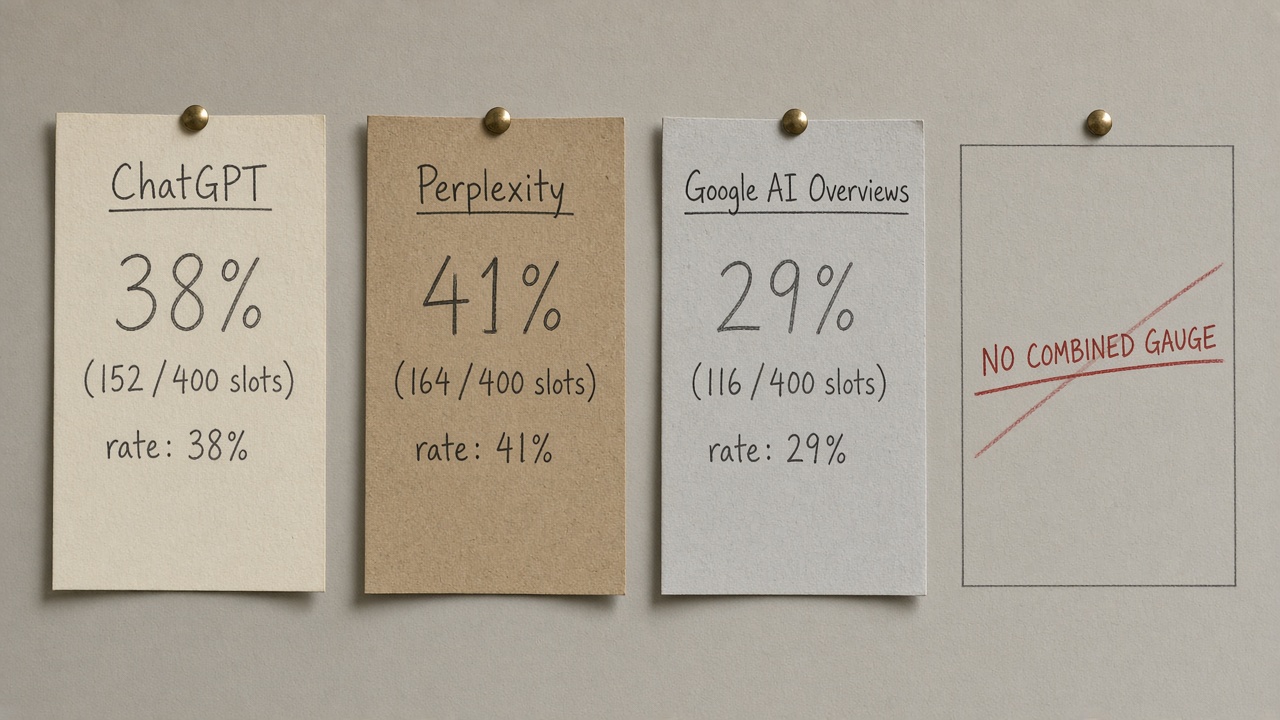
Should ChatGPT, Perplexity, and Google AI Overviews share one score? No. Across 15,155 brand configurations, the median gap between a brand's best and worst Google model — Gemini, AI Overviews, and AI Mode — was 8 points. One Google citation share already hides that spread; blending the three hides more.
Report each rate per engine on the same frozen prompts. A cross-engine average is a number the sheet must refuse.
Sources per Answer, Mar to Jun
Which AI Visibility Metrics Are Vanity Numbers?
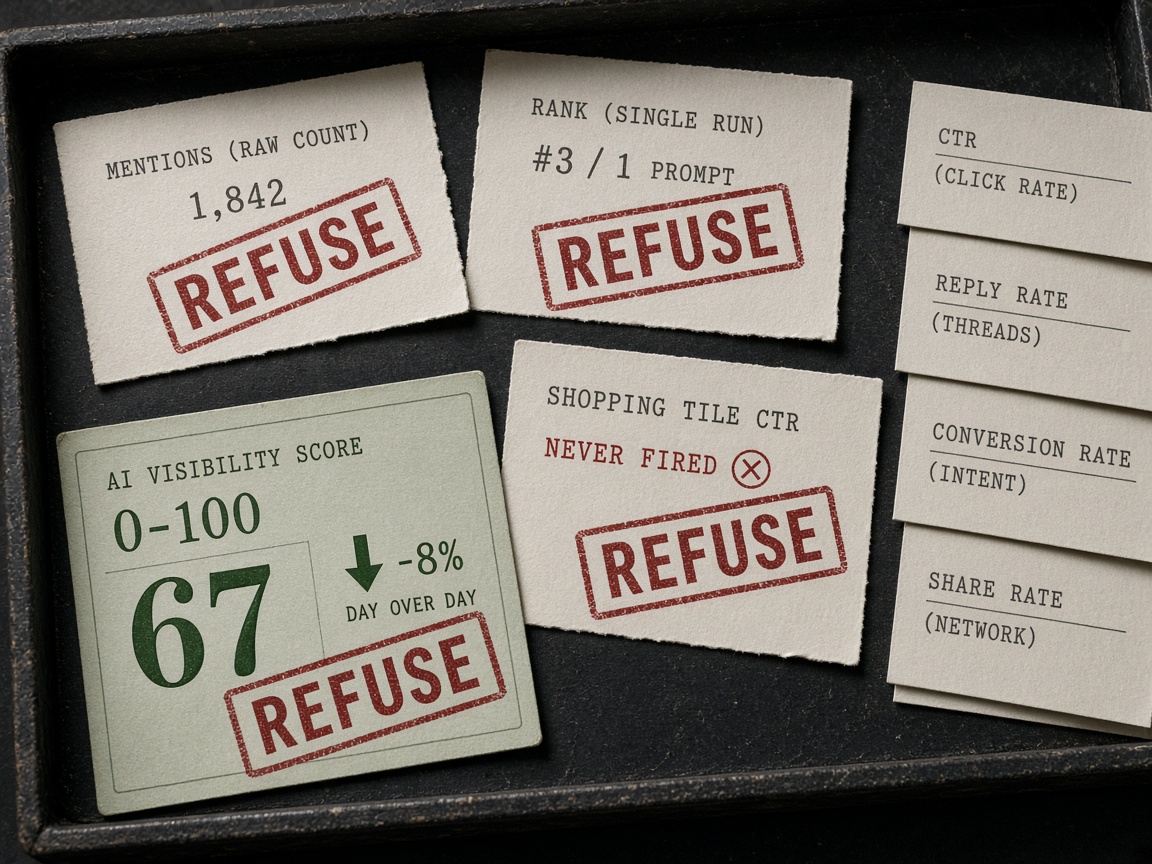
With each rate already split by engine, refuse what still is not a rate: raw mention count, single-run rank, day-over-day swings on a thin prompt set, shopping share for software, and any proprietary 0–100 AI visibility score.
Raw mention count is vanity unless you pair it with a quality check such as sentiment or accuracy. GEO Toolbox treats a composite 0–100 score the same way: proprietary weights mean the same brand scores differently by vendor, so it cannot be a KPI you compare over time or across tools.
Single-run rank is not a metric. SparkToro and Gumshoe found the odds of ChatGPT, Claude, or Google's AI returning the same brand list twice were under 1 in 100, and the same list in the same order under 1 in 1,000.
Do not import shopping dashboards. Profound put the software and SaaS shopping trigger rate under 0.01x baseline, and financial products at 0.0x. For most software categories that surface almost never fires. An AI visibility score is a blended vanity metric. Keep the four separate rates, or withhold the number.
Not a KPI — A 0–100 AI visibility score blends proprietary weights into one number you cannot compare. Report mention rate, citation rate, citation share, and share of voice separately, or withhold the score.
How Many Prompt Runs Before a Metric Is Trustworthy?
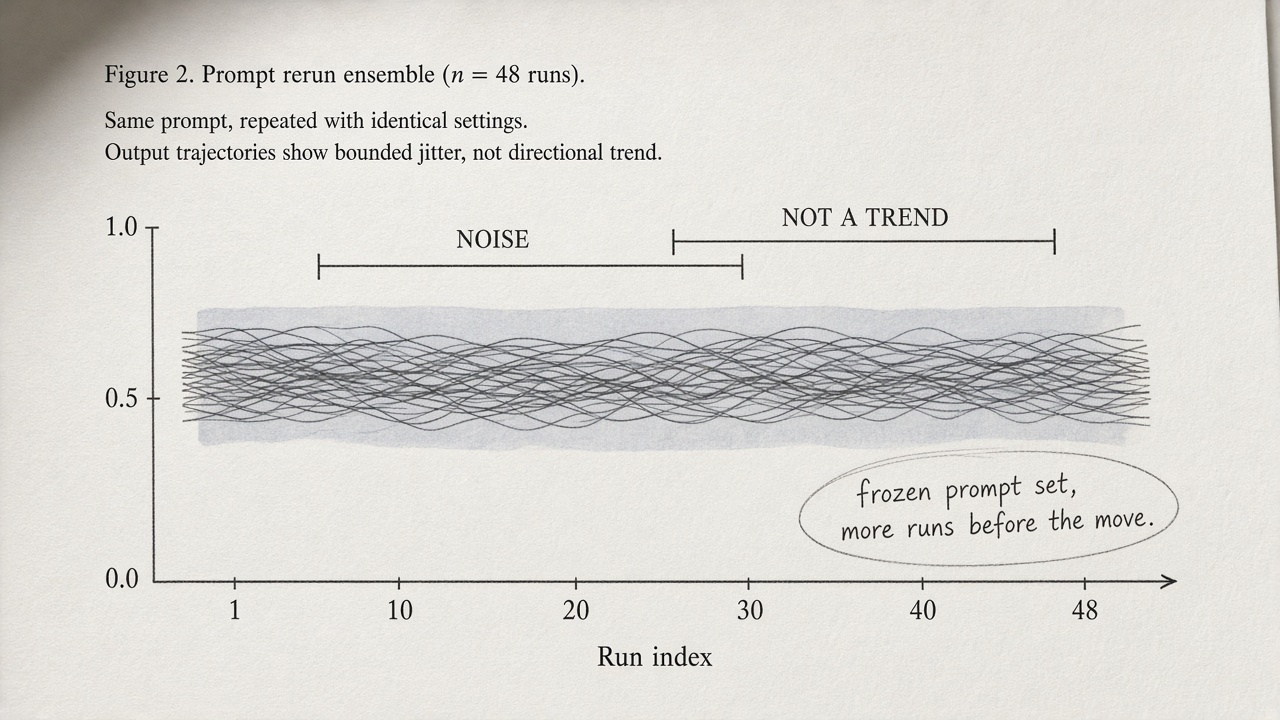
There is no universal run count that makes an AI visibility metric trustworthy. It is trustworthy only when the prompt set stays frozen and this week's interval does not overlap last week's. If those intervals overlap, do not call the move a trend, and do not refresh.
Every reported number is a sample estimate, not a census. In tracking of 22.5 million ChatGPT Shopping offers, 95% of product titles appeared in under 30% of runs of the same prompt. Citation distributions follow a power law, sample-to-sample variability is large, and many domain-level differences marketers report fall inside the measurement noise floor.
That is why the number changes every time you check. Citation drift ran 54% to 59% every week across Google AI Overviews, Google AI Mode, and ChatGPT Search. Change the prompts and you change the denominator, so a new prompt set is a new metric. Overlapping intervals mean you refuse the move.
Refuse the move — Trust comes from a frozen prompt set and a non-overlapping interval, not from a magic number of runs.
How Noisy One AI Sample Is
How Do You Measure AI Referral Traffic When Most Visits Have No Referrer?
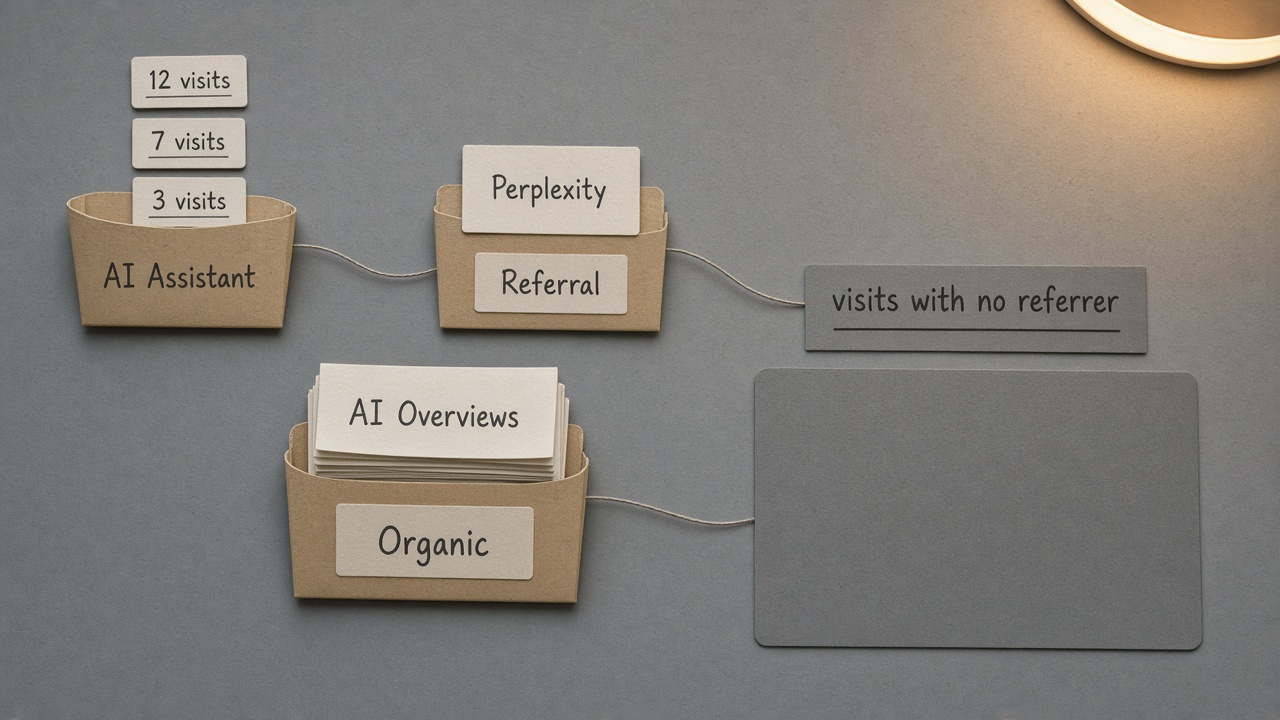
A frozen, non-overlapping sample still only estimates answer presence. You cannot recover visits that arrive with no referrer, so AI referral traffic is a floor, not a full count, and it never measures mentions.
GA4 shows clicks that already arrived, and only some of them. Since May 2026 it has a native AI Assistant channel for ChatGPT, Gemini, Copilot, Grok, and DeepSeek. Perplexity still lands in Referral, and Google AI Overviews count as Organic Search. Do not read AI Assistant as total AI traffic, and do not read any GA4 channel as citations or mentions.
A referral jump can be an engine change, not your page. After ChatGPT shifted to inline branded URLs, the share of answers with a clickable brand URL rose from about 4–5% to 22%, and B2B SaaS referrals rose about 3x while ecommerce stayed flat. Pair every presence rate with this lagging floor or with branded-search lift. Leading mention and citation rates alone are not ROI.
A floor, not proof — AI referral traffic counts only some arrived clicks and never mentions; pair each presence rate with that floor or branded-search lift before treating it as ROI.
Weekly Dashboard vs Monthly Review: When a Gap Justifies a Refresh
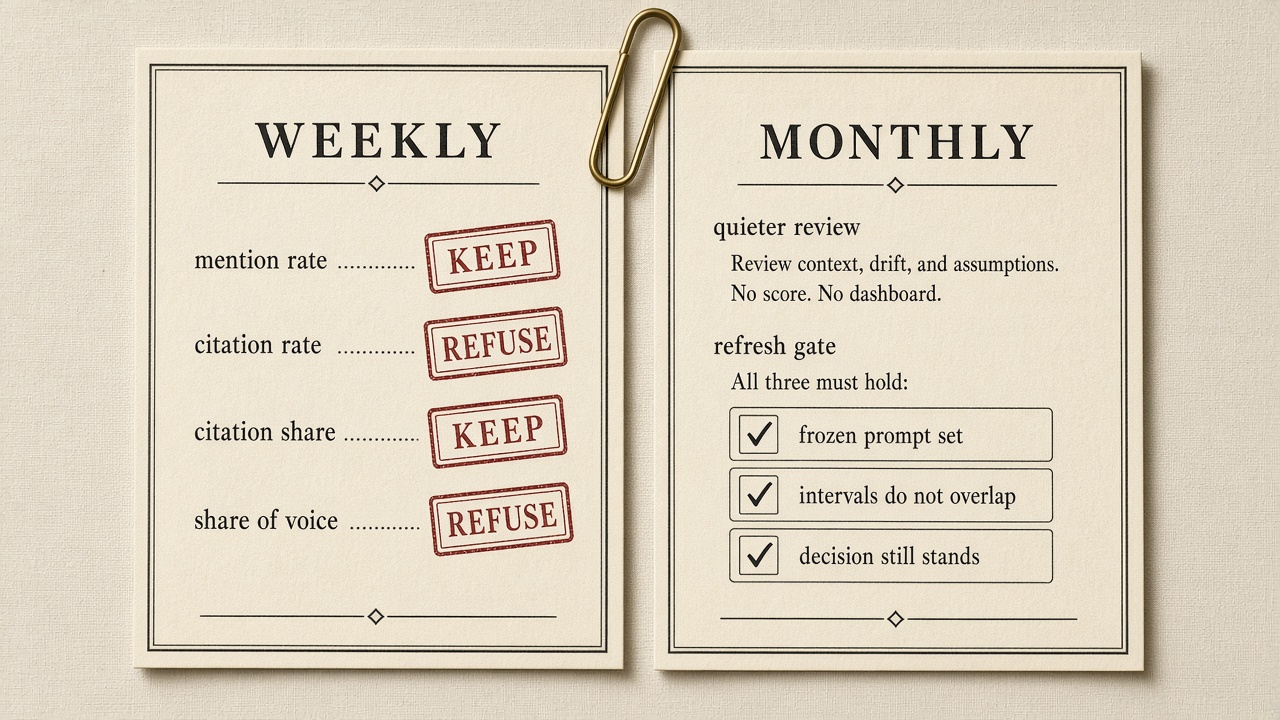
If the frozen sample still holds, the weekly board is four lines per engine: mention rate, citation rate, citation share, and share of voice, each with its denominator, plus a one-line sentiment or accuracy check when you have one. A logged gap is not a refresh until it clears the gate below. Refuse raw counts, blended scores, and any week-over-week move inside the noise.
Monthly is where you ask whether presence is turning into anything a business can see: citation drift, owned versus third-party sources, the AI referral floor, and branded-search lift.
Change a page only in order. The gap must repeat on the frozen set, the interval must not overlap the prior read, and you must be past the citation lag. Median time to a first ChatGPT or Claude citation for about 900 new marketing pages was 6.81 days; the 90th percentile was 37.10 days. The distribution is skewed, so a mean is the wrong summary and a day-two rewrite is not a measurement.
A repeated mention gap is not automatically a page problem. Branded web mentions correlated with AI Overview brand visibility at 0.664, versus 0.326 for Domain Rating and 0.218 for backlinks—moderate and not causal. Check third-party coverage before rewriting your own URL. How the log is kept lives in the mention-log article; this close only states when a logged gap is allowed to change a page.
Refresh gate — Refresh only after a repeated gap on a non-overlapping frozen sample, past the citation lag, and after third-party coverage is checked—not because a weekly count moved.
Key Takeaways
Freeze this week’s prompt sample, report the four rates per engine with their denominators, and hold any refresh until the next non-overlapping interval confirms the gap.
Frequently Asked Questions
You Might Also Like
- AEO AI Search Visibility: How to Track Mentions Across Answer Engines
- Measurement Brand Mention Tracking for AI Search: How to See Who Cites You
- AI Search AI Overview Citation Patterns: What Gets Quoted vs Ignored
- Measurement How to Audit ChatGPT Mentions for Your Brand Without Guesswork
- Workflows Content Refresh Strategy: How to Update Pages So Rankings Do Not Decay