AI Search Visibility: How to Track Mentions Across Answer Engines
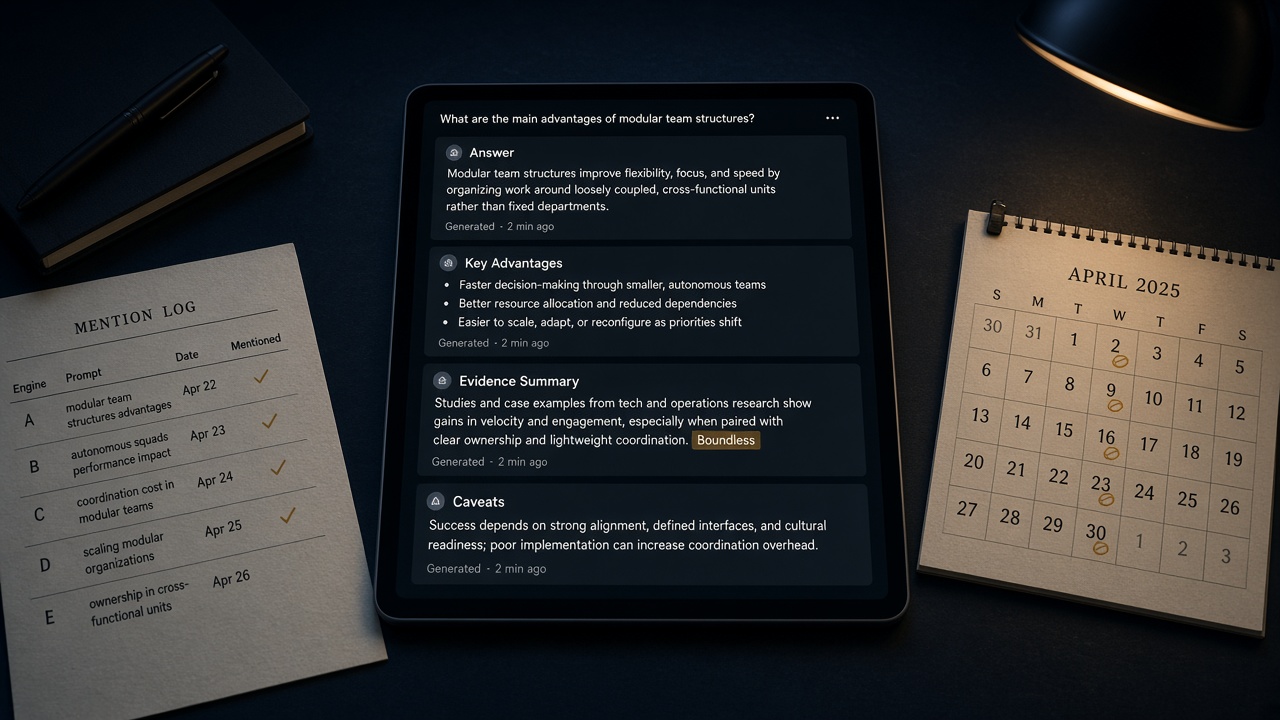
Classic rank tracking answers a simple question: where does a URL sit for a keyword. Answer engines do not work that way. ChatGPT, Perplexity, Google AI Overviews, and similar systems generate responses—they may cite you, paraphrase you, name a competitor, or skip the web entirely. A single prompt on a Tuesday is not visibility; it is a snapshot that can change with model version, retrieval, and how the question is asked.
If you came here for AI search visibility, you need an operating system, not another audit PDF. That means choosing which engines matter, locking a prompt set that matches real buyer questions, running those prompts on a cadence, and scoring mentions (brand, product, URL, sentiment, position in the answer) so trends are comparable week to week.
This article stays at that system level: what to measure, how to keep the panel stable, and how to read movement without pretending generative answers are a SERP. The goal is evergreen: whenever you find this, the same loop—engines, prompts, cadence, scoring—still applies.
- Treat AI visibility as panel tracking: same engines, same prompts, same schedule, scored mentions over time.
- Cover the engines your buyers actually use (ChatGPT, Perplexity, AI Overviews, and others as they matter), not a vanity list.
- Prompt sets should mirror jobs-to-be-done questions, not only branded vanity queries.
- Score brand, citation, competitor share, and answer role so you can explain how you appeared, not only if.
- One-off audits are useful for a kickoff; they are not a visibility program.
What AI search visibility actually measures
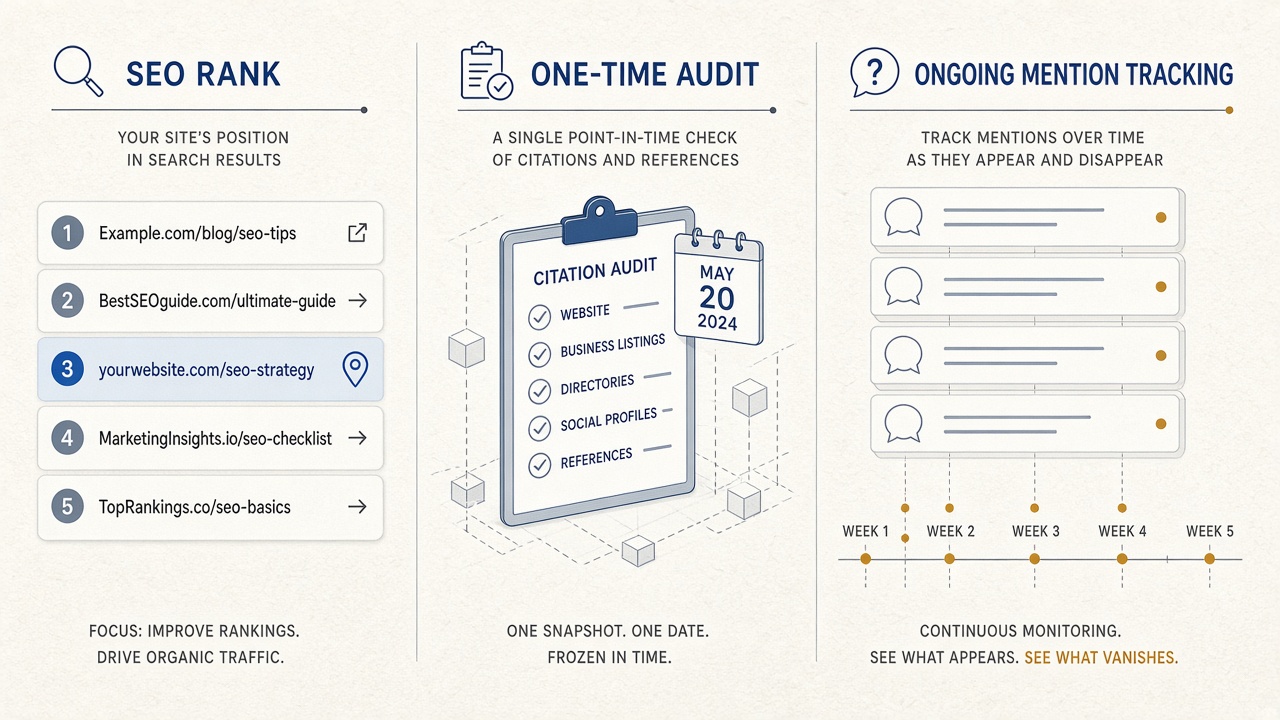
Once you treat answers as a channel, visibility is no longer a screenshot of a lucky citation. It is the share of times your brand name and your URLs show up across a fixed prompt set, repeated on a cadence you can defend. Rank position in classic search is a different instrument. Here the unit of work is presence in generated answers over time, so you can see whether you appear more often, less often, or not at all as engines refresh.
Keep three labels distinct. A mention is simply that your brand or a URL appears in the answer. A citation is stronger: the engine attributes a claim to you, often with a source chip or link. A blue-link rank is still the ordered SERP result and does not tell you whether an answer engine used you. Mixing those three is how teams celebrate a rank they never measured in the answers that actually get read.
If you have already run a one-time AI visibility checker, treat that as an audit: a snapshot of where you stand on a given day. This piece is the always-on tracker—the same prompts, scored on a schedule, so share of mentions can move. Strategy still lives elsewhere: AEO versus SEO, and GEO or AEO explainers, cover how you earn those mentions. Measurement stays here.
What lean teams should not track yet
- Every model variant and every temperature setting—pick a small, named set of engines and freeze them.
- Every long-tail prompt you can invent—lock a representative set that matches how people actually ask, then hold it still.
- One-off screenshots without a log—without a prompt ID, date, and mention/citation flag, you cannot compare periods.
Consistency beats coverage. A modest prompt set you rerun is the only way share of mentions becomes a real time series instead of a pile of anecdotes.
Measure share, not screenshots — AI search visibility is share of brand and URL mentions on a frozen prompt set over time—not rank, not a single citation, and not every model you could possibly query.
Map the engines, freeze the prompts, keep one mention log
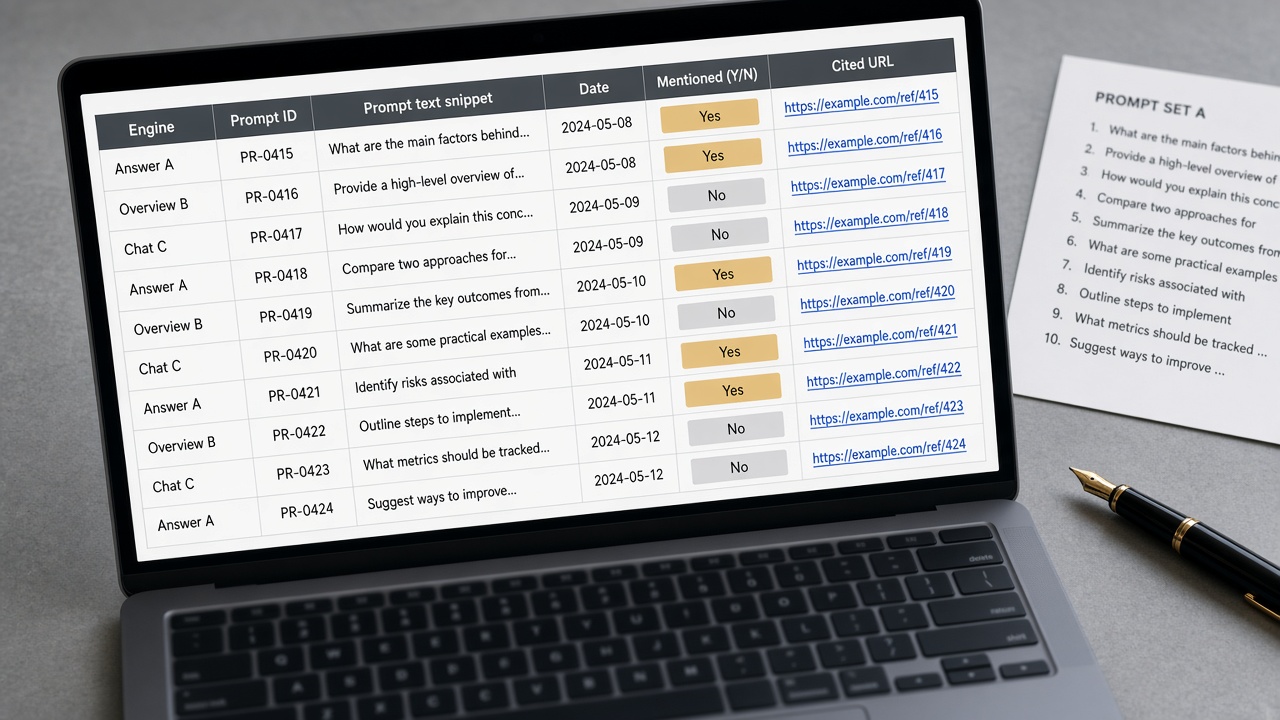
Once you know you are measuring share of mentions over time, the next job is to freeze the surfaces and questions you will actually score. Start with a short roster: ChatGPT, Perplexity, and Google AI Overviews, then add one extra surface your buyers already use—Gemini or Copilot is enough. A tight list keeps runs comparable and keeps the work inside a lean team’s week.
Prompts should follow jobs-to-be-done, not every keyword you already rank for. Aim for a modest, representative set that mixes category discovery, comparison, how-to, and branded queries. Write them once, assign each a stable prompt ID, and reuse the same wording every cycle. Rotating phrasing from cycle to cycle breaks the trend: you cannot tell whether the brand vanished from answers or you simply asked a different question.
That log is the measurement spine. Because every run uses the same engines and the same prompt IDs, yes/no mention and citation flags become a time series instead of a pile of screenshots. Competitors named in the notes cell show who else the engines keep inserting when your brand is absent. With the roster, prompts, and fields frozen, you can finally talk about cadence and how the scores move.
Fixed inputs — Visibility only becomes comparable when engines, prompt IDs, and log fields stay identical from run to run—not when you recapture a new screenshot of a new question.
Set a cadence and read mention trends, not one-off snapshots
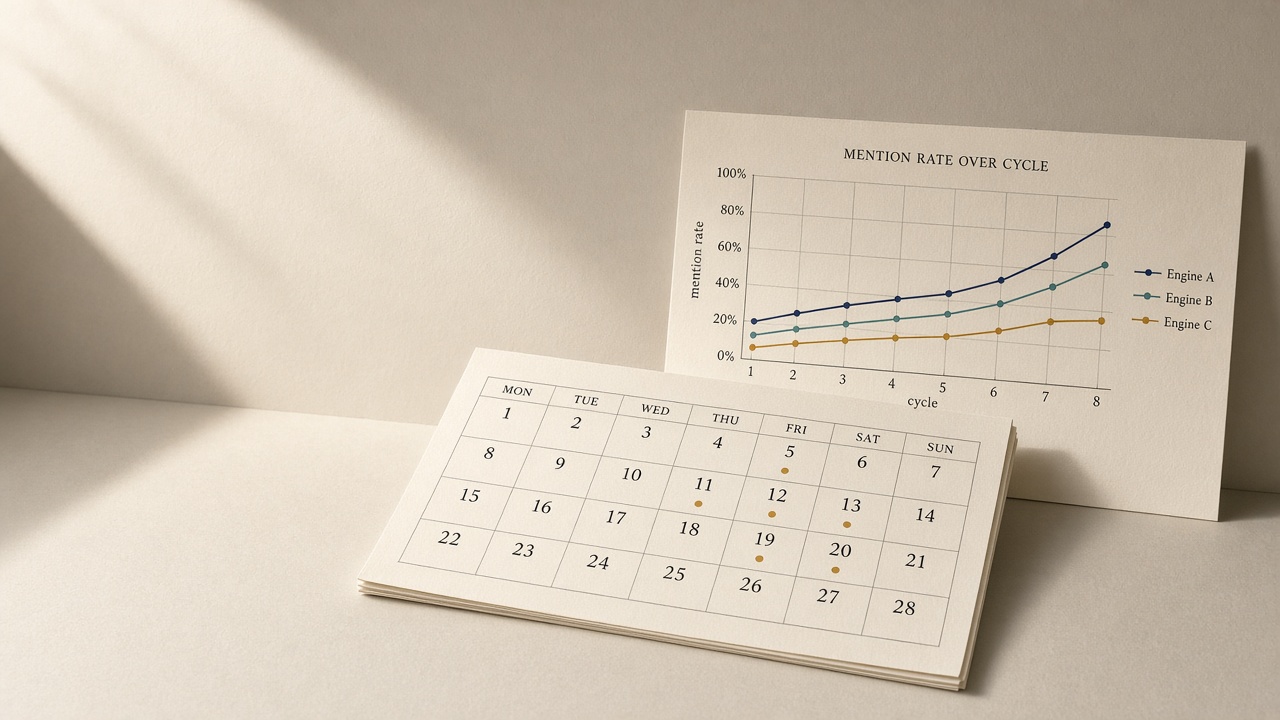
With engines, prompt IDs, and the mention log frozen, the next job is time. Run the full prompt set on a steady cycle so every engine sees the same questions on a comparable date. If you need a closer read, add a more frequent pass on a smaller high-intent subset—the same IDs, never rewritten—so you catch movement without turning the sheet into daily noise.
Score simply. For each engine and each prompt cluster, record mention rate (did the brand or URL appear in the answer) and citation rate (was a source link shown). Do not rebuild a full audit rubric or blend in checker-style grades. Two rates, same definitions every cycle, are enough to see whether answers still include you.
Direction and concentration beat a vanity total
Read the series for direction—up, flat, or down—and for concentration: one engine carrying all the mentions versus the same pattern across the roster. A rising grand total that lives only in a single product is a different story than a quiet lift everywhere. Decide in advance what counts as a real change—such as a cluster that keeps losing mentions across cycles—so you do not chase a single dip.
Flag noise before you treat a drop as a collapse. Model updates, personalized chats, and unsaved sessions can make one run look empty even when the frozen prompts still work on a clean account. Log the anomaly, rerun the same IDs on a fresh session, and only then update the trend. Cadence plus those two rates is the system; the next step is turning persistent gaps into a brief.
Cadence — Regular full-set runs plus simple mention and citation rates, read as direction and concentration, show whether answers still include you—without treating one noisy session as a collapse.
Turn mention gaps into the next brief
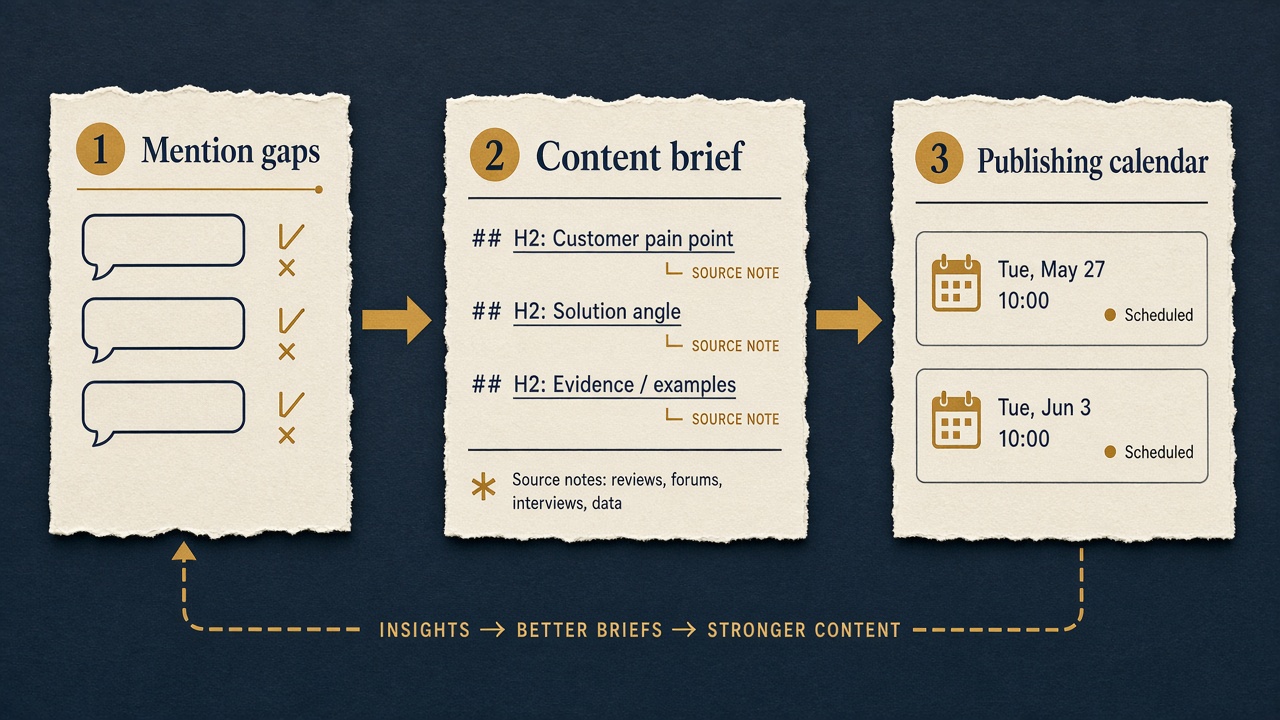
Once the log shows direction—not a single screenshot—the job is to convert missing mentions into work the team already knows how to ship. A gap is a prompt cluster where answers name a competitor or no one at all, while your brand or URL stays out. Do not add more columns to the sheet. Map each gap to one content action: an extractable answer that models can lift, clearer entity language so the brand is unambiguous, or a comparison page that belongs in that job-to-be-done.
Prioritize clusters where rivals appear and you do not. Those are the highest-signal misses: the engine already treats the topic as answerable, and someone else is in the slot. Leave long-tail noise alone. Hand operators the cluster ID, the engines involved, and the action type, then point them at the playbooks you already use for earning citations—answer-engine work, generative-engine work, or a ChatGPT-specific checklist. This article does not re-teach those tactics; visibility tracking only tells you where they should run.
Feed that gap list into the same briefing and publishing queue the team already uses so measurement never becomes a side project. Automated publishing and a concierge layer for online queries help only after the engine roster, frozen prompts, mention log, and cadence exist. Until then, scale is just more unreadable snapshots. Once the log is naming the same clusters as misses, those clusters are already the next briefs—no extra visibility report required.
Close the loop — A mention gap is a content brief—extractable answer, entity clarity, or comparison—queued in the same pipeline you already publish from, not another tracking field.
Key Takeaways
Freeze your engine list and prompt IDs this week, start the mention log on the next cadence, and only then ask an assistant to turn the first gap cluster into a briefing.
Frequently Asked Questions
You Might Also Like
- AEO AI Visibility Checker: How to Audit Whether AI Engines Cite You
- AEO Answer Engine Optimization (AEO): How to Get Cited by AI Search
- AEO How to Get Cited by ChatGPT: A Practical Visibility Checklist
- AEO What Is Generative Engine Optimization (GEO)? The 2026 Playbook
- Comparisons AEO vs SEO: What's Different and What Still Matters