What Is Content Automation? A Plain-English Definition

Most people first hear content automation as a product pitch: an AI blog writer, an autoblogging plugin, a keyword in, article out. That picture is too small, and it is why a lot of teams either over-trust a draft generator or dismiss the whole idea as spam. The useful definition is operational. Content automation is software and models handling the repeatable steps in how you plan, create, optimize, publish, and distribute articles—so people spend time on judgment instead of copy-paste.
On that spectrum, an AI writer is one station, not the factory. A real research-to-publish loop also clusters topics, builds briefs, drafts with constraints, inserts internal links, checks on-page SEO, ships to a CMS, and feeds performance back into the next brief. Autoblogging sits at the far end: unattended production. Lean teams usually belong in the middle—higher output and consistent structure, with quality gates that a human or a strict rule set still has to pass.
This article defines content automation in plain English, separates it from nearby ideas such as programmatic SEO and AI concierges, and maps what actually belongs in software versus what should stay human if you care about uniqueness, brand, and search quality—not raw article count.
- Content automation covers the full research-to-publish loop, not just AI-generated drafts.
- It is a spectrum from assisted writing to autoblogging; most lean teams should keep quality gates in the loop.
- The payoff is faster brief-to-publish cycles, consistent SEO structure, and time back for strategy and brand voice.
- The risks are thin or duplicate pages, brand drift, and factual errors when uniqueness and E-E-A-T checks are skipped.
- Automate high-ROI repetitive jobs first—clustering, briefs, internal links, meta, scheduling—before unattended publishing.
What Content Automation Actually Covers
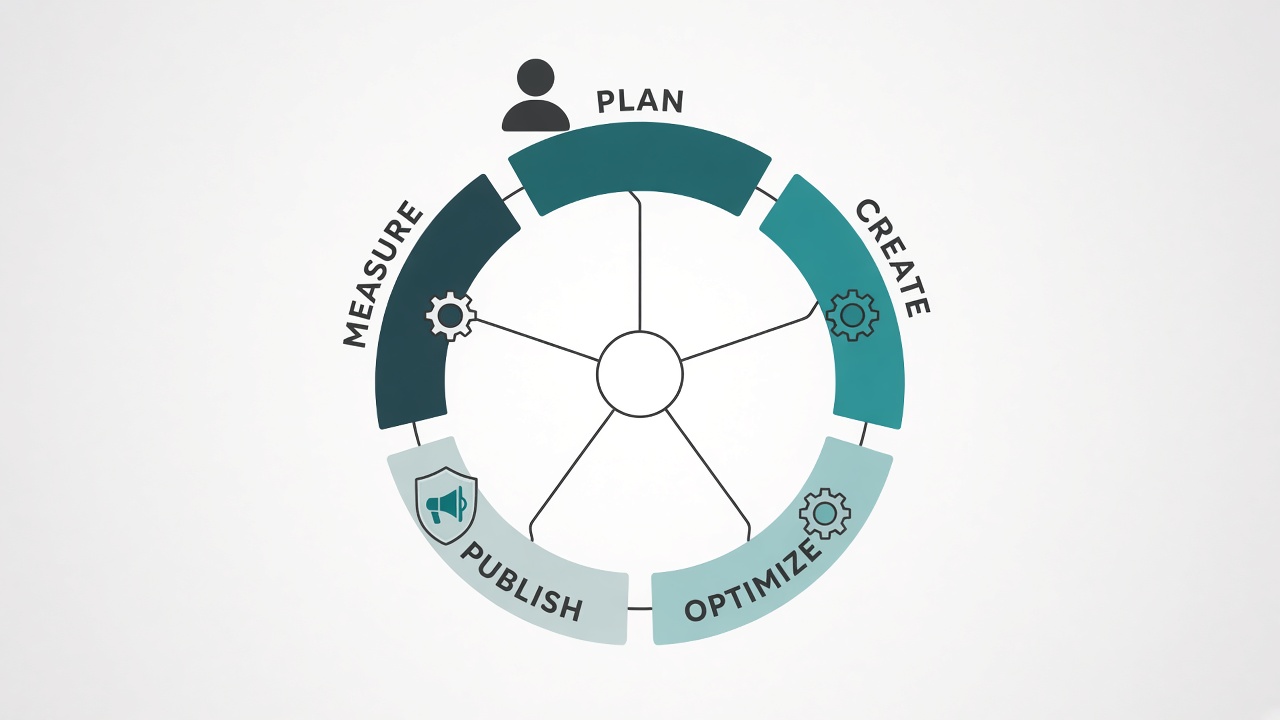
Once you look past product pitches, the practical scope is the full production line: every step that can be templated, checked, or scheduled without reinventing it each time. Draft generation is only one station on that line.
What makes those stations automatable is not magic—it is rules, templates, and checks. Clustering criteria, brief schemas, on-page validators, link maps, CMS payloads, and feedback thresholds can all run at volume once they are explicit.
The reader job is usually the same: scale SEO and content marketing output without a large editorial headcount. For SMBs and startups the promise is consistency and speed—more pages that look and rank like a process, not a scramble—while humans still own strategy, voice, facts, and the quality gates that decide what actually goes live.
In short — Content automation runs the repeatable research-to-publish work so lean teams can scale; strategy, voice, facts, and quality stay human.
From AI Drafts to Full Pipelines
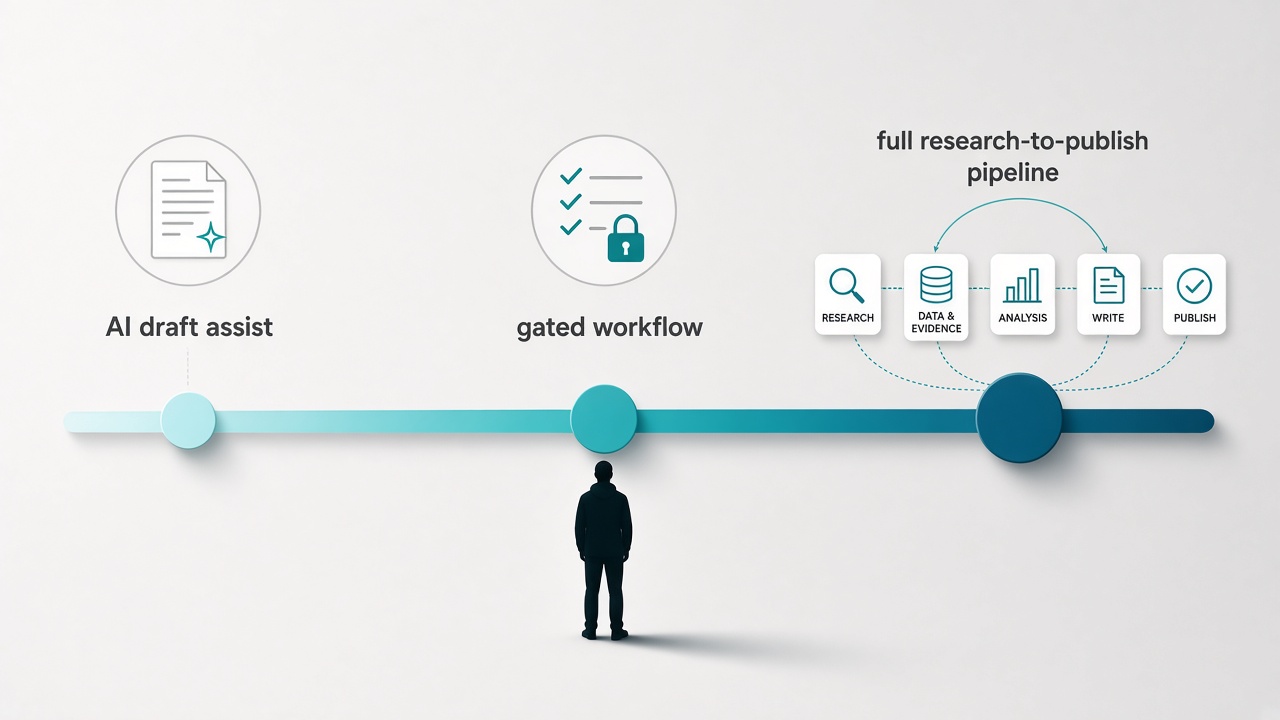
Once that loop is clear, the next question is how much of it software actually owns. Tools sit on a spectrum, not a single switch. An AI blog writer lives at the assisted end: it helps with drafts while a person still researches, structures, and hits publish. Content marketing automation moves further along by adding calendars, scheduling, and distribution so finished pieces actually leave the building. Full pipelines sit at the far end. They own brief-to-publish with explicit rules—clusters into briefs, drafts, on-page SEO, internal links, CMS publish—then fold performance back into the next cycle.
Three operating modes sit on the same line. Assisted mode is a copilot in the editor. Gated workflows run more of the loop but halt for a human or a hard rule before anything goes live. Unattended automated SEO publishing ships when those checks pass. Content scaling is the outcome of moving right without a larger newsroom. SEO automation is the on-page and publishing slice of that move. Autoblogging is simply the unattended end of the same spectrum, not a different category. Climb in that order rather than jumping to unattended publishing because a model can write paragraphs.
The further right you go, the stronger those briefs, uniqueness checks, and edit gates must be—not thinner. Higher automation is extra process, not permission to skip oversight. Volume without those gates is how brand voice drifts and thin pages slip through.
The tradeoff — Moving right on the spectrum multiplies output only if briefs, uniqueness checks, and edit gates get stricter—not looser.
What Content Automation Is Not
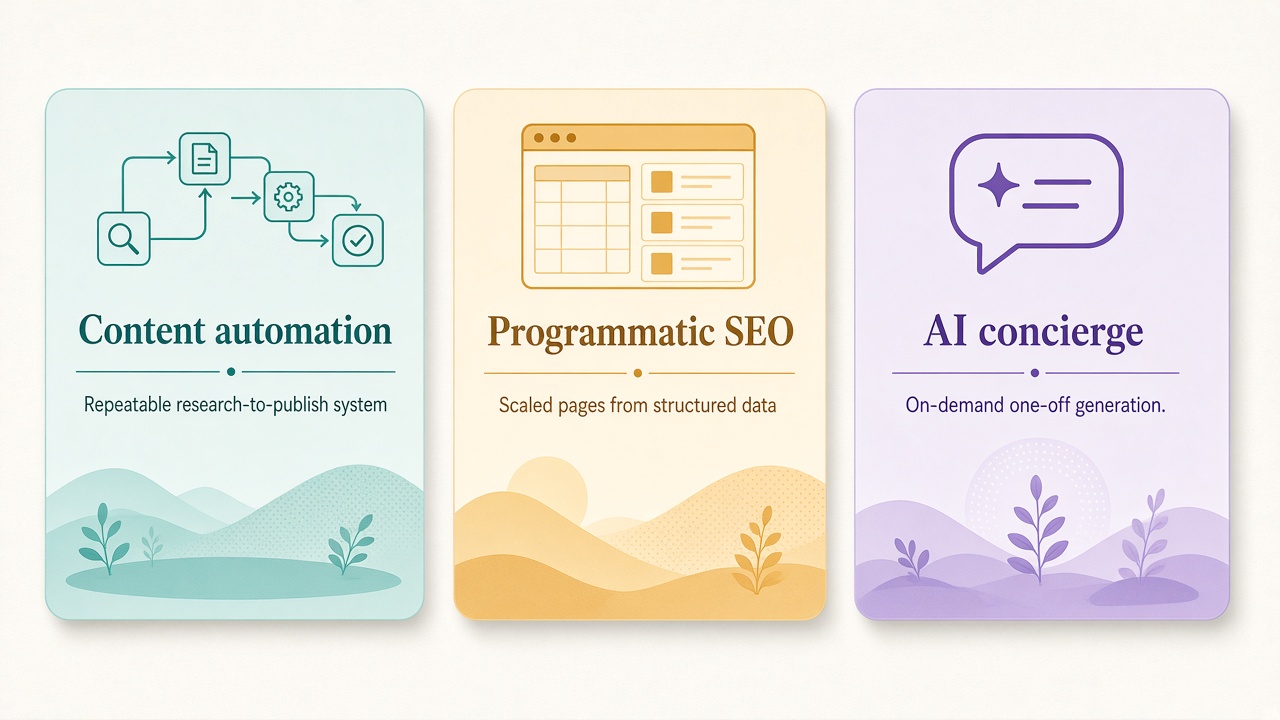
With that spectrum in view, it is just as useful to name what the term does not cover. Content automation is a research-to-publish workflow for articles—not every neighboring tactic that also uses software or AI.
Programmatic SEO, for instance, scales pages from structured data—locations, SKUs, directories—through templates. It can sit beside an automated content stack, but it is data-to-page generation, not a brief-to-article loop with clustering and drafts.
An AI concierge is different again: it answers live queries in the moment. That is query handling, not article production. Mixing those jobs blurs what you are actually automating.
Flooding a CMS with unreviewed AI pages is not the definition either. That is a failure mode—thin or duplicate output with no uniqueness check. The label still assumes humans own strategy, voice, and facts.
For the adjacent maps, treat autoblogging, programmatic SEO, and SEO automation tools as separate deep-dives. They overlap at the edges; they are not the same loop.
The cutoff — Content automation is a gated article workflow. Programmatic templates, live concierges, and unreviewed bulk pages sit next to it—they are not the same thing.
Benefits, Risks, and the Quality Gates You Cannot Skip
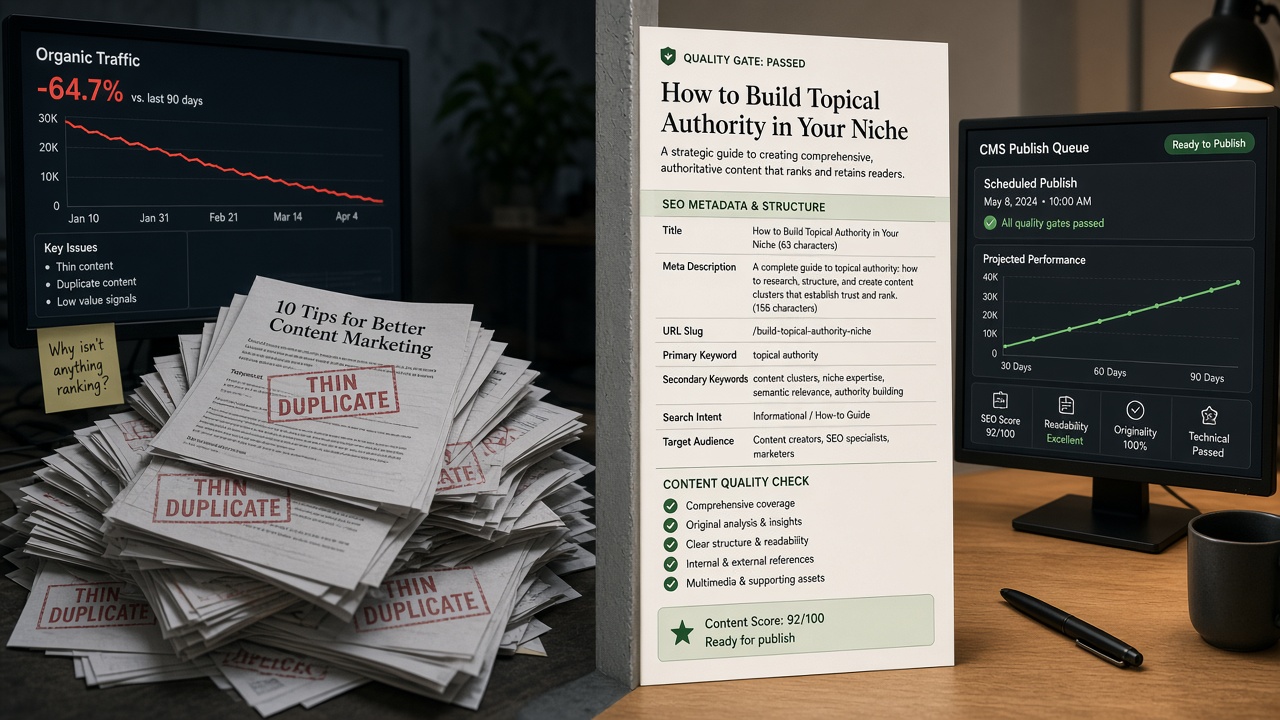
With the topic framed, the useful question is the trade-off: what a lean team actually gains, what breaks when the loop runs without judgment, and which checks cannot be skipped.
Used well, automation raises output without a matching editorial bench. It applies SEO structure the same way on every page, shortens the path from brief to publish, and hands clustering, formatting, and CMS busywork back so people can spend time on strategy and brand.
The downside is equally concrete. Thin or duplicate pages, brand drift, factual errors, and weak E-E-A-T are what you get when uniqueness and editorial judgment are treated as optional. Search and AI answers both treat that mix as noise. Volume without those checks is how a site trains both systems to ignore it.
Nothing ships until these gates clear
- An intent-fit brief so the draft answers the query the page is meant to win.
- A uniqueness check against existing pages so you are not competing with yourself.
- Source and fact checks before anything is public.
- A voice pass so the brand does not flatten into generic machine tone.
- On-page SEO and internal links as a last structural pass.
- A human or rule-based ship gate—no unattended publish until the checks above clear.
Judge the pipeline on indexed quality pages, traffic and rankings per piece, time-to-publish, revision rate, and citation readiness. Raw article count is a vanity number; it hides thin inventory instead of proving the loop works.
Ship the gates — Automation only scales content when every piece still clears intent, uniqueness, facts, voice, and a ship decision—and you count indexed, useful pages, not drafts.
Five rungs: how lean teams should grow automation

Those quality gates and metrics make the next decision practical: what to automate first, and when it is safe to go further. Lean teams do not jump from an assisted draft to unattended publishing. They climb a ladder, taking over high-ROI, repeatable work before they ever remove a human from the last mile.
- Keyword clustering and briefs—so every piece starts from intent, not a blank page.
- Meta, internal links, and scheduling—the on-page and calendar chores that should never wait on a writer.
- Gated AI drafting—machines produce a draft; a human or rule-based edit still has to clear it.
- CMS publish with monitoring—ship through the CMS, then watch indexation, rankings, and revisions.
- Selective unattended paths—only after those gates have proven stable on real output.
Keep strategy, original expertise, sensitive claims, and final brand judgment human longer than any other part of the loop. Those are the pieces that hold voice and trust as volume rises. The stack that supports the ladder is a shape, not a shopping list: a research and brief layer, draft plus edit gates, on-page checks, CMS publishing with monitoring, and a performance feedback loop that informs the next briefs.
Move to the next rung only while revision rate and quality metrics stay healthy. If uniqueness, voice, or citation-readiness slip, freeze unattended paths and tighten briefs and gates before you add more automation.
Order of operations — Automate clustering, briefs, and on-page chores first; keep strategy, expertise, and brand judgment human; open unattended publishing only after gates and revision rates stay stable.
Key Takeaways
Map your process to the five-rung ladder and, when you are ready to automate briefs through gated publish without dropping quality, see how Flowcrews runs that loop for lean teams.
Frequently Asked Questions
You Might Also Like
- Automation What Is Autoblogging? How Automated SEO Publishing Actually Works
- Automation SEO Automation: Tools, Workflows, and What to Automate First
- Comparisons Best SEO Automation Tools in 2026 (Compared by Job-to-Be-Done)
- Automation Programmatic SEO: How to Scale Pages Without Thin Content
- Guides SEO Content Brief Template: The Complete Guide to Briefs That Rank