Content Marketing Automation: A Practical Playbook

Most teams that try to “automate content” start with a writer and end with a pile of thin pages. Draft speed is rarely the real bottleneck. The work that actually compounds is turning research into briefs, briefs into on-brand drafts, drafts into optimized and internally linked pages, and pages into distribution—without letting quality or voice collapse as volume rises.
Content marketing automation is that full orchestration: research, clustering, briefing, drafting, optimization, publishing, and distribution, with people as gates rather than as the entire factory. For a lean team, the playbook is not unattended publishing. It is which tasks to automate first, where a person must still decide, and how to run a research-to-publish stack that stays useful to readers and defensible in search.
This guide is for operators who need scale without a newsroom. It maps high-ROI work first—keyword clustering and briefs, on-page optimization, internal linking, and distribution—then the quality gates that keep automated output from drifting into generic or autoblogging-style filler, including content structured enough to be retrieved and cited in answer engines, not only ranked as a URL.
- Treat automation as a research-to-publish pipeline, not as unattended AI writing.
- Automate clustering, briefs, on-page SEO, internal linking, and distribution before full auto-publish.
- Keep human quality gates so volume does not produce thin or off-brand pages.
- A practical stack pairs research tools, brief generators, gated AI drafts, CMS workflows, and analytics.
- SEO automation, programmatic pages, and autoblogging only work when those same gates stay in place.
Automation Is Orchestration, Not Autopilot
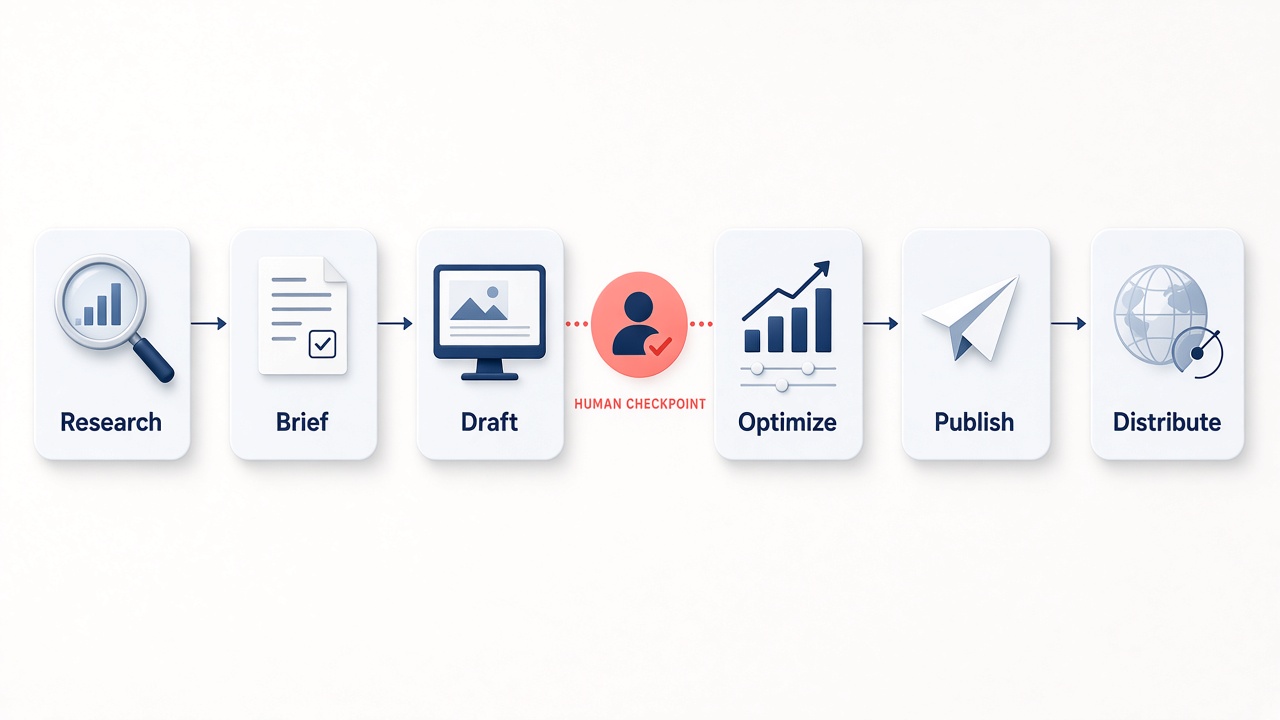
Most teams hear “content marketing automation” and picture a chatbot replacing the editorial calendar. The useful definition is narrower and more operational: it is the coordination of research, briefing, drafting, on-page optimization, publishing, internal linking, and distribution as one stack—not a swap of writers for generated copy.
That stack can run in two modes, and mixing them up is how scope explodes. Assistive automation keeps humans in the loop as quality gates on briefs, drafts, and go-live. Unattended publishing removes those gates. The first is how lean teams scale without brand drift; the second is a different bet, closer to autoblogging than to a marketing program. Decide which mode you are buying before you map tools.
Adjacent terms get used as synonyms, and they are not. SEO automation owns technical and content-ops work. Content scaling is the outcome you want. Autoblogging is one end-to-end publishing pattern. Treat them as neighboring practices rather than redefining them here.
What most email-and-social tool lists skip is the research-to-publish SEO pipeline itself—clustering, briefs, on-page work, internal links, and the quality controls that keep pages useful. Distribution tools move whatever already exists. They do not build the system that produces it.
Orchestration first — Content marketing automation coordinates research through distribution with humans as quality gates—it is not a chatbot, an unattended blog, or a social-scheduling list.
What to Automate First—and What to Leave Human
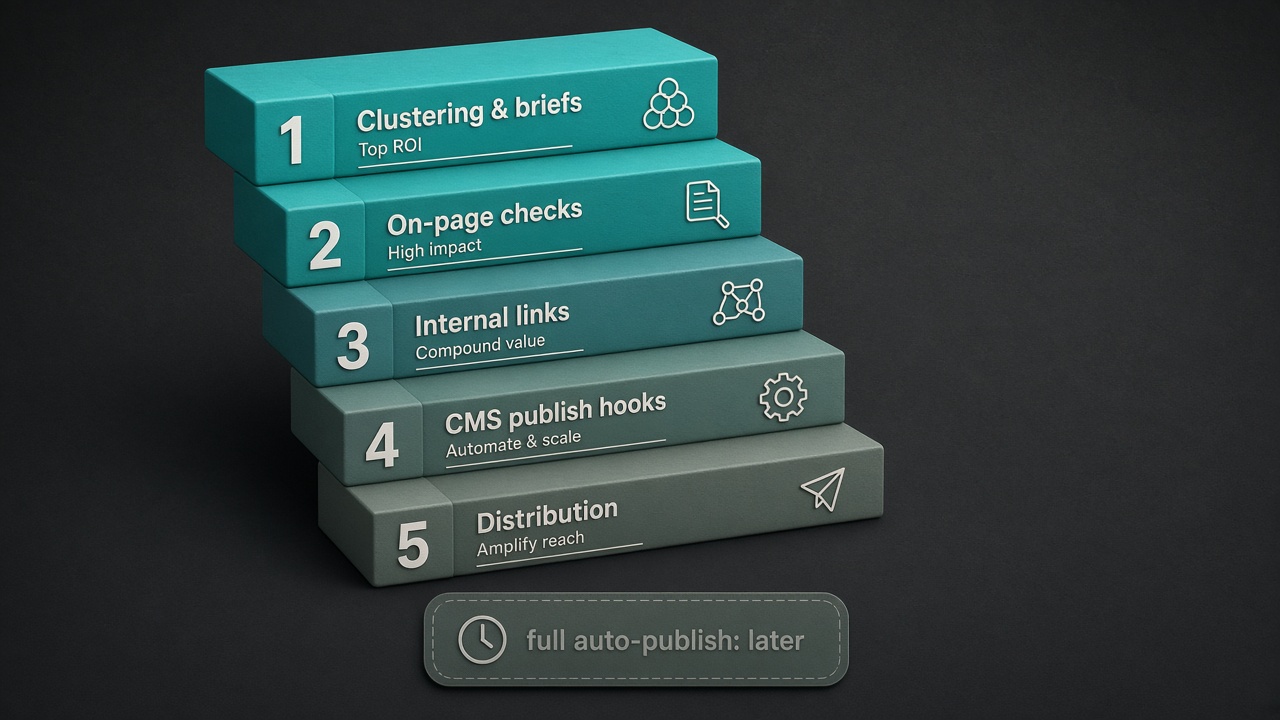
Sequence is the real first decision. Wire the wrong jobs first and the stack will manufacture thin pages faster than editors can catch them; wire research and structure first and every human hour multiplies.
Automating draft volume before clustering and briefs creates content debt—overlapping URLs, weak intent match, and rewrites that erase any time you thought you saved. Automating clustering, briefs, and on-page checks first hands editors a map and a checklist so they spend time on judgment, original insight, and a final yes.
For a lean team, implement in this order—repetitive, rules-based work first; unattended long-form last.
Fully unattended long-form publishing stays off this list until briefs, brand voice, and uniqueness gates are stable. Automate the repetitive, rules-based steps; keep judgment, original insight, and final publish approval human.
Order — Cluster and brief first so automation multiplies editors; delay unattended publishing until quality gates are boringly reliable.
Wire a Lean Research-to-Publish Stack
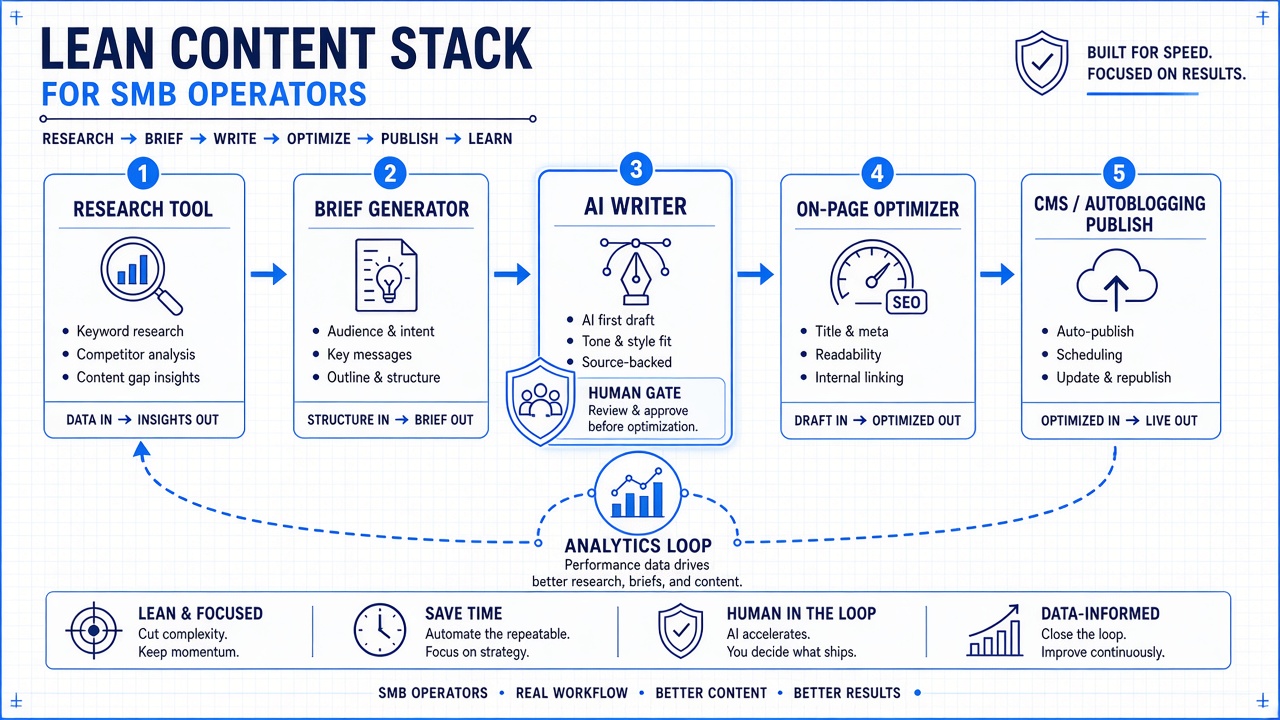
With that priority order in hand, the next move is to give each job a home in a stack small enough that one owner can name every integration. Map the path by work, not by vendor category, so clustering, briefs, drafts, on-page checks, publishing, and feedback actually hand off instead of living in separate logins.
Jobs in the minimal stack
- Research and SERP intel that clusters topics and captures intent before anyone writes.
- A brief generator whose schema is the contract the rest of the stack must honor.
- AI draft assist behind a human editor—not unattended long-form.
- An optimization layer for on-page checks, internal-link suggestions, and metadata.
- CMS scheduling and publish hooks that fire only after that checklist clears.
- Analytics or Search Console feedback that loops topics back into the queue.
Those pieces scale only when they share that brief schema. Research fills the fields; the writer drafts against them; the optimization checklist gates the CMS; distribution templates run after the URL is live. Performance data then retires, refreshes, or seeds the next cluster. Prefer a handful of reliable integrations over a shelf of “best SEO automation tools” with no owner. Bake answer-engine readiness into the same gate—structured headings, clear entities, consistent metadata—rather than treating it as a retrofit. Leave vendor roundups and full workflow tours to adjacent articles; this playbook stays on the wiring.
Own the path — Automate the handoffs between research, brief, draft, optimization, CMS, and analytics—and leave every extra tool off the board until someone owns it.
Quality Gates That Protect Brand and Rankings
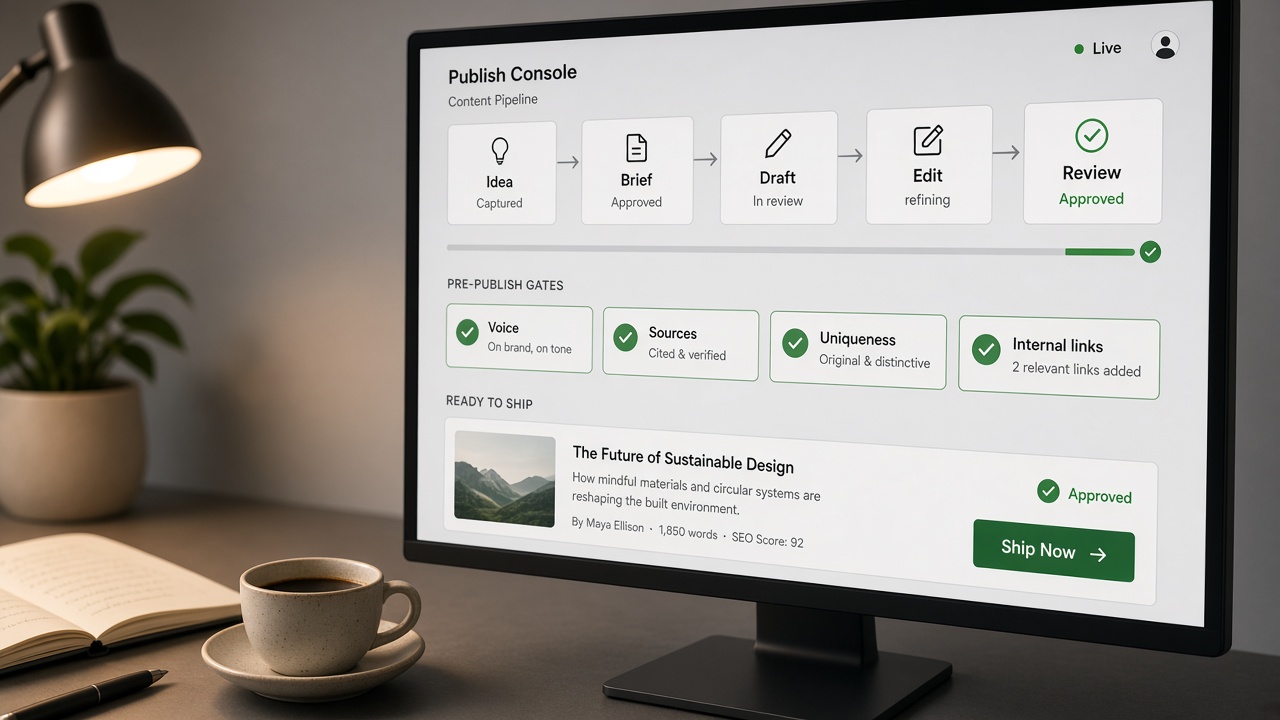
What keeps that setup from turning into unattended publishing is a short list of quality gates between draft and CMS. Automating clustering, briefs, on-page checks, and internal linking should multiply editors—not skip them.
Make these checks mandatory
- Source-backed claims: nothing assertive ships without a cited or editor-verified basis.
- Brand voice pass: tone, terms, and promises match the living style guide.
- Intent match to the brief: the draft still answers the clustered query and the searcher’s job.
- Duplicate and near-duplicate scan: uniqueness against your own corpus and close SERP copies.
- Internal-link minimums: enough contextual links into related clusters before publish.
Require a human editor to sign off on every net-new pillar or money page. Tightly templated updates can take a lighter review once those gates pass. Programmatic pages and autoblogging templates still need uniqueness rules, or scale turns into doorway risk.
Write down the failure modes and the fix for each. Generic AI filler is caught by uniqueness and intent-to-brief checks. Brand drift is caught by a voice pass against approved language. Missing entities are caught on the same optimization checklist that already gates the CMS. The remedy is always a gate or a checklist item—not hope that the model will behave.
Quality gates — Scale the research-to-publish stack only as far as uniqueness, voice, intent, and a human sign-off on money pages can still catch thin or off-brand work.
Scale volume only when the quality loop holds
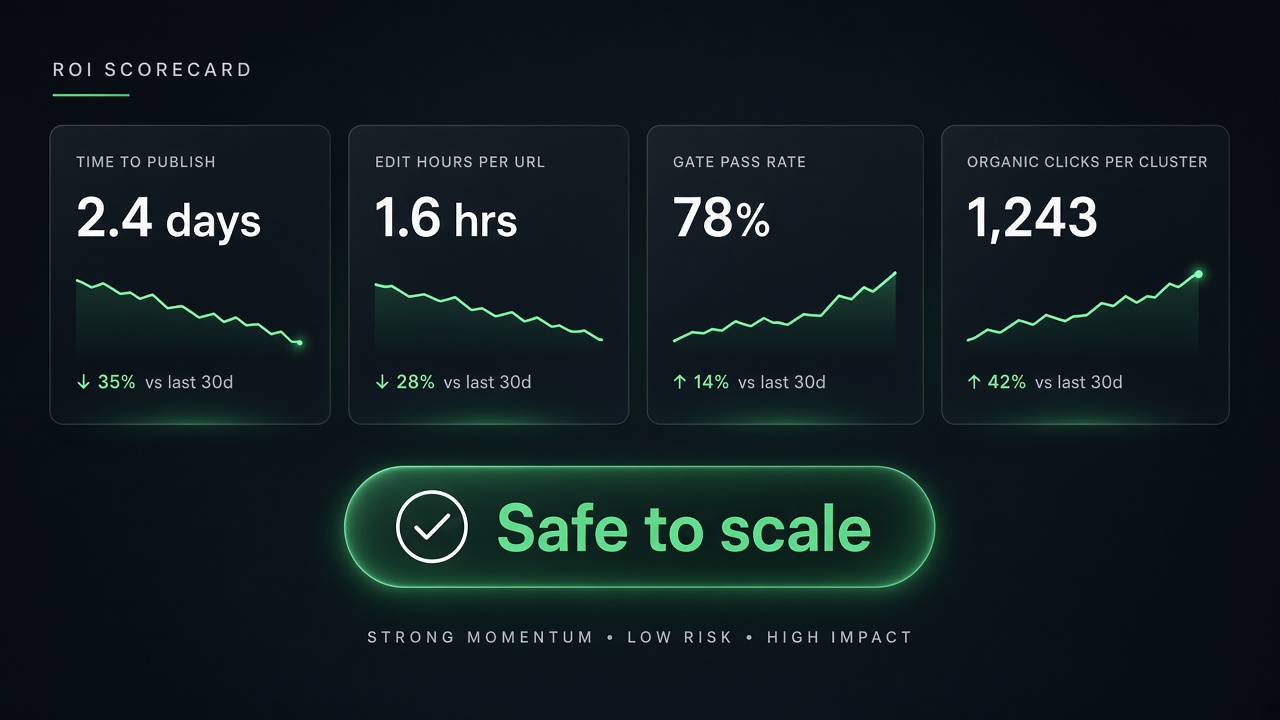
Once those gates are in place, the stack still needs a scoreboard. Automating clustering, briefs, on-page work, internal links, and distribution will raise output; it only raises useful coverage if you watch both the clock and what the pages actually earn.
Leading and lagging metrics
- Time-to-brief, time-to-publish, and edit hours per URL—proof the research-to-publish loop is lighter on people.
- Indexation rate, plus organic clicks and conversions per automated cluster—proof the market still cares.
- Thin-content or rewrite rate—the early warning that uniqueness or intent match is slipping.
Treat extra volume as a go/no-go, not a default. Increase cluster output only when quality-gate pass rate and engagement hold steady for a defined window. If either dips, freeze new templates and repair the brief or the gates first. ROI for a lean team is more covered intents per FTE, not raw word count.
Looking ahead, answer-engine visibility sits beside classic rankings. Keep structured, citable checks—entities, headings, consistent metadata—inside the same optimization loop so AEO and SEO scale together.
The scale rule — Raise volume only when gate pass rate and engagement stay steady; measure covered intents per FTE, not words published.
Key Takeaways
Wire clustering, briefs, and quality gates into one research-to-publish loop this week, then increase volume only after those gates and engagement actually hold.
Frequently Asked Questions
You Might Also Like
- Automation SEO Automation: Tools, Workflows, and What to Automate First
- Automation Programmatic SEO: How to Scale Pages Without Thin Content
- Automation What Is Content Automation? A Plain-English Definition
- Guides SEO Content Brief Template: The Complete Guide to Briefs That Rank
- Strategy Keyword Clustering: How to Group Keywords into Rankable Topics