Best SEO Automation Tools in 2026 (Compared by Job-to-Be-Done)

Most roundups of the best SEO automation tools still rank products by how many AI features they list. That is how lean teams buy overlapping licenses, ship thin pages, and still cannot say who owns quality.
Treat automation as discrete jobs-to-be-done: keyword research and clustering, briefs, writing and publishing, internal linking, measurement, and answer-engine visibility (AEO). A tool earns a place when it owns one of those jobs, blocks weak output before it goes live, and plugs into the CMS you already run—not when it claims to replace an entire content team.
If you arrived here to choose software, start with the job you will actually hand off this quarter. Automate the repetitive, high-leverage work first (clusters, briefs, internal links). Keep a human review layer on anything that can become doorway pages, brand drift, or a ranking filter. The rest of this guide is a buyer’s scorecard: how to compare tools by job, what “good enough” quality gates look like, and how to assemble a minimal pipeline that publishes useful pages instead of volume for its own sake.
- Choose tools by the job they own—research, briefs, publish, links, measurement, AEO—not by feature count.
- Automate clustering, briefs, and internal linking before full article generation.
- Require quality gates and human review so scale does not become thin content or brand drift.
- Fit the stack to your CMS and budget; an all-in-one that owns no job well is more expensive than it looks.
- Treat AEO visibility as a first-class job alongside classic rankings and reporting.
Why Feature Lists Fail SEO Tool Buyers
That scorecard is not a how-to. It will not walk you through programmatic templates, autoblogging setups, keyword clustering methods, or AEO tactics—those belong in operational playbooks. Here the only question is what to buy: which tool you assign to which job, and whether it clears quality, CMS, and cost checks before it ever publishes.
Feature matrices make that look simple. They treat every checkbox as equal, so a platform that “does” research, briefs, publishing, linking, reporting, and AEO in one login looks like a bargain. What they omit is the integration tax of wiring those features into WordPress or your actual CMS, the review hours a lean team still spends catching thin pages and brand drift, and the ranking risk of volume that never earned a human pass. Startups and agencies pay those costs in calendar time, not on the pricing page.
If you are replacing discrete human hours—an afternoon of research, stalled briefs, internal links that wait for a sprint—you do not need an all-in-one AI SEO suite. You need one tool per job, scored hard.
The six jobs we use throughout are keyword research, briefing, writing and publishing, internal linking, measurement, and AEO visibility. For each, the non-negotiable lens is the quality gate: can the output ship without doorway pages, brand dilution, or a full rewrite? Everything that follows is that scorecard, not a feature tour.
Buy the job, not the suite — Feature matrices hide integration tax, review burden, and thin-content risk. Assign each tool one job and score it on quality gates, CMS fit, and lean-team cost.
Score Every Tool on One Job—Then on Five Gates
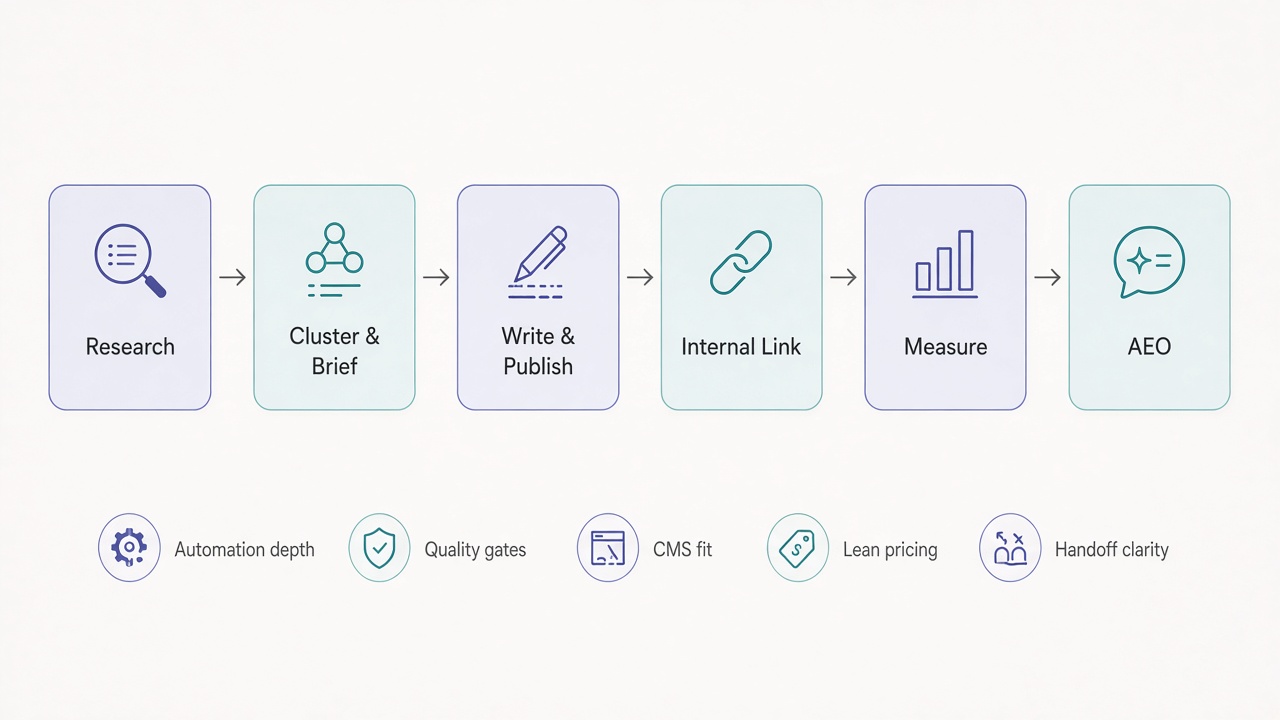
Name the job first: the outcome you will ship, the inputs the tool must consume, and the line where a human still owns the page. If a product cannot be described that way, it is a feature bundle, not a hire.
The six jobs, in operator language
- Keyword research — Outcome: a prioritized, intent-labeled opportunity list. Inputs: seeds, competitors, query data. Automate clustering and gaps; do not invent topics you cannot defend.
- Briefing — Outcome: a brief a writer or model can execute. Inputs: SERP patterns, entities, outline constraints. Automate structure and must-cover claims; stop before first-draft copy.
- Writing/publishing — Outcome: a CMS-ready draft. Inputs: the brief and voice rules. Automate generation and WordPress formatting; do not auto-publish without review.
- Internal linking — Outcome: relevant links on live URLs. Inputs: your URL inventory and topical map. Automate rule-based suggestions; never mass-insert.
- Measurement — Outcome: a clear view of what moved. Inputs: ranks, traffic, conversions. Automate collection and alerts; leave the strategy call to a person.
- AEO visibility — Outcome: answers that can be cited. Inputs: questions, entities, schema. Automate packaging for answer surfaces; do not fabricate citations.
When a new tool launches mid-year, ignore the feature count and run five scores. Automate high-ROI repetition first—clustering, briefs, and internal links—before you trust full article generation.
Two things sit outside this rubric on purpose. It is not a lock-in pitch for any suite, and it is not a recommendation to automate the whole pipeline. A five on research and a two on publishing means you buy research—full stop.
One job, five scores — Assign every SEO automation tool a single job, rate automation depth, quality gates, CMS/cost fit, and handoff from 1–5, and refuse “automate everything” stacks that skip a human gate.
Score Research Tools on Clusters and Briefs, Not Database Size
That same rule is how you buy the research layer. Ignore keyword-database size. Score cluster quality, SERP-intent fidelity, export-to-brief workflows, and API or CMS readiness. If two tools disagree on which queries share a results page, the larger index is not the better tool—it is just a more expensive guess.
Where clustering stops and briefing starts
Clustering is finished when the map is stable: a parent topic, supporting queries, duplicate-topic flags, and a recommended URL. Briefing starts there. It turns that map into an outline with search-intent labels, entities to cover, and questions the SERP already rewards. Score the jobs separately even when one vendor bundles them, or you will pay twice for the same keyword list dressed up as AI content.
Gates before anyone drafts
Before a draft exists, the research layer has to catch thin and doorway risk. Treat these as must-haves:
- Duplicate-topic detection so you do not brief a page that already exists or overlaps a sibling cluster.
- Search-intent labels that match the actual SERP—informational, commercial, transactional, local—not a modifier guess.
- Entity coverage listed in the brief so the draft cannot skip the people, products, and concepts ranking pages treat as table stakes.
If the tool cannot export that package—cluster, intent, entities, cannibalization notes—into a brief or an API, it is not automation-ready. A CSV dump is not a workflow.
Default picks by scenario
Agencies need isolated workspaces, reusable cluster maps, and briefs that leave the suite—into WordPress or whatever each client already runs. A single-product startup should run one SERP-true clusterer and one briefing layer with a clean CMS handoff, then stop. Two research suites double review time, not rankings. Keep a human on the cluster and the brief; that gate is what stops programmatic output from becoming doorway pages. Writing and publishing are the next purchase, not an add-on checkbox.
Two jobs, one handoff — Buy clustering until the map is stable, then briefing until intent, duplicates, and entities are labeled. Database size is not the score.
Score Writing and Publishing on Briefs, CMS Paths, and Human Gates
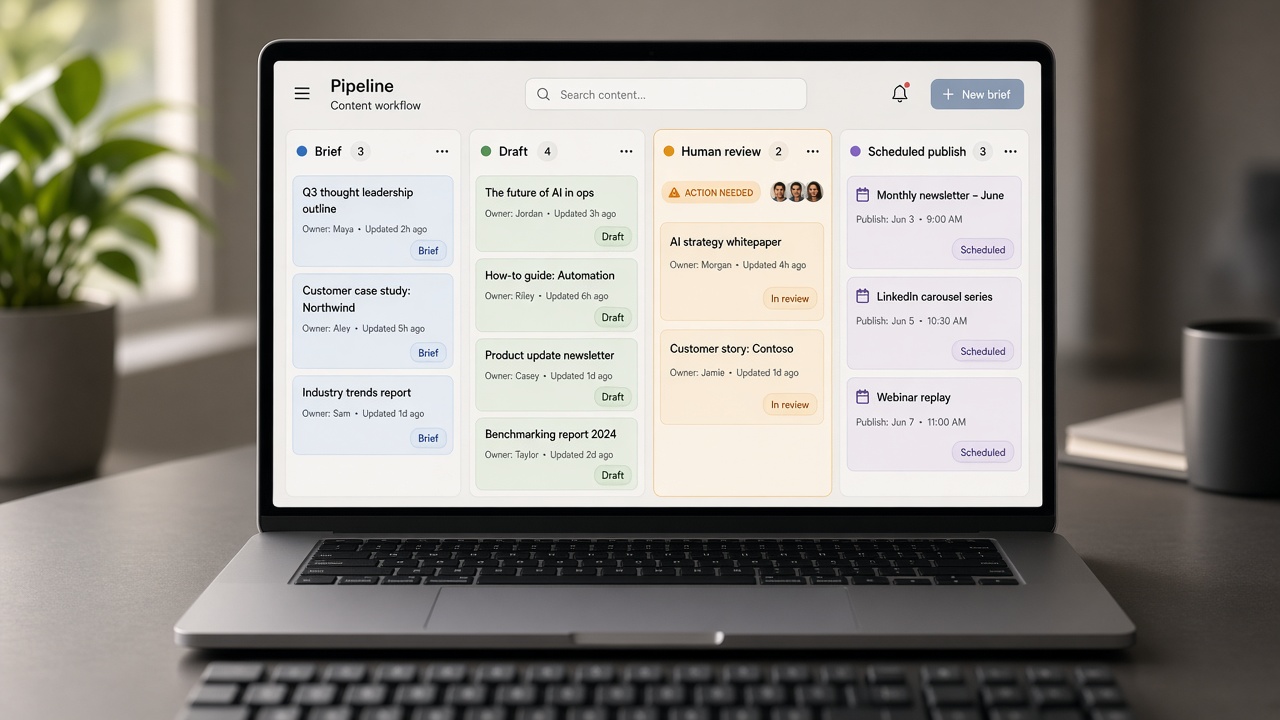
That purchase is a class decision. Catalogs still sell “AI writing” as if a chat copilot and a research-to-publish pipeline were one product. They are not. Assist tools draft from a pasted prompt. Pipeline tools ingest an approved brief, generate a candidate, run on-page checks, and stop until a human signs off. Match the class to the writing-and-publishing job, or you will buy words and still ship by hand.
Assist is not a pipeline
Assist is a copilot: brief in, draft out, you copy it into the CMS. Pipeline automation is the production line: brief in, uniqueness and style gates, scheduled publish, named approver, live URL. Score them on the same matrix and chat looks cheaper while pipelines look bloated. Lean teams that need volume with a quality gate buy the pipeline; teams that still outline by hand buy assist and keep the CMS step human.
Score the gates, not the generator
Once the class is clear, score whether the tool respects the brief you already approved.
- Brief adherence — intent label, entity coverage, and outline stay intact through the draft.
- On-page optimization depth — titles, meta, headings, internal-link slots, and structured-data suggestions that follow the brief, not a generic SEO score.
- CMS publish paths — native WordPress or your CMS, draft versus live, authors, categories, and canonicals without a spreadsheet round-trip.
- Scheduling and human-approval checkpoints — queues and embargoes, with an approver step a cron job cannot skip.
- Uniqueness and style gates — near-duplicate and brand-voice checks before anything is public.
Brand drift, invented facts, and thin variants of the same cluster are the failure modes. A generator that spins near-identical pages from one parent topic is doorway risk, not depth. Uniqueness and style should be hard stops before publish, not optional toggles after.
Seat models either punish a small team or reward it. Charging every reviewer makes safe volume expensive; usage- or site-based plans that include an approval role keep the human on the gate without extra licenses. Contract for few editors, many pages, one CMS. Treat this layer as the concierge after research and briefs—pages that can rank because they cleared gates, not because the model produced more copy. Buy that job once; internal linking is the next discrete purchase.
Pipeline vs. assist — Buy write/publish tools for brief adherence, CMS publish paths, and unskippable human gates—not for how many words the model can generate.
Score Internal Linking on Context, Hubs, and Safe Apply
Internal linking is that next discrete purchase because publish only ships pages—it does not place them. A URL that cleared brief adherence and human approval still behaves like an orphan until something maps it into hubs, spokes, and related commercial pages. Buy a linker for that job alone, then score crawl depth, anchor quality, hub awareness, apply safety, CMS fit, and lean-team cost—not how many AI links a demo can spray.
Crawl, context, hubs, and safe apply
- Crawl depth — reaches nested templates, indexable pagination, and URLs from the latest publish batch, not just the homepage.
- Contextual anchors — phrases that fit the surrounding sentence the way an editor would write them, not stuffed exact matches.
- Hub-and-spoke awareness — parent cluster pages get supporting links; spokes point up and across with restraint.
- Bulk-safe apply — stage, preview, exclude templates, protect URLs, and roll back before anything hits production.
For lean teams, wiring existing gated pages is usually higher ROI than another round of full article generation. Research, briefs, and human-approved drafts are already paid for. Placement is leverage on inventory that passed quality gates. More copy without a graph just grows orphans—and the thin-content risk this scorecard is built to avoid.
"Orphan pages are a placement problem, not a production problem. Automate the graph after the gates, not instead of them."
— FlowCrews editorial
Require three gates before anything applies in bulk: no spammy over-linking, protected money pages (pricing, checkout, flagship commercial URLs) that bulk jobs cannot touch, and a review queue when a new cluster lands so spokes do not auto-attach to the wrong hub. The publish handoff should emit URL, canonical, cluster ID, and primary entities so the linker enqueues the page without a sitemap scavenger hunt.
Internal linking — buy it as its own job and score crawl depth, contextual anchors, hub-and-spoke awareness, and bulk-safe apply, with over-link caps, protected money pages, and a review queue so new URLs enter the graph without scavenger hunts.
Score Measurement and AEO Tools on Alerts, Decay, and Closed Loops
n. Once that payload exists, the linker should enqueue the URL without waiting on a full recrawl. Measurement is the next discrete job: it does not discover pages; it tells an owner whether a published URL is still earning its cluster. Buy reporting as a signal layer, not a wall of charts.
Score reporting tools on three things. First, anomaly alerts that surface ranking, indexing, or traffic breaks fast enough for a lean operator to act the same week. Second, content-decay signals—pages that still belong to a valid cluster but are losing intent fit, freshness, or SERP position. Third, dashboards mapped to job-to-be-done owners: research re-clusters, briefing revises entities, publishing queues a rewrite, linking rebalances hubs. If a widget cannot name who acts, it is vanity.
Treat AEO visibility as its own purchase
Do not fold answer-engine presence into a ranking report and call it done. AEO tools should track citations, find answer-shaped content gaps, and send brief feedback—without becoming a full AEO playbook or an autoblogging FAQ mill. Citation tracking shows whether engines mention your URLs. Gap detection finds questions models answer without you. Brief feedback should return missing entities, question formats, and source shapes to the briefing queue. Detect and enqueue; keep a human gate before anyone mass-reformats pages into answer bait.
Prefer tools that push losers and winners back into research and brief queues automatically. Decayed URLs re-enter clustering; winning answer formats become brief constraints. That closed loop is the quality test for this layer. Score lean-team cost and integrations the same way as every other job: Search Console, analytics, and the CMS should feed alerts without a dedicated analyst seat for every dashboard viewer.
Closed-loop measurement — Score reporting and AEO tools on anomaly alerts, decay signals, and dashboards that re-queue work to research and briefs—not vanity charts.
Quality Gates Every Automated Stack Must Enforce

If those feeds cannot halt publish, an alert is only a post-mortem. Quality gates are the stop in the closed loop: they sit in front of research, briefs, drafts, internal links, and AEO enqueue so automation depth never outruns the review you will actually do. Buy the tool that can fail a page—not the one that can generate more of them.
Gates that belong in the pipeline, not a style guide
- Uniqueness threshold — reject near-duplicates and cluster variants that do not earn a distinct URL.
- Intent match — the page must serve the labeled SERP intent, not a generic template overlay.
- Source and E-E-A-T checks — claims need attributable sources; topics that imply experience require an expert or first-hand pass.
- Banned claims — medical, financial, legal, and guarantee language your brand will not stand behind.
- Internal-link caps — over-link limits, protected money pages, and no orphan hubs.
- Unskippable publish approval — a named reviewer can block the apply step, not merely comment after it ships.
Map human minutes to the job, not the model. Clustering and briefing need a fast duplicate-and-entity check before anyone writes. Writing and publishing take the heaviest gate: uniqueness, factuality, and voice before the CMS path runs. Internal linking stays queued for new clusters and protected URLs. Measurement and AEO should detect, then enqueue a brief—they do not auto-generate another thin variant because a citation appeared.
Throughput-first buying still produces the failure modes that burn trust: doorway-style URL farms, template brand drift, uncited expertise that readers and answer engines stop quoting, and index bloat after a tool swap. Interchangeable, mismatched-intent pages stop compounding whether or not anyone names an AI penalty.
Stop shipping when the gates start failing
- Uniqueness or near-duplicate flags rise after a tool or model change.
- Live queries no longer match the intent labeled on the brief.
- Reviewers rubber-stamp to clear a queue instead of blocking.
When any of those show up, freeze new URL creation, roll back the last automation layer, and re-run live inventory through the gates before you add another job to the stack.
Quality gates — Automate only what can still fail uniqueness, intent, source, banned-claim, link-cap, and human-approval checks; if those signals drop after a tool change, stop shipping until the stack is gated again.
Three Minimal Stacks You Can Run Without an Ops Hire
That last clause is the blueprint: add a job only after live inventory still clears uniqueness, intent match, and a real reviewer. Buy clustering and briefs first, internal links on already-gated pages second, measurement with AEO enqueue third, and write/publish automation only when those handoffs are boring. Full autoblogging generation stays last—it is the layer most likely to ship thin variants.
Buy clustering, briefs, and links before generation
| Job | Buy when | Review owner |
|---|---|---|
| Clustering + briefs | First purchase | Founder or editor on every map |
| Internal linking | A reviewed URL set exists | Same owner; queue new clusters |
| Measurement + AEO enqueue | You publish on a cadence | The person who watches alerts |
| Write/publish automation | Briefs and links stay clean | Unskippable approver before CMS publish |
Scattered point tools fail that order. A keyword suite, a standalone writer, a rank tracker, and a linking plugin that never share a cluster ID produce orphan drafts and doorway-shaped variants. After, research exports a stable cluster and brief; the CMS publishes only with approval; the linker applies on URL, canonical, cluster ID, and entities; measurement returns winners, losers, and answer gaps to the same queues.
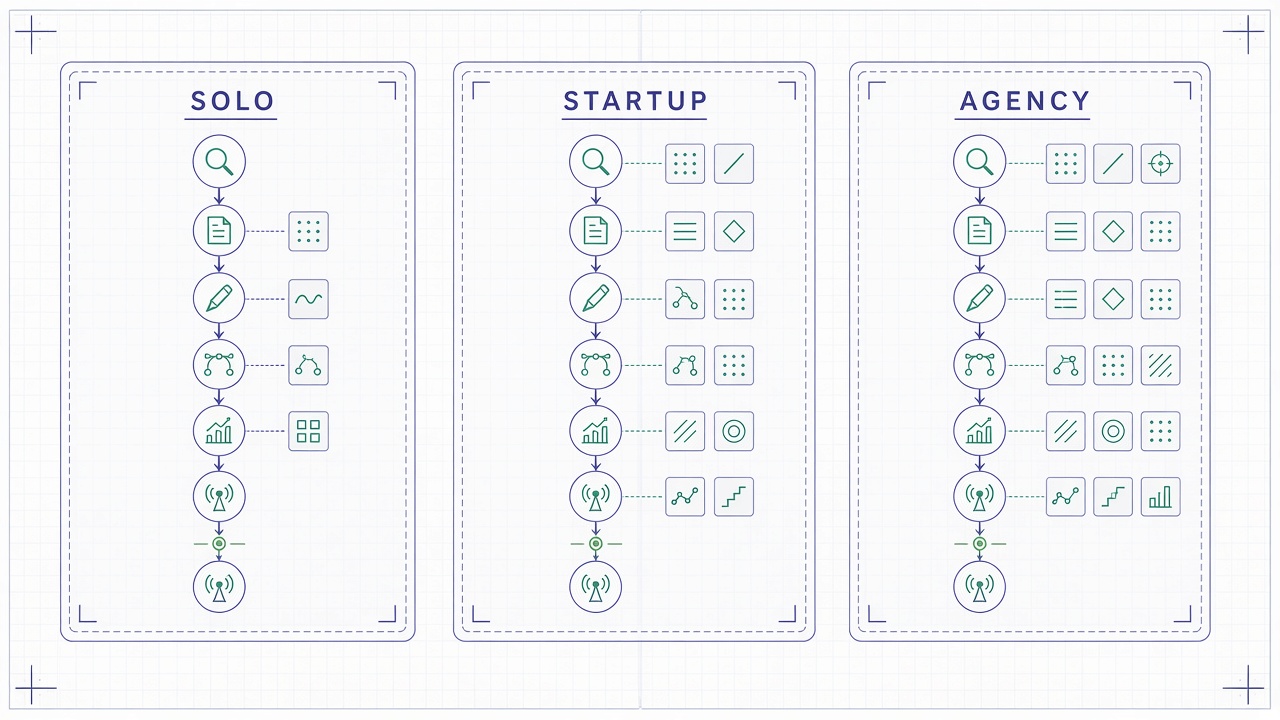
Solo, startup, and agency patterns
- Solo Concierge. One clusterer-plus-brief layer, CMS approval on every URL, a contextual linker with over-link caps, Search Console plus decay alerts. The founder owns briefs and publish.
- Startup Pipeline. Cluster maps per product line, brief-to-CMS export, hub-aware linking, one measurement owner, AEO as enqueue-only. Price one editor seat, not a seat per writer.
- Agency Workspaces. Isolated workspaces, CMS-agnostic brief exports, queued linking with protected money pages, reporting per job owner, citations per property. Named reviewers per client; no shared prompts across accounts.
Write the handoff once—which tool owns which job, who clicks approve, when to freeze—and train on the gates, not vendor screens. Keep the CMS as the system of record. If a tool cannot ingest a cluster ID and return a clean export, leave it out. A FlowCrews-style concierge loop (queries in, gated pages out) stays operable that way, without an ops hire to babysit integrations.
Minimal stack — assign one tool per job, buy clustering, briefs, and internal links before generation, and name a review owner so the pipeline runs without an ops hire.
Key Takeaways
Assign your next SEO tool to one job, score it on the five gates, and only add another layer once CMS handoffs and a named reviewer are already in place.
Frequently Asked Questions
You Might Also Like
- Automation SEO Automation: Tools, Workflows, and What to Automate First
- Strategy Keyword Clustering: How to Group Keywords into Rankable Topics
- Guides SEO Content Brief Template: The Complete Guide to Briefs That Rank
- AEO Answer Engine Optimization (AEO): How to Get Cited by AI Search
- Automation Programmatic SEO: How to Scale Pages Without Thin Content