Automation
Technical SEO Pipelines for AI Autoblogs: Automating Schema Trust Signals, CWV Gates, and Audit Loops in 2026

AI autoblogs can ship hundreds of pages a week, but volume without a technical safety net creates the exact problems that bury content: thin entity signals, failed Core Web Vitals, orphan URLs, and schema that no longer earns citations. Search and AI answer engines now treat clean technical foundations as a filter, not a nice-to-have. Slow or poorly marked-up pages get skipped for AI Overviews and Mode citations even when the writing is strong.
That is why technical SEO for autoblogs has shifted from periodic audits to publish-time pipelines. Instead of chasing issues after the fact, you wire schema generation and validation, CWV field-data gates, crawl/index alerts, image prioritization, and internal-link/canonical checks into the same no-code flow that publishes the page. More than 47% of marketers are already implementing AI SEO tools to improve search efficiency, and another 84% use them to spot emerging trends—yet most stacks still leave the highest-leverage technical tasks manual.
This article shows how to build that pipeline for 2026 realities: entity-first schema (Organization, Person, sameAs, knowsAbout) after the March rich-result restrictions, CrUX-based CWV thresholds that protect AI visibility, and continuous audit loops that scale without a full engineering team. You will leave with a practical three-layer stack—scheduled crawler, no-code automation, and LLM-assisted drafts with human approval—so every AI-generated URL ships crawlable, trustworthy, and fast.
- Automate schema trust signals, CWV publish gates, and audit loops at publish time so AI autoblog volume does not create crawl or citation debt.
- After March 2026, prioritize entity schema (Organization/Person with sameAs and knowsAbout) over restricted FAQ/How-To rich-result tactics for AI Mode citations.
- Gate publishes on field CWV (LCP under 2.5s, INP under 200ms aiming sub-150ms, CLS under 0.1); slow pages risk exclusion from AI Overviews.
- Use a three-layer stack: scheduled crawler + no-code tools (n8n/Make/Zapier) + LLM suggestions with human approval.
- Start with index alerts and CWV monitoring, then scale schema validation and internal linking as volume grows.
How High-Volume Autoblogging Builds Invisible Technical Debt

Unchecked volume turns technical SEO into a silent liability. High-frequency AI publishing does not merely add pages; it multiplies orphan URLs, stale sitemap entries, missing author and entity markup, and unoptimized asset bloat faster than any manual review cycle can catch. Each publish wave leaves behind pages that never receive internal links, sitemaps that lag days behind reality, and Article nodes stripped of Person or Organization context—exactly the signals both classic crawlers and answer engines now require.
That debt is no longer invisible to buyers or machines. Forrester reports 89% of B2B buyers have adopted generative AI for research, so unclean technical signals block classic rankings and AI citations in the same stroke. An orphan page with no sameAs links or knowsAbout properties simply never surfaces in the entity graphs that power overviews and chat answers. The same neglect that once cost a few ranking positions now costs visibility inside the research tools your audience already trusts.
Most teams already own crawlers, monitors, and schema validators. The gap is process, not tooling. Gartner found marketers report using only 33% of their martech stack’s capabilities; the unused remainder is precisely where orphan detection, CWV field-data gates, and entity-markup checks should live. Debt accumulates because publish workflows treat technical hygiene as an after-the-fact audit instead of a publish-time gate. Adding another dashboard does not close that loop—wiring the tools you already have into an automated pipeline does.
With the cost of that process gap clear, the practical response is a publish-time system that reuses existing crawlers, monitors, and validators instead of adding another dashboard or headcount.
Invisible debt is a process gap — high-volume AI publishing creates orphan pages, stale sitemaps, and missing entity markup faster than manual checks can catch; the fix is automating the tools you already own into publish-time gates, not adding another dashboard.The Three-Layer Stack: Crawlers, No-Code Routers, and Human-Approved LLM Fixes
That single publish-time system rests on a deliberately simple three-layer stack. At the base sit scheduled crawlers and CrUX field-data monitors that continuously surface crawl errors, index coverage gaps, orphan pages, and Core Web Vitals regressions. The middle layer is a no-code router—n8n, Make, or Zapier—that receives those signals, enriches them with sitemap and log data, and routes only actionable items forward. On top sits a lightweight LLM assistant that drafts schema markup, internal-link suggestions, or image-optimization patches; every proposal still requires a human click before it touches production. Nothing in the stack needs a full engineering team; the whole loop runs as publish-time automation.
Not every technical task deserves automation on day one. Focus first on the twelve high-leverage items that keep high-volume AI content crawlable and citation-ready: crawl monitoring, index alerts, sitemap generation, orphan detection, schema generation/validation/deployment, Core Web Vitals monitoring, image optimization, render-blocking detection, internal-link optimization, and canonical management. Start with crawl/index alerts and CWV gates—the lowest-effort, highest-impact pair—then layer in schema and link work once volume justifies it. AI-powered analysis of the resulting data streams cuts the time spent interpreting those signals by up to 50 percent, which is usually enough ROI to green-light the build; 65 percent of businesses already report that AI improves their overall SEO efforts.
How the three layers actually wire together
Keeping a human in the loop on entity claims and canonical decisions is non-negotiable. Automated schema that invents credentials or canonicals that accidentally consolidate distinct intents create quality regressions that erase any ranking or AI-citation gains the pipeline was built to protect. The rest of the twelve tasks can run with lighter oversight once the approval gates are in place.
Three-layer automation — crawlers plus CrUX, no-code routers, and human-approved LLM drafts — turns the twelve highest-impact technical SEO tasks into a publish-time pipeline that cuts analysis time by up to 50 % while still protecting schema and canonical quality.
Automating Entity Schema for AI Mode Citation Lift
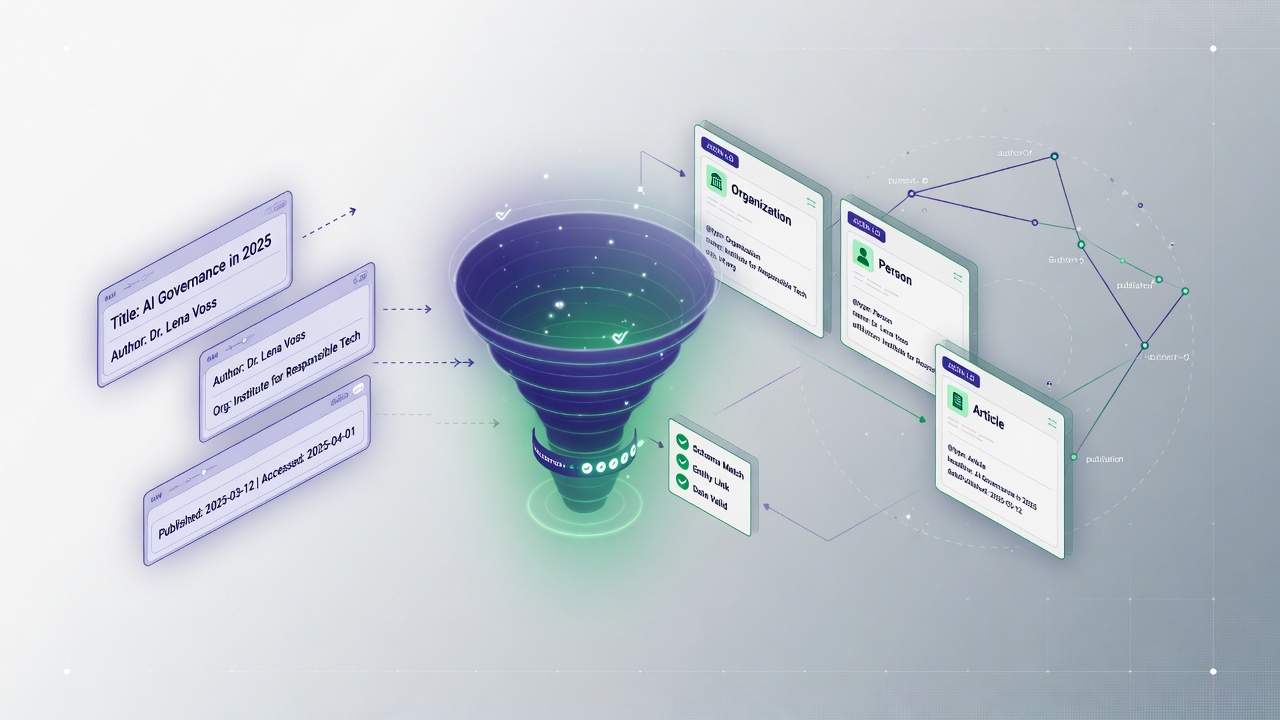
With those human approval gates locked in for high-stakes schema claims, the next priority is automating the entity markup that actually moves the needle in 2026. Pure rich-result chasing no longer carries the same weight. After the March 2026 core update, FAQ rich-result impressions dropped by nearly half—47% across tracked sites. In their place, clean entity schema delivered a 3.2× lift in AI Mode citations for sites that treated structured data as a trust layer rather than a SERP decoration.
AI Mode now reads schema to verify claims, map entity relationships, and judge source credibility even when no traditional rich result appears. Accurate Organization, Person, and Article markup with sameAs and knowsAbout properties signals that the page belongs to a real, cross-referenced entity. That verification step is what raises citation probability inside generative answers. Schema that invents credentials or leaves author and publisher fields empty simply fails the check and gets skipped.
Generate, validate, deploy—never ship bare pages
JSON-LD in the document head remains the preferred implementation. Thirty-one schema types still retain active rich-result support, so the pipeline should continue emitting those where they genuinely fit the content. The highest-leverage work, however, sits with entity types: Organization and Person blocks that carry stable sameAs links to authoritative profiles, plus Article markup that correctly wires author, datePublished, and publisher. Pull these values from the same content metadata the autoblog already stores—author records, brand knowledge graph, canonical URLs—so the generated JSON-LD stays consistent across thousands of pages.
Wire the flow as four automated stages. First, generate the JSON-LD payload from page metadata at draft time. Second, validate it against Google’s Rich Results test plus a lightweight custom check that confirms required entity properties (sameAs URLs resolve, knowsAbout terms match the page topic, author matches an approved Person node). Third, deploy only after both validators pass and the human approval gate for novel claims has cleared. Fourth, post a Slack diff alert whenever the live schema on a URL changes, so regressions surface within minutes instead of the next quarterly audit. The result is that every autoblogged page ships with complete, machine-readable trust signals and never lands bare.
Once this generate-validate-deploy loop is running inside the no-code router, schema stops being a manual afterthought and becomes a publish-time guarantee. That guarantee is what keeps high-volume AI content both crawlable for classic bots and citation-ready for AI Mode.
Entity schema over rich-result gaming — After the March 2026 update, FAQ impressions fell 47% while clean Organization/Person/Article markup with sameAs and knowsAbout drove 3.2× AI Mode citation lift; automate JSON-LD generation, dual validation, and Slack diff alerts so every autoblogged page ships with verifiable trust signals.Core Web Vitals Publish Gates That Stop Slow Pages Reaching AI Overviews
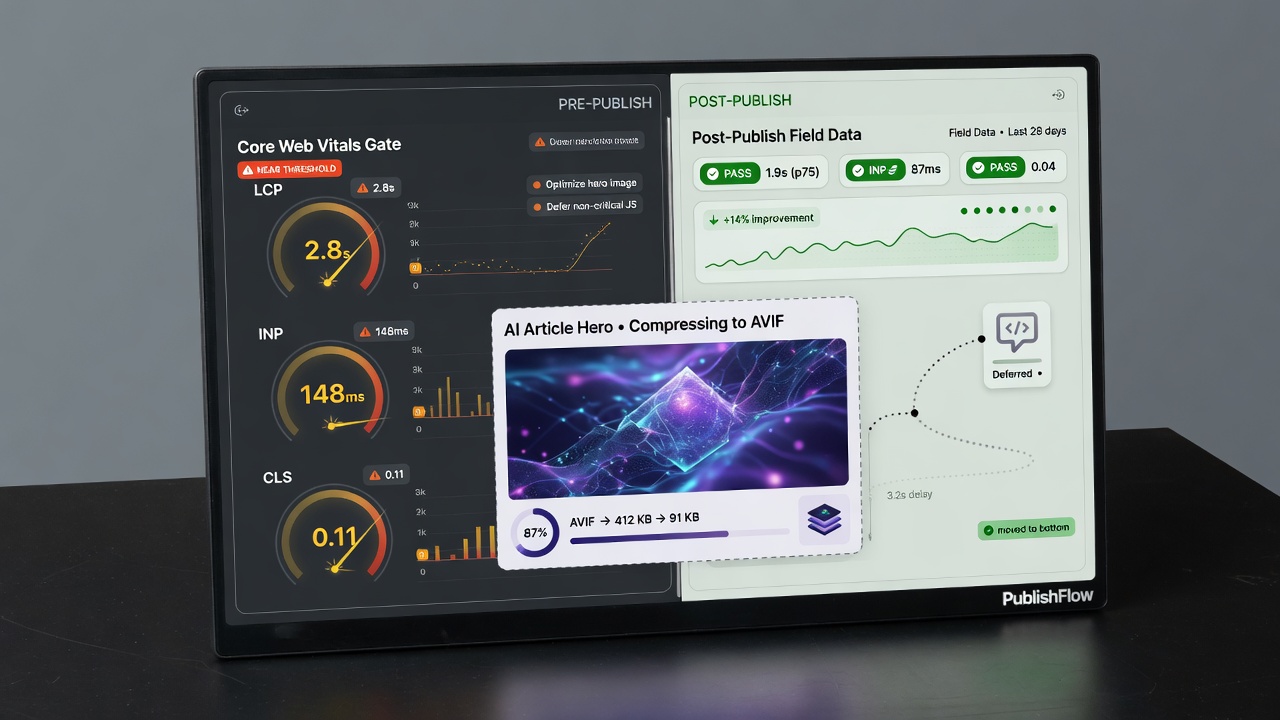
That same no-code router now needs a second hard gate. Schema makes a page citation-ready; Core Web Vitals decide whether AI systems will even consider it. Experience has become a pre-filter: slow pages get dropped from AI Overviews regardless of how clean the entity markup or how strong the content is. For high-volume autoblogs this means every publish path—draft, regenerate, or bulk update—must pass real-user field thresholds before the URL is allowed live.
The gates are non-negotiable and mobile-first. Pull CrUX data at the 75th percentile and block (or auto-remediate) any URL that fails: LCP under 2.5 seconds, INP under 200 ms (top-performing sites already aim sub-150 ms), and CLS under 0.1. Lab scores are useful for debugging, but ranking and AI citation decisions run on field data, so the pipeline must query CrUX or a RUM feed, not just Lighthouse, at both pre-publish and post-publish checkpoints.
Image pipelines and embed isolation do most of the heavy lifting
Images are the LCP element on over 70% of pages. Autoblog media therefore cannot ship as raw uploads. The router should auto-convert to AVIF/WebP, write explicit width/height, generate priority hints for the hero, and serve correctly sized srcsets before the page is marked publishable. AI-assisted image analysis routinely cuts LCP by 30–50% when this step is enforced in the same generate-validate-deploy loop used for schema. That single automation removes the largest source of field-data failures at scale.
In-article AI chat widgets and third-party embeds are the next common regressors. They inflate INP through main-thread work and CLS through late-loading containers. Isolate them behind lazy-load boundaries, reserve space with aspect-ratio boxes, and load chat scripts only after the primary content has painted or on explicit user intent. The same router that injects schema can inject these loading policies so every AI-assisted page ships with the interaction budget already protected.
Finally, attach the business case so engineering attention stays funded. Google’s research showed that a 0.1-second improvement in mobile load time lifted conversion rates by 8.4% and average order value by 9.2%. Framing CWV gates as conversion infrastructure—not just “SEO hygiene”—keeps the publish-time checks from being treated as optional. Once the thresholds, image transforms, and embed rules live inside the no-code path, slow pages never reach the index or the AI citation layer in the first place.
CWV gates are citation prerequisites — enforce LCP <2.5s, INP <200ms (aim <150ms), and CLS <0.1 on CrUX mobile field data at publish time, because slow experience filters pages from AI Overviews even when content and schema are excellent.
Continuous Crawl, Index, and Audit Loops That Catch Debt Before It Compounds
Publish-time CWV gates stop slow pages from ever shipping, but bulk AI publishes still generate fresh crawl and index problems the moment clusters expand. Soft 404s appear when templates render thin or near-duplicate bodies. Accidental noindex tags slip into a variant. Coverage drops overnight because a sitemap update lagged the content push. The only reliable counter is a continuous audit loop that treats every bulk publish as a potential debt event and surfaces issues within hours, not weekly reviews.
Scheduled crawls that flag accidents fast
Wire a scheduled crawler (or Search Console API pull) into the same no-code router that already handles schema and CWV. After every bulk drop, trigger a focused crawl of the new URL set plus a sample of the parent hub. Flag noindex accidents, soft 404s, unexpected robots blocks, and sudden coverage drops while the content is still warm. Route the findings straight to Slack or the team queue so an SEO owner can clear the blocker before the pages age out of the discovery window. The goal is hours-to-signal, not end-of-sprint surprises.
Orphans, broken links, and template-level normalization
AI cluster expansion is especially good at creating orphans and broken internal links. New programmatic pages launch without inbound anchors from the hub or sibling articles; older URLs get rewritten and leave 404 trails. Auto-detect these graph breaks on every crawl pass, then queue lightweight link-graph fixes—either template-level internal-link injections or a human-approved LLM suggestion for contextual anchors. At the same time, normalize canonicals and hreflang on the template output itself. Programmatic URL patterns must never compete with one another or with the primary locale version. Bake the self-referencing canonical and correct hreflang set into the render step so every new page ships already clean.
Health scorecards instead of log diving
Raw crawl logs and coverage reports overwhelm owners once volume scales. Roll the key signals—indexation rate, orphan count, broken-link rate, canonical conflicts, and recent coverage delta—into a simple health scorecard per content hub. One glance tells the team whether a hub is stable, drifting, or actively leaking crawl equity. Action items stay attached to the scorecard so fixes remain in the same no-code flow rather than disappearing into spreadsheets. This keeps technical SEO foundational for both classic rankings and AI-engine citations without forcing anyone to live inside log files.
Together these loops close the third layer of the pipeline: after schema trust signals and CWV gates have done their publish-time work, continuous crawl and audit automation keeps the live inventory crawlable, non-competitive, and citation-ready as the autoblog keeps growing.
Continuous audit loops — Schedule post-publish crawls, auto-queue orphan and link-graph fixes, normalize canonicals at template level, and surface hub health scorecards so technical debt never outruns the content volume.Wire Every Check into the Autopublish Workflow
With the three layers defined, the remaining work is wiring them into the moment a page actually ships. Hard gates belong inside the CMS or autoblog publish step itself—not in a dashboard someone might ignore. Before any URL goes live, require valid entity JSON-LD (Organization, Person, or Article with the expected sameAs and knowsAbout properties), explicit image width/height plus fetchpriority on the LCP candidate, a self-referencing canonical that matches the final template output, and a lab CWV budget check that fails the job if LCP, INP, or CLS projections blow the thresholds. If any gate fails, the publish aborts and the no-code router returns a clear diff to the editor instead of creating another orphan or bare page.
Once the page clears those gates, the same flows that handled validation should stay connected after publish. Pipe CrUX and RUM field data plus index-coverage and soft-404 alerts into the identical n8n, Make, or Zapier scenarios that already notify editors. A regression on mobile INP or a sudden drop in indexed URLs for a hub should surface in Slack or email within hours, not weeks. That keeps the continuous audit loop from §5 tied directly to the people who can act.
On-page experiences such as in-article AI chat give useful secondary signals—dwell time, follow-up questions, scroll depth—but they are health inputs, not substitutes for Core Web Vitals field data. Treat them as supporting context for page-experience reviews; never let strong engagement mask a failing LCP or CLS score that can still keep the URL out of AI Overviews.
A practical adoption sequence
Niche-site owners without a full dev team should sequence the work rather than attempting the entire stack at once. Start with index and CWV monitoring: scheduled crawls, coverage alerts, and CrUX thresholds give immediate visibility into debt already accumulating. Next, automate schema generation, validation, and head deployment so new autoblogged URLs never ship without entity markup. Only after those two layers are stable should you expand into internal-link graph fixes and more aggressive canonical/hreflang normalization as publish volume grows. Each step reuses the same crawler → router → human-approved LLM pattern, so complexity compounds only when the site can absorb it.
Do I need custom code to add publish gates?
No. Most modern headless or no-code CMS platforms and autoblog tools expose pre-publish webhooks or conditional steps. Map the required JSON-LD, image attributes, canonical, and lab CWV checks there, then let the no-code router fail the job and notify the editor.
What if my stack has no native CrUX integration?
Pull the CrUX API or a RUM snippet on a schedule through the same automation tool already watching your crawler. Route threshold breaches into the existing editor alert channel so field-data regressions surface beside index issues.
How much human review is still required?
Keep humans on schema claim accuracy, canonical changes, and any bulk redirect or noindex decisions. Everything else—validation, deployment, alert routing, orphan detection—can run unattended once the gates and loops are wired.
Can in-article AI chat replace CWV monitoring?
No. Chat interaction and dwell data are valuable secondary health signals for engagement, but search and AI Overview eligibility still hinge on field CWV. Use both; never trade one for the other.
When hard gates sit inside the publish step, post-publish alerts reuse the same no-code paths, and adoption follows the index-and-CWV-first sequence, the three-layer pipeline stops being a diagram and becomes the default way every autoblogged URL reaches the live web—crawlable, citation-ready, and ranking-safe as volume continues to climb.
Publish-time hard gates plus shared alert flows — embed entity JSON-LD, image priority, canonical, and lab CWV checks before go-live, then route CrUX/index alerts through the same no-code paths so the full technical stack runs automatically as the autoblog scales.Key Takeaways
Wire entity-schema validation and CWV publish gates into your autoblog flow this week so every page ships crawlable, citation-ready, and ranking-safe.
Common questions
High publish volume creates crawl, index, schema, and performance debt faster than manual checks can catch it. Pipelines enforce schema trust signals, CWV gates, and audit loops at publish time so every URL stays eligible for rankings and AI citations.
Entity schema—Organization and Person with sameAs and knowsAbout, plus accurate Article/Author markup—helps AI Mode verify claims and source credibility. FAQ and How-To rich results were heavily restricted; clean entity signals now drive citation probability even without traditional rich results.
Target LCP under 2.5 seconds, INP under 200ms (top sites aim under 150ms), and CLS under 0.1 using CrUX field data at the 75th percentile on mobile. Slow pages can be filtered from AI Overviews regardless of content quality.
Combine a scheduled crawler for monitoring, a no-code layer (n8n, Make, or Zapier) for alerts and deploy steps, and an LLM for draft schema or fix suggestions with human approval before publish. This covers the core automatable tasks without a full engineering team.
Start with crawl/index alerts and Core Web Vitals field-data monitoring—high impact, low effort. Then add schema generation/validation/deploy, image optimization for LCP, and internal-link plus canonical checks as volume scales.
Yes. Automation protects visibility and frees time for strategy, but human approval on schema quality, content substance, and edge-case fixes prevents the quality drops that hurt both traditional rankings and AI citations.
You Might Also Like