
Programmatic SEO Strategies for Scaling AI Generated Content
Programmatic SEO turns structured data, templates, and automation into large libraries of pages that each target a precise search intent. When you layer modern AI agents and autoblogging platforms on top of that foundation, the same system can research, draft, enrich, publish, and continuously improve content at a pace no manual team can match—while still producing pages that feel genuinely useful to the reader.
The risk most teams fear is thin or duplicate content that triggers quality filters. The antidote is not fewer pages; it is tighter control: automated keyword mapping, unique data fields, strong internal linking, metadata discipline, and real-time quality checks. Done this way, programmatic SEO becomes a growth engine rather than a liability. One AI client grew from 67 to over 2,100 monthly signups in ten months with a fully automated programmatic SEO engine; other well-known products have added tens of thousands of visitors through database-driven and user-generated page systems.
This article walks through the exact strategies that keep scale and quality aligned. You will see how to design page templates that stay evergreen, how AI agents handle mapping and optimization across thousands of URLs, how autoblogging tools like Flows deliver rich outputs and embed helpful in-article chat, and how that chat layer both improves comprehension and opens clean monetization paths. Every section advances one idea: build systems that produce genuinely useful pages at volume so search engines reward them and readers stay long enough to convert.
From Manual Rules to Autonomous AI Agents in Programmatic SEO
scale. The decisive leap arrives when those systems stop depending on rigid, hand-coded rules and begin running on autonomous AI agents that map, generate, and refine pages on their own.
For years programmatic SEO meant databases, static templates, and carefully written if-then logic. An SEO specialist defined the keyword patterns, locked the content slots, and hoped the resulting thousands of pages would hold up. That model scaled volume, yet it stayed brittle: every new intent cluster, ranking shift, or internal-link opportunity required another round of manual rules. Autonomous agents invert the workflow. Instead of waiting for instructions, they continuously read search data, cluster intent, select the right template variant, and decide what to publish or update.
Real-time keyword and content adjustments
Because the agents stay online, they treat the entire page inventory as a living system. When a keyword’s volume spikes, a competitor moves, or engagement metrics dip, the agent rewrites titles, expands thin sections, refreshes metadata, and rewires internal links—often across thousands of URLs in a single pass. Quality gates remain in place; the agent simply enforces them at machine speed rather than waiting for a weekly audit. As a result, AI-driven programmatic SEO automates content generation, keyword mapping, and performance tracking across thousands of pages. In the words of practitioners who have deployed these systems, “They can create targeted pages, analyse performance metrics, optimise content structure, and ensure consistent SEO implementation across thousands of pages.”
The practical outcome is a library that stays evergreen by design. Templates still supply structure and brand voice, yet the agents keep every instance aligned with current search behavior and the broader content strategy. Manual oversight shifts from writing rules to setting goals and reviewing exceptions—freeing teams to focus on higher-order decisions while the system quietly scales useful, penalty-resistant pages.
Autonomous agents — replace static rule sets with continuous, real-time keyword mapping and content optimization, letting programmatic SEO scale thousands of useful pages without constant human intervention.Building Penalty-Free Autoblogging Workflows with Flows
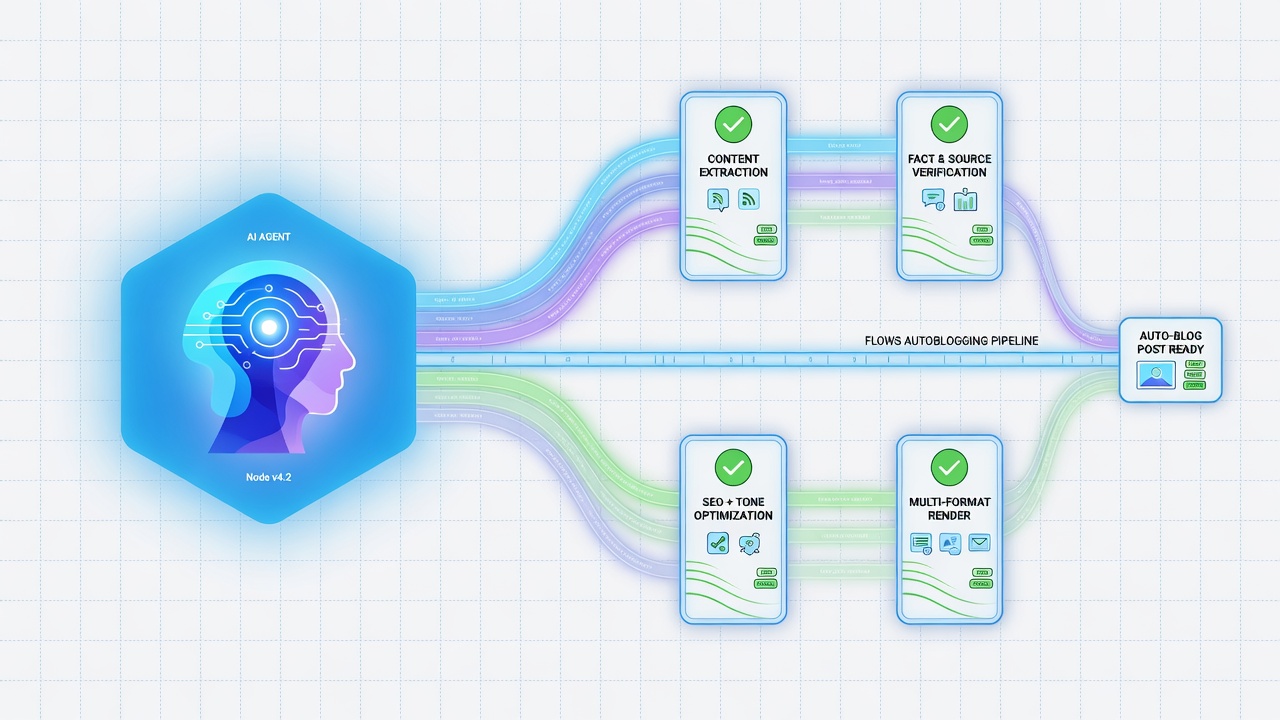
That hand-off from writing rules to setting goals is precisely where an autoblogging platform becomes the operational layer. Flows sits on top of the agent stack and turns those goals into a continuous publish loop: it ingests structured data, applies your templates, runs the agents, and ships fully formed pages—complete with embedded AI chat—while the quality gates stay locked in place so the volume never outruns usefulness or trust signals.
The practical result is a penalty-resistant workflow that still feels intentional to both search engines and readers. Below is how the pieces connect inside Flows, followed by the specific ways agents keep Experience, Expertise, Authoritativeness, and Trustworthiness visible on every generated page.
Flows integration in five clear moves
Once the workflow is running, the same agents that generate the copy also enforce the E-E-A-T signals that keep large-scale pages safe. They do this by treating trustworthiness as a set of non-negotiable constraints rather than optional polish.
How agents lock in E-E-A-T on every page
Experience is surfaced by pulling real usage patterns, customer language, or first-hand details from your connected data sources and weaving them into the narrative so the page reads as lived knowledge rather than generic summary. Expertise is protected through topic-level knowledge graphs and style guides that force the model to stay inside verified claims and preferred terminology; any sentence that drifts outside those bounds is rewritten or rejected before publish. Authoritativeness comes from consistent bylines, structured author bios, and automatic internal linking to your strongest pillar content, all of which Flows inserts at generation time. Trustworthiness is maintained by mandatory source attribution fields, freshness timestamps, and a final factual-consistency pass that cross-checks numbers and statements against the original database—flagging anything that cannot be verified.
Because these checks run inside the same agent loop that creates the page, E-E-A-T is not bolted on after the fact; it is baked into the template and the policy layer. The result is thousands of pages that still feel authored, current, and reliable—exactly the profile search engines reward and readers trust—while the team only intervenes on true exceptions.
Flows turns agent goals into a closed publish loop — connect data and templates, set E-E-A-T guardrails, enable auto-optimization and in-article chat, then let the system ship only pages that clear every quality gate.
Scaling Rich, Interactive Pages from Database-Driven Templates
That same baked-in reliability extends directly to the richness of every page the system ships. Once the agent loop has enforced E-E-A-T constraints, it still has to produce output that feels complete—not thin text stubs, but fully formed experiences that hold attention and satisfy search intent. This is where database-driven generation becomes the engine: structured data feeds (product catalogs, location inventories, comparison matrices, user-intent clusters) are mapped to flexible templates so each URL inherits the right media, interactive modules, and internal links without manual assembly.
The template layer is deliberately media-aware. Agents pull approved image sets, short video clips, charts, or downloadable assets from the connected data source and place them according to layout rules that already satisfy Core Web Vitals and accessibility checks. Interactive components—expandable comparison tables, dynamic filters, calculators, or embedded FAQ accordions—are injected as first-class elements rather than afterthoughts. Because these components are defined once in the component library and parameterized by the same database rows that drive the copy, every generated page can include them at scale while remaining consistent in design and behavior.
From static rows to living content clusters
Database-driven generation also powers the internal architecture that search engines reward. Each record can spawn not only a primary landing page but a surrounding cluster of supporting URLs—related guides, variant comparisons, and contextual deep-dives—automatically interlinked with optimized anchor text. Metadata, schema markup, and canonical rules travel with the record, so the entire cluster stays coherent as the underlying data updates. Real-world programmatic SEO case studies from 2026 illustrate exactly this pattern: innovative companies leverage scalable content generation and tightly linked content clusters to turn structured data into sustained organic visibility.
Quality gates remain inside the same loop. Before a page is published, the agent verifies that required media assets resolved correctly, that interactive modules loaded without console errors, and that the resulting HTML still matches the E-E-A-T and brand-voice policies already enforced. Only pages that clear every check go live; the rest surface as exceptions for human review. The outcome is thousands of pages that look and behave like carefully crafted editorial work—rich media, useful interactivity, clean internal linking—while the production cost stays closer to a database query than a content brief.
Database-driven richness — Templates fed by structured data let AI agents ship fully media-rich, interactive pages and coherent content clusters at massive scale, with quality and E-E-A-T checks enforced before anything goes live.In-Article AI Chat: Guiding Readers and Monetizing Attention Without SEO Risk
Those same template-driven pages become far more valuable the moment an AI chat sits inside them. Instead of leaving readers to scroll, scan, and bounce, the chat turns every page into a guided conversation that answers follow-up questions, surfaces related resources, and keeps people moving deeper into the cluster. Flows is built for exactly this: the platform lets you render a contextual AI chat directly in the article so the assistant already knows the page’s data, the surrounding internal links, and the conversion goals you defined for that template.
How the chat actually integrates and lifts engagement
Integration is straightforward once the programmatic pipeline is running. You attach the chat component to the page template the same way you attach a calculator or filter table. The agent that generated the page also seeds the chat with the page’s structured data, key entities, and approved answer boundaries. When a reader opens the chat they are not talking to a generic model; they are talking to an assistant constrained to that page’s topic, the site’s expertise rules, and the internal-link graph. The result is answers that feel native rather than bolted on.
Engagement improves because the chat removes friction at the exact moments people usually leave. A reader stuck on a comparison can ask for a plain-language summary. Someone hunting a specific filter value can request it instead of hunting through tables. Someone ready to act can be walked to the next logical page or form. Time-on-page rises, pogo-sticking falls, and the internal-link equity you already baked into the templates gets used more often because the chat actively recommends the right next step.
Monetization that stays clean for search engines
The same conversation layer is where monetization happens—without stuffing the visible content full of offers that would look spammy to both users and crawlers. Because the chat is interactive and on-demand, recommendations appear only when the reader signals intent. That can be a contextual product suggestion, a soft lead-capture prompt, an affiliate resource that matches the exact question asked, or an upgrade path into a paid tool or membership. The page itself remains useful editorial or data-driven content; the commercial layer lives inside the dialogue.
Search risk stays low for three practical reasons. First, the core HTML content that crawlers index is unchanged—the chat is an enhancement, not a replacement. Second, quality gates already enforced by the agents (E-E-A-T constraints, originality checks, thin-content filters) still apply to every page before it goes live; the chat simply inherits those guardrails. Third, better user signals—longer sessions, clearer navigation, fewer dead-end exits—align with what modern ranking systems already reward. You are not buying traffic with cloaking or doorway pages; you are making the pages you already scaled more helpful and more commercially effective at the same time.
Does embedding AI chat dilute the page’s main content for crawlers?
No. The chat loads as an interactive layer; the primary HTML, headings, and structured data remain fully crawlable and unchanged. Crawlers see the same rich, template-driven page the agents published.
How do you keep chat answers from inventing claims that hurt trust or E-E-A-T?
The generating agents seed the chat with the page’s verified data and explicit expertise boundaries. Answers stay inside those rails, and any out-of-scope request is gracefully declined or routed to a human-reviewed resource.
Can monetization inside the chat trigger thin-content or over-optimization flags?
Not when offers appear only on clear user intent and the underlying page still delivers standalone value. The commercial moment is conversational and optional, so the indexed content never becomes a sales letter.
Once the chat is live across the programmatic set, every new page the agents ship automatically inherits the same engagement and monetization behavior. You scale the conversation layer the same way you scaled the pages themselves—through templates, data, and guardrails—rather than hand-configuring widgets one URL at a time.
In-article AI chat turns template-driven programmatic pages into guided, intent-aware experiences that raise engagement and surface monetization only when readers ask—without altering crawlable content or inviting SEO penalties.
Real Campaign Metrics That Prove Agent-Driven Scale Works
That same template-and-guardrail model is exactly what turns isolated wins into a compounding system. When AI agents own keyword mapping, page generation, internal linking, metadata, and ongoing optimization inside a Flows-style stack, the growth numbers stop looking like lucky spikes and start looking like engineered outcomes you can repeat across thousands of URLs.
One fully automated programmatic SEO engine moved a client from 67 to over 2,100 monthly signups—a 3,035% increase—in just ten months. The agents continuously refined targeting, structure, and performance loops rather than relying on one-time template dumps. Similar patterns appear elsewhere: Webflow’s user-generated programmatic approach, built on template tweaks and scalable UGC pages, added more than 90K in traffic. Userpilot reached 100K visitors in the same ten-month window by treating Excel sheets as a live database that auto-populated hundreds of articles. In each case the core machinery is identical to the agent-plus-Flows workflow—data-driven templates, automated quality gates, and real-time adjustment—so the results transfer directly.
These figures are not the product of manual content farms. They come from agents that keep mapping new keyword opportunities, tightening internal links, refreshing metadata, and enforcing the same E-E-A-T and quality checks already baked into every template. Because the conversation layer and monetization rules travel with the templates, every new page inherits both the ranking potential and the engagement behavior that produced the original lift. The practical takeaway is simple: once the agent loops are live, the metrics themselves become inputs that further tune the next wave of pages, turning each campaign into fuel for the next.
Agent-driven proof — Documented campaigns delivered 3,035% signup growth and six-figure traffic gains when AI agents automated mapping, generation, and optimization inside template-driven programmatic systems.
Programmatic SEO Campaign Metrics
Key Takeaways
Pilot a Flows workflow on one focused content cluster today and watch autonomous agents, inherited chat, and monetization compound your programmatic SEO results.
Frequently Asked Questions
Programmatic SEO uses templates, structured data, and automation to generate and optimize large numbers of targeted pages at once, rather than writing each page by hand. It still requires unique value on every URL; the difference is scale and systematic consistency across keyword mapping, metadata, and internal links.
Yes, when each page is built from distinct data, clear intent, solid structure, and ongoing quality checks. AI agents help by enforcing uniqueness, optimizing on-page elements, and flagging thin or overlapping content before it ships.
They automate keyword mapping, content generation, structure optimization, and performance tracking across thousands of pages. That lets the system create targeted pages, analyze metrics, and keep SEO implementation consistent without manual bottlenecks.
Autoblogging tools take structured inputs and AI drafts and turn them into fully published, richly formatted articles. Platforms that also support in-article AI chat give readers instant help with understanding and navigation while opening additional monetization paths.
Chat helps visitors clarify concepts, find related pages, and take next steps without leaving the article. That longer, more guided session improves satisfaction and creates natural moments for relevant offers or product guidance.
Documented cases include growing from 67 to over 2,100 monthly signups in ten months with a fully automated engine, plus examples of +90K traffic via user-generated programmatic pages and roughly 100K visitors in ten months from database-driven article systems.