Long-Tail Keywords: How to Turn Low-Volume Queries Into Rankable Briefs

Most of the keyword universe is long-tail, and almost none of it deserves its own URL. Ahrefs is explicit that there is no universal volume cutoff and that length is the wrong test: some one-word terms sit under 100 searches a month, while some five-word phrases are huge. Backlinko’s study of 306 million U.S. keywords found 91.8% were long-tail (1–100 searches a month) yet those keywords together were only 3.3% of total search volume. The median keyword in that set got 10 searches a month.
The practical mistake is briefing every low-volume string. Supporting variations often share a parent topic and should not get separate pages. Conversational and AI fan-out queries stretch the tail further: Ahrefs notes that over 95% of conversational long-tail keywords have no measurable search volume, and Google’s John Mueller said in 2025 that about 15% of queries are still new every day. Volume tools will always miss part of the tail. Missing volume is not a reason to publish a thin page.
Treat the long-tail as a briefing decision, not a content quota. The next step is a fail-closed test: unique intent with a distinct SERP gets a brief, a collision supports the parent page, a repeating question becomes an FAQ or fan-out theme, and everything else is refused.
- Long-tail means low volume and specific intent, not a fixed word count.
- Most keywords are long-tail, but they are a small share of total search demand.
- Do not open a URL for every low-volume query; check whether the same pages already rank for a parent phrasing.
- Conversational and AI fan-out queries are mostly zero-volume and rarely repeat exactly.
- The rankable unit is a unique-intent cluster, not a single 10-search phrase.
Is a Long-Tail Keyword Defined by Word Count or Search Volume?
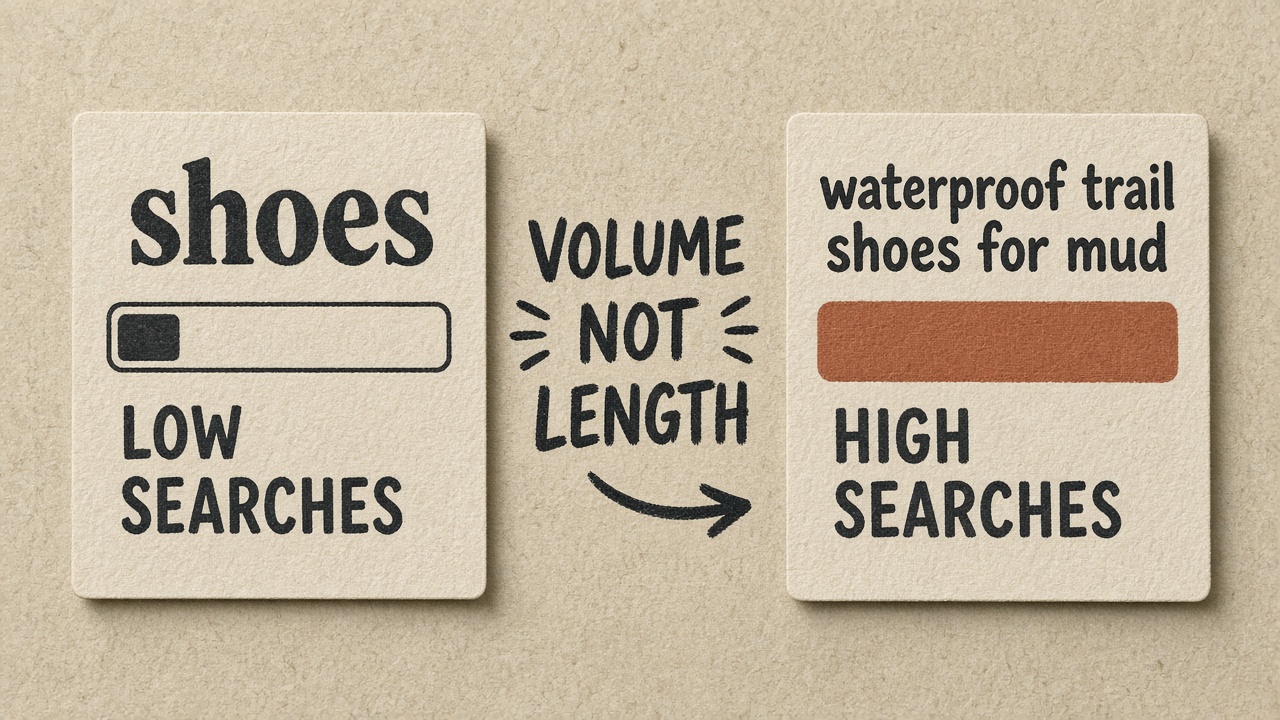
A long-tail keyword is a specific query with low search volume relative to its head term. It is not a phrase that clears a word-count minimum, and there is no universal volume cutoff that separates the tail from the head. Ahrefs defines the class by low monthly search volume and specificity, and is explicit that no fixed search-volume threshold makes a keyword long-tail. What places a query there is how thin its demand is next to the broader term, and how particular the searcher’s situation is.
Word length is the trap. Ahrefs notes that some one-word keywords get under 100 searches, while some five-word keywords get hundreds of thousands. Length does not make a long-tail. Volume does. A short, rarely searched term can sit in the tail; a long phrase with head-term demand does not.
Semrush’s shorthand is still a useful filter, not the definition. In that framing, long-tail keywords generally contain three or more words, carry less search volume, and describe a specific searcher situation at the low-volume, higher-conversion end of the demand curve. Use it to scan a list. Then judge the query against its parent term. A three-word phrase that already matches head demand fails, even if it looks long.
Question keywords are not the same class
A question is a format, not a volume class. Backlinko found that 14.1% of keywords were question queries, and “how” was the most common question type at 8.07%. That slice includes head terms, support lines that belong on a parent page, and one-offs that rarely repeat. Asking something does not put the query in the tail.
- Short and long-tail: a one-word specialist term — an obscure tool, material, or model name — whose demand is low relative to the head topic it belongs to.
- Long and not long-tail: a five-word phrase that still pulls hundreds of thousands of searches. Extra words do not move head demand into the tail.
The definition — A long-tail keyword is a low-volume, specific query relative to its head term. Word count and question form are filters, not the definition, and there is no universal volume cutoff.
Most Keywords Are Long-Tail, but Most Demand Is Not

Most keywords are long-tail, and most search demand is not. That split is the reason a huge tail never justifies a brief for every phrase: the set of rare queries is enormous, and the traffic sitting inside it is small.
Backlinko’s study of those 306 million U.S. keywords is the clearest version of the mismatch. Defining long-tail as 1–100 searches a month, it found 91.8% of keywords in that band, yet all of them together were only 3.3% of total search volume. Average volume was 989 searches; the median keyword got 10. The average is pulled up by a thin layer of head terms. The typical keyword is a trickle.
Ahrefs’ U.S. database shows the same shape further down the curve. Keywords with fewer than 10 monthly searches make up almost 93% of the set — 2.3 billion keywords — against just under 18,000 keywords above 100,000 searches. SparkToro’s panel of about 332 million queries found 612,981 keywords that appeared only once, and that unique-query tail was still only 2.2% of total search volume. Scarcity is the norm. Volume is concentrated.
Length is not the same as the 1–100 class
Difficulty tracks volume, not phrase length. Backlinko found keyword difficulty rises about 1.63 points each time search volume doubles, and five-or-more-word terms get about 10 times fewer searches than one-to-three-word terms. That is a tendency, not a definition. An Ubersuggest look at 103,921 sites, dated May 2025, attributed 31.5% of organic traffic to three-word keywords and 28.2% to four-word phrases, versus 3.7% for single-word searches. Mid-length phrases can carry a large share of a site’s organic traffic precisely because many of them are not in the 1–100 band. Word count is a poor proxy for the low-volume class that actually needs the collision test.
Do longer queries convert better?
They can, and the lift is real — and still small in absolute terms, and measured in paid search rather than organic. NP Digital’s May 2025 paid-search study of 40 companies, branded terms excluded, found conversion at 0.17% for one-word terms, 1.02% for three-word terms, and a peak of 1.94% for six-word terms. Specificity helps a click turn into a conversion. It does not turn a 10-search phrase into a page that earns its keep on volume alone.
Treat the figures that circulate the other way as secondary aggregations, not as a brief threshold. Ranktracker’s 2025 roundup repeats claims that long-tail keywords convert at a 36% average and account for 70–92% of search traffic. Those numbers conflict with the primary demand-share findings from Backlinko and SparkToro. A conversion story that implies the tail owns most of search is not a planning input. Unique intent still decides whether a low-volume query gets its own URL, supports a parent page, or is refused as too thin.
Demand share — A huge long-tail is a reason to be selective. Most keywords sit at 1–100 searches or below, yet they hold only a few percent of demand, and a modest paid-search conversion lift does not change that.
Organic Traffic by Keyword Length
Supporting, Topical, and Conversational Long-Tail Keywords Do Different Work
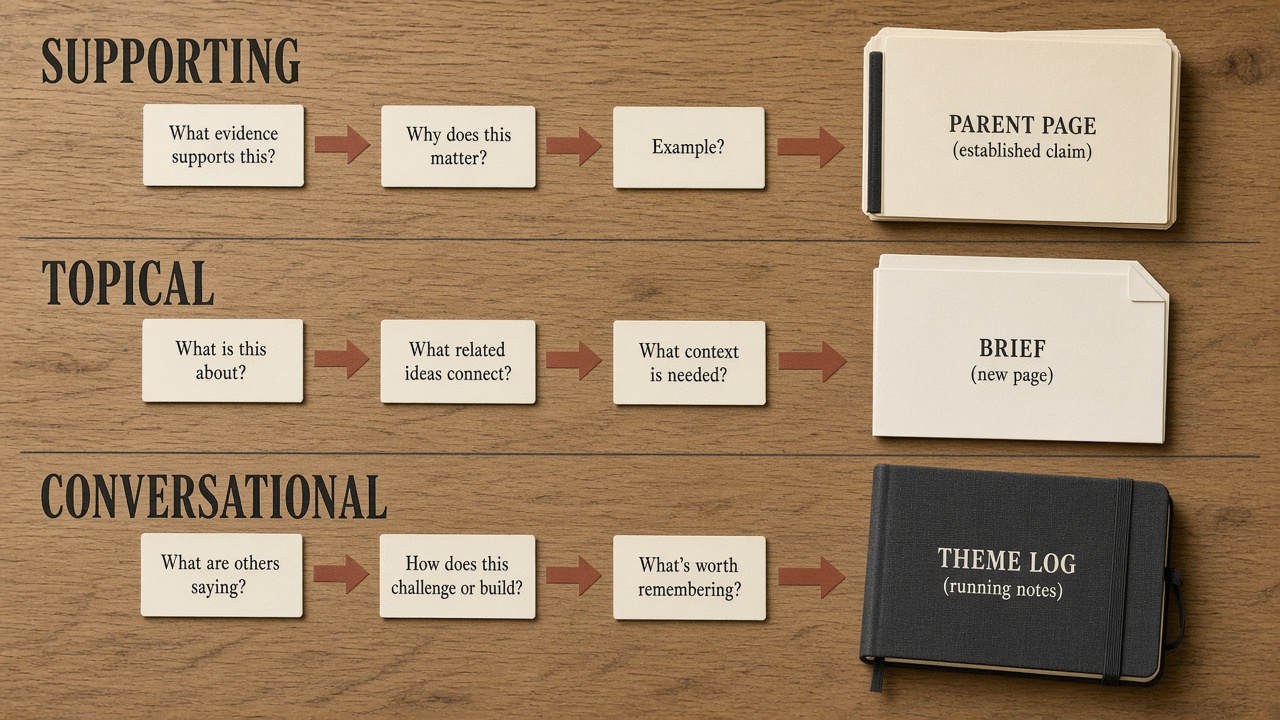
Knowing that most queries sit in the tail still does not tell you which ones deserve a URL. A low-volume phrase has one of three jobs: supporting, when it shares the parent topic; topical, when unique intent can earn its own page; or conversational, when the wording almost never repeats and usually should not become a URL.
Supporting: same job, thinner wording
Supporting long-tail stays inside a page you already have. Ahrefs treats “best healthy treats for dogs” as long-tail because it receives only 100 monthly searches, against a related head phrasing at 6,800. The searcher wants the same kind of answer. Put that phrase in the parent brief as a field, subheading, or variant to cover — not as a second article that will collide with the same results.
Topical: the only class that can earn a page
Topical long-tail is the only class that can justify a new rank contract. The searcher is in a distinct situation, and the results are not already the parent’s. If the same URLs already rank for a higher-volume phrasing of the same job, you are looking at a supporting variation wearing more specific words. Specificity alone is not a brief.
Conversational: log the theme, skip the URL
Conversational long-tail, including the way people phrase questions in AI search, is the third class. Ahrefs notes that over 95% of those queries have no measurable search volume, because the wording almost never repeats. Capture the recurring theme as an FAQ or fan-out note. Do not commission a URL for a sentence that will not come back.
The routing rule is short: same page, new page, or log. Never publish because a query is specific.
Route, don’t publish — Same intent supports the parent page, unique intent with a SERP that is not already the parent’s can earn a page, and non-repeating conversational phrasing gets logged — never published just because it is specific.
Does a Low-Volume Query Need Its Own Page — or Just a Heading?

That routing rule is the whole brief decision, and search volume is not what settles it. A low-volume query needs its own page only when it has unique intent the parent cannot cover without changing what that page ranks for. If the same pages already rank for a higher-volume phrasing of the same job, the query belongs on that parent as a field, an FAQ, or a heading — not a new URL. There is no monthly-search floor: a 10-search phrase with a unique results page can be briefed, and a 100-search near-duplicate should not.
Length follows the job; it does not create one. Ahrefs contrasts a 3,400-word page for “how to buy bitcoin” with a 1,000-word page for a more specific cash-out query. A narrow long-tail can be satisfied in far less copy than the head term, so a short draft is not evidence the query is too thin, and a long draft is not evidence it deserves a URL.
One brief covers one rankable intent cluster. Supporting long-tails pile into that brief as fields, headings, and FAQs. They do not each become a primary keyword, and they do not each get a URL. How many long-tail keywords one brief should cover is however many share that single rank contract — not a quota, and not one page per phrase.
In a pillar cluster, the pillar owns the head intent. A long-tail page exists only for an intent the pillar cannot satisfy without changing that rank contract. Keyword clustering is the method for grouping supporting phrases onto the parent brief; it is not a license to publish every member of the group. Finding and grouping those phrases comes next. Inventing a volume cutoff does not.
The gate — Brief a low-volume query only when intent and the results page are unique. Otherwise support the parent, log it as an FAQ or fan-out theme, or refuse it. Volume and draft length do not decide.
How to Find and Cluster Long-Tail Keywords Without a Big Stack
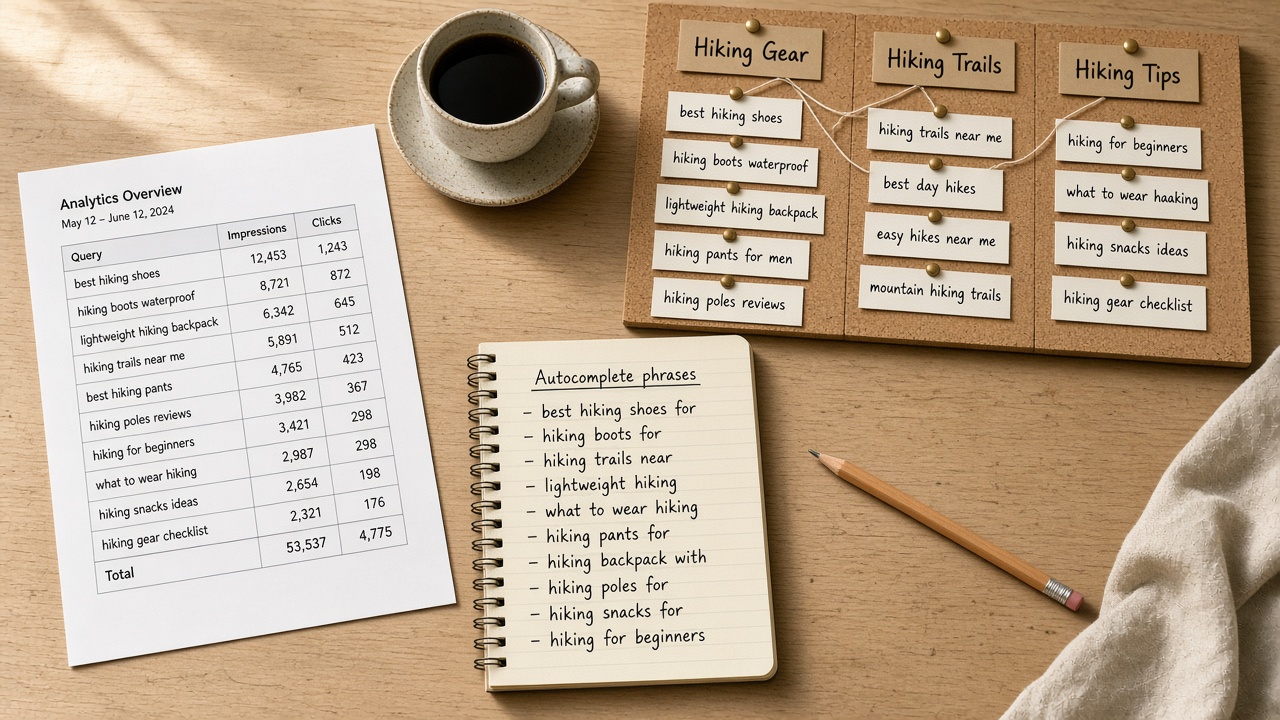
You do not need an enterprise research stack to find long-tail keywords worth briefing. Once a query only earns a URL when its intent and results differ from the parent, the hunt shrinks: pull the queries you already earn or almost earn, then cluster them by the pages that rank — not by how alike the wording looks.
A short list of sources is enough. Search Console query reports show terms that already draw impressions or clicks. Autocomplete and People Also Ask surface the phrasings people actually type. Competitor H2s reveal which specifics a ranking page already covers. Support tickets and sales calls name the situations customers use in their own words. The site’s practical long-tail workflow and the automation-for-briefs guide can speed that collection; they do not replace the judgment that follows.
Cluster by the pages that rank, then label the job
Group queries that collide on the same results page into one brief. Split them only when the top results are a different page type or a different intent. Similar phrasing is not a cluster, and a pile of variants is not a plan. The clustering definition article covers the method; the implication here is hold or publish.
The output of that step is a job label, not a spreadsheet dump. Primary means open a new brief. Support means add a field or heading on the parent. FAQ means log the query for an existing page or a fan-out theme. Reject means the query is too thin — no unique intent, no distinct results — and should not be commissioned at all.
SERP first — Find long-tail keywords in queries you already almost rank for, then group anything that shares a results page into one brief and stop at a job label: primary, support, FAQ, or reject.
Where Zero-Volume and AI Fan-Out Queries Fit

Once clusters have a job label, the queries a tool cannot measure still need a place. A zero in a keyword tool does not mean nobody searched it. Tools miss new phrasing and wording that almost never repeats, which is why a query can appear in Search Console, a ticket, or an AI answer and still show no monthly volume. That gap does not make each phrasing a page.
John Mueller said in 2025 that about 15% of Google queries are still new every day, and the share has stayed around 15% even with LLMs and AI search. Volume databases will always lag that slice of the tail. A blank volume field is a measurement limit, not evidence the query is unused and not a reason to open a URL.
AI fan-out shows how wide the miss is. Seer Interactive’s Gemini 3 research found 10.7 average fan-out queries per prompt, 6.7 average words, and 95% with zero monthly search volume. A follow-up of 1,300 prompts produced 11,029 unique fan-outs, 99% at zero monthly search volume, and only 8 queries that appeared in all 13 runs. Exact fan-out strings almost never repeat, so they cannot each carry a rank contract.
Fit them as themes. If several fan-outs name the same unanswered intent and a stable SERP exists, fold that theme into a brief or an FAQ. If the wording never repeats and the parent already covers it, log the theme or refuse it. The cluster’s job label still decides: primary only when covering the theme would change the parent’s rank contract. Do not brief the raw fan-out list.
Theme, not string — A tool zero means the database lagged a new or non-repeating query, not that the phrasing deserves a URL. Brief or FAQ only the shared intent behind fan-outs that a stable SERP can actually rank.
What a Long-Tail Brief Must Include Before You Open a URL

A tool zero, or a fan-out that never repeats, already told you not to open a URL. The brief is where that decision has to stick. A long-tail brief is a rank contract for one unique intent, plus an explicit refuse list — not a keyword dump that invites a new page for every variant.
Keep the rest of your usual brief. Add only the fields that stop thin URLs from spawning.
- Primary query, and the single intent it actually serves.
- Parent URL when this query supports a page that already exists.
- A SERP collision note: whether the same pages already rank for a higher-volume phrasing of the same job.
- Supporting terms, and the FAQ set that stays on this page rather than earning its own address.
- What must not be split into new pages, written as a refuse list, not a suggestion.
- A length cue tied to how specific the query is, not to a house word count.
Every leftover query gets a job before anyone writes: primary, support, FAQ, or reject. Tell the writer and the model which label applies. If a term has no job, it does not ship.
The handoff format lives in the SEO content brief article, and the free brief generator is where that format gets filled. This pass only adds the long-tail hold and refuse fields those pieces assume.
If the brief cannot name a distinct SERP and a reader job the parent page does not already do, do not commission the URL.
Fail closed — A long-tail brief earns a page only when it names one unique intent, a distinct SERP, and an explicit refuse list. Everything else supports the parent, becomes an FAQ, or is rejected.
Key Takeaways
Open a new URL only after the brief names a distinct SERP and a reader job the parent page does not already cover.
Frequently Asked Questions
You Might Also Like
- Strategy Keyword Clustering: How to Group Keywords into Rankable Topics
- Automation How to Turn Keyword Clusters Into Briefs Automatically
- Guides SEO Content Brief Template: The Complete Guide to Briefs That Rank
- Guides How to Create a Topic Cluster (Step-by-Step)
- Templates SEO Article Outline Template for AEO and Classic Rankings