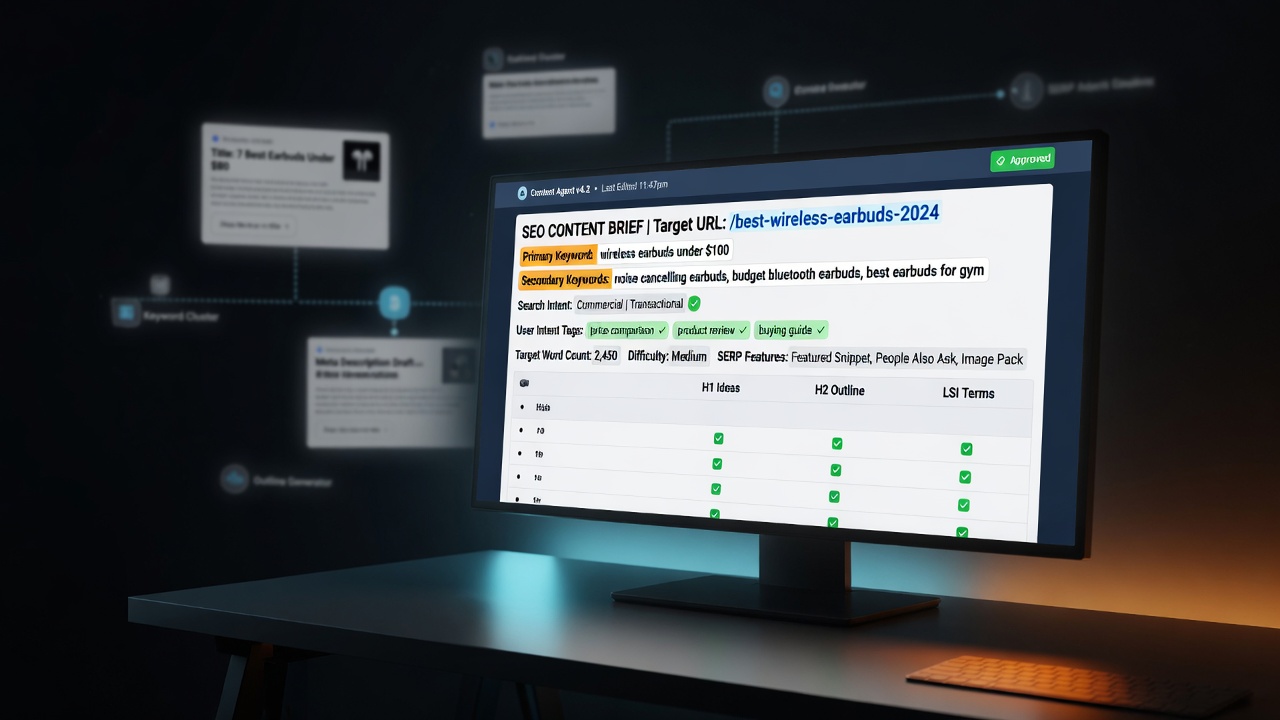
How to Turn SEO Briefs into Machine-Readable Specs for AI Agents

Most SEO briefs are written for people. They mix goals, keyword notes, competitor observations, and a loose outline into a document an editor can interpret. An AI agent cannot. It will fill every gap with a plausible guess, which is how you get thin pages, invented facts, and copy that never quite matches search intent.
A machine-readable spec is the opposite of that brief. It is a structured contract—usually JSON, sometimes YAML or tightly typed markdown—that names every field an agent needs to execute: primary and secondary keywords, search intent, entities, E-E-A-T requirements, outline hierarchy, internal links, schema types, citation targets, and the quality gates that reject off-brief output. The agent does not infer the job. It runs the job.
This article shows how to convert a human brief or a SERP snapshot into that spec, how to validate it before generation, and how the same structure feeds autoblogging pipelines, multi-agent crews, and in-article chat without drifting off brief. The through-line is simple: SEO automation stays accurate only when the brief is no longer ambiguous.
- 1
Human SEO briefs leave gaps that agents fill with guesses; structured specs close those gaps.
- 2
Map intent, entities, outline, links, schema, E-E-A-T, and quality gates into JSON or an equivalent format.
- 3
Validate the spec before generation so uniqueness, trust signals, and brief-fit are non-negotiable.
- 4
The same spec can drive autoblogging, multi-agent crews, and in-article chat without drift.
- 5
Treat the spec as a contract: if a required field is missing, the agent should stop, not invent.
Human Briefs vs. Machine-Readable Specs

Ambiguity is the default state of a traditional SEO brief. It is written for a person: a narrative goal, a cluster of keywords, a suggested outline, and optional notes a freelancer can interpret or quietly rewrite. Agents cannot do that work. They parse fields. When a key is missing or a value is free text, they invent intent, invent entities, and invent structure.
A machine-readable spec is the opposite contract. Every decision is a typed field. Required keys must be present. Allowed values are enums, not impressions. Before a single sentence is drafted, the agent validates the object against a schema and fails closed instead of guessing.
Formats an agent can reject before it writes
Three formats work because they are both editable and checkable: a JSON schema that rejects incomplete payloads, YAML front matter that pins metadata to a document, and locked markdown blocks that keep the contract separate from the draft. These are not nicer templates for freelancers. They are the control layer for SEO automation and for multi-agent crews that must share one source of truth.
That is the gap most brief guides never close. They stop at the human handoff—how to write instructions a writer will understand—and skip the parseable contract an agent can refuse to execute until every required key is filled.
Spec, not brief — Agents stay accurate when every decision is a typed, required, enumerable field they can validate before drafting. A narrative brief is still a human document.
The Fields an Agent Spec Must Lock Before It Writes
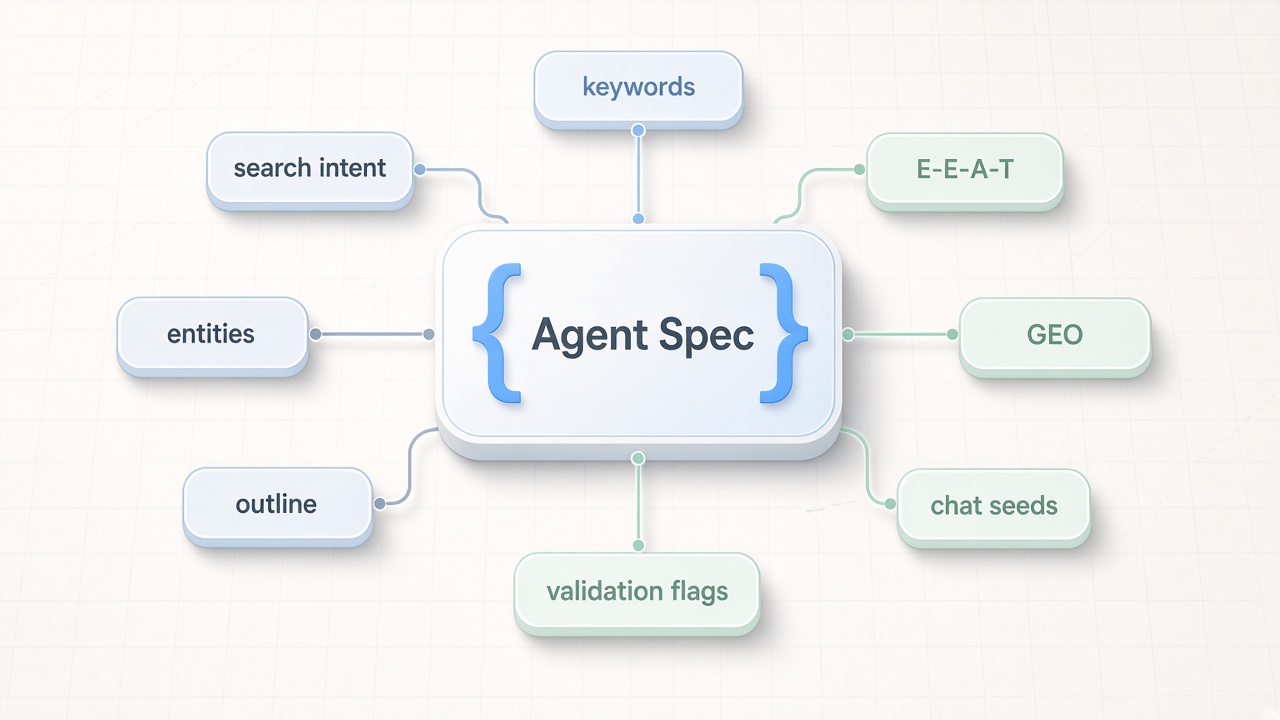
A usable spec is that contract made concrete—a closed set of named fields. If a required key is empty, the agent should halt rather than invent a keyword, an entity, or a heading nobody authorized. The list below is the minimum an SEO automation crew can validate before a single paragraph is generated.
Retrieval and coverage
- Primary and secondary keywords — one target phrase plus a short supporting list the draft must use, not expand.
- Search intent — an enum such as informational, commercial, transactional, or navigational that the model cannot rewrite.
- Audience — one concrete phrase, not a persona essay.
- Entity list — brands, products, places, people, and terms the agent must not conflate.
- Must-cover questions — the SERP questions the piece has to answer in full.
Structure, trust, and Flows extras
- Outline hierarchy — ordered H2 and H3 titles so the architecture cannot drift at generate time.
- Internal link targets — slugs or URLs, never “something relevant.”
- Schema types — the markup the page will actually ship, such as Article, FAQPage, or HowTo.
- E-E-A-T requirements — the experience claim, the author or reviewer slot, and which statements need a source.
- Uniqueness constraints — the angle, what existing pages already cover, and what this draft must not restate.
- Flows extras — GEO citation targets, in-article chat prompt seeds (clarify, navigate, or convert), and optional CTA or monetization slots so the model does not invent an offer mid-paragraph.
Field names have to stay stable. Crews and ai content automation stacks reuse one contract across niches; renaming entity_list to topics in a new vertical is how agents start inventing intent again. Version the schema if you must add keys—never silently rename the ones already in production.
Closed field set — lock keywords, intent, audience, entities, questions, outline, links, schema, E-E-A-T, uniqueness, and Flows extras under stable names, and treat a missing key as a stop, not a prompt to invent.
Map the Brief Once: SERP Evidence to a Locked Spec

With those names frozen, conversion is a mapping job, not a rewrite for a “smarter” model. You take what the SERP already showed you and drop it onto the keys the crew already knows. A human goal such as “help beginners understand X and rank for Y” becomes values an agent can check: intent as an enum (informational, commercial, transactional, navigational), includeFAQ as a boolean, length as a band. Narrative stays in a notes field if you need it; it never becomes the executable contract.
Write the result to one source-of-truth file per article—JSON, YAML front matter, or a locked markdown block—so every agent reads the same contract. Lightweight paths are enough: a form or sheet that emits that file, a snippet dropped into an autoblogging queue, or a shared artifact a multi-agent crew checks out. You do not rebuild the workflow for each niche; you emit one parseable spec and let the existing stack execute it.
One spec file — Conversion maps SERP evidence onto stable keys. Enums, booleans, and halt conditions replace narrative goals so every agent executes the same contract instead of inventing one.
Validation Gates, Failure Modes, and Reject-and-Retry

That emit step is only safe if the stack treats the file as a contract. Before any agent drafts, the spec must clear machine-checkable gates. Fail one and execution does not start.
Five gates before a draft is allowed
- Schema validation — required keys present, types legal, enums from the closed set.
- Keyword and entity coverage — primary, secondaries, and named entities appear in the locked outline.
- Outline completeness — must-cover questions map to headings; no empty H2s.
- Internal-link presence — every target slug or URL is listed and non-empty.
- E-E-A-T checklist — experience notes, source constraints, and uniqueness rules are filled fields.
Weak specs produce the usual wreckage: invented statistics, thin H2s that restate the keyword, ignored intent, missing citations, and duplicate angles that cannibalize queued pages.
Recovery is a reject-and-retry loop against the same contract. The agent gets a structured error list, not a new brief, and revises until every gate is green.
Those gates keep every run tied to the contract without tool lock-in: output that matches the locked outline and intent, citations that stay inside approved sources, and CTAs that match the monetization slot—runnable by any crew that can parse the spec.
Validation gates — schema, coverage, outline, links, and E-E-A-T must pass before a draft; failures loop against the same locked contract so invented stats and ignored intent never publish.
Let Chat, GEO, and Publishing Read the Same Spec
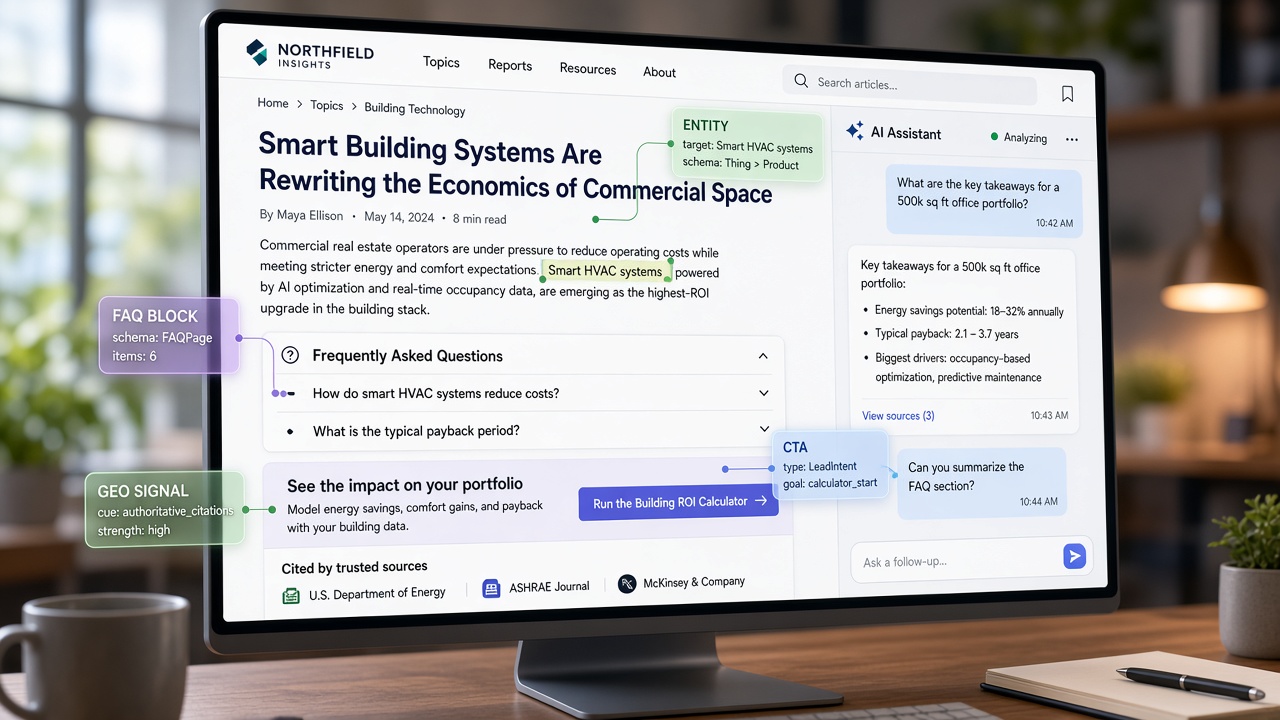
Once a crew can parse that file, every later surface should parse it too—chat, generative answers, and the publish queue included. None of them should receive a second, looser brief.
- In-article chat reads prompt seeds for definitions, outline navigation, and offer questions. If a seed is missing, the assistant stays silent instead of inventing an angle.
- GEO stays citable because entities, quotable claims, and source slots are already locked. Answer engines attribute approved material; they do not mint new facts.
- Publishing consumes slug, title, meta, schema type, and monetization blocks. Autoblogging queues emit what the contract named—they do not invent a URL or an offer.
That is the contract interface, not a new crew. A missing required key should keep chat quiet, leave citations empty, and stop the queue from publishing.
One field-complete spec then carries intent, entities, and structure from the brief to the live URL.
One contract — chat seeds, citable GEO claims, and publish fields all come from the locked spec, so no downstream system invents intent, entities, or structure.
Key Takeaways
Convert your next human brief into a field-complete, machine-readable spec and let every agent, in-article chat, and publish step execute only what you locked.
Frequently Asked Questions
It is a structured document—typically JSON, YAML, or typed markdown—that lists every instruction an agent must follow to produce a page. Unlike a human brief, it has named fields, allowed values, and validation rules, so the agent executes a contract instead of interpreting prose.
Human briefs assume a reader who can infer intent, fill missing entities, and judge quality. Agents treat unstated details as permission to invent, which produces off-intent structure, thin sections, and weak trust signals. Specs remove that ambiguity by making every requirement explicit.
At minimum: primary and secondary keywords, search intent, entity lists, outline hierarchy, internal-link targets, schema types, E-E-A-T or citation requirements, and quality gates. Add GEO citation targets and chat prompt seeds when the page will include in-article assistance or monetization.
JSON is the most reliable interchange format for APIs and multi-agent crews because parsers and validators are consistent. YAML is easier for humans to edit. Structured markdown works when a platform already expects sectioned prompts. Choose the format your pipeline can validate, not the one that merely looks tidy.
A complete spec ties every section to required entities, sources, and uniqueness checks, then blocks generation when those fields fail validation. Agents still write the prose, but they cannot skip evidence, invent facts, or collapse the outline into generic filler without failing a gate.
The same fields that drive the article—intent, entities, outline, and allowed claims—become the chat context and the autoblogging job ticket. Readers get answers grounded in the published spec, and downstream agents republish or update pages without rewriting the brief from scratch.
You Might Also Like