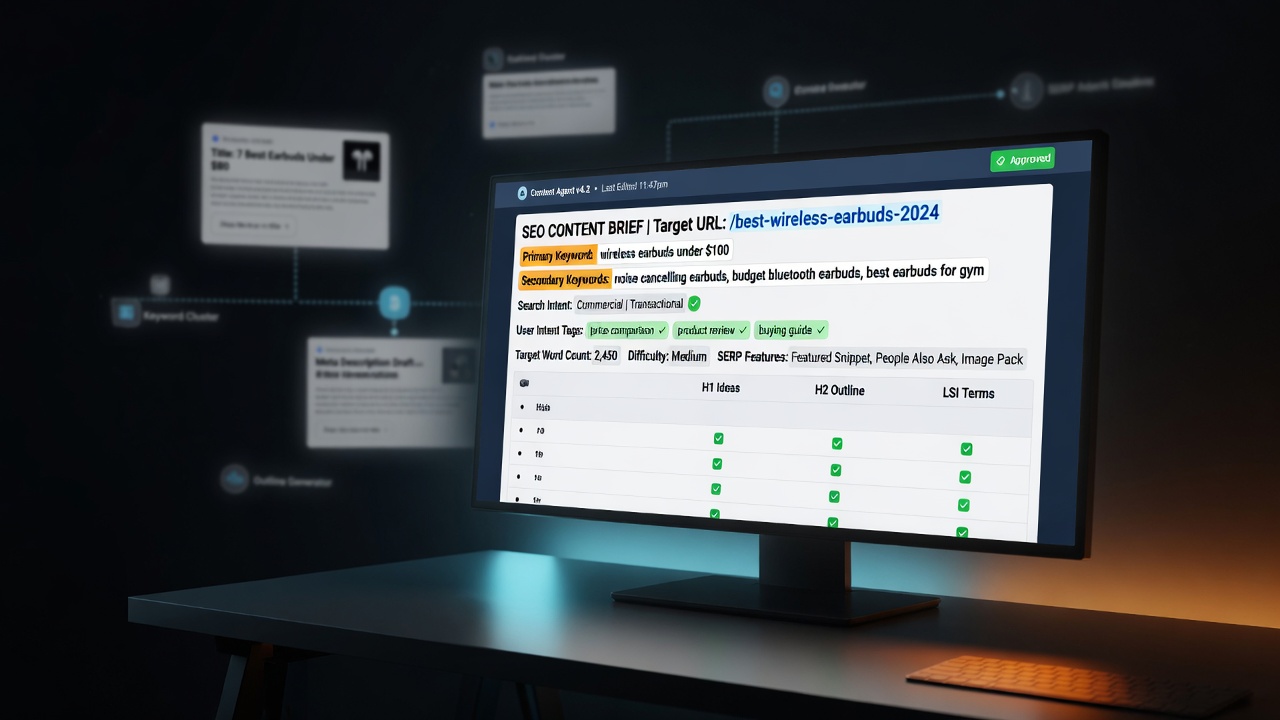
Free AI-Optimized SEO Content Brief Template for Autoblogging and Agentic Workflows
Autoblogging rarely fails because a model cannot write. It fails because the brief is a human memo and the stack is a crew of agents. Keywords live in one tab, entities in another, quality rules in a Slack thread, and the in-article chat that should help the reader never inherited the page’s job. Each hop reinterprets intent. Thin pages, mismatched GEO signals, and chat that cannot navigate or monetize are the predictable result.
A free AI-optimized SEO content brief template closes that seam. One copy-paste spec carries primary, secondary, and long-tail terms with intent, searcher questions, entity and GEO cues, E-E-A-T evidence requirements, unique outline angles, internal-link targets, schema suggestions, penalty-safety gates, and chat or lead hooks. Turned into JSON, that same contract is what research, draft, fact-check, optimize, and publish agents execute—without a second guess at what “good” meant.
This article is that contract, field by field. It is written for people who already want SEO automation and need a brief that stays accurate in low-competition volume niches whenever a reader—or an agent—lands on the page. The next sections unpack every field, then the machine-readable shape, the gates, the chat layer, and how you know the brief is working.
- 1
Treat the brief as a machine-readable contract every agent executes, not as a creative prompt.
- 2
Include intent-tagged keywords, entities and GEO signals, E-E-A-T evidence, outline angles, links, schema, and quality gates.
- 3
Put chat, navigation, and monetization hooks in the same spec so published pages can convert.
- 4
Use SERP-to-brief automation to keep the contract fresh for AI Overviews and autopublishing.
- 5
Judge the brief by time-to-publish, chat engagement, dwell, and attributed revenue—not rankings alone.
The Brief Is a Multi-Agent Publishing Contract
That sequence only holds if the brief is a contract first. A freelancer outline can stay fuzzy and still get rescued in comments. An agent crew cannot. What you hand downstream is a single source of truth with enforceable fields: if a required slot is empty, generation does not start. You are not briefing a person who will infer your standards. You are locking the intent every system will execute.
Map every block to a consumer
Write for jobs, not for a generic writer. Each consumer should be able to read only its section and still do the right work.
- Research agents use the keyword and intent block so they expand questions and entities without changing the target.
- Draft agents use the unique angle and outline so they cannot invent a new thesis mid-generation.
- Fact-check agents use evidence rules: what must be cited, what is first-hand, what is off-limits.
- Publish agents use schema suggestions and Core Web Vitals notes so markup and page health are not afterthoughts.
- The on-page assistant uses chat seeds for understanding, navigation, and monetization.
- Operators use named metrics owners for time-to-publish, dwell, chat engagement, and attributed revenue.
Human-only checklists assume judgment in the loop. Single-SERP-tool templates dump competing titles and URLs and call that research. Neither requires machine-readable completeness before a draft starts. Agents fill empty fields with fluent filler. Missing intent becomes a guess. Missing citation rules become unsourced claims. A slogan where the unique angle should be becomes a cluster of near-duplicate pages.
That is the failure mode of high-volume autoblogging. Ambiguous briefs do not yield drafts you polish later. They yield thin, duplicate, or uncited pages the same agents cannot self-correct, because there is nothing complete enough to score against. Completeness sits in front of generation—not after it.
Publishing contract — An AI-optimized SEO brief is one enforceable source of truth mapped to each agent. If a required field is empty, no draft starts; otherwise high-volume pipelines ship thin, duplicate, or uncited pages that agents cannot self-correct.
The Copy-Ready Brief Template for Docs, Notion, and Your CMS
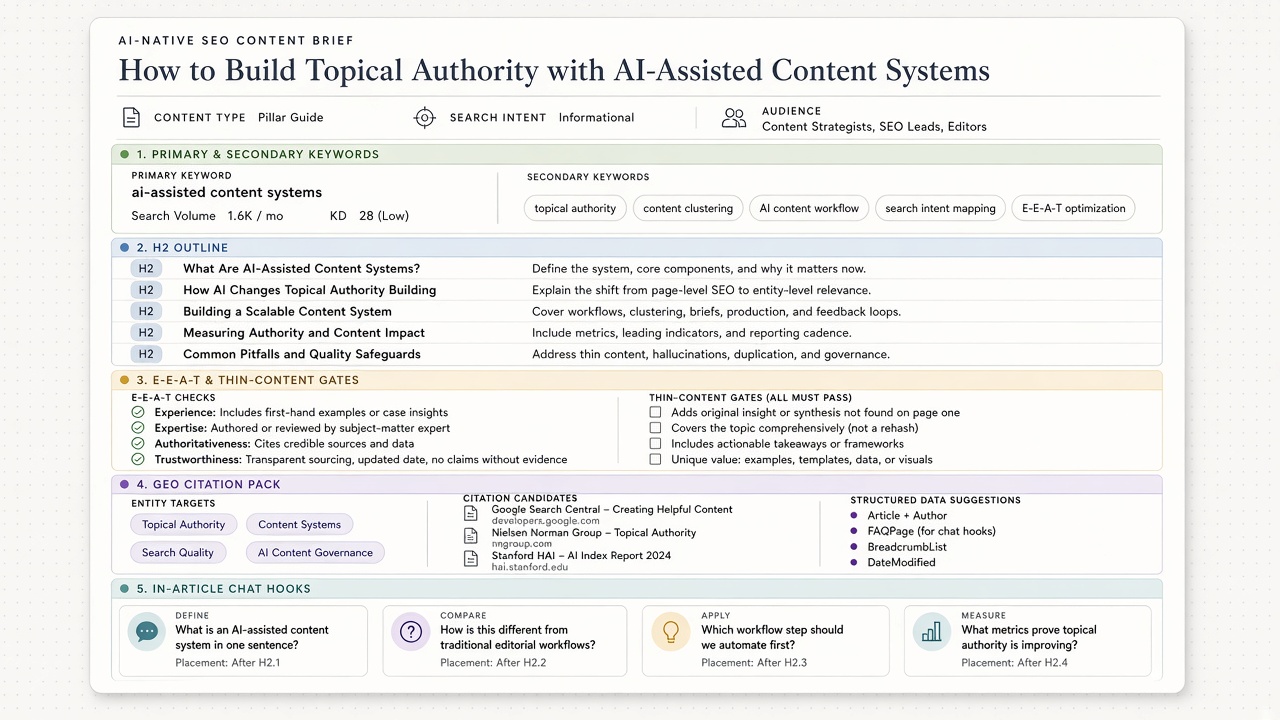
That completeness is a document you can paste today. Copy the field set below into Google Docs, Notion, or a CMS custom-field group and reuse it on every URL in a low-competition, mid-volume niche. A required slot stays empty only if you have marked it optional; otherwise the crew does not draft.
Keyword contract: primary, secondary, longtail
Start with terms a research agent can score and a draft agent cannot skip. For the primary query, each secondary, and each longtail, record the phrase, the search intent, an approximate difficulty band, and a must-use or optional label. Must-use terms belong in the title, an early heading, and the body. Optional terms appear only when they serve the unique angle—never as stuffing.
- Primary — one target query, its intent, difficulty band, always must-use.
- Secondary — same-intent supporters, each labeled must-use or optional.
- Longtail — narrower variants, labeled the same way so agents do not cram every modifier into one paragraph.
Questions, entities, gaps, and the angle agents cannot drop
Four fields stop two agents from shipping the same generic explainer. List the searcher questions the page must resolve, in order. List the entities—products, standards, people, places, tools—the draft has to name so the piece is grounded rather than interchangeable. Capture competitor gap notes: what current results omit, bury, or get wrong. Then write a unique-value angle in one or two sentences and mark it non-omissible. If that angle is missing from the outline or the draft, the page fails the brief.
Skeleton, citations, schema, and a hard stop list
Give the draft agent a heading order, not a theme. Specify the H2/H3 skeleton with the unique angle assigned to a named section, a word-band so the piece is neither thin nor padded, internal-link targets (destination plus intended anchor), and the types of external citations required—primary documentation, standards, first-party data—not a finished URL dump. Suggest a schema type that matches the intent. Close with an explicit do-not-cover list so neighboring cluster pages stay distinct.
- H2/H3 skeleton — ordered headings the draft must follow.
- Word-band, internal links, citation types, suggested schema — constraints a publish agent can check without rereading the SERP.
- Do not cover — topics reserved for other URLs or outside this intent.
In this same document, leave three labeled blocks empty: GEO pack, quality gates, and chat or monetization hooks. Later sections fill them. Do not invent placeholder copy; an empty labeled field is still something an agent can see and skip. Install the template once, then fill it in this order.
When those fields live in one place, they still need a shape a crew can ingest without interpreting headings. That is the jump from a pasteable template to a spec.
One pasteable contract — keywords with intent and must-use labels, questions, entities, gaps, a non-omissible angle, a heading skeleton, links, citation types, schema, a word-band, and a do-not-cover list, plus empty slots for GEO, quality gates, and chat hooks.
A JSON Spec Agents Can Ingest Without Guesswork
The spec is that shape: one JSON object, one stable briefId, and nested fields that already match the template you just pasted. Research, draft, fact-check, optimize, and publish agents bind to keys instead of guessing what an H2 meant. If a required field is missing, generation does not start.
Slide a human brief against the same contract as JSON. One side is headings a model must interpret. The other is typed objects a crew can slice without rereading prose.
What changes is not polish. An orchestrator can project each role a view of one canonical brief and merge write-backs without forking a second document. The keys stay stable even when the team, the CMS, or the model changes.
Nested objects that mirror the template
Keep the top level small. Nest only where the template already grouped work, and leave geo, gates, and chatHooks as reserved objects so later agents can attach signals without changing the contract.
- keywords — primary, secondary, and longtail entries, each with intent, an approximate KD band, and a must-use or optional flag
- questions and entities — searcher questions the draft must answer, plus people, products, places, and concepts treated as first-class
- uniqueAngle — a single non-omissible string; an empty angle fails validation
- outline — ordered nodes with level, heading, and a short note so the skeleton cannot collapse into generic H2s
- evidence and links — citation types plus a non-empty rule, internal targets, and the kinds of external sources that count
- schema, plus reserved geo, gates, and chatHooks — publish hints, pack signals, thresholds, and in-article chat seeds
One briefId, three sliced views
The orchestrator never forks the file. It loads one object by briefId and projects a research-only view (keywords, questions, entities, competitor gaps), a draft-only view (angle, outline, wordBand, do-not-cover), or a QA-only view (evidence, gates, schema). Write-backs merge to that ID so publish never optimizes a different brief than research filled.
Fail closed before the first draft token
Minimal validation is a gate, not a style note. Refuse to enqueue generation until all of the following hold:
- Required fields are present
- A word-band is set
- At least one unique angle is non-empty
- The citation rule is non-empty
- Gate thresholds are defined as keys, even if later steps fill the values
Empty prose is not a threshold. The shape stays tool-agnostic: custom agents, an autopublishing pipeline, or a platform like Flows can ingest the same object. Nothing assumes a particular SERP scraper; the research agent writes whatever it gathered into the fields.
One JSON contract — a stable briefId, typed nested fields, sliced views, and fail-closed validation so every agent executes the same intent without interpreting headings.
Turn Quality and E-E-A-T Into Pass/Fail Gates
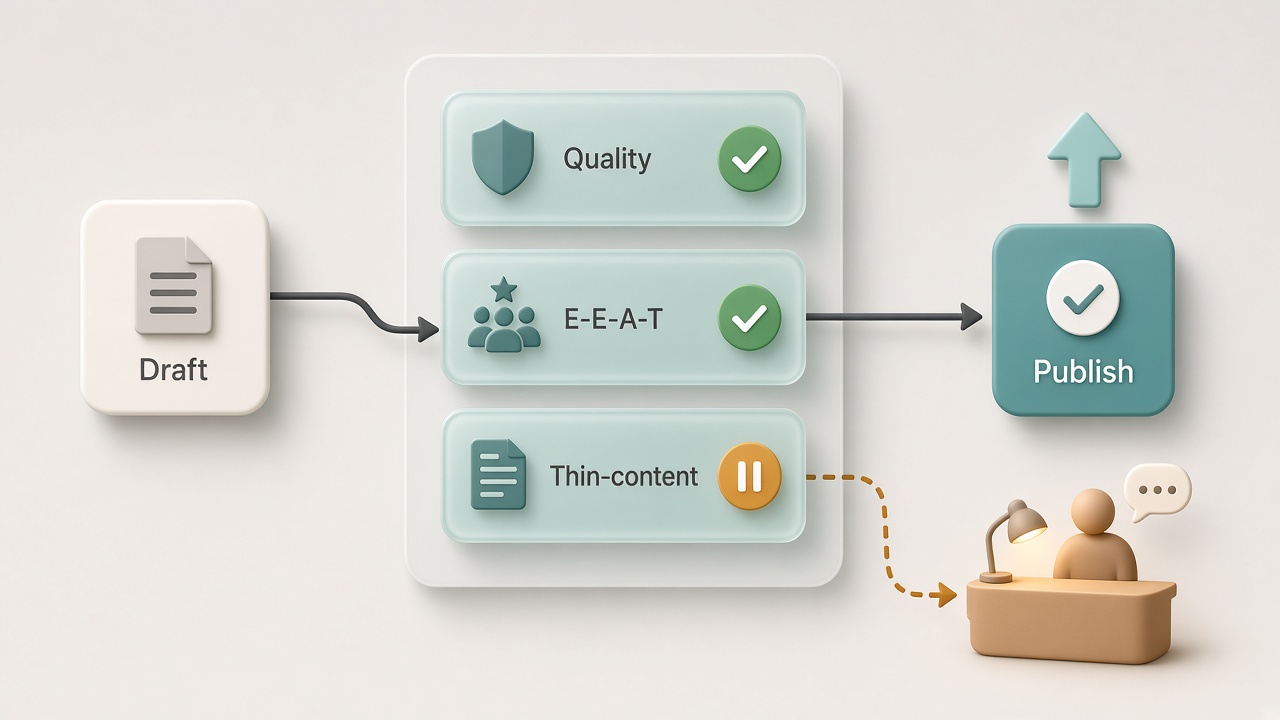
Those same fields stay incomplete until you attach pass/fail gates the QA and publish agents must evaluate before a page can go live. A brief without thresholds is still a suggestion. A brief with gates is a contract the pipeline can refuse to execute.
The checks a draft has to clear
Encode each check as a named key with a numeric or boolean threshold so a QA agent scores the draft against the brief, not against a vibe. For high-volume niche work, reusable defaults usually cover:
- An originality or similarity ceiling so near-duplicate cluster pages never ship
- A minimum count of unique sections that are not restatements of the H2 titles
- A citation-density floor tied to the evidence object already in the spec
- A banned-phrase list that kills empty boilerplate and generic closers
- Thin-content floors on both the word band and required entities, so a short, entity-poor draft fails even if it looks tidy
Specify E-E-A-T as fields, not a tone note
“Write with authority” is not something an agent can pass or fail. State whether first-person experience anecdotes are allowed, required, or forbidden; which expert source types must appear; what the author bio hook should be (named practitioner, brand desk, or reviewed-by line); and the last-updated rule the publish agent must stamp. Those become enum or boolean checks on the same object the draft agent already received.
What optimize and publish still have to verify
Carry Core Web Vitals and schema as verification tasks, not slogans. The brief already suggested a schema type; the optimize slice confirms that markup is present and valid, and that embeds did not introduce obvious layout or render problems. Flag any sentence that asserts a measurement, a process, or a product outcome so the fact-check agent knows what to verify against the citation rule. An uncited flagged claim fails the gate.
A failed gate does not get a silent second rewrite. It blocks autopublish and routes the brief-plus-draft to human review with the failing keys attached. That is how a niche site stays protected at scale: volume still moves, but thin, uncited, or boilerplate pages never become live inventory. Keep the gate set as defaults you tighten per vertical. Raise citation density, lower the similarity ceiling, or require experience anecdotes for a sensitive niche without touching keywords, outline, or unique angle. The rest of the template stays intact; only the thresholds change.
Gates, not slogans — originality ceilings, citation floors, and structured E-E-A-T demands turn the brief into a contract the publish agent can refuse, so thin pages never reach the live site.
Put GEO Citations and AI-Overview Signals on the Brief Itself
Those reserved GEO slots are the counterpart to the gates you just tightened. Thresholds decide whether a draft is allowed to publish; GEO fields decide whether answer engines can lift it without guessing. Both live on the same brief so a citation agent cannot invent sources the draft agent never saw, and neither one renegotiates keywords, outline, or unique angle to do the job.
Lock claims, quotes, and source tiers before anyone writes
Fill the GEO pack with typed fields, not a leftover bibliography. Research agents resolve these before drafting starts; draft agents consume them as constraints, not suggestions.
- Claim-to-source pairs — every non-obvious assertion maps to a URL or citation type that must be resolved first.
- Quotable definitions — one-sentence, entity-first lines marked as lift-safe for overviews and answer engines.
- Statistic attribution slots — empty holders for value, unit, date, and source so no figure reaches the draft without an owner.
- Preferred source tiers — primary research, official documentation, and named datasets rank above secondary explainers, so a roundup never equals the originating record.
Make the page extractable, then keep it eligible
Require an answer-first summary on the outline node that owns the primary question: one or two sentences a model can extract without the surrounding argument. Pair that with explicit entity disambiguation—which product, which standard, which market—so AI Overviews do not collapse your page into a neighbor’s entity. Instruct agents to place citations beside the claims they support, not only in a footnote block, and to honor a high-trust source floor you set on the brief rather than a single decorative link.
Refresh triggers keep the same contract current: a data-age ceiling for any dated figure, plus a SERP-shift note when the featured answer or entity mix changes. When either fires, the orchestrator re-runs research and citation slices only. All of this nests under the existing geo object in the JSON spec. Orchestrators pass that object to citation and draft agents as one slice; empty pairs, empty tiers, or a missing answer-first summary fail validation the same way a missing unique angle does. The agents never drift because they never receive two versions of the truth.
GEO is a contract slice — claim-to-source pairs, lift-safe definitions, attributed figures, source tiers, answer-first summaries, and refresh triggers live on the same JSON object so citation and draft agents cannot invent their own rules.
Seed Chat and Revenue Hooks as Required Brief Fields
That rule does not stop at citations. The reserved chatHooks object is the next required slice of the same contract—starter questions, knowledge scope, escalation paths, off-limits claims, and structured revenue placements—so draft, embed, and offer agents execute one intent instead of inventing a widget after publish.
What every chat seed must name
Treat chat configuration as enforceable fields, not a prompt you paste later. Empty starter questions or an undefined scope fail validation the same way a missing unique angle does. The brief should lock four things before any draft starts:
- Starter questions the in-article assistant may open with, each mapped to a specific outline node.
- Knowledge scope — this page, approved internal docs, or a named tool set, and nothing outside it.
- Escalation to a human or an email capture when the question leaves that scope.
- Off-limits claims the widget must never invent: guarantees, medical advice, or pricing the article does not support.
Monetization hooks are placements, not a link dump
Define each hook as a structured placement tied to searcher intent and to a specific outline node: a comparison moment after the alternatives section, a checklist CTA where the reader is ready to act, a lead magnet at the close of a how-to block. Agents then insert one justified offer at the right beat instead of stuffing affiliate URLs wherever the model feels promotional. Informational intent can require a soft capture and forbid hard-sell language; commercial intent can require the comparison hook while the do-not-cover list still blocks unapproved products.
Align the widget with the outline
Map every starter question to the H2 or H3 it belongs under so help arrives in context. A reader mid-implementation should get that step, not a generic recap of the whole article. That alignment turns the chat into navigation rather than a sidebar novelty, and it gives operators a clean path from the published page to ongoing engagement. Brief-level chat config is the bridge: the same object that gated the draft now seeds the embed, so conversations, captures, and attributed revenue trace back to the contract instead of whatever the widget improvised.
Keep compliance on the brief itself. Disclosure language, YMYL caution, and what the chat may not recommend live as flags both the draft agent and the embed agent inherit. In regulated niches, empty compliance notes fail validation so a high-volume pipeline cannot ship a helpful-looking assistant that is not allowed to speak on the topic.
Chat and revenue are brief fields — starter questions, scope, escalation, off-limits claims, and intent-tied placements must live on the same contract so agents cannot improvise a widget or stuff links after publish.
Close the Loop: Brief, Publish, Measure, Tighten
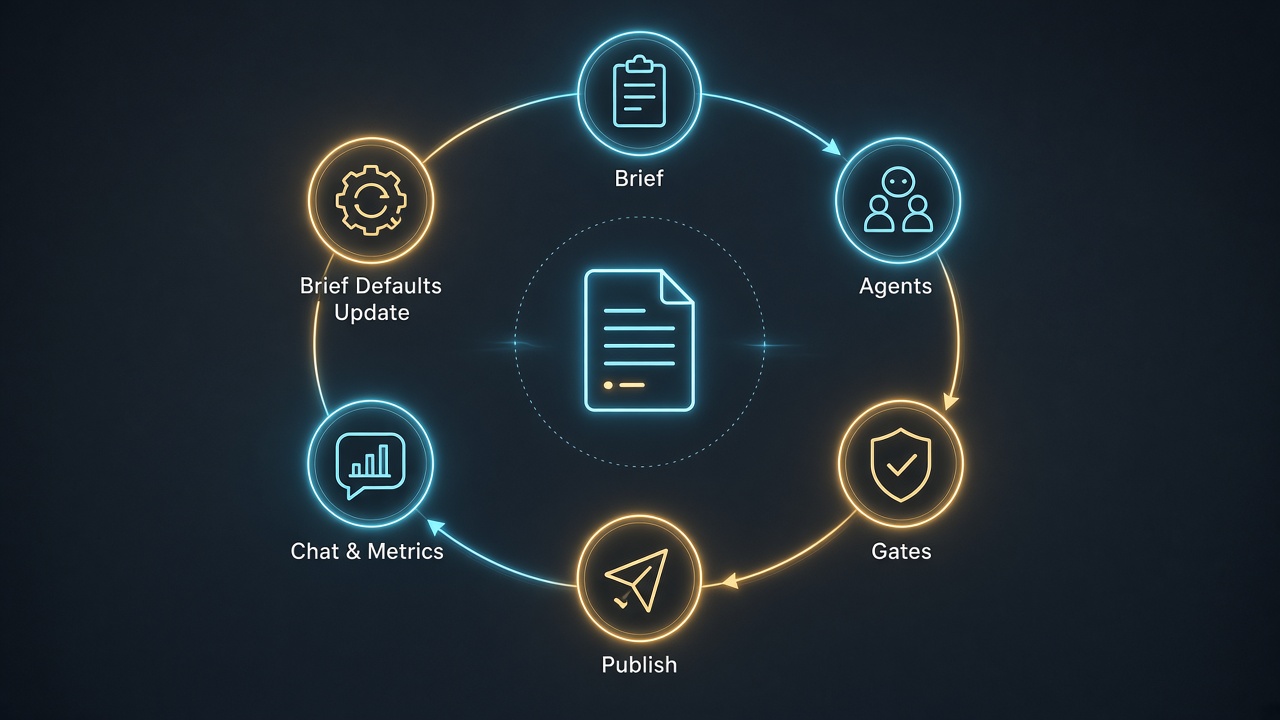
Those inherited flags complete the contract. What remains is not another field to invent—it is a loop that treats every brief as an experiment you can score and then tighten.
From SERP gap to a live, measurable page
Start with SERP and gap notes: who already ranks, which questions they leave open, which entities they blur. Fill the same template or JSON the earlier sections defined. Hand slices to the crew—research, draft, fact-check, optimize, publish. Gates either clear the URL or route it to review. Publish with schema and the in-article chat already seeded from the brief. Then score the outcome. None of that depends on a particular vendor. A solopreneur can run it from Docs or Notion plus a lightweight orchestrator; a Flows-style system can put the chat on the page the moment the brief clears.
- Pull SERP and gap inputs into the brief—intent, competing entities, unanswered questions, citation opportunities.
- Complete the template or JSON so every reserved slot (gates, GEO, chat, compliance) is filled, not implied.
- Dispatch research-only, draft-only, and QA-only slices of that same object.
- Block autopublish on any failed gate; ship only what clears.
- Go live with chat hooks active, then score the URL against the brief that created it.
Measure the brief, not only the rank
Rankings lag and they hide operational waste. Watch time-to-publish, gate pass rate, chat engagement and conversions, dwell, assisted revenue, and refresh cost. A fast publish that would fail originality on the next pass is expensive. A ranking URL with a silent assistant is an unfinished brief.
Misses should change the template, not just the next slug. Thin unique sections mean a stricter unique-angle rule. Weak citations mean a higher source-tier floor. Quiet chats mean starter questions rewritten against the outline nodes they were meant to serve. The next batch of low-KD URLs inherits the correction instead of repeating the miss.
A weekly rhythm for many small URLs
- Cluster day: fill a handful of briefs (or generate JSON) before any draft runs.
- Execute window: let the crew work; only failed gates get a human.
- Scorecard pass: read pass rate, chat, dwell, assisted conversions, and the refresh queue—then change one default on the template.
Keep the loop boring on purpose. The brief is the contract; the week is the audit. When defaults get stricter because last week’s pages proved they needed to, autoblogging stops being a volume bet and becomes a publishing system you can trust.
If you only operationalize one habit, make it this: never ship the next cluster on last month’s defaults. The machine-readable brief is how every agent stays on the same intent—and the scorecard is how that intent gets sharper.
The brief is a loop — fill it from the SERP, run the crew through gates, publish with chat live, then write failed metrics back into the template so the next URLs are stricter by default.
Key Takeaways
Copy the field set into Docs, Notion, or your CMS, lock the JSON validation, and run your next cluster through one shared brief so every agent executes the same intent.
Frequently Asked Questions
It is a structured specification for one URL: target queries and intent, entities, evidence the draft must cite, outline angles, links, schema, quality gates, and any chat or monetization hooks. Unlike a writer memo, it is written so research, draft, review, and publish agents can execute it without reinterpretation.
JSON (or an equivalent structured spec) removes ambiguity. Multi-agent crews can research, draft, fact-check, optimize, and publish from the same fields, and you can version, validate, and reuse the contract across a 100–1,000 article niche without the brief drifting.
Embed thin-content thresholds, originality checks, citation requirements for claims, and notes on schema and Core Web Vitals before anyone hits publish. Putting penalty-safety rules in the brief—not in a later audit—keeps high-volume pipelines from shipping pages that cannot stand up in search.
The brief should name the entities, facts, and unique angles a model would need to cite or summarize the page correctly. Pair that with searcher questions and evidence requirements so the draft is extractable, attributable, and still useful when a reader never clicks through an overview.
Give the chat the article’s thesis, outline, allowed recommendations, and navigation jobs as fields in the brief. Then the assistant can explain, route, and monetize without inventing a second strategy that fights the page.
Track time-to-publish, chat engagement and conversions, dwell time, and revenue attributed to brief-driven URLs—not only rankings. If agents still argue about intent or chat cannot fulfill the page’s job, the contract is incomplete.
You Might Also Like