How to Read a Competitor’s Topic Cluster Without Copying Their URLs

Competitive research is the planning tactic marketers most often call their best, yet regular use of topic-clustering tools is rare: Semrush’s 2023 content marketing report, as cited by Nexklicks, puts the share who call it their best planning method at 45%. The gap is not a missing export. It is reading the export as strategy instead of as a sitemap to copy. A competitor’s topical map shows which subjects they built, which subtopics they covered, and where the coverage is thin. Folder paths are not that map. The cluster is the set of pages that share an intent and point at a hub—not the slugs under a directory. This pass is built for one person. Filter noise, name the pillar by inbound links, group queries by shared results, and stop before you open a new URL. Almost 93% of US keywords are too small to justify their own URL, and Ahrefs’ 2025 study found only 1.74% of new pages reached Google’s top 10 within a year. Expand or merge first. Copy the rival’s outline last, or not at all.
- Read a rival cluster as intents and link roles, not as URLs to clone.
- The pillar is the page most of the cluster links to, not the URL that looks most important.
- Group queries by shared search results; shared wording is not the test.
- A long gap list collapses into a handful of clusters—that is the unit of work.
- Create a new page only after expand and merge fail; most new URLs never reach the top 10 within a year.
What Competitor Topic Cluster Analysis Is, and How It Differs from a Keyword Gap Export
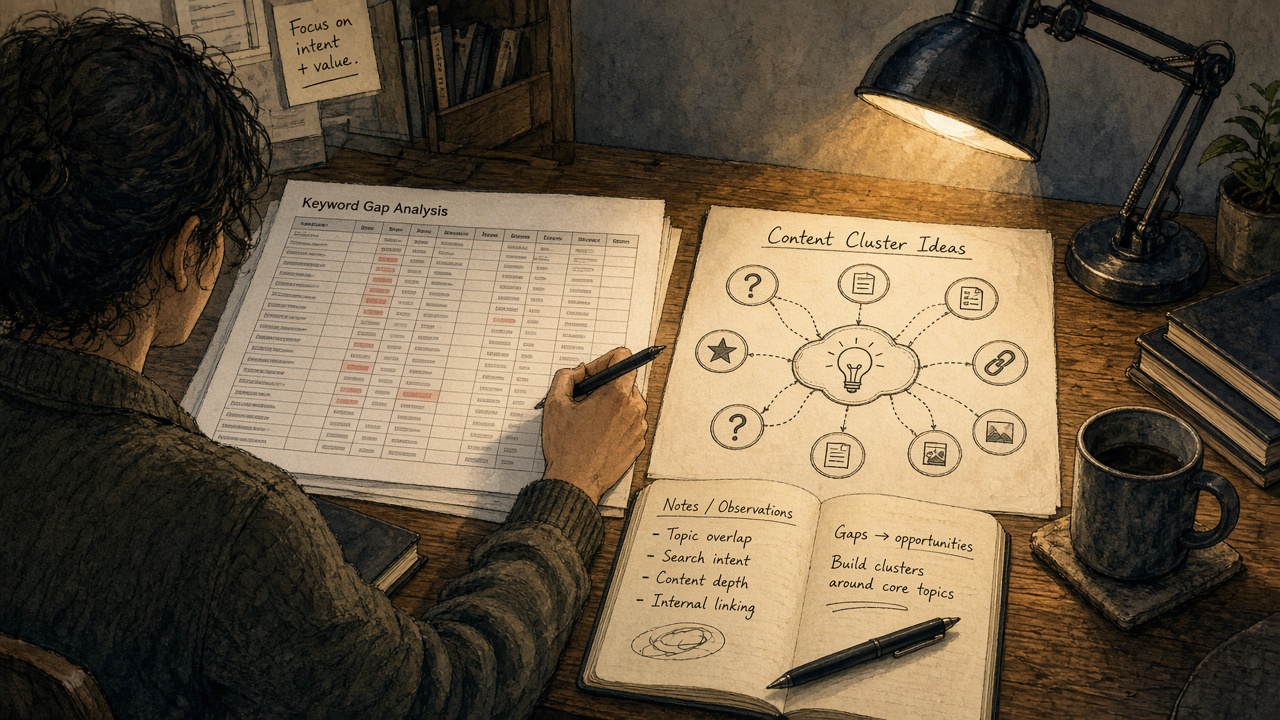
Competitor topic cluster analysis reads which subjects a rival built, which intents those pages serve, and which page the cluster points at. It is not a URL list to queue.
A keyword gap export is a query list. After filtering, that list collapses—a long gap list can become 18 clusters—and the cluster is the unit of work. Group the queries first, the way keyword clustering does, by shared results rather than shared words, before you interpret a rival map.
The biggest mistake is copying the competitor instead of understanding why the structure works. Their slug, folder, and outline never enter your brief queue.
Read, don't clone — Read the rival cluster as intents and link roles, then decide whether to create, expand, merge, or skip—never as URLs to clone.
How to Find the Real Pillar Without Trusting Folders
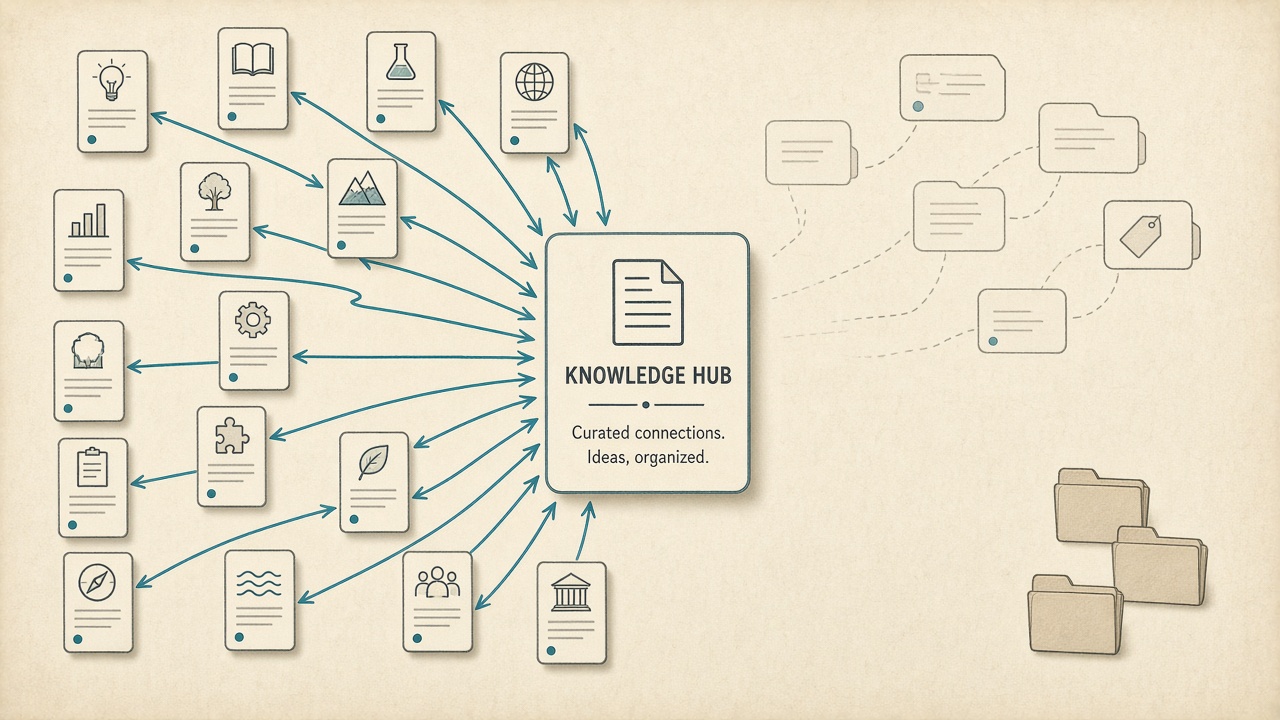
Once the queries are grouped, the pillar is the page the cluster points at. Find it by inbound internal links from pages on the same subject, not by the shortest path or the URL that looks most important. Most pages on one topic can still point at a single hub.
Folder structure is not a strategy. One /blog/ directory can hold many posts across 15 different topics with no internal clustering logic at all. Before you interpret shape, keep only URLs above a modest organic-traffic floor—about 50 visits a month—so a one-off ranking does not look deliberate. Drop tag, filter, and pagination URLs.
A hub often concentrates those links and acts as the authority node even when external links are thin. Hub pages commonly receive 50 or more internal links. Most pages on one topic can still have one pillar if 28 of them link to a single resource. Orphans have almost no in-cluster links. Tag archives collect unrelated posts; they are noise, not spokes.
Link role, not path — The real pillar is the page the filtered cluster points at. Folders, short URLs, and tag archives do not decide it.
How Many Supporting Pages Mean Depth, and When Not to Match a Stronger Site

Once the pillar is the page the cluster points at, stop counting URLs. Shape beats article count. One pillar and 12 supporting articles is committed depth. Several pillar-level pages and almost no spokes is a structural gap you can go deeper on without matching their slugs.
A workable blog cluster is one pillar plus about 6 to 15 unique-intent spokes, not a quota copied from a larger site. A tight cluster of 8 to 10 pages can establish topical authority faster than copying a broad 40-page rival map.
If you can only reach mid-page one, the prize is smaller than volume suggests. Clicks concentrate at the top—7.1%—so do not chase a stronger site’s whole cluster for a mid-SERP maybe. When their hub is entrenched and you already have a related page, take the narrower intent they skipped.
Shape over size — Depth is one pillar with a limited set of unique-intent spokes, not a cloned map. If you cannot own the top of the SERP, skip the entrenched hub and take the tighter job they left open.
How SERP Overlap Keeps You From Copying a Rival URL or Cannibalizing Your Own
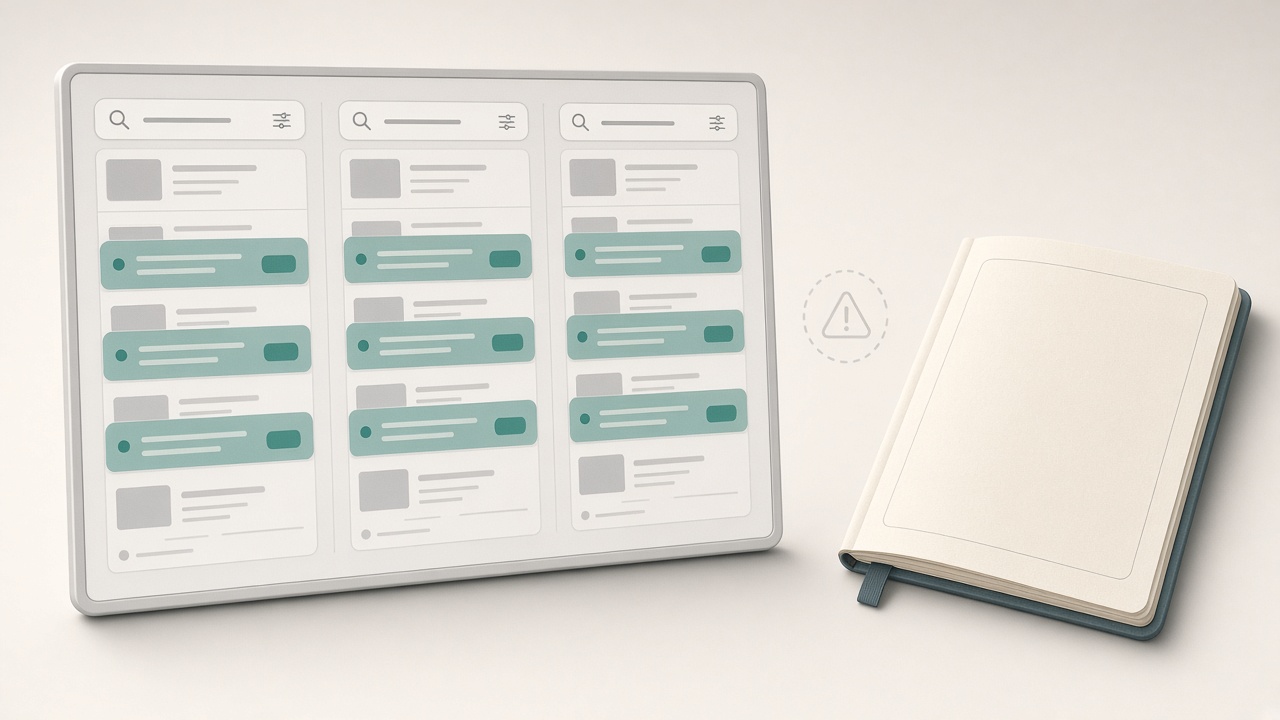
Skipping their page count is only half the decision. SERP overlap is how you refuse a rival URL that should be one page on your site, and how you avoid cannibalizing a pillar or spoke you already published. Group queries by shared results, not shared words. If at least three of the top 10 organic URLs match, those queries are one page, even if the competitor split them.
Copying that one target URL still misses the cluster. Most of a ranking page’s traffic value sits outside its primary keyword: 45 to 60% of the keywords driving traffic to a competitor page are not the term the page targets.
Before any new URL, search your own cluster map and Search Console for the same intent. If a pillar or spoke already covers it, expand or retarget that URL. A rival split is not permission to split. One URL per intent keeps credit from fracturing, so refuse a second slug when overlap says the queries belong together, even if their folder makes the split look official.
One page — If three or more of the top 10 results are the same URLs, those queries stay on one page—expand what you already rank, and do not clone the rival split.
What to Log Before a Brief, and How to Spot a Half-Answer

The choice not to open a second slug still needs a record before it becomes a brief. Log the intent, the reader’s job, the link role, the SERP-overlap group, the evidence they actually show, the questions left open, and a provisional create, expand, merge, or skip. Do not log their slug, H2 outline, or folder to reuse.
That card is the only artifact that may enter a brief. A rival outline is reference, then it is deleted from the queue.
Half-answers show up as a question in the heading with a generic closer, a missing number, or steps that stop before the operator can act. Across 948 audited competitor pages, no cluster averaged more than 0.50 first-party data points per page, so original evidence is the repeatable gap, not a longer rewrite. Note the missing proof in your own words. That note becomes the information gain, not a paraphrase of their section.
Card, not clone — Log intent, link role, overlap group, and the proof they skipped; the brief never inherits their slug, outline, or folder.
When a Missing Subtopic Is a Create — and When to Expand, Merge, or Skip
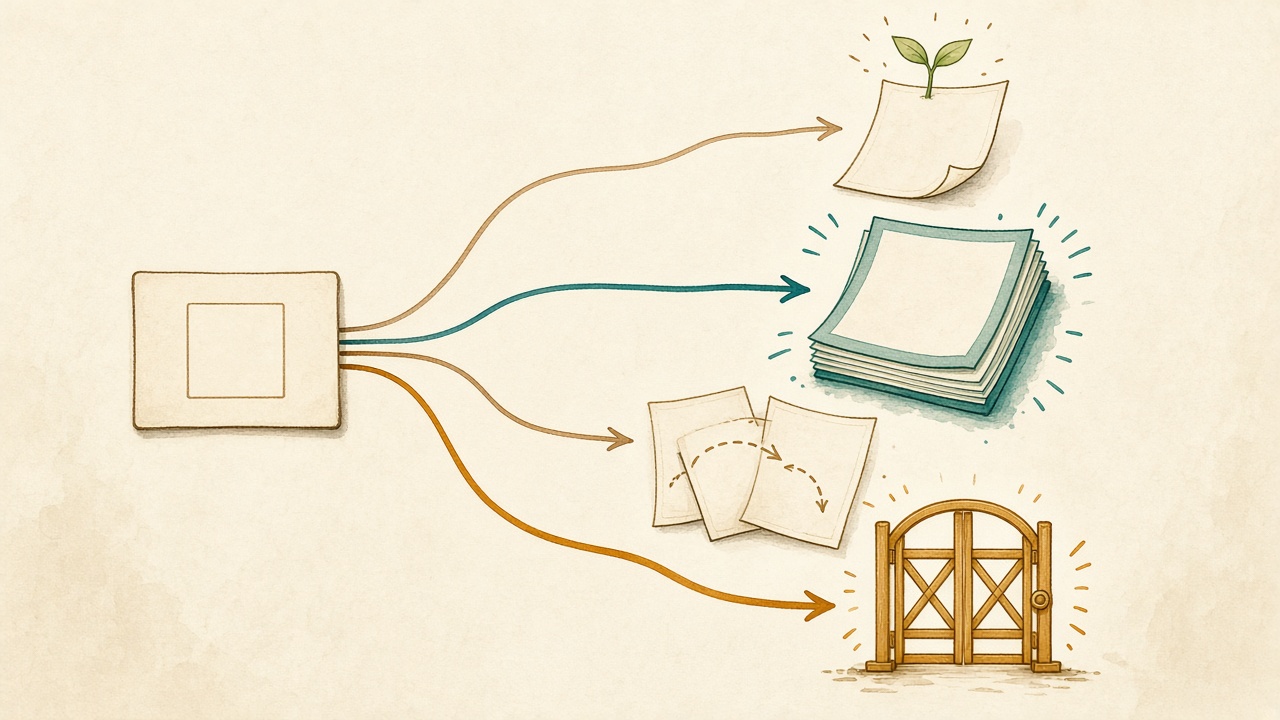
That provisional call is rarely create. A missing subtopic earns a new URL only when the intent is unique, SERP overlap treats it as its own page, and nothing you publish can absorb it. Otherwise expand, merge, or skip.
Do not open a page because a rival has one. Group gap keywords into topics first, and open a new URL only after expand and merge fail.
Expand if the live pillar or spoke can take the missing section, example, or proof. Merge if two of your URLs, or two rival splits, share results. Skip tag noise, tiny queries, mid-SERP prizes, and any angle you cannot beat with information gain. The create-a-cluster worksheet still seats that spoke under one pillar and a limited spoke set.
Rarely create — Create only for a unique intent with nowhere to land. Expand or merge first; skip anything too small, too entrenched, or impossible to out-prove.
How Many Search Competitors to Compare, and What a Human Must Still Refuse

Once the card already says create, expand, merge, or skip, the next limit is who you read. A usable set is two to five real search competitors — the domains that rank for this cluster — not every business rival. Starting with two to five keeps the list usable. One-person scope is one cluster at a time; a sixth domain adds noise faster than it adds a new intent.
Automate only the noise filter: the traffic floor, tag and filter drops, internal-link counts, and SERP URL overlap. Those are counts, not strategy. A human still has to name the intent, mark half-answers, and refuse or delete copied slugs, pasted outlines, and any brief that is only a longer version of their pillar. If the queue holds a rival URL with your domain swapped in, delete it before it becomes a draft.
Refuse the clone — Compare two to five ranking domains, one cluster at a time. Automate the counts, and delete any brief that is a swapped URL or a longer copy of their pillar.
When to Re-Read a Live Cluster, and How Tightness Earns AI Citations
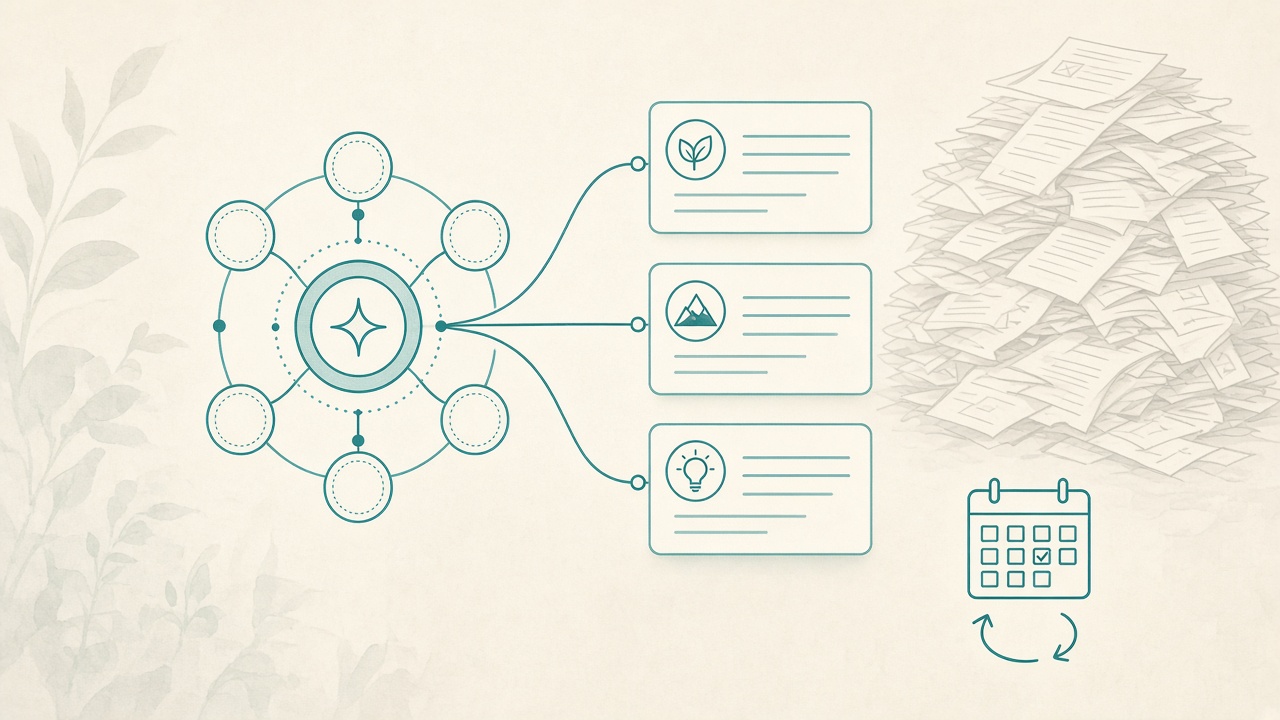
After you have refused the cloned slug, do not put the live cluster on a weekly recopy schedule. Re-read it after your new page is indexed, when the rival adds spokes to the same hub, or when your impressions stall—and update the reading card, not their outline.
A tight cluster helps AI fan-out because each unique intent has one URL and the spokes point at the pillar, so an assistant can cite the page that answers the sub-question instead of a cloned slug. HubSpot’s early topic-cluster tests found that adding internal links between related pages improved SERP placement and impressions. Copy that link role, not their URLs. Keep the cluster smaller than the rival’s if that is all your evidence can support; breadth without proof does not earn citations. The site’s pillar-and-spoke strategy piece is how that citation graph stays one URL per intent.
Cadence — Re-read on index, new spokes, or stalled impressions, and earn citations with one URL per intent plus internal link roles—never a weekly clone of their outline.
Key Takeaways
Pick one live rival cluster, fill a single reading card, and make one create, expand, merge, or skip call before you write another brief.
Frequently Asked Questions
You Might Also Like
- Strategy Content Gap vs Keyword Gap: Which One Becomes a Brief
- Guides SEO Competitor Content Gap Analysis: A One-Person Method Without a Suite
- Guides How Many Cluster Articles Does a Pillar Need?
- AEO Topic Cluster Strategy: How to Map Pillars That Compound Rankings
- Strategy Topical Coverage Score: A Spreadsheet Check Before You Open Another Cluster