Creating Topic Clusters for Low-Difficulty AI Content
Building search presence in the age of generative search requires more than publishing isolated, keyword-stuffed articles. Modern search engines evaluate topical authority, rewarding sites that demonstrate deep, structured expertise on a given subject. For publishers leveraging AI content, the fastest path to establishing this authority is through systematic, interlinked content hubs. By focusing AI content generation on low-difficulty keywords, you can bypass highly competitive search spaces and claim immediate rankings while building a robust foundation for broader, high-intent topics.
The secret to scaling this process lies in combining AI automation with strict structural discipline. Research by BrightEdge reveals that sites with strong internal linking structures, which form the backbone of topic clusters, rank 40 percent higher in search. Implementing these internal linking patterns systematically ensures search engines and AI engines alike recognize your site as a comprehensive resource. By utilizing AI tools to automate the semantic grouping of keywords and generate cluster structures based on search intent and SERP data, publishers can programmatically launch hundreds of highly targeted, interlinked articles that naturally rank and sustain their positions over time.
- 1
Topic clusters group related content around a central pillar page to build semantic authority and rank faster on search engines.
- 2
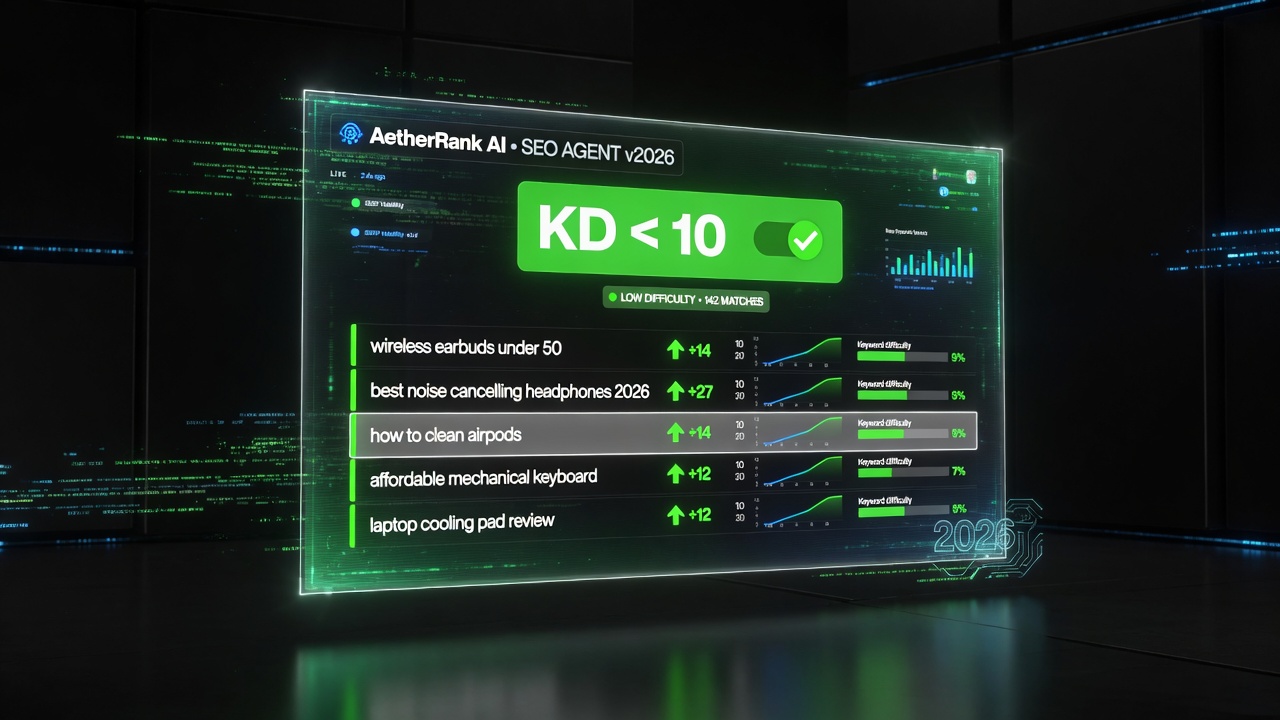
Focusing AI content on low-difficulty keywords (KD under 35) helps publishers secure quick traffic wins and build foundational authority.
- 3
Sites with solid internal linking structures rank 40 percent higher in search, making structured link templates critical for programmatic SEO.
- 4
AI SEO tools automate keyword grouping and cluster generation, drastically reducing manual strategy and mapping times.
Why Low-Difficulty Keywords Are the True Foundation of AI-Driven Topic Clusters
Building authority quickly requires a strategic entry point. While high-volume keywords are tempting, targeting low-difficulty keywords provides the immediate search footprint that newly launched AI content needs. Because these terms face minimal competition, search crawlers index and rank them far faster. This rapid indexing creates an early, active stream of organic traffic, proving to search engines that your domain can reliably satisfy user queries before you attempt to compete for high-volume, high-competition terms.
This low-barrier entry does more than just secure quick wins; it acts as the scaffolding for your entire cluster expansion. By programmatically deploying highly targeted, specific articles addressing niche queries, you systematically build a dense web of topical coverage. This structure is highly beneficial because topic clusters—organized sets of content built around a central theme—help you earn topical authority and make your content easier for AI to understand in generative search results.
Aligning Search Intent Across Traditional and Generative Engines
To turn low-difficulty keywords into a cohesive network, publishers must align every page with precise search intent. Modern search platforms and generative AI engines no longer look at keywords in isolation; they evaluate how comprehensively a site addresses a user's broader journey. By mapping low-difficulty keywords to specific search intents—such as informational, transactional, or comparative—you ensure that both traditional algorithms and generative answer engines recognize your cluster as a highly relevant, logically structured resource.
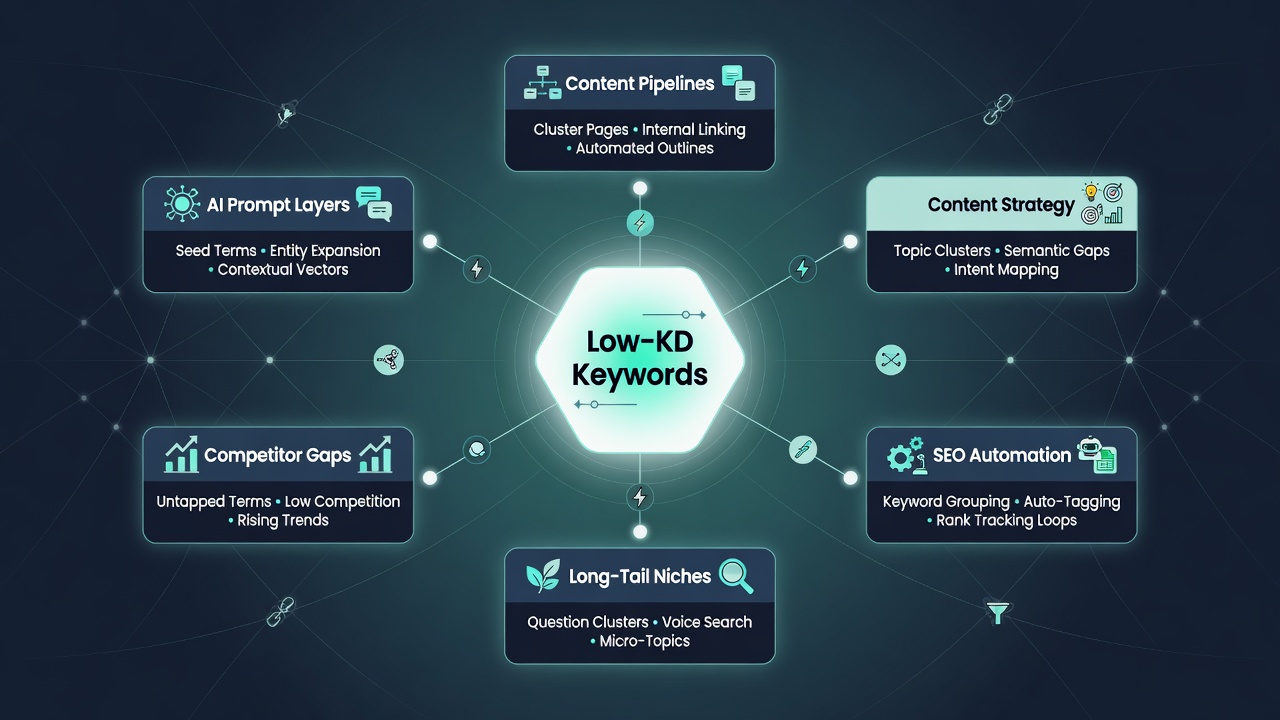
Low-KD Anchoring — Targeting low-difficulty keywords creates a fast track for indexing and organic traffic, building the foundational topical authority that search engines and generative AI models require to trust your broader cluster.Automating Semantic Cluster Architecture with AI Engines
t resource. Moving away from manual keyword mapping means letting machine learning do the heavy lifting of semantic categorization. Traditional SEO workflows relied on massive spreadsheets, arbitrary filters, and hours of manual SERP analysis to group related terms. Today, advanced AI tools automate semantic grouping, identify content gaps, and generate cluster structures based on search intent and SERP data.
By analyzing real-time search engine results pages, these platforms detect hidden semantic relationships that human analysis often misses. They group keywords not just by lexical similarity, but by actual user intent, ensuring that your supporting pages reinforce your pillar content without competing against each other in the SERPs.
Once these cluster structures are defined, they can be directly integrated into automated publishing and autoblogging workflows. Instead of creating content briefs one by one, SEO automation platforms can instantly spin up optimized outlines for an entire cluster of low-difficulty terms, accelerating your production schedule from months to hours.
Algorithmic Clustering — Replacing manual spreadsheets with AI-driven semantic grouping tools allows publishers to map search intent accurately and scale content production with zero structural friction.Designing the Internal Linking Architecture Inside Programmatic Templates
To turn a collection of individual articles into a highly cohesive topical network, you cannot treat internal linking as an afterthought. Instead of manually inserting links after publishing, modern SEO automation relies on building strict linking rules directly into your programmatic content templates before a single word is generated. When your automated CMS templates dictate where and how links flow, you eliminate human error and ensure every new page instantly passes equity to its neighbors.
A robust internal linking template should map out structured semantic relationships across three distinct levels:
- Hub-to-Spoke: The central pillar page links out to every supporting low-difficulty article, and every supporting article links back to the pillar with keyword-rich anchor text.
- Spoke-to-Variation: Highly related sub-topics link directly to one another, signaling deep semantic relationships to search crawlers.
- Variation-to-Variation: Lateral links between sibling pages that address similar search intents under the same sub-topic.
This systematic approach to site architecture yields massive performance benefits. In fact, websites that leverage strong internal linking structures—forming the structural backbone of these topic clusters—rank 40 percent higher in search engine results. By integrating these specific hub-to-spoke and spoke-to-variation patterns right into your programmatic SEO templates from the very beginning, you ensure that as your site scales, your search visibility scales alongside it.
Template-driven linking — Building hub-to-spoke and spoke-to-variation linking rules directly into programmatic templates guarantees a clean site architecture that can rank 40 percent higher by signaling clear semantic relationships to search engines.Scaling AI Content Safely: Mitigating Risk with Structured Clusters
This systematic scaling, however, often raises a critical concern: how to expand your content library rapidly without triggering search engine penalties. When publishers deploy programmatic AI engines to generate hundreds of pages, the risk of over-optimization and repetitive internal linking increases. The antidote lies in combining low-difficulty keywords with a highly structured, template-driven cluster architecture.
By targeting low-competition search terms, you naturally avoid the aggressive keyword stuffing that triggers manual reviews. Instead of forcing highly competitive terms into your copy, your AI engine writes naturally about specific, long-tail user problems. When your internal linking rules are hardcoded into your templates, link flow remains balanced and predictable, rather than looking like an artificial, overnight link-building scheme.
This controlled distribution of link equity does more than just shield your site from algorithmic penalties. Because search engines rely heavily on semantic relationships to understand site structure, this organized approach signals deep expertise.
Ultimately, topic clusters strengthen authority signals by aligning content with Google’s semantic and intent-focused ranking shifts. By focusing on intent matching rather than keyword density, your programmatic scaling efforts read as a comprehensive, user-first resource. Authority builds steadily and organically, establishing a bulletproof foundation that both traditional crawlers and generative AI search engines trust implicitly.
Structured moderation — Scaling programmatic content with low-difficulty keywords and rigid linking templates prevents optimization footprints while satisfying search engines' semantic ranking algorithms.
Key Takeaways
Let Flows automate your entire SEO strategy by programmatically building, writing, and linking high-authority topic clusters for your website today.
Frequently Asked Questions
Topic clusters strengthen authority signals by aligning content with Google’s semantic and intent-focused ranking shifts. Organized sets of content built around a central theme help you earn topical authority and make your content easier for AI to understand in generative search results.
AI tools automate semantic grouping, identify content gaps, and generate cluster structures based on search intent and SERP data. This eliminates the tedious manual mapping of keywords and speeds up programmatic scaling.
According to BrightEdge, sites with strong internal linking structures, which form the backbone of topic clusters, rank 40 percent higher in search. A strong internal link architecture signals semantic relationships to search crawlers.
Internal linking should be built into programmatic SEO templates from the start. This includes defining clear, automated linking patterns such as hub-to-spoke, spoke-to-variation, and variation-to-variation pathways.
You Might Also Like