AI Automation
Creating Rich Content with AI Tools

Search engines and readers have grown tired of flat, generic walls of text. Today, winning the SEO game requires building dynamic, highly engaging digital environments. Fortunately, artificial intelligence has evolved from a basic drafting assistant into a powerful engine for creating multifaceted, interactive articles. As highlighted in Google Search's guidance about AI-generated content, "AI has the ability to power new levels of expression and creativity, and to serve as a critical tool to help people create great content for the web." By combining automated workflows with human oversight, brands can publish articles that hold attention and drive conversions far better than traditional blogs.
Creating this level of depth is no longer a manual chore. Modern platforms enable creators to build semantically rich articles that target broader entities and topics, a strategy supported by tools like MarketMuse, according to the hands-on review "I Tried 18 AI SEO Tools. Here Are The Ones That Really Work." Furthermore, optimizing for modern search engines requires structuring your data carefully. The industry report "Best Practices for Enhancing AI Visibility in 2026" notes that "AI visibility improves when content is structured, entity-driven, and written in a clear question-and-answer format that generative engines can extract, trust, and cite."
To truly stand out, forward-thinking publishers are taking rich content a step further by embedding interactive AI chat widgets directly inside their articles. This allows readers to ask follow-up questions, navigate complex topics, and interact with the content in real time, dramatically increasing time-on-page and opening new monetization channels. Let's explore how you can harness these advanced AI tools and structured workflows to elevate your content strategy from basic text to an interactive digital experience.
TL;DR
- AI tools have evolved to help creators build deeply structured, interactive, and semantically rich content that ranks highly.
- Google officially supports AI-assisted content creation as long as the output remains helpful, original, and user-centric.
- Structuring content with clear Q&A formats and schemas makes it highly visible to modern generative search engines.
- Embedding interactive elements like live AI chat inside articles boosts dwell time, improves navigation, and unlocks new monetization.
Beyond Plain Text: The Anatomy of Rich, Interactive Content
To transition from basic text to a truly interactive digital experience, we first need to redefine what "content" actually means in the modern search landscape. It is no longer enough to publish blocks of paragraphs and hope for the best. Today, rich content is defined by its structure and utility—incorporating dynamic elements like comparison tables, interactive FAQs, and embedded AI chat features directly into the page.
When readers can interact with an article—whether by calculating a metric, toggling a data point, or asking an embedded AI assistant a specific question—their dwell time skyrockets. This deep engagement does more than just please human readers; it signals strong user satisfaction to search engine algorithms, leading to better organic rankings and, ultimately, higher conversion rates.
However, a common trap when using a standard AI SEO content generator is relying on generic, flat text. Out-of-the-box AI writing tools often churn out repetitive, essay-style articles that lack visual structure, unique insights, or interactive elements. They generate words, not experiences. To bridge this gap, publishers must combine AI's raw drafting power with smart layout design, structured formatting, and interactive layers.
Interactive experiences win — Static text is no longer enough; modern SEO requires structured, multi-dimensional content that actively engages readers and keeps them on your page longer.
From Flat Text to Rich Layouts: How to Prompt AI for Structured Content
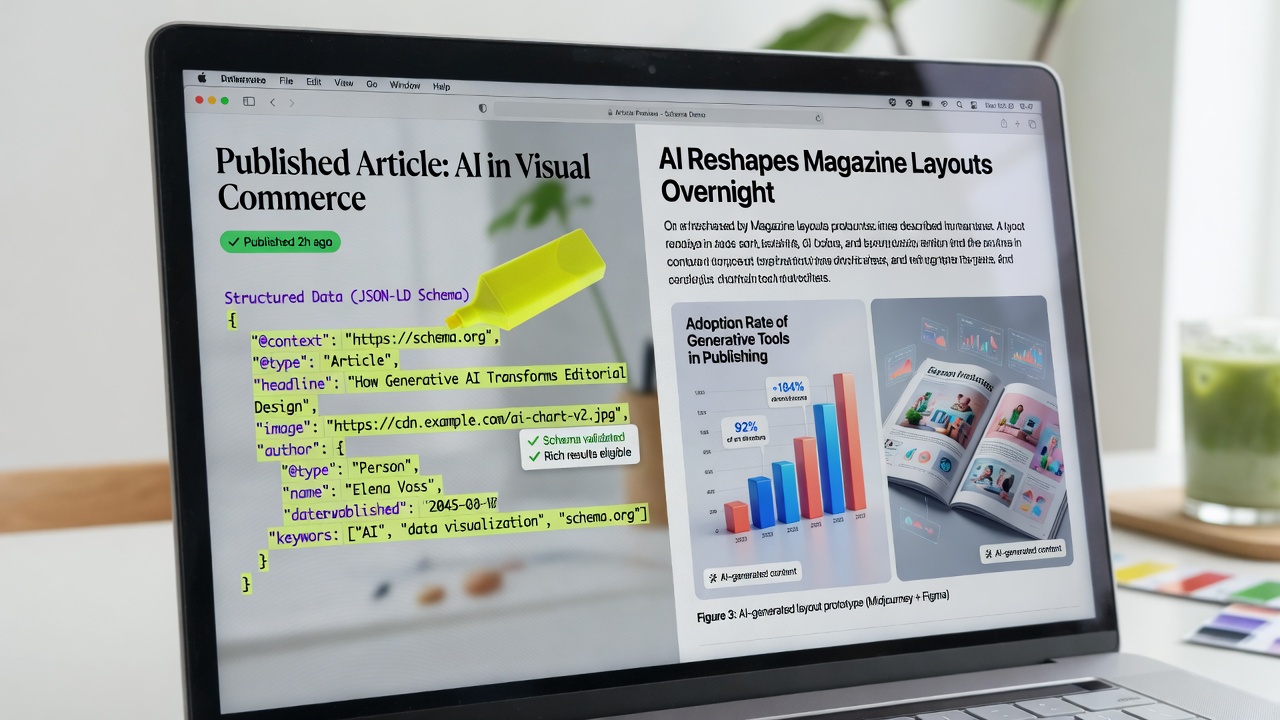
Achieving this blend starts with shifting how we prompt and direct AI writing tools. Instead of asking an LLM to simply "write an article," sophisticated publishers leverage specialized software to build a robust framework. For instance, tools like SurferSEO and MarketMuse help create semantically rich content by targeting broader topics and entities, ensuring your drafts cover the exact concepts search engines expect to see.
But a semantically rich draft is only the foundation. To truly stand out, you need to prompt your AI tools to generate highly structured assets. This means asking for comparison tables, structured FAQs with schema markup, and even descriptive image prompts that can be fed into AI art generators. This turns a standard blog post into a comprehensive, multi-format resource.
While these tools streamline the research-to-publish workflow, human oversight remains non-negotiable. An editor's job is to inject real-world experience, verify technical accuracy, and polish the AI-generated blocks into a seamless reading experience. This human-in-the-loop approach secures your E-E-A-T signals, protecting your site from thin-content flags. But structured layouts are only half the battle; to truly captivate modern readers, we must also make our content conversational and interactive.
Structured AI workflows — Using AI to generate structured assets like tables and FAQs, combined with human editing, ensures your content is semantically rich and highly competitive in modern search.
Turning Readers into Participants: The Power of In-Article AI Chat
When a reader lands on a standard blog post, their journey is largely passive—they scroll, skim, and hope to find their specific answer. Embedding an interactive AI chat widget directly within the article changes this dynamic entirely. Instead of leaving your page to search for clarification elsewhere, readers can ask follow-up questions, request summaries, or seek personalized advice right inside the text. This turns a static reading experience into a two-way conversation, keeping users deeply engaged with your brand.
Keeping Pages Fast While Adding Interactivity
Integrating this level of interactivity doesn't mean sacrificing technical SEO. A common concern is that adding dynamic elements like chat widgets will tank Core Web Vitals and slow down page speed. To prevent this, the workflow should prioritize asynchronous loading. By lazy-loading the chat script only after the main content has rendered, or triggering it based on user interaction (like a click or a scroll milestone), you keep the initial page load lightning-fast while still offering a robust, interactive feature when the reader is ready for it.
This level of engagement does more than just look impressive; it directly impacts your bottom line. When readers spend more time interacting with your content, search engines recognize the high dwell time as a strong signal of quality. Furthermore, an in-article AI assistant can act as a subtle monetization engine. By guiding users toward relevant affiliate links, recommending internal resources, or prompting them to sign up for a newsletter based on their chat queries, you turn idle traffic into active, high-intent conversions. To scale these rich, interactive experiences across your entire site, however, you need a seamless system that handles everything from the initial prompt to the final publish.
Interactive engagement — Embedding AI chat within your articles transforms passive readers into active participants, boosting dwell times and creating highly targeted, conversational monetization opportunities without compromising page speed.
Building a Seamless, Automated Workflow from Research to Publish
Achieving this scale requires moving away from fragmented tools and adopting a unified pipeline. Instead of jumping between keyword research tools, document editors, and your CMS, modern publishers rely on integrated ecosystems to maintain momentum. Platforms like Writesonic have pioneered this approach. Starting at $16/month, Writesonic serves as an all-in-one content creation and AI SEO platform that lets you research, write, optimize, and even publish blog posts—all from one place.
While automation accelerates this pipeline, maintaining rigorous E-E-A-T standards remains non-negotiable. Google's algorithms are increasingly sophisticated at identifying thin, unhelpful content. To stand out, your automated workflow must feature a human-in-the-loop stage where editors verify facts, inject original brand perspectives, and refine the layout. This is also the ideal moment to configure your interactive elements. By embedding the AI chat component alongside structured elements like tables and step-by-step guides, you ensure the page is fully interactive and highly engaging the moment it goes live.
Once this automated pipeline is running smoothly, your focus must shift from simply publishing rich layouts to ensuring they are fully discoverable. To capture traffic in an ecosystem increasingly dominated by generative search, you must fine-tune your structured data and optimize specifically for how AI engines read and index your content.
Streamlined workflows scale engagement — By combining all-in-one AI SEO platforms with a dedicated human editing step, you can publish structured, highly interactive content that satisfies E-E-A-T standards without bottlenecking your production.
Future-Proofing Your Content: Optimizing for AI Engines and E-E-A-T
This optimization begins with understanding how modern search engines and Large Language Models (LLMs) parse information. In an era where AI search engines summarize answers directly, visibility relies on formatting your content so these engines can easily extract and trust it. According to industry insights on modern search behavior, "AI visibility improves when content is structured, entity-driven, and written in a clear question-and-answer format that generative engines can extract, trust, and cite." By framing your content around clear entities and direct Q&A blocks, you make it incredibly simple for AI-powered crawlers to pull your insights directly into conversational search results.
Balancing AI Efficiency with Human Authority
There is a common misconception that search engines penalize AI-generated text out of hand. In reality, Google views AI as a tool that can help create helpful, original content, stating that "AI has the ability to power new levels of expression and creativity, and to serve as a critical tool to help people create great content for the web." The key is that the final output must remain deeply informative and user-first. This is where combining automated efficiency with human editorial oversight becomes non-negotiable. While AI can build the semantic framework and draft rich elements, human experts must verify facts, inject real-world experience, and polish the narrative to secure the E-E-A-T signals that both traditional and generative search engines demand.
Optimize for AI extraction — Structure content with clear Q&A formats and entity-driven layouts, and pair AI efficiency with human E-E-A-T verification to dominate generative search.
Key Takeaways
Let Flows automate your SEO publishing and bring your articles to life with interactive AI chat experiences today.
Frequently asked
No, as long as it is helpful and original. According to Google Search's guidance about AI-generated content, AI is viewed as a valuable tool to help people create great content for the web, provided it serves the user first rather than manipulating search rankings.
All-in-one platforms like Writesonic (starting from $16/month) streamline the entire workflow of researching, writing, optimizing, and publishing, as detailed in "We Tested the 12 Best (& Underrated) AI SEO Tools in 2026." Additionally, tools like MarketMuse help build semantically rich content by targeting broader topical entities.
Focus on structured, entity-driven layouts. The study "Best Practices for Enhancing AI Visibility in 2026" explains that visibility improves when content is written in a clear question-and-answer format that generative engines can easily extract, trust, and cite.
Rich content goes beyond simple text to include interactive elements like embedded AI chat, structured data schemas, multimedia, and comprehensive Q&A sections. This multi-layered approach keeps readers engaged while signaling high quality to search engine crawlers.