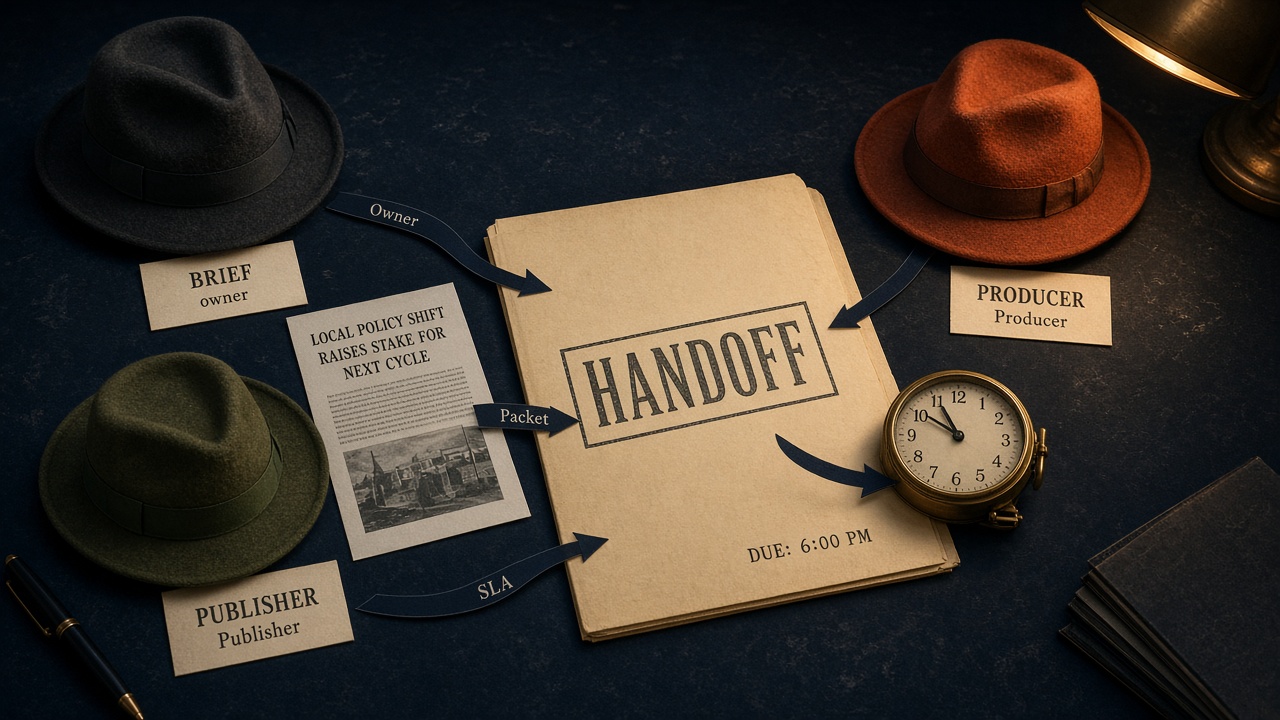
Content Ops for Lean Teams: Roles, Handoffs, and SLAs
Small teams do not stall because they lack ideas. They stall because the next move is unclear: who owns it, what must travel with it, and when it is due. Content ops for a lean crew is not extra process theater. It is a thin operating system that keeps brief, draft, review, and publish moving when the same people wear several hats.
Treat the work as three roles, not three full-time seats. One person can rotate, but the hat on a given ticket stays single-threaded. Pair that with a handoff packet—the brief, assets, constraints, and decision log that the next owner actually needs—and with SLAs that name calendar time, not vague “ASAP.” Automation (SEO briefs, publishing queues, an AI concierge on queries) then amplifies a system that already has owners, instead of hiding a broken one.
This article walks that system: the three hats, what belongs in each packet, how to set SLAs you can keep, and how to run the loop without hiring a dedicated ops layer. The goal is evergreen: whenever you find this page, the same rules still apply.
- Separate three hats—brief owner, maker, and publisher—even if one person rotates through them.
- Never hand off a ticket without a packet: goal, audience, source notes, SEO constraints, assets, and open decisions.
- SLAs name the next due time and who is on the clock; they are calendars, not vibes.
- Automation and AI assistants speed a defined workflow; they do not replace an owner or a complete brief.
- Lean ops scales output by reducing wait states, not by adding headcount or meetings.
What a lean content ops workflow actually is
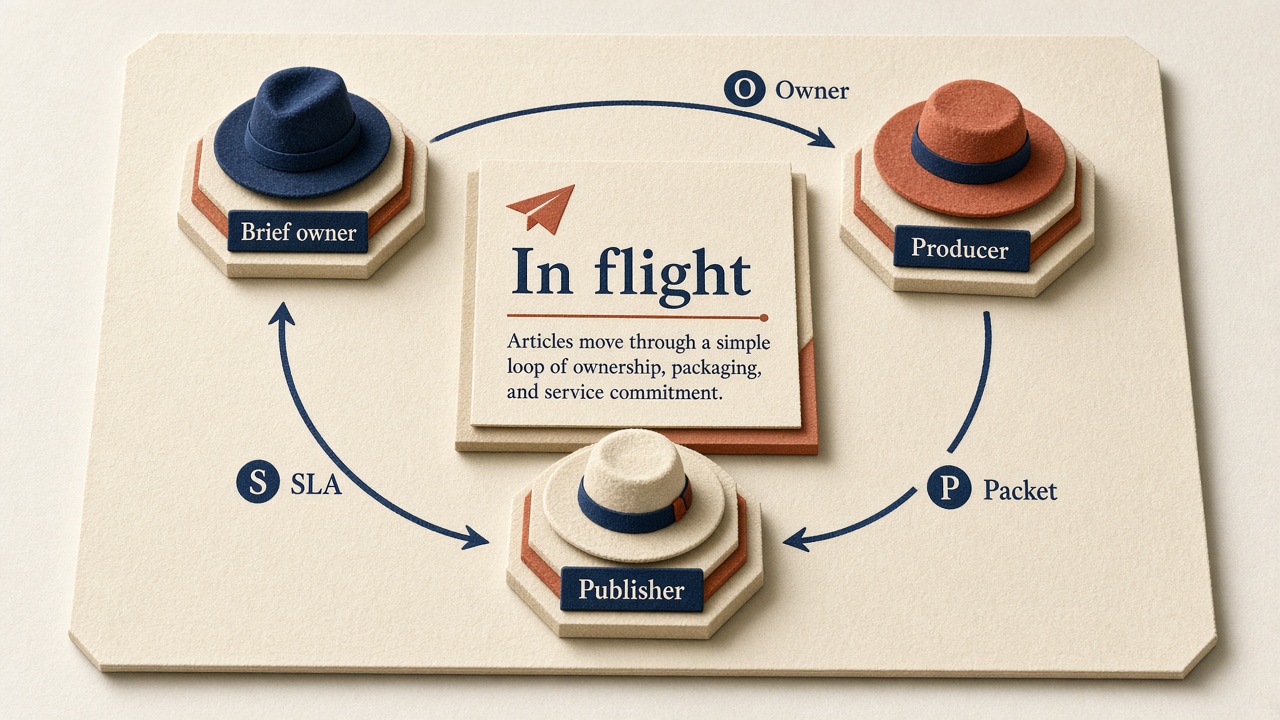
A content ops workflow on a lean team is not a longer brief-to-publish checklist. Stages still matter—you can map them against a full SEO workflow process checklist or a brief-to-publish workflow—but the operating system is simpler: ownership, a complete handoff, and a timebox. Someone is accountable for the piece in flight. They pass a packet that the next person can act on without a meeting. And the SLA names when that next action is due, so the queue never waits on a missing owner.
The failure mode is almost always the same. Two people each assume the other owns QA, so the draft sits. Or one founder wears every hat, the calendar has no clock, and “almost ready” becomes the default state. Ops does not require a department. A small crew can run it if hats stay exclusive at each gate: one owner per in-flight piece at a time. When that owner’s gate is done, they ship the packet and the SLA starts for the next hat—not a group chat, not a vague “when you have a minute.”
Content automation and SEO automation can draft, score, or route. They cannot invent an accountable next owner. Tools move work; they do not replace the named person who must accept it before the clock starts.
The workflow — Lean ops is one owner per gate, a complete handoff packet, and an SLA that starts the next due time—not a longer list of stages.
The three hats that run brief to publish
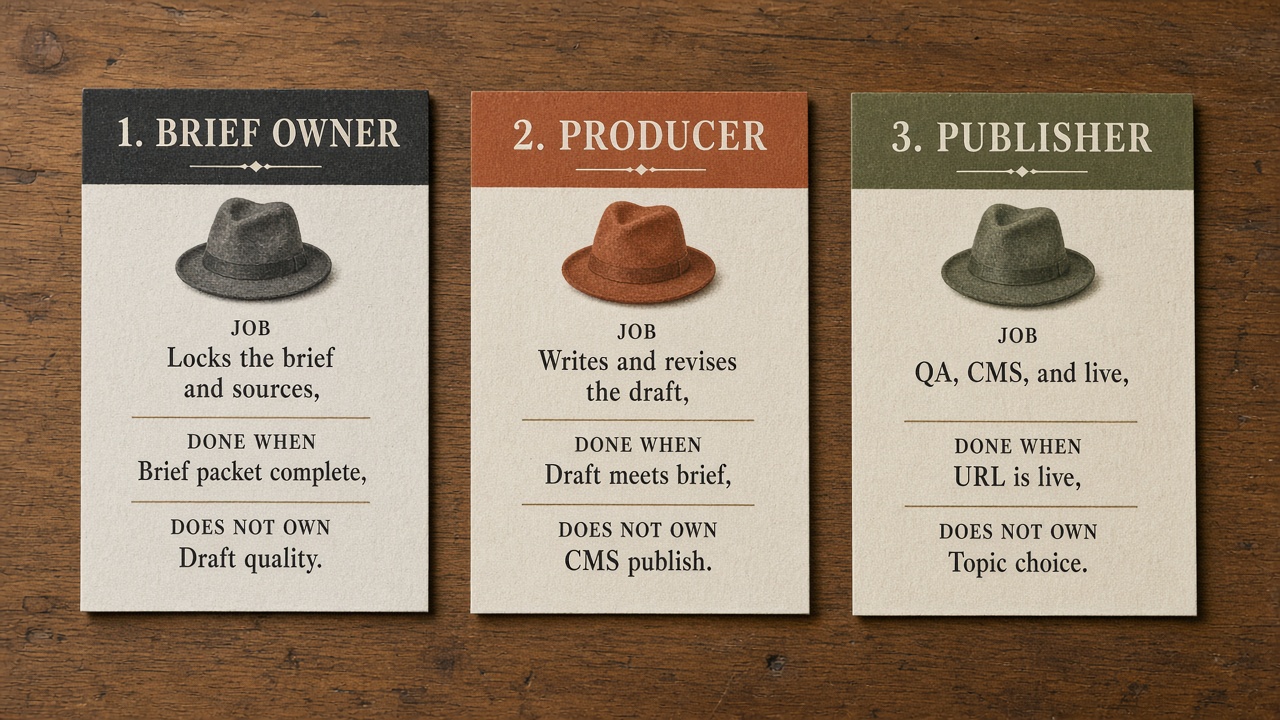
Those hats are not job titles. They are three exclusive gates on a single piece: who decides what it is, who writes it, and who is allowed to make the URL real. Keep them distinct and the clock never stalls on a missing owner. Collapse them into “whoever is free” and you recreate the dual failure already named—shared QA with no one accountable, or a founder with no due time.
The same person can wear these hats in sequence on a lean team. They cannot be brief owner and publisher on the same piece at the same moment without a written self-handoff—otherwise there is no gate, only a private rewrite. That is RACI-lite: one accountable owner per gate. Reviewers advise. They do not silently take the clock.
Hats, not titles — One owner per gate, sequential hats allowed, simultaneous brief-and-publish on the same piece forbidden unless a written self-handoff exists.
Handoff packets that do not die in Slack
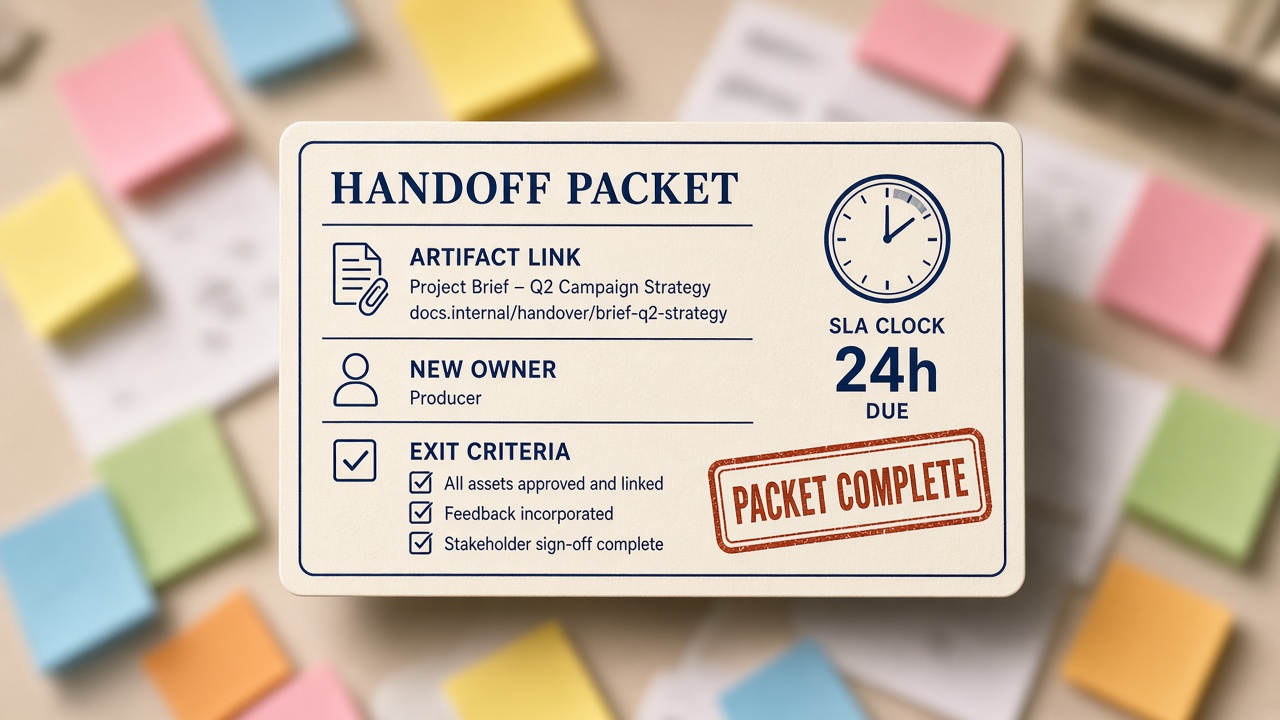
Those three hats only stay distinct if the work actually moves. A handoff is not a ping. It is a packet plus an owner change: the artifact, proof that exit criteria were met, known risks, a due-by time, and a named person now on the clock. Without that bundle, brief-to-publish waits on whoever happens to notice a thread.
Ban “FYI in Slack” as the system of record. The packet lives where the work lives—the brief doc, the draft, the CMS ticket—so the next owner can pick it up without reconstructing context from chat.
What each stage must ship
- Brief → draft: a locked SEO content brief, examples of the voice you want, must-include entities, and an explicit what-not-to-cover list so the producer does not reopen strategy.
- Draft → QA: draft URL or doc, every place the draft left the brief, claims that still need a source check, and a suggested title and slug.
- QA → publish: pass/fail notes, completed CMS fields, internal links (including adjacent workflow pieces on this site), and who owns go-live.
If a field is missing, the packet is incomplete and the clock does not start. Completeness is the only way a one- or two-person team avoids becoming a bottleneck of unanswered questions.
Packet, not ping — A handoff is a complete packet plus a new owner on a due-by time—not a Slack ping that leaves the work without a clock.
Content handoff SLAs you can actually keep
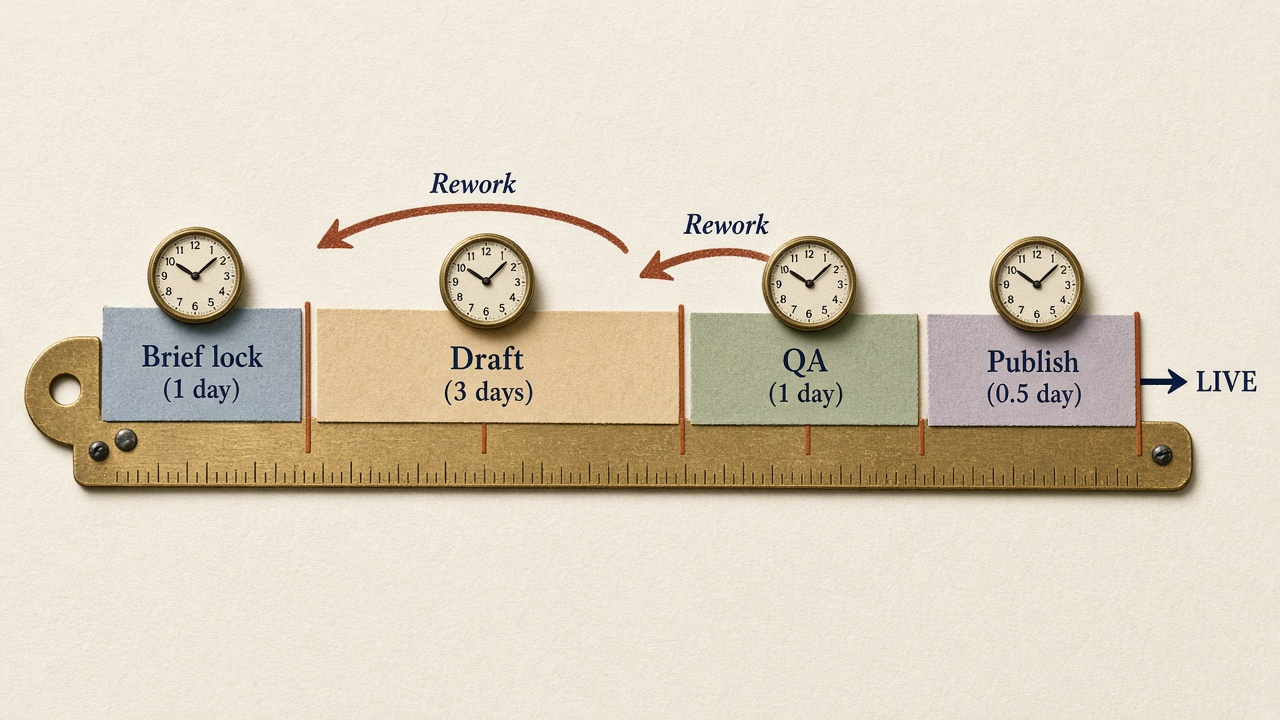
Once the packet is the system of record, the SLA is simply wait-time after that packet is complete—not a calendar wish from kickoff. The clock starts when the previous hat has shipped artifact, exit criteria, risks, due-by, and a named next owner. Until then, nothing is late because nothing is in flight.
Publish the windows you can keep at current capacity, then treat them as public. Write down the wait each hat already survives, and shorten or lengthen those windows when WIP changes—not when someone is optimistic in Slack.
Incomplete packets do not start the clock. A bounce-back resets ownership to the previous hat so strategy does not hide inside a draft. Rework after a failed QA uses a shorter SLA than a net-new draft so broken pieces cannot age in the same queue as fresh work. Track age-in-stage—how long this hat has held this piece—not vanity same-day promises founders will ignore.
Keepable SLA — An SLA is the wait after a complete packet; bounce-backs reset the owner, rework is shorter than a new draft, and age-in-stage is the only clock that matters.
Cadence, WIP limits, and when to hire the next hat
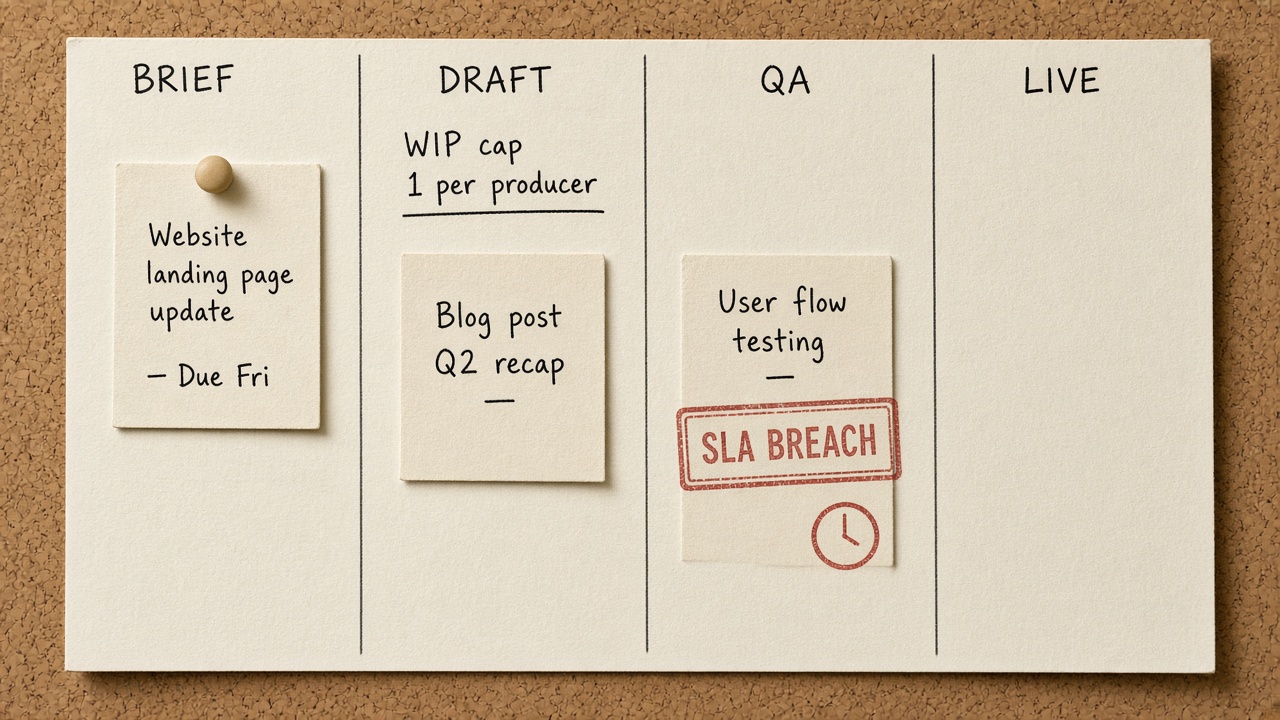
Age-in-stage only stays honest if the team looks at it on a clock. A weekly huddle is not a status theater: what’s on the clock, what’s past SLA, and which of the three hats is overloaded. Anything that is not a complete packet or a named owner is off the agenda.
Protect throughput with a hard WIP limit: one in-flight piece per producer hat. Extra ideas wait in a brief backlog until a producer is free. You scale a lean content marketing operation by raising completed packets per week, not by starting more topics. When capacity truly breaks, add a contractor to a named hat—usually producer or QA—never a vague “content help” seat that smears ownership.
Park overflow in the brief backlog with a complete packet already attached, so a free producer starts work instead of a meeting. Hiring is due when the same hat is past SLA for several weeks in a row—not when the backlog merely looks long.
Scale the system — Limit WIP to one live piece per producer, review age-in-stage weekly, and hire into a named hat—automation comes after ownership, not instead of it.
Key Takeaways
Pick one in-flight piece this week, name the three hats, and ship the next stage only as a complete packet with a due-by time.
Frequently Asked Questions
You Might Also Like
- Workflows SEO Workflow Management: How to Run Content From Brief to Publish
- Workflows SEO Workflow Process: A Repeatable Brief-to-Publish Checklist
- Strategy How to Scale Content Marketing Without Diluting Quality
- Workflows Content Automation Workflow: Research, Draft, QA, Publish
- Automation SEO Automation: Tools, Workflows, and What to Automate First