Content Publishing
AI Publishing vs Manual Content Creation

For years, the recipe for search engine optimization was straightforward: hire a team of writers, spend weeks planning, and manually draft every single paragraph. But today, the sheer speed of search engine updates and competitor output has turned pure manual creation into a major growth bottleneck. Marketers are forced to choose between publishing slow, expensive manual articles or finding a faster way to scale.
AI publishing has evolved from a simple writing assistant into a comprehensive engine for content automation. Many teams worry that moving away from manual writing will hurt their search presence, but modern search engines have made their stance clear: usefulness, relevance, and user satisfaction matter far more than who or what wrote the words. The focus has shifted from the tool used to the actual value delivered to the reader.
By looking objectively at how AI automation stacks up against manual creation, we can map out a strategy that delivers high-velocity, high-ranking content without sacrificing editorial integrity. Let us dive into the core differences between these two approaches to see how automated systems are reshaping the digital landscape.
TL;DR
- AI publishing dramatically reduces production time from weeks to hours, significantly lowering operational costs.
- Search engines prioritize the practical value and accuracy of content over whether it was created by a human or an AI.
- A hybrid workflow that pairs automated AI drafting with human strategic oversight yields the highest ROI and safety.
- Modern AI SEO platforms streamline the entire lifecycle of evergreen content, from keyword targeting to automated internal linking.
The True Cost of Creation: Weeks of Manual Labor vs. Hours of Automation

At the heart of this shift is a simple, undeniable reality: traditional content creation is incredibly resource-intensive. A typical manual campaign requires weeks of coordination—from keyword research and brief creation to multiple rounds of drafting, editing, and manual publishing. This slow-moving pipeline often costs thousands of dollars in freelance fees, editorial overhead, and project management hours.
In contrast, AI publishing automation compresses this entire lifecycle. Tasks that once dragged on for weeks are reduced to hours. By automating repetitive processes like initial research, draft generation, and SEO formatting, businesses can bypass traditional bottlenecks entirely. The resulting dollar savings are substantial, freeing up budget to focus on high-level strategy rather than administrative upkeep. This shift enables brands to scale their output volume exponentially without a linear increase in costs.
Ultimately, the financial and operational contrast is stark: manual creation charges a premium for slow, incremental growth, while automation offers a cost-effective fast track to digital footprint expansion. But saving time and money only matters if the end product actually performs. This brings us to the ultimate test of automated content: how search engines view and rank AI-generated assets compared to human-written ones.
Efficiency wins — AI publishing compresses weeks of manual editorial work into hours, eliminating costly bottlenecks and drastically reducing the cost per asset while driving higher content volume.
What Search Engines Actually Care About: Value Over Origin

For years, a persistent myth suggested that search engines would automatically penalize any content not typed out by human fingers. But as algorithms have matured, the reality has become clear: search platforms do not care how a piece of content was made, only how well it serves the reader.
"Our focus is on the quality of content, rather than how content is produced. This has been our consistent stance on automatically generated content for years."
— Google Search Central Guidance
High-quality AI-generated content does not inherently hurt rankings when it provides genuine value. Modern search engines prioritize usefulness over the creation method. This means that an article generated through AI publishing automation can rank just as high—and often higher—than a manually written piece, provided it is accurate, comprehensive, and directly answers the searcher's query.
The shift in modern SEO is no longer about tricking the system with manual labor; it is about using automation to scale the delivery of real utility. However, achieving this high standard of quality consistently requires more than just pushing a button and walking away.
Utility is king — Search engines evaluate content based on its informational value and user satisfaction, meaning AI-generated content ranks exceptionally well if it genuinely solves the reader's problem.
The Co-Pilot Approach: Merging AI Efficiency with Human Direction

This is where the hybrid workflow comes in. Instead of choosing between purely manual writing or fully hands-off automation, modern teams treat AI as an incredibly fast drafting and research partner. By combining the speed of AI publishing with targeted human oversight, you get the best of both worlds: rapid production and absolute quality control.
While AI engines are excellent at structuring and drafting SEO-optimized articles, they can occasionally invent facts or repeat concepts. A human editor acts as a crucial safety net, catching these "hallucinations" and verifying data points. More importantly, human touchpoints inject the unique brand voice, personal experiences, and creative nuances that automated tools cannot replicate on their own. This collaboration ensures your content remains both authoritative and deeply engaging.
Once you have established this reliable workflow for maintaining quality, the next step is applying it to unlock true, long-term search engine visibility.
The hybrid model wins — Combining AI speed with human editorial oversight ensures your content remains factually accurate, creative, and strictly aligned with your brand voice.
Scaling Evergreen Content: Consistent Output Without the Burnout

Achieving long-term visibility relies on a steady stream of evergreen content, but maintaining this manually is a fast track to team burnout. AI publishing platforms solve this bottleneck by automating foundational SEO elements—like metadata, internal linking, and schema markup—while seamlessly managing complex publishing schedules and multi-channel distribution.
Instead of scrambling to write and format articles week after week, teams can queue months of optimized evergreen content in a fraction of the time. This consistent output signals reliability to search engines, ensuring your site is crawled and indexed regularly. By removing the mechanical friction of manual publishing, you turn a chaotic editorial calendar into a predictable, highly scalable growth engine. But to truly justify shifting from manual production to automated systems, we must look at the hard numbers.
Scalable consistency — AI publishing platforms automate SEO formatting, scheduling, and distribution, allowing brands to maintain high content velocity without exhausting their teams.
The Bottom Line: Quantifying the ROI of Automated Publishing
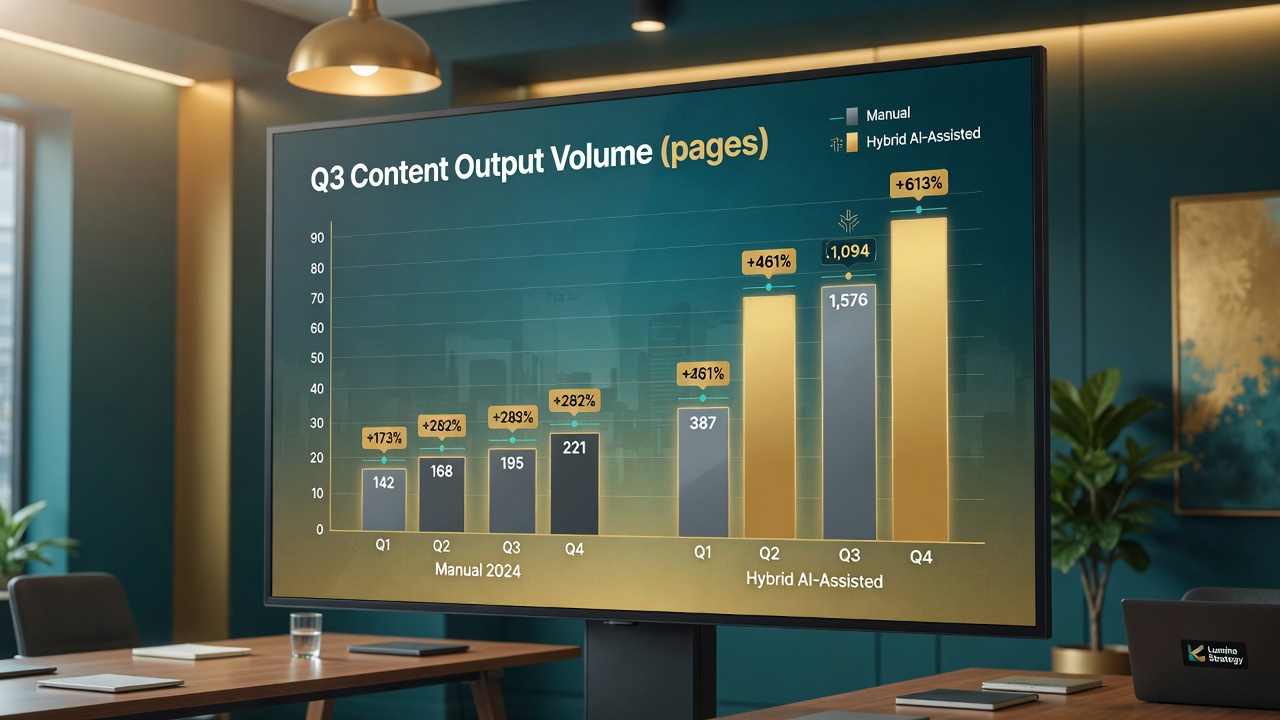
The hard numbers paint a clear picture of efficiency. When you transition from a purely manual workflow to an AI-assisted publishing model, the most immediate impact is felt in your content velocity.
This dramatic increase in velocity doesn't just mean more pages on your site; it translates directly to faster indexing, broader keyword coverage, and a significantly shortened time-to-publish. When AI handles the heavy lifting of drafting and SEO optimization, your team's energy shifts from basic production to high-level strategy.
By blending AI's raw drafting speed with human strategic oversight, businesses are seeing a highly efficient return on their investment. Instead of burning budget on endless rounds of structural editing, teams can focus resources on high-impact optimization and distribution, proving that automation is as much a financial victory as it is an operational one.
Automated publishing pays off — Shifting to an AI-driven workflow increases monthly content velocity by 42% and delivers an impressive $7.65 return for every dollar spent when paired with human oversight.
Key Takeaways
Discover how Flows can automate your SEO publishing and help you scale your organic traffic effortlessly.
Frequently asked
No, Google does not penalize content solely because it is generated by AI. The search engine prioritizes high-quality, helpful content that satisfies user intent, regardless of how it was produced.
The primary advantage is speed and scalability. AI publishing allows businesses to produce high-quality drafts, optimize SEO elements, and publish content in minutes instead of weeks, drastically reducing overhead costs.
The best approach is a hybrid workflow where AI handles research, structural drafting, and basic optimization, while human editors refine the tone, inject unique brand insights, and verify facts.
Yes, modern AI SEO platforms excel at maintaining evergreen content by automating keyword research, optimizing meta tags, managing internal linking, and scheduling regular updates to keep articles relevant.