Topic Cluster Map Template for SaaS Content Teams
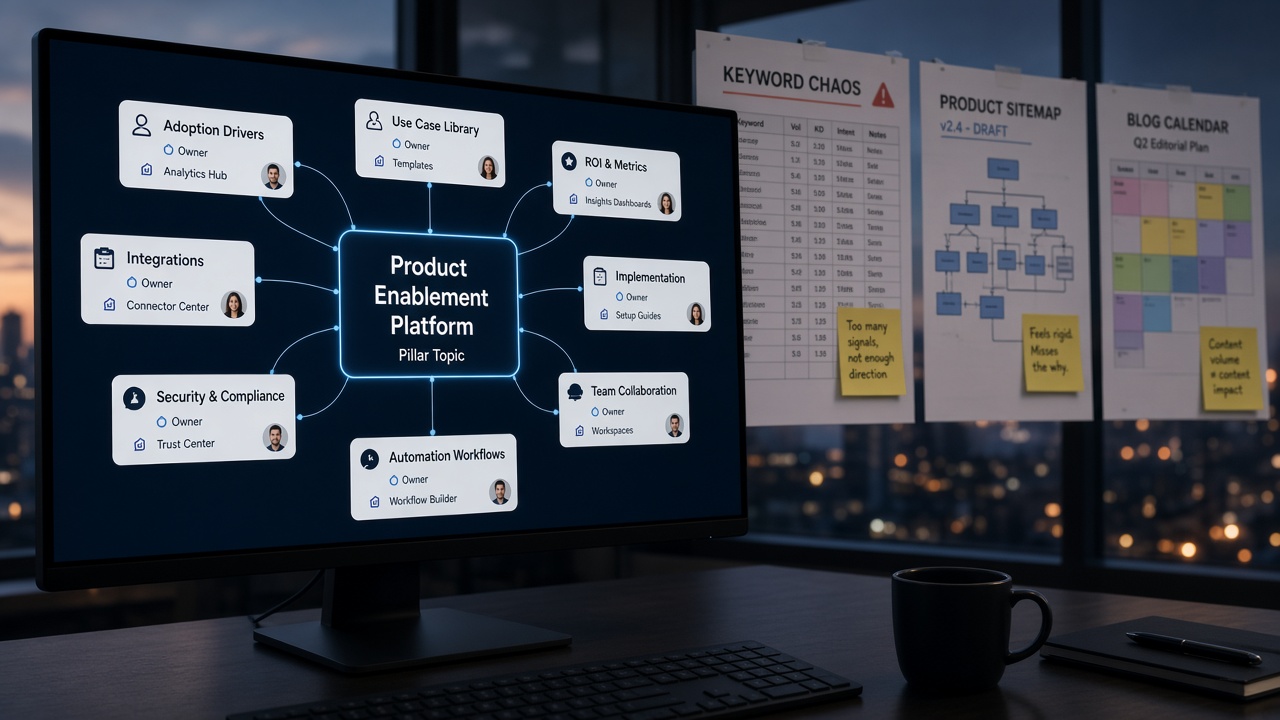
SaaS content teams rarely fail because they lack keyword lists. They fail because those lists never become a map: which URL owns the category, which articles answer one intent only, and which product pages stay out of the editorial mix. A topic cluster strategy is that map—not a mind map of themes, but a reusable grid you fill once and then turn into briefs, internal links, and a publishing queue.
This article is the template itself. You will see how to name a pillar that can actually rank for a problem buyers already search, how to cluster keywords so spokes do not cannibalize each other, and how to keep comparison and feature pages in their own lane. Use it as evergreen operating procedure: fill the cells, lock the URLs, then ship.
- One pillar URL should own a buyer problem; spokes each answer a single distinct intent.
- Keyword clustering is useful only when it produces unique titles, not overlapping articles.
- Product and pricing pages sit beside the cluster—they are not spokes unless intent matches.
- An internal linking grid turns the map into briefs and a calendar instead of a slide deck.
- Reuse the same map for every product line so SEO content briefs stay consistent.
The reusable SaaS cluster map (not another pillar explainer)
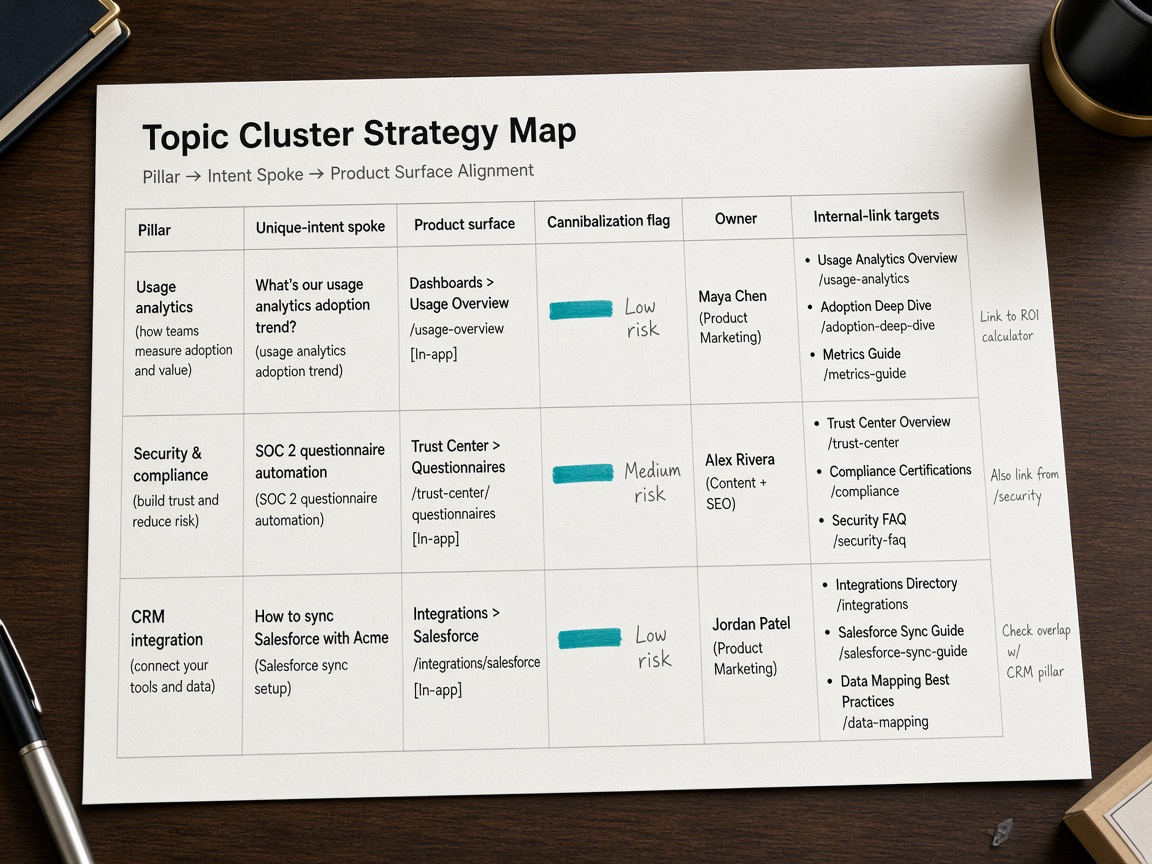
If you already know how pillars and spokes work, skip the theory. Treat one living sheet as the single source of truth so writers, SEO, and product never argue from different tabs.
Every row is a spoke candidate. Every column is a decision you make before anyone opens a blank doc. Fill these fields and the map can generate a brief without a second workshop.
- Cluster name and pillar URL — the problem space one product-aware pillar owns.
- Spoke title, primary query, search intent, and funnel stage — one unique intent per row.
- Product surface and ICP/segment — which UI, feature, or workflow this piece actually supports, and for whom.
- Owner, status, and canonical link targets — who ships it, where it sits in the queue, and which URLs it must link to (and receive links from).
Add a cannibalization column and refuse to approve a spoke until it is checked against the marketing site, docs, changelog, comparison pages, and alternative pages. SaaS sites already rank for a lot of the same jobs; a blog post that restates a docs article or a pricing comparison is wasted crawl budget.
Generic blog cluster sheets skip product-surface and feature-owner fields. SaaS maps cannot. A spoke about “permissions” is useless until you know whether it maps to SSO, roles, or audit logs — and which PM owns the surface so claims stay accurate. Uniqueness is non-negotiable: if two rows share the same job-to-be-done, merge them. Do not ship a second thin article.
Template, not theory — The map is a decision grid: unique intent, product surface, owner, and a cannibalization check before any brief is written.
Fill the map from product, ICP, and intent—not from keyword volume
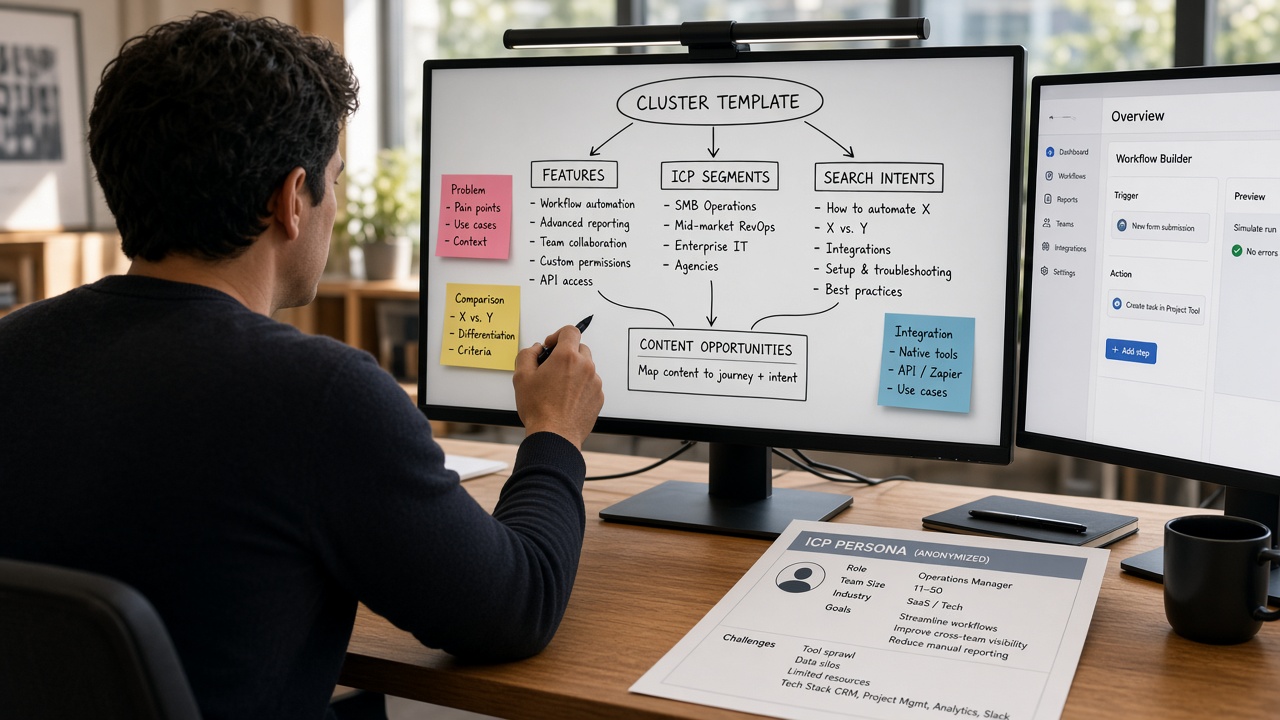
Once the fields exist, filling them is a product exercise first. Start from the taxonomy and the jobs-to-be-done your software actually owns. Each row is a unique job, not a new article idea. Keyword clustering comes last: it only labels the primary query that row already deserves. If two phrases describe the same job, they stay one row. Extra articles invented from a cluster tool are how SaaS sites cannibalize themselves.
Give SaaS-specific cluster types their own maps or clearly labeled groups so comparison content never collides with the educational pillar: problem and education, use-case, competitor and alternative, integration, and industry. A competitor page and a “what is” pillar can share a product surface and still fight for the same SERP if they sit in one undifferentiated sheet.
Work one pillar at a time. Teams still assembling a first pillar worksheet can use a separate how-to-create-a-cluster guide; this map assumes the pillar is already chosen and you are completing rows around it.
Reject quota thinking. Padding the template with near-duplicate rows does not make a cluster denser; it makes briefs fight. If you need a rule of thumb for how many cluster articles belong on a map, use the existing piece on cluster size rather than inventing filler here.
Map fill rule — Fill from jobs-to-be-done and product surfaces, label with keywords, group SaaS cluster types so comparison never collides with the pillar, and freeze each unique-intent row with an owner.
Turn each map row into a brief, a link grid, and a publishing queue
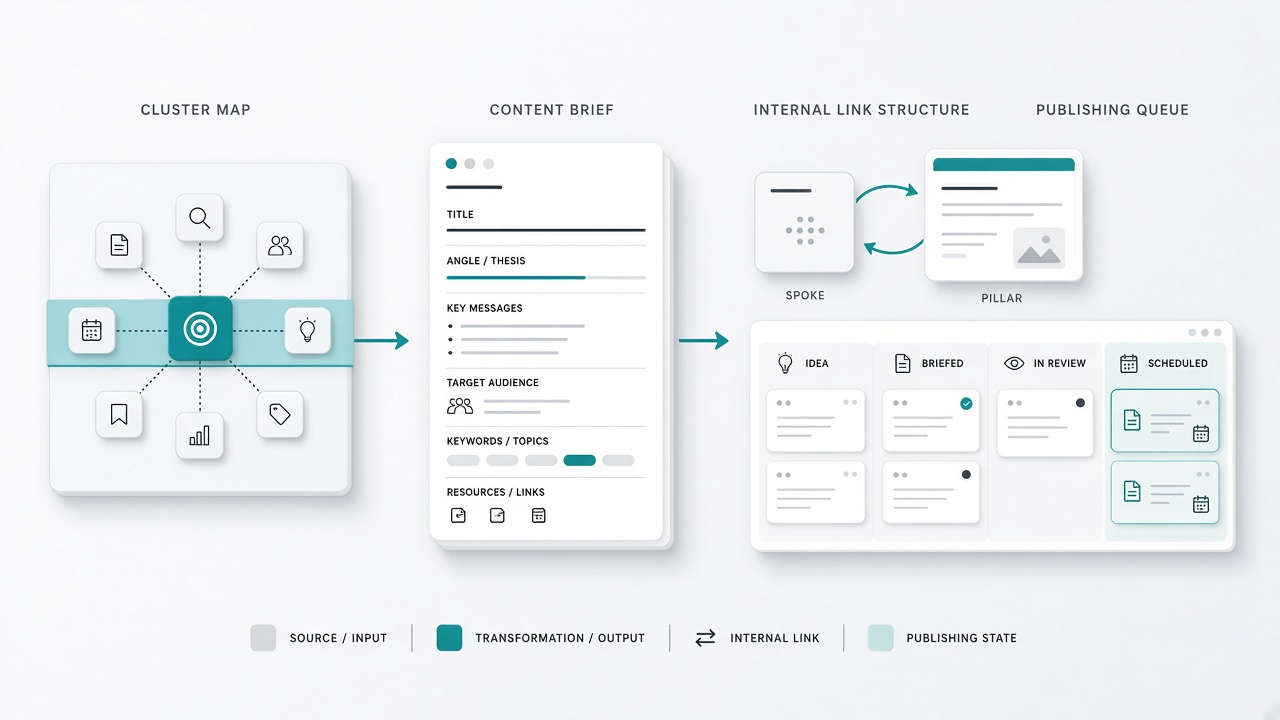
Once a row is approved, it is no longer a planning artifact—it is the seed of an SEO content brief. Copy the primary query and intent into the brief as the job the page must satisfy. Write the outline angle as a single sentence that could only belong to this row: the problem it owns, the product surface that proves the solution, and the ICP it speaks to. List the proof to include (screens, workflow, limitation, comparison point) and, just as important, list what not to cover because another row already owns that job. That “do not cover” line is how the map prevents two writers from drafting the same how-to under different titles.
Treat the same row as a lightweight internal linking tool. Every spoke brief lists the pillar URL plus one or two sibling spokes that share the cluster but not the intent. The pillar brief lists every live spoke so nothing sits as an orphan. Those URLs go into the brief before drafting starts, so linking is a production step, not a cleanup pass after publish.
Programmatic SEO belongs only on templatizable spoke families—integrations, industries, roles—that still pass the unique-intent test. Do not auto-generate overlapping how-tos from the same map; if two templates would answer the same job-to-be-done, they collapse back into one row. Keep a simple status on every row so the template feeds the queue instead of sitting in a strategy folder: briefed, in draft, linked, live. Handoff is the point of this stage—briefs, links, and a queue—not another pass at grouping keywords or rebuilding the cluster from scratch.
Handoff — An approved row becomes a brief with intent, proof, exclusions, and a small link set; status fields turn that grid into a production queue, with programmatic pages limited to families that still own a unique intent.
Keep the cluster map current as the product ships
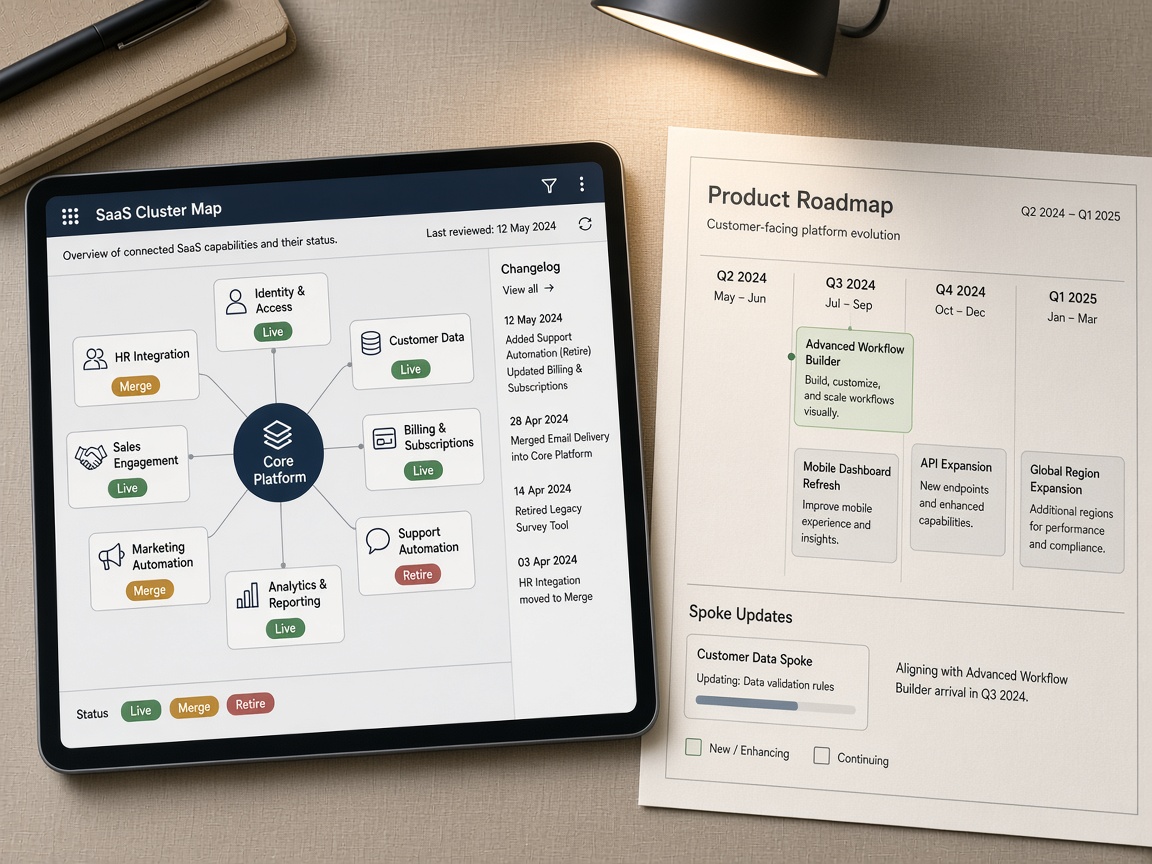
A cluster map only stays useful if it tracks the product after that setup. Add last-reviewed and change-reason to every row so a shipped feature, a pricing shift, or a new competitor cannot silently obsolete the pillar or a spoke. When something material changes, update those two fields first, then decide whether the URL still owns the same job.
Split a spoke only when a genuinely new unique intent appears—same job, different question, different brief. Merge when two URLs start ranking for the same job-to-be-done; keep the stronger canonical and redirect or retarget the rest. Retire a page when the answer now belongs on a product, docs, or changelog URL, and record that move in the cannibalization column so marketing does not republish it.
Version the map, or keep a changelog tab, so contractors and new writers do not recreate clusters that already exist. The changelog is what prevents duplicate pillars when someone joins mid-cycle.
Paste this column list into Sheets or Notion and you have the template, not another framework:
- Cluster name, pillar URL, spoke title, primary query, intent, funnel
- Product surface, ICP, owner, status, canonical links, cannibalization
- Last-reviewed, change-reason, map version or changelog note
Maintain it — The map stays the single source of truth only if every product change is dated, reasoned, and reflected in split, merge, or retire rules—plus a version so nobody rebuilds what already exists.
Key Takeaways
Copy the column list into your workspace, freeze one product-aware pillar, and brief the first unique-intent spokes this week.
Frequently Asked Questions
You Might Also Like
- Strategy Topic Cluster Content Strategy: Pillars, Spokes, and Internal Links
- Guides How to Create a Topic Cluster (Step-by-Step)
- Guides SEO Content Brief Template: The Complete Guide to Briefs That Rank
- Guides How Many Cluster Articles Does a Pillar Need?
- Guides SEO Content Brief Examples for Product, Comparison, and How-To Pages