
How Programmatic SEO Enhances AI Autoblogging Results
AI autoblogging can flood a site with pages overnight, yet most of those pages stall: thin, repetitive, and invisible to the long-tail queries that actually convert. The missing layer is programmatic SEO—the discipline of using templates, data, and structured markup to generate thousands of distinct, intent-matched pages at once.
When you fuse the two, AI stops doing simple variable swaps and starts writing natural, page-specific copy from your data model. The result is a library of unique URLs that search engines can crawl, understand, and rank—pages that scale in hours instead of months and stay penalty-resistant because every one is genuinely different. Documented builds have launched 13,000+ programmatic pages; properly run programs commonly deliver 50–200% organic growth inside twelve months, with the strongest implementations reaching 300–700% in the first year.
This article walks through exactly how that fusion works: the templates that keep quality high, the structured data that unlocks rich results, the guardrails that avoid thin-content flags, and the scaling patterns that turn a basic AI blog into a durable ranking engine. You will leave with a clear blueprint you can apply whether you are enriching an existing autoblog or building a programmatic layer from scratch.
Why Pure AI Autoblogging Hits Its Limits So Fast

AI-powered autoblogging tools generate pages at impressive speed, but the resulting content often fails to deliver lasting search visibility.
The first fracture appears in quality signals. Generic model output tends to recycle the same phrasing patterns, shallow explanations, and predictable section orders across dozens or hundreds of URLs. Search engines treat that sameness as thin or unhelpful, so pages get filtered, demoted, or ignored even when the underlying topic has real demand. Volume alone cannot compensate for content that feels interchangeable.
Missing structure that ranking systems expect
Without deliberate templates, every page becomes a one-off experiment. Headings wander, entity coverage stays inconsistent, internal links form no clear hierarchy, and schema markup is either absent or applied haphazardly. Crawlers and ranking systems reward predictable architecture—clear topic clusters, repeated but purposeful page layouts, and data fields that machines can parse at scale. Pure autoblogging skips that scaffolding, so even well-written individual articles struggle to reinforce one another or accumulate topical authority.
Keyword clusters left on the table
Automation that simply “writes more posts” also misses the long-tail map. It rarely systematically targets related modifiers, location variants, comparison phrases, or intent-specific questions that surround a core topic. The result is a scatter of loosely related pages instead of a dense, interlinked system that captures an entire demand neighborhood. Traffic stays fragmented and growth plateaus because the site never becomes the comprehensive resource searchers (and algorithms) prefer.
These three gaps—quality filters, structural inconsistency, and incomplete keyword coverage—explain why teams that rely on plain AI autoblogging alone watch early momentum fade. The next layer of the solution supplies exactly what is missing.
Plain AI autoblogging stalls — Generic output triggers quality filters, pages lack the consistent templates ranking systems reward, and automation alone never systematically covers long-tail keyword clusters.Programmatic SEO: The Scaling Layer AI Autoblogging Needs
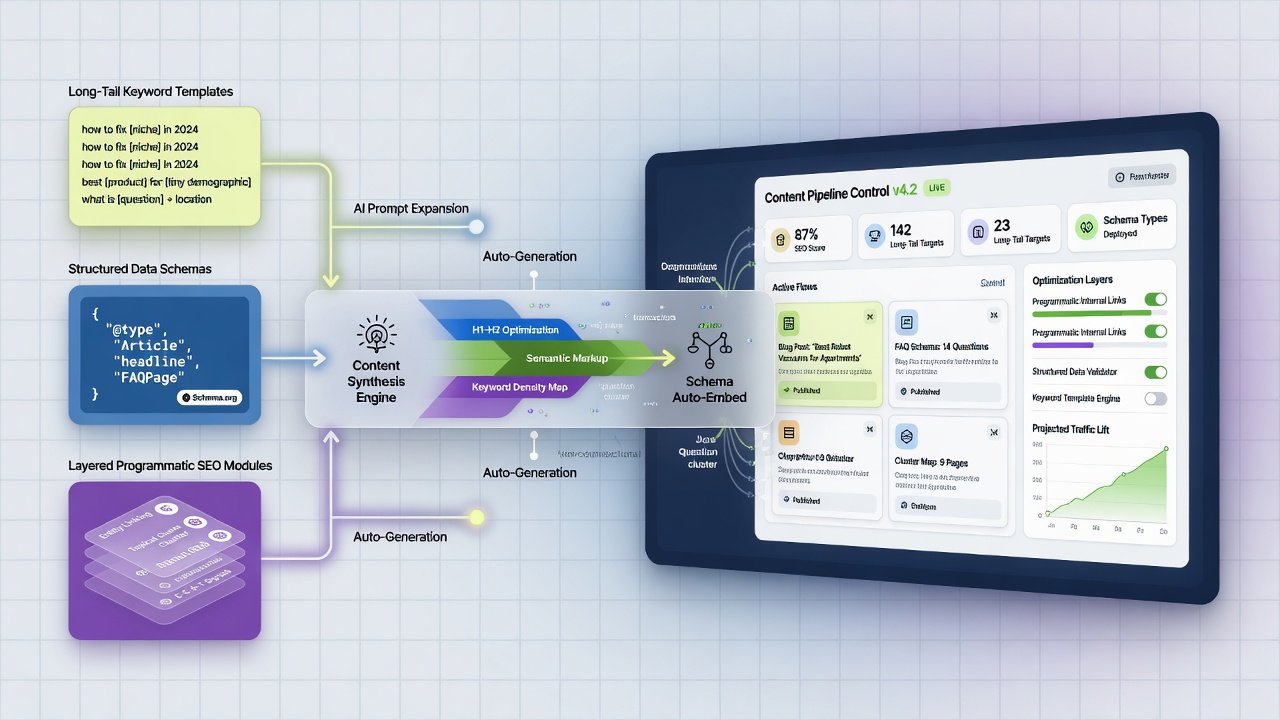
Programmatic SEO supplies the missing architecture that turns one-off AI drafts into coherent, rank-ready page systems.
Instead of asking a model to invent every page from scratch, you define a reusable template once—title pattern, H1 and subheading hierarchy, internal-link slots, FAQ blocks, and conversion elements. That single blueprint then multiplies across thousands of long-tail keyword variations. Each resulting page stays unique because the variable data (city names, product attributes, comparison criteria, or user intent modifiers) changes while the underlying SEO skeleton remains identical. The result is volume without chaos: every URL inherits the same crawlable structure search engines already reward.
One of the biggest advantages of programmatic SEO is its ability to scale quickly. Instead of manually creating pages, businesses can generate thousands of keyword-targeted pages in a fraction of the time, all sharing uniform structure that keeps quality signals consistent.
Structured Data That Signals Clear Relevance
Templates alone are not enough. Programmatic systems embed structured data—schema markup for products, locations, FAQs, how-tos, or reviews—directly into every generated page. These machine-readable signals tell search engines precisely what the page is about, who it serves, and how it relates to neighboring pages in the same cluster. When every long-tail URL carries the same clean schema pattern, crawlers can map the entire system faster and assign topical authority more confidently. That clarity is exactly what pure AI output usually lacks.
AI Writes the Language; the Framework Holds the Rankings
This is where AI autoblogging finally becomes an asset rather than a liability. The model is no longer responsible for inventing structure, keyword strategy, or internal linking. It only fills the natural-language slots inside an already optimized template—intro paragraphs, benefit descriptions, comparison tables, and closing CTAs. Because the SEO framework stays fixed, the generated copy can vary freely without drifting into thin or duplicate territory. The combination produces pages that feel human-written yet remain systematically aligned with the long-tail opportunities you set out to capture.
In short, programmatic SEO does not replace AI content generation; it gives that generation a durable skeleton so the finished pages can scale, rank, and compound traffic instead of stalling after the first wave of publications.
Programmatic templates + AI — Fixed SEO frameworks let you generate thousands of unique, structured pages at speed while AI only handles the variable natural-language layer, preserving ranking signals and avoiding the quality traps of pure autoblogging.
Building Penalty-Resistant Templates That Scale Cleanly

Penalty-resistant templates succeed when every generated URL delivers enough unique substance that search engines treat the page as a genuine answer rather than a thin variant.
The first safeguard is deliberate AI enrichment. Instead of dropping a keyword into a fixed sentence and calling the page done, the template reserves multiple open slots—intro paragraphs, comparison notes, local context, FAQs—that the model must fill with original prose drawn from the underlying data. This approach turns what would have been near-identical boilerplate into pages that read as purposefully written for their specific query.
Feed Distinct Data Into Every URL
Distinct value starts with the data layer. Each template instance should pull a unique combination of attributes—pricing tiers, feature matrices, location stats, inventory counts, or user-review aggregates—so the AI has concrete material that cannot appear on any sibling page. When the model works from those differences, the resulting copy naturally diverges in both facts and phrasing. As one implementation guide notes, AI creates unique content for each page using your data and templates; instead of simple variable substitution, AI writes natural paragraphs that reflect the specific inputs it received.
Keep the Skeleton Crawl-Friendly at Any Volume
Scale only works if crawlers can move through the section without friction. Maintain a predictable URL pattern, consistent heading hierarchy, and internal links that surface the most important entities first. Breadcrumb markup, clear canonical tags, and a logical sitemap hierarchy prevent the large page set from looking like an accidental duplicate farm. When structure stays uniform while the AI-written body stays unique, the site can expand to thousands of long-tail URLs without triggering quality or duplicate-content filters.
Taken together, enriched AI slots, differentiated data feeds, and disciplined crawl architecture turn programmatic templates into durable ranking assets rather than short-lived bulk experiments.
Penalty-resistant scale — Enrich every template slot with AI-written prose drawn from unique data, and keep URL structure and internal linking consistent so large page sets stay crawlable and free of thin or duplicate signals.Structured Data and AI: Making Every Programmatic Page Distinct

Structured data acts as the semantic backbone that tells search engines exactly what each page is about, long before they finish reading the body copy. In a programmatic system every URL inherits a schema template—Product, FAQ, HowTo, LocalBusiness, or a custom type—that maps purpose, entities, and relationships in a machine-readable format. That clarity lets crawlers classify the page correctly and match it to the right long-tail queries instead of treating it as yet another generic article.
From Raw Fields to Natural Language
AI then takes the same underlying data that populates the schema and expands it into fluent paragraphs. A price field, a location attribute, or a feature list becomes context-rich explanation rather than a bare variable swap. The model weaves those facts into introductions, comparisons, and benefit statements that feel written for a human reader while remaining tightly grounded in the unique data feed for that URL. The page therefore carries two complementary layers: a precise machine-readable skeleton and a natural-language body that elaborates on every data point.
"Schema tells the engine what the page is; AI tells the reader why it matters. Remove either layer and the page loses either visibility or substance."
— Flows Editorial
This hybrid construction is exactly what prevents the thin-content penalties that pure autoblogging so often triggers. Because each page carries both unique data and AI-generated narrative that expands on it, the content is neither duplicated across the site nor reduced to a skeletal template with a few swapped tokens. Search engines encounter a purposeful document with clear entity signals, consistent internal structure, and substantial differentiated text. The result is a scalable library of pages that remain distinct at the URL level while still benefiting from the speed and consistency of automation.
Schema plus AI enrichment — Structured data gives every programmatic page a clear purpose machines can parse, while AI turns the same data into natural, unique prose that keeps the content from looking thin or duplicated.
Traffic Growth Benchmarks Hybrid Systems Actually Deliver
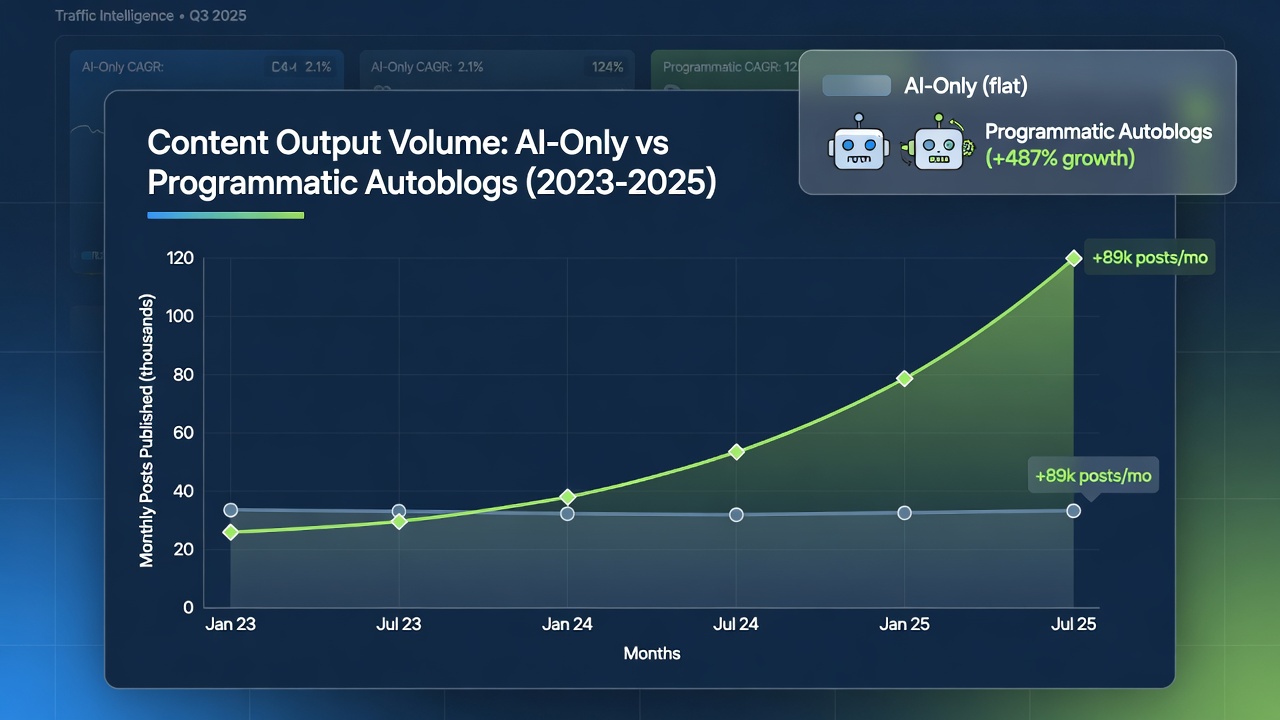
Hybrid systems that pair programmatic templates with AI enrichment convert structural clarity into measurable traffic gains far faster than pure autoblogging ever could.
The speed advantage shows up first in page volume. Programmatic SEO enables generation of large volumes of unique pages targeting long-tail keywords at scale via automation and templates—one documented build put 13,000+ programmatic pages live in a matter of hours. Those pages, each carrying distinct data and AI-written natural language, then delivered substantial SEO traffic gains. That kind of rapid coverage is simply out of reach for manual publishing or for AI tools that spit out disconnected posts without a shared template skeleton.
Typical and high-performing year-one ranges
Once the library is live, the traffic curve continues to compound. Properly executed programmatic SEO typically delivers 50–200% increases in organic traffic within 12 months. When the same systems are run with care—clean data feeds, thorough AI enrichment of every content slot, and consistent internal linking—successful implementations typically see a 300–700% increase in organic traffic within the first year of deployment. The spread between those two bands reflects execution quality more than luck: sites that treat AI as a fill-in layer on top of strong templates and unique data sit at the upper end; sites that still lean on thin substitution sit nearer the lower end or stall entirely.
These numbers also explain why hybrid setups consistently outperform standalone AI autoblogs. Pure autoblogging can generate text quickly, yet it rarely produces the uniform structure, entity clarity, or long-tail keyword clustering needed for search engines to treat thousands of URLs as a coherent, high-value section. The hybrid model supplies that missing layer, so each new page adds incremental authority instead of competing with its siblings. The result is not a one-time spike but a compounding library that keeps attracting qualified long-tail visits month after month with minimal ongoing manual effort.
In short, the benchmarks are not abstract promises. They are the observable outcome of pairing reusable templates and structured data with AI that writes genuine, differentiated prose—turning automation from a volume play into a ranking and traffic engine.
Hybrid traffic lifts — Documented builds of 13,000+ pages have produced +466% SEO traffic in 60 days, while well-run programmatic systems routinely deliver 50–200% organic growth (and 300–700% in stronger cases) within the first year—far outpacing standalone AI autoblogs.Sustaining Rankings: How to Maintain and Optimize Hybrid Autoblogs

Once the hybrid system is live and driving traffic, the real work shifts from launch to continuous stewardship. Programmatic templates and AI enrichment create the initial advantage, but search intent drifts, competitors refresh, and algorithms reward pages that stay current. Treating the site as a living inventory—rather than a one-time bulk publish—keeps the compound growth intact.
Track ranking shifts and refresh low performers
Monitor position changes at the template and keyword-cluster level rather than chasing every individual URL. When a cluster of pages slips or plateaus, pull the shared data fields and AI-written sections that underperform. Refresh those slots with fresher source data, tighter entity coverage, or clearer answers to the queries now ranking. Because the structure is already crawl-friendly and schema-rich, a focused rewrite usually restores visibility faster than rebuilding from scratch.
Update templates when search intent evolves
Intent rarely stays static. A template that once matched informational queries may later need comparison tables, pricing context, or local modifiers. Review SERP features and top-ranking patterns for your core clusters periodically, then adjust the master template: add or reorder content blocks, refine schema properties, and redefine which data fields the AI must expand. Propagating a single improved template across the inventory instantly upgrades every related page without manual edits.
Let AI keep differentiating the long tail
Schedule light AI passes that re-enrich existing pages with new angles drawn from updated feeds—recent examples, alternative use cases, or clarified definitions. The goal is not wholesale regeneration but incremental uniqueness that prevents pages from converging into sameness over time. Combined with the stable programmatic skeleton, these ongoing differentiations protect against thin-content flags and keep the site compounding rather than decaying.
Maintenance is therefore the quiet multiplier. Track what moves, evolve the templates that govern structure, and keep AI working on differentiation. Done consistently, the hybrid system remains a ranking engine instead of a static archive, delivering durable organic growth long after the initial build.
Ongoing stewardship multiplies the hybrid advantage — track cluster-level rankings, evolve templates with shifting intent, and use AI for continuous differentiation so programmatic pages keep ranking instead of stagnating.Key Takeaways
Start pairing your programmatic templates with AI enrichment today and turn bulk publishing into a compounding traffic system that actually ranks.
Frequently Asked Questions
Programmatic SEO uses automation, templates, and structured data to generate large volumes of unique pages that each target a specific long-tail keyword. When paired with AI autoblogging, the AI writes natural paragraphs from your data instead of performing simple variable substitution, producing distinct, rankable content at scale.
Properly executed programmatic SEO typically delivers 50–200% increases in organic traffic within 12 months. Successful implementations often see 300–700% growth in the first year, and documented cases have reached +466% in just 60 days after launching 13,000+ pages.
Yes. AI creates unique content for each page using your data and templates, writing natural paragraphs rather than swapping a few variables. That uniqueness, combined with proper structured data and internal linking, keeps pages distinct and penalty-resistant.
One of the biggest advantages is speed: instead of manually creating pages, you can generate thousands of keyword-targeted pages with uniform structure in a fraction of the time—sometimes thousands of live URLs in a few hours.
The system relies on real data models, AI-written natural language, consistent templates, and structured markup so every page is genuinely useful and distinct. Search engines receive crawlable, well-structured content rather than thin or near-duplicate autoblog filler.
Sites that already produce volume but struggle with thin or repetitive pages gain the most. The approach is especially effective for businesses that can map data (locations, products, comparisons, attributes) into long-tail keyword templates and let AI enrich each page.