Hard-Stop Publish Gates for Autoblogs: Schema, CWV, and Audit Policies That Block Bad Pages

Autoblogs fail in public. A generator can ship hundreds of URLs before anyone notices missing Article markup, a bloated largest contentful paint, or a canonical that points nowhere. Search engines and answer engines do not wait for a weekly review. They crawl what you published, then decide whether the site still looks like a source worth citing.
The useful mental model is not a later audit. It is a release control. Software teams already refuse to merge code that fails tests. Technical SEO for automated publishing needs the same posture: fail closed at publish time, queue the fix, then ship. Schema completeness, Core Web Vitals budgets, and crawl-audit thresholds become gates, not dashboards you open after rankings move.
Without those gates, velocity is not an advantage. It is how thin markup, layout shift, and indexability defects compound into a site-wide quality signal. The first problem to name is that collapse: more pages, faster, with no hard stop, until crawl efficiency, rankings, and generative eligibility degrade together.
- 1
Fail-closed gates block autoblog pages that fail schema, Core Web Vitals, or audit checks before they go live.
- 2
Treat technical SEO like continuous integration: no publish until required tests pass.
- 3
Validate JSON-LD for articles, entities, FAQs, and breadcrumbs so every post is citation-ready.
- 4
Set CWV release budgets that fit content-heavy AI pages, then queue failures instead of shipping them.
- 5
Severity rules and remediation queues keep output high without leaking defective URLs into the index.
Why Autoblog Velocity Turns Technical SEO Into Live Debt

That collapse is not a ranking puzzle sitting downstream of copy. It is what happens when a checklist built for a handful of pages a week meets a generator that never sleeps.
Human technical SEO assumed someone would still look. Titles, schema, indexability, internal links, and performance sat on a punch list because volume was low enough that a specialist could clear it before launch. Autoblogs invert that ratio. Pages keep landing. The list does not shrink. Unfixed issues become live URLs, and live URLs become the site's default state. What used to be a backlog turns into permanent debt the moment search engines can fetch it.
Live pages that should never have been URLs
Once a defective page is discoverable, the harm is structural. Crawlers spend budget on templates that fail to render, thin entity markup, or conflicting canonicals. Internal links pass equity into destinations that cannot rank, which starves the pages that could. Incomplete structured data and unstable layout also weaken the experience and citation signals that both classic ranking systems and generative engines use to decide what is worth quoting. You do not get a polite queue. You get a crawl graph full of liabilities.
The useful response is not another content-pipeline tour. Pipelines explain how text is produced. They do not decide whether a URL is allowed to exist. What has to sit before discovery is stop/go release control: if the candidate fails its technical checks, it never receives a public address.
Those gates are quality brakes, not a return to manual review. They encode the same technical standards a careful editor would apply, then enforce them at machine speed so scaled output stays ranking-safe without a human standing in the doorway of every post.
Fail-closed publish gates — Autoblog velocity makes post-publish SEO a losing race; block defective pages before they become crawlable URLs so scale does not become live technical debt.
Block, Flag, or Sample: A Severity Model for Publish Gates
What those brakes still need is a graded trigger. Treat every technical defect as a hard stop and the queue stalls on noise; treat everything as a warning and defective URLs ship at machine speed. The workable policy is three outcomes encoded once: block, flag, and sample.
Three outcomes, not a binary go/no-go
A block is fail-closed—the page never receives a public URL. Reserve it for faults that harm the site the moment they are discoverable: an accidental noindex on an intended indexable post, a missing or conflicting canonical on a templated URL, JSON-LD that does not parse, or catastrophic layout shift. Those are not taste calls. A flag lets the page ship and records a structured exception—incomplete recommended schema fields, vitals sitting past a warning budget, thin internal links—for retry or review. A sample is a deeper check you cannot afford on every render: full crawl, mobile parity, template-variant audits. A failed sample should promote that template or cluster into block or flag until the class of defect is fixed.
Calibrating those three outcomes is the difference between a gate that actually protects rankings and a gate that only looks strict.
On one side, every lint is a hard stop: the queue jams, good articles wait behind false positives, and operators start bypassing the gate so the safety net becomes optional. On the other, only lethal defects block; the rest flag or sample, so throughput and ranking safety move together. Over-blocking kills the pipeline. Under-blocking recreates live technical debt—broken pages become permanent URLs. Severity is how you hold both failure modes at once.
Same model, tighter where the URL is worth more
Money pages belong in the strictest mapping: more conditions in the block tier, flags that must clear on the next refresh, samples that approach a census. Programmatic article templates sit in the middle—validate the class once, block class-level faults (canonical pattern, JSON-LD shape, CLS budget), and sample individual instances. Experimental niches invert the mix: fewer hard stops, more flags and samples, so you learn which defects actually waste crawl before you promote them to blocks. The tiers stay fixed; only the risk-to-tier mapping changes with URL value and blast radius.
Severity, not more checks — encode block, flag, and sample so lethal defects never receive a URL, while flags and samples keep the pipeline moving instead of training operators to bypass the gate.
Schema Gates That Prove Eligibility, Not Markup Presence
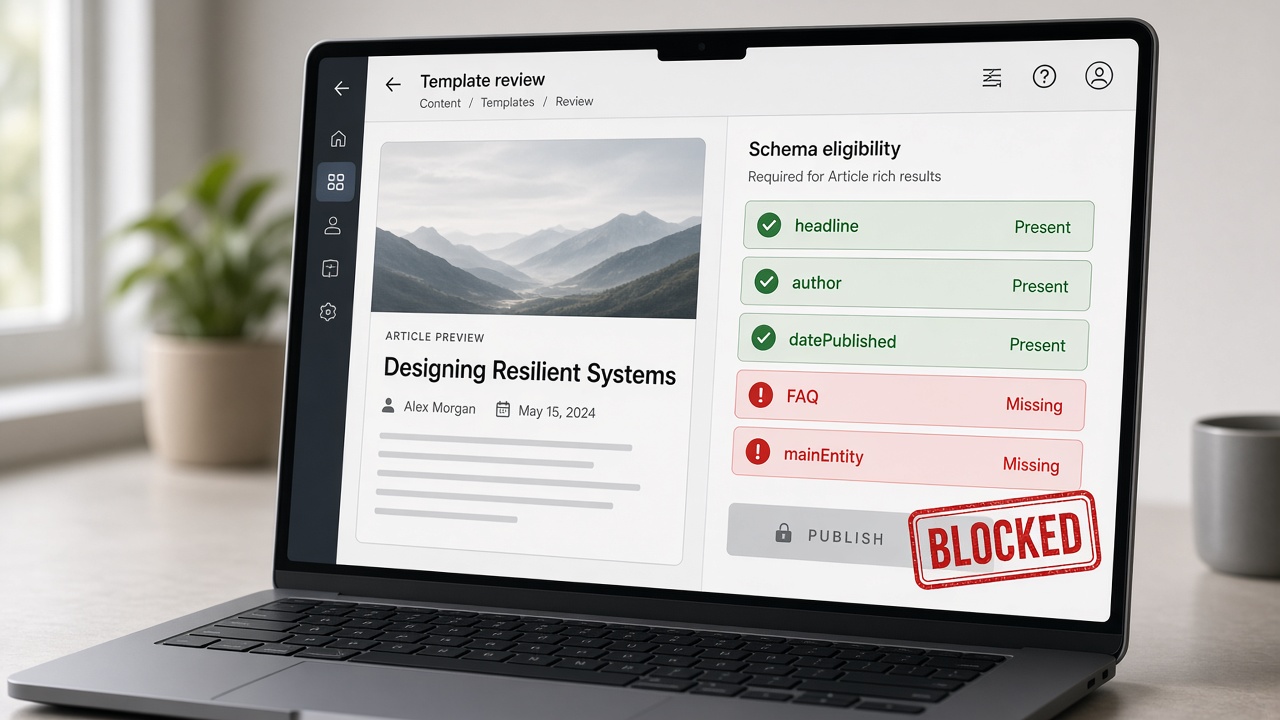
Schema is the first place that mapping has to get concrete. A page can leave the renderer with a JSON-LD blob and still fail every test that actually matters: required properties for the declared type, a type that fits the template, and entities that match the visible headline, author, breadcrumbs, and canonical. Markup presence is a pipeline step. Eligibility is the gate.
Treat the graph as a contract the template must satisfy before a public URL exists. If the page claims Article, it needs a headline that matches the H1, a datePublished, a publisher, and an author the brand can stand behind. If it claims FAQPage, every Question needs a non-empty acceptedAnswer. If it emits BreadcrumbList, every item in the trail must resolve. Unparseable JSON-LD already belongs in the block tier; missing required fields and type/template mismatches should too, because crawlers cannot interpret the page and richer-result eligibility never starts.
Block on broken contracts, flag on incomplete extras
Publish-time validation should parse the JSON-LD, reject syntax errors, then walk required properties and conflicting signals. Duplicate types, a graph URL that disagrees with the canonical, or Organization markup that names a different publisher than the byline are not warnings—they poison machine interpretation. Recommended-but-optional fields can flag without killing the URL, so the gate stays strict where the contract fails and flexible where the page is still coherent.
Failure modes autoblogs actually produce
- Hallucinated authors — bylines or Person nodes the brand does not own and cannot defend.
- Empty FAQ nodes — Question items with blank or stub acceptedAnswer text.
- Mismatched headlines — a schema headline that diverges from the visible H1.
- Orphan breadcrumbs — trails that skip parents, invent categories, or point at unpublished URLs.
None of that is ranking magic. Clean structured data makes the page machine-readable: richer results when they are granted, and clearer entity reading for classic search and generative citation. The gate’s job is to refuse pages that cannot be interpreted correctly before they become discoverable URLs.
Eligibility over injection — Schema gates should fail closed on unparseable JSON-LD, missing required properties, type/template mismatch, and conflicting entity signals, while flagging incomplete recommended fields so generated pages stay interpretable without promising rich-result guarantees.
Core Web Vitals as Template Release Budgets
The same refuse-before-discovery rule applies to how the page actually loads. Eligible schema does not save a hero that never becomes Largest Contentful Paint in time, or a late module that shoves the article after first paint. Core Web Vitals are not vanity scores you run weeks later on already-indexed URLs. In an autoblog they are release budgets attached to the template: ceilings the assembled page must meet in a pre-publish lab render, or the gate does not mint a public address.
Attach the budget to the layout, not the article
Long-form and media-heavy layouts carry more images, embeds, and FAQ blocks than a thin landing page, so their ceilings differ—but the check is the same. Render the candidate against the template budget before publish.
- Largest Contentful Paint — the intended hero or first content block must be the measured LCP: already sized, compressed, and unblocked by webfonts or late CSS.
- Interaction to Next Paint — keep unbounded third-party scripts and eager hydration off the critical path.
- Cumulative Layout Shift — reserve aspect ratios for images, embeds, and late-injected modules so the page does not reflow after first paint.
These are synthetic lab checks. Field INP and real-user LCP do not exist until the URL has traffic, so the publish gate is fail-closed on lab against the template budget. Field measurement is a post-deploy re-test that can tighten the budget or promote a template from flag to block; it does not replace the pre-publish stop.
Remediate, then decide block or flag
A failed budget should fire automated hooks first, not a human ticket. Recompress and resize the LCP image, convert format, lazy-load everything below the fold, subset and preload fonts, and lock dimensions on media. If the page then clears, it ships. If it still misses a catastrophic threshold—especially layout shift that would shove content after paint—it blocks. A warning-band miss flags with a structured exception, the same severity model used for incomplete schema. Compute is spent on the page about to exist, not on a crawl of pages that already hurt.
Template budgets — treat LCP, INP, and CLS as fail-closed lab ceilings on the layout, run compression, lazy-load, and stability hooks first, then block or flag; save field measurement for a post-deploy re-test.
Audit Loops That Queue Fixes, Not Dashboard Graveyards
The rest of the technical surface deserves the same spend-it-first rule. Schema and vitals decide eligibility and speed; the audit loop decides whether the URL is even fit to be discovered. Failed checks cannot land as charts. They become queued jobs—severity, owner, re-test—or they die in a dashboard while the page ships.
The dimensions that matter at scale
Skip the hundred-checker suite. Audit the surfaces that waste crawl or publish a defective URL:
- Indexability — robots, meta robots, and X-Robots-Tag agree the page should be found.
- Canonicals — one resolvable canonical that matches the intended URL.
- Mobile — viewport, tap targets, and template parity on the phone render.
- Internal links — no orphans; hubs actually point at the new URL.
- Status codes — public HTML is a clean 200, not a soft-404 or redirect chain.
- Thin or duplicate risk — real body versus chrome, and near-duplicate clusters.
Failures inherit the same block, flag, and sample model. Accidental noindex, a conflicting canonical, or a non-200 on the would-be permalink blocks. Thin inlinks or a borderline duplicate flag. A risky new template variant is sampled until trusted.
Pre-publish audits run on the rendered candidate and can refuse the public URL. Watch loops re-run those same dimensions after a template, CDN, or header change, because drift turns a green page into live debt. A live URL that would now fail a block check joins the same queue as a rollback candidate.
The only honest exit is a closed loop. Nothing goes live, and nothing is re-submitted for crawl, until the original gate is green.
That last step keeps the queue from becoming theater. Recrawling a still-red URL just teaches the index the defect. Fix it, re-run the same check, then let discovery happen.
Jobs, not charts — every failed audit becomes a queued job with severity, an owner, and a re-test; the page publishes or is recrawled only after that same gate runs green.
Exception Paths, Rollbacks, and Versioned Policy Packs

The same rule has to hold after go-live, and it has to hold when someone is under pressure to ship anyway. Emergencies are real—a legal page that cannot wait, a third-party tag that tanks a lab check, field Core Web Vitals that later blow the template budget—but the operator failure mode is the global kill switch: gates off “until this is handled,” then never quite restored. Fail-closed autoblogs stay ranking-safe only when exceptions are explicit and time-boxed, live breaches unpublish automatically, and the rules themselves are versioned like the templates they guard.
Time-boxed exceptions, not a disabled stack
An exception waives a named check for a named URL or template: owner, reason, and an expiry measured in hours or days. When it lapses, the page re-enters the same stop/go path. That keeps a campaign or takedown from becoming a permanent hole in the gate. If a waiver needs to become normal, promote it through policy change—reviewed and versioned—not a forgotten dashboard toggle. Blanket “SEO gates off” is how live debt returns under a different name.
Unpublish when a live URL would now fail a block
Watch loops already catch template, CDN, and header drift. Operator policy should go one step further than queuing a fix: if a public URL would now fail a block-tier check, or field vitals breach the hard budget, noindex or unpublish first, then run the same remediate-and-re-test job. Recrawl only when green. Pulling the defect out of the indexable set is the counterpart to refusing discovery on a red draft—otherwise the index learns the regression you just found.
Policy packs and gates as configuration
The tiers stay the same; mapping tightness and review load change with who is operating the fleet.
- Solopreneur pack — hard blocks on unparseable markup, missing or conflicting canonicals, accidental noindex, and catastrophic layout shift; flags for incomplete recommended schema and warning-budget vitals; short-lived exceptions.
- Agency pack — a shared block list across autoblogs, tighter mapping on money and programmatic templates, and change review before anyone relaxes a rule for a single property.
Store those rules as configuration as code: versioned required-property lists, lab budgets, and audit thresholds, with staging allowed to differ from production. A quieter LCP budget or a dropped schema field is a template-grade release, not a one-off tweak. That is how hybrid, no-code workflows keep technical SEO as a safety net instead of a switch someone can leave off.
Versioned exceptions — keep gates fail-closed by waiving named checks with an expiry, unpublishing live URLs that would now fail a block, and treating rule changes like template releases rather than a kill switch.
Prove the Gates: Crawl Efficiency, Rank Stability, and Machine Trust
Those versioned packs only earn their keep if you can see what they change. After the safety net stays on, the last layer is measurement — not a lucky ranking screenshot, but a handful of operational reads that sit next to the gates themselves.
Five signals that prove the stack
- Block rate — how often the fail-closed path stops a defective page before a public URL exists.
- Time-to-remediate — how long a blocked or flagged item stays queued before the same check runs green.
- Index coverage — whether intended URLs get discovered and junk stays out.
- Crawl waste — whether bots stop spending budget on thin, duplicate, or broken variants.
- Template-level CWV pass rate — whether shipped templates stay inside the lab budgets you set for LCP, INP, and CLS.
Those reads show whether the severity model is catching real defects or just manufacturing noise.
Gate discipline does not manufacture rankings. It removes the self-inflicted shocks of scaled output: accidental noindex, conflicting canonicals, unparseable entities, layout shifts after discovery. Stability is mostly those shocks not happening. Scaled-content risk shrinks for the same reason — defective pages never join the index in volume, so there is less for a quality system to treat as a pattern.
The same ingredients serve generative systems. Cleaner entities, stable URLs, and structured eligibility — required properties present, type matching the template, claims consistent with on-page copy — are inputs a machine can parse once and trust again. You are not chasing an overview badge. You are making every published URL citation-ready.
Retune severity from outcomes
Once a month, or after each template-grade release, sit the five signals together. If blocks cluster on a field that never appears in coverage or crawl waste, loosen that check to a flag. If flags leak into live debt, or field vitals fail after ship, promote the check to block. Tighten and loosen from those outcomes, not from a noisy week of positions. That closes the loop: fail-closed gates, queued fixes, versioned policy, and evidence the stack is still a safety net — not a switch someone can leave off.
Prove the gates with operations, not hope — block rate, time-to-remediate, index coverage, crawl waste, and template CWV pass rate show whether fail-closed publish control is protecting crawl efficiency, rank stability, and machine-trusted entities.
Key Takeaways
Before the next bulk publish, map your templates to block, flag, and sample gates for schema eligibility, lab CWV budgets, and queued audits, then tighten the policy pack from block rate, crawl waste, and template pass rate.
Frequently Asked Questions
A hard-stop gate is a pre-publish check that blocks a page from going live when a required test fails. Unlike a report you read later, it treats schema, Core Web Vitals, or audit defects as release failures, not optional cleanup.
At minimum, validate JSON-LD for the page type you actually ship: Article or BlogPosting, BreadcrumbList, FAQPage when FAQs exist, and organization or entity markup the article cites. Completeness and parseability matter more than dumping every schema type onto the page.
Set explicit ceilings for LCP, INP, and CLS on representative content-heavy templates, then fail the publish if a new page would break those budgets. Pair the check with image and script hooks so the queue can fix weight instead of publishing a slow URL.
No. Use a severity model: indexability, canonical, and required schema failures should hard-stop; weaker internal-link or polish issues can flag and queue. Blocking everything creates a bottleneck; blocking nothing recreates the original quality leak.
Track blocked-versus-shipped rates alongside crawl waste, indexation of thin or broken URLs, ranking stability, and whether pages remain eligible for rich results or generative citations. Gates work when fewer defective pages ever reach the live index.
Yes, if validation, performance budgets, and audit policies sit in the publish workflow itself. Operators then tune thresholds and remediation rules; the system refuses bad pages instead of waiting for a manual SEO review.
You Might Also Like