Customizing AI Writing Tools for Rich Content Output

Using standard prompts to generate digital content often yields a generic, flat output that fails to capture a brand's unique identity or satisfy modern search engines. As publishers scale their production, the challenge shifts from merely generating text to producing rich, highly structured, and authoritative evergreen assets. The key to successful content automation lies in deeply customizing your AI writing tools, transforming them from simple text generators into highly calibrated engines that output publication-ready drafts.
This customization is critical for search performance. According to Google Search's guidance about AI-generated content, "Using AI doesn't give content any special gains. It's just content. If it is useful, helpful, original, and satisfies aspects of E-E-A-T, it might do well in Search." Furthermore, Google clarifies that "Appropriate use of AI or automation is not against our guidelines. This means that it is not used to generate content primarily to manipulate search rankings." To build long-term search visibility, publishers must configure their AI tools to produce structured, deeply researched, and brand-aligned content. By embedding your brand's unique voice, logical heading structures, semantic keywords, and plans for multimedia integration directly into the AI pipeline, you can reliably generate rich content that stands the test of time and drives organic performance.
- 1
Google rewards high-quality, helpful, original content that demonstrates E-E-A-T, regardless of whether it is AI-generated or human-produced.
- 2
Customizing AI writing tools with brand kits, style guides, and specific past examples is essential to maintain a consistent brand voice at scale.
- 3
Rich content outputs require structured formatting, including logical headings, key takeaways, and planned multimedia elements like charts or videos.
- 4
AI tools should be configured as pipeline-ready engines that generate initial drafts for human refinement, ensuring accuracy, depth, and evergreen value.
Beyond the Prompt: Why Pipeline-First Customization Matters for Rich AI Content

Many organizations still treat an AI content generator as a simple prompt-and-response engine, relying on basic brand kits or superficial tone sliders. This approach inevitably produces generic drafts that require extensive, manual human rewriting before they are ready for production, completely defeating the purpose of content automation.
To succeed with SEO automation, publishers cannot rely on thin, scaled text. Success requires a sophisticated, pipeline-first setup that generates structured, voice-locked, and media-annotated drafts that are immediately ready for auto-publishing and interactive in-article AI chat systems.
Pipeline-First Customization — Moving beyond basic prompts to deeply integrated, voice-locked workflows is the only way to scale high-quality, E-E-A-T compliant content that ranks and engages readers.Architecting Brand Voice Engines That Scale Across Automation Pipelines
Transitioning from generic outputs to a high-performing ai content generator requires locking in your brand's unique DNA before the first word is ever drafted. When scaling production through an ai blog writer, the greatest risk is "voice drift"—the tendency of large language models to default to generic, robotic prose over the course of a long-form article. To maintain authority, publishers must embed style guides, vocabulary rules, and tonal constraints directly into the generation pipeline.
Modern enterprise tools provide robust mechanisms to ingest and enforce these rules at scale. Rather than relying on simple adjectives like "professional" or "witty," sophisticated setups leverage deep training assets to anchor the model's vocabulary and phrasing.
By standardizing these configurations, you ensure that every asset generated by your seo content automation engines reads as if it were penned by an in-house expert. This systematic approach forms the foundation for reliable, hands-off publishing workflows that consistently satisfy both readers and search engine quality guidelines.
Systematize your voice — Treat brand voice as an engineering configuration by uploading real style assets, building multi-persona kits in tools like AirOps and Jasper, and testing for vocabulary drift before automating production.
Baking E-E-A-T and Evergreen Architecture Directly Into Your AI Engines
Achieving a consistent brand voice is only half the battle; to withstand algorithm updates and drive compounding organic traffic, your automated outputs must possess inherent authority. You cannot rely on post-generation editing to inject credibility. Instead, your content automation pipelines must be configured to prioritize Experience, Expertise, Authoritativeness, and Trustworthiness (E-E-A-T) from the very first draft.
Systematizing First-Hand Experience and Expert Citations
To prevent generic, regurgitated text, program your AI content generator to systematically surface real-world experience markers and credible citations. Instruct the model to reference industry-standard data points, structure hypothetical case studies based on actual parameters, and leave explicit placeholders for real expert quotes and human author reviews. This ensures that while the AI handles the heavy lifting, the final asset is anchored by genuine authority.
Structuring for Snippets and AI Overviews
Search engines and AI-driven discovery engines reward highly organized information. Your system prompts must enforce a strict, logical H2/H3 heading hierarchy and mandate natural, semantic keyword placement. Designing your pipeline to produce concise, direct answers immediately following these headings optimizes your content for Google's featured snippets and AI Overviews.
- Enforce Logical Hierarchies: Program the AI to use descriptive H2 and H3 tags to organize concepts logically.
- Target Semantic Snippets: Instruct the model to define core terms in 2-3 sentence summaries directly below headings.
- Build Evergreen Foundations: Use the AI tool to draft timeless, foundational structures that require minimal updates over time, leaving specific data refinement to human editors.
Structuring AI Outputs for Multimedia Integration and Schema Readiness
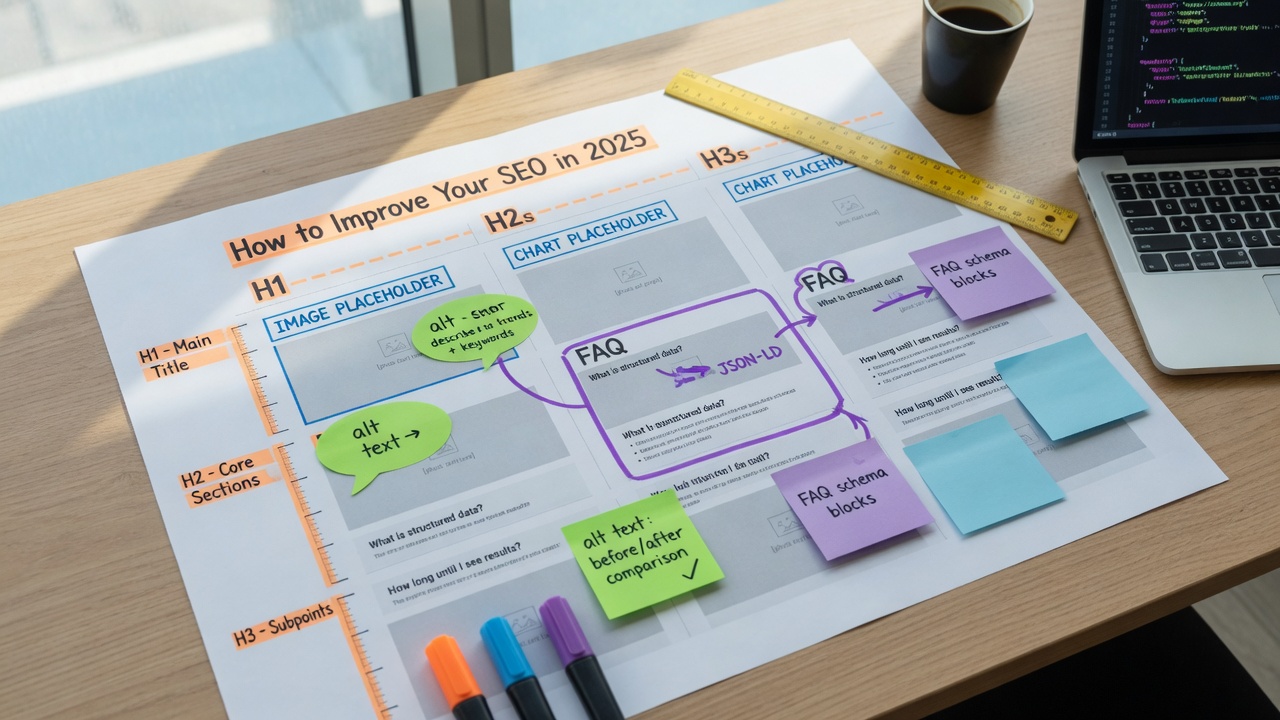
To turn basic text into high-ranking evergreen assets, your AI content generator must do more than just write paragraphs; it must lay the structural groundwork for visual depth and search engine readability. A truly automated pipeline designs the blueprint for rich media integration and structured data before the draft ever reaches your content management system.
Prompting for Visual Assets and Dwell-Time Boosters
Rather than treating media as an afterthought, configure your AI blog writer to explicitly suggest and place assets like charts, infographics, or videos directly within the draft flow. You can instruct the engine to generate descriptive alt-text placeholders and detailed image concepts at logical transition points. This structural preparation makes it incredibly easy for editorial teams to insert targeted visuals that boost user engagement and dwell time.
- Visual Placeholders: Prompt the model to insert
[IMAGE PLACEHOLDER: Description of a chart showing X trend]along with search-optimized alt text. - Interactive Elements: Instruct the pipeline to flag sections that would benefit from an embedded video or an interactive calculator.
Enforcing Rich Results and Interactive Formats
To capture premium real estate in modern search engine results pages, your SEO content automation engine must consistently output structured micro-formats. Modern tools allow you to generate full posts that natively include target key takeaways, structured tables, and dedicated FAQ blocks optimized for specific keywords directly inside the editor. By forcing the AI to output these blocks, you ensure the content is primed for schema markup injection.
This rigorous structural formatting directly supports eligibility for Google's rich snippets and AI Overviews. When the AI outputs clean HTML tables and clear Q&A structures, search crawlers can easily parse, index, and feature your content at the very top of search results.
Schema-First Outputs — By configuring your AI content generator to natively output structured FAQs, visual placeholders, and key takeaways, you create drafts that are immediately ready for schema markup and highly optimized for rich search results.From Setup to Execution: Configuring Writesonic, Jasper, and Custom GPTs for Pipeline-Ready Outputs
To turn these structured blueprint requirements into a functional reality, you must configure your AI writing tools to enforce these rules natively. Relying on basic prompting leads to inconsistent formatting and voice drift. Instead, enterprise teams must implement tool-specific customization playbooks that lock in brand guidelines, structural requirements, and SEO configurations directly at the engine level.
Optimizing Writesonic and Jasper for Scaled Brand Alignment
Writesonic stands out as one of the most comprehensive and customizable AI content tools on the market today, particularly because of its robust brand voice customization and multi-model access. By uploading your style guides directly into its memory and selecting the most capable underlying model for your specific niche, you ensure that even complex, multi-layered SEO outlines are executed with consistent stylistic discipline.
Similarly, Jasper and AirOps allow you to build dedicated Brand Kits and target personas. By feeding Jasper your exact editorial guidelines, the platform bakes your tone into its long-form document editor. This prevents the AI from defaulting to generic, robotic phrasing and ensures that key structural elements—like H3 subheadings, bullet lists, and FAQ sections—are generated with the correct brand phrasing on the first pass.
Enforcing Structural Output via Custom GPTs
For organizations building bespoke content automation pipelines, creating a Custom GPT or API-driven assistant in ChatGPT is the ultimate way to maintain control. Inside the GPT's instructions, you must explicitly define the required output schema. You can program the engine to reject any generation that does not include the specific multimedia placeholders, HTML formatting, and natural semantic keyword integration your SEO strategy demands.
As shown above, moving from unconfigured out-of-the-box generation to a tool-specific, customized pipeline completely changes the quality of the raw output. Instead of spending hours fixing generic phrasing and missing HTML elements, editors receive publish-ready, structured assets that can transition smoothly into automated publishing schedules.
Tool Customization is Key — Configuring brand kits, multi-model access, and strict output instructions in tools like Writesonic, Jasper, and Custom GPTs is essential to generate structured, pipeline-ready drafts that require minimal human editing.
Connecting Your Custom AI Pipeline to Automation and Interactive In-Article Chat
Once your AI writing tools are configured to output structured, brand-aligned HTML, the final step is to bridge the gap between generation and live distribution. A truly automated pipeline does not stop at producing a clean draft; it packages the entire asset—generating optimized meta titles, descriptions, and sectioned body copy—so it can plug directly into auto-publishing platforms without manual copy-pasting. By formatting these elements into standardized JSON or Markdown payloads, your content management system can instantly ingest, tag, and schedule the post for publication.
Powering In-Article AI Assistants with Structured Context
This structured approach to content generation does more than satisfy search engine algorithms; it also serves as the foundational knowledge base for interactive, in-article AI chat systems. When an article is built with clear heading hierarchies, explicit key takeaways, and defined semantic sections, an on-page AI assistant can easily parse the document. When a reader asks a highly specific question, the chat assistant can quickly locate the relevant E-E-A-T signals or evergreen data points within the text, providing accurate, real-time answers that keep users engaged on your page longer.
Ultimately, content automation is a continuous loop. Once your structured assets are live and interacting with readers, you must monitor performance metrics like search rankings, dwell time, and chat engagement. Use these insights to refine your custom prompting configurations, adjust your brand voice engines, and continuously optimize your AI writing pipelines for even greater precision over time.
Connected Pipelines — Integrating structured AI outputs into auto-publishing systems and interactive on-page chat tools maximizes content distribution efficiency while keeping readers engaged through highly accurate, context-aware interactions.Key Takeaways
Start transforming your content strategy today by building a customized, automated AI writing pipeline with Flows to deliver rich, search-optimized articles effortlessly.
Frequently Asked Questions
No. According to Google Search's guidance, appropriate use of AI or automation is not against their guidelines as long as it is not used primarily to manipulate search rankings. Google rewards original, high-quality content that demonstrates E-E-A-T, regardless of how it is produced.
You can train your AI writing tools by uploading brand guidelines, style guides, and past writing examples. Tools like Writesonic allow uploading PDFs to match style, AirOps supports customizable Brand Kits, and ChatGPT enables brand voice control via Custom GPTs or specific conversational instructions.
Use AI to generate initial drafts focusing on timeless topics and logical structures. Then, have human editors refine the drafts to ensure factual accuracy, add depth, incorporate expert insights, and establish internal linking that keeps the content relevant long-term.
AI content should be structured with logical H2 and H3 headings, natural keyword integration, key takeaways, and schema. This logical structure improves readability and helps the content qualify for featured snippets and AI Overviews.
You Might Also Like