What Is Keyword Clustering? A Simple Definition with Examples
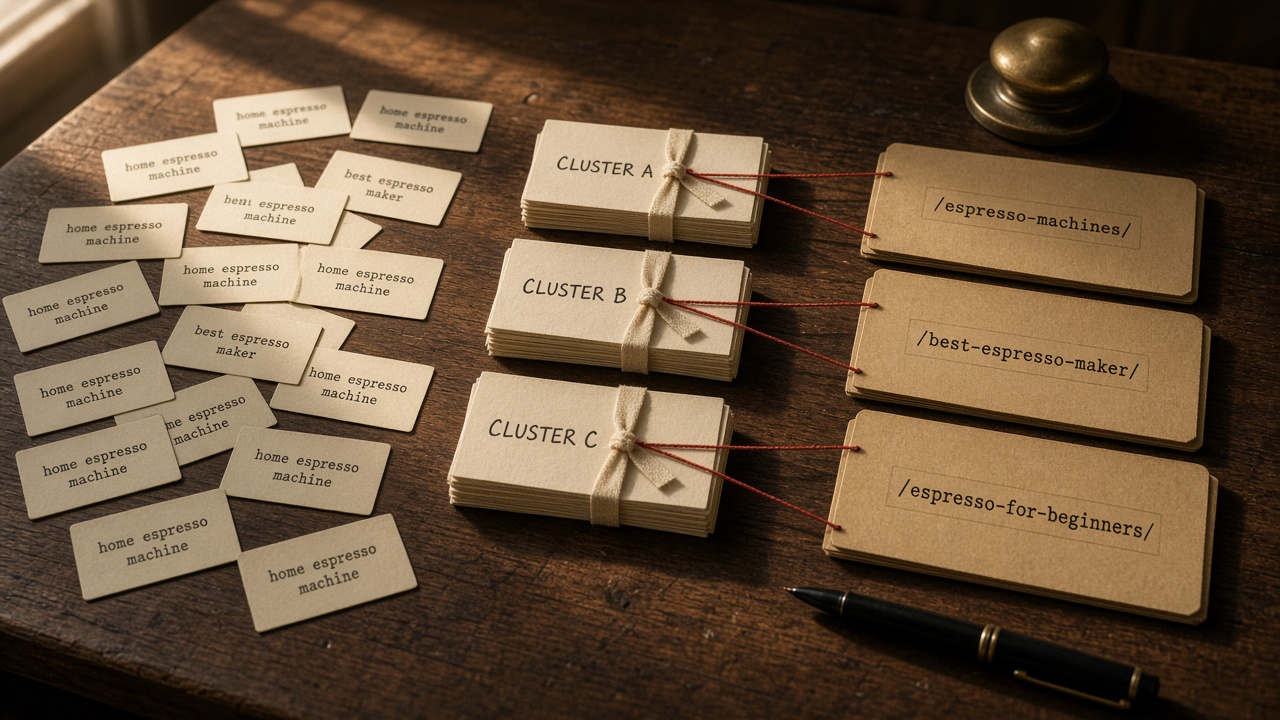
If you have ever built a keyword list and felt pressure to write a separate article for every row, you already know the trap. Searchers use many phrasings for the same job: what is keyword clustering, keyword grouping for SEO, cluster keywords by intent. Those are not ten topics. They are one topic with overlapping language.
Keyword clustering is the practice of grouping those related queries by meaning and search intent, then assigning each group to the page that should rank for it. Done well, you get fuller coverage, fewer duplicate outlines, and less keyword cannibalization—when your own URLs compete for the same result.
This article defines clustering in plain English, shows how it differs from a topic-cluster (hub-and-spoke) site structure, and walks through examples you can reuse when you scale content without flooding the site with thin pages.
- Keyword clustering groups similar queries so one strong page can rank for many related searches.
- The grouping key is intent and meaning, not just shared words or a spreadsheet sort.
- Clusters reduce thin content and stop multiple URLs from competing for the same SERP.
- Topic clusters (pillar plus spokes) are a site architecture; keyword clusters are how you assign queries to URLs.
- Use clusters to decide what to combine, what to split, and what not to publish at all.
What Keyword Clustering Actually Means
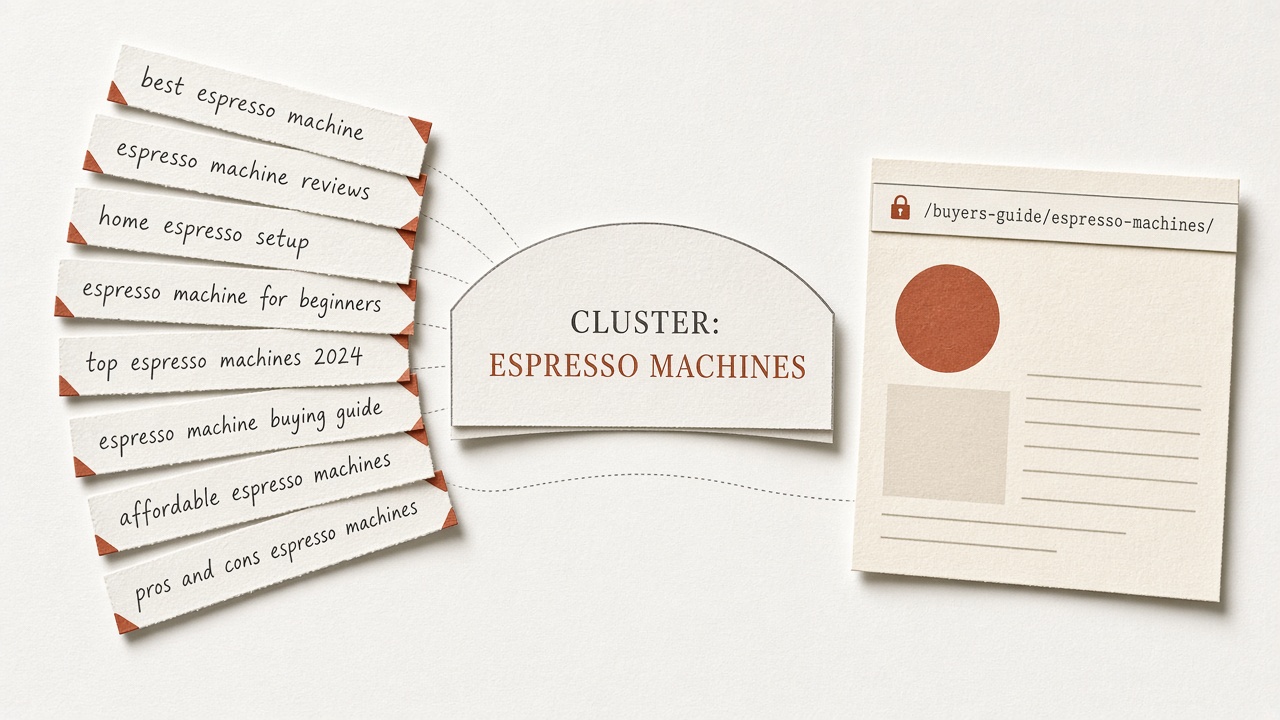
In practice a cluster is the set of phrases one URL should own: the variants, follow-ups, and near-duplicates that already surface the same kinds of results. You are matching how the SERP groups those queries, not inventing a new taxonomy.
That is different from stuffing synonyms into a paragraph, from publishing a separate post for every long-tail twist, and from mapping your entire site architecture. Synonym stuffing does not change intent. A post per variant creates thin, competing pages. Site architecture is a broader information-design job. Clustering is narrower: which queries one page (or a small set of pages) should own.
In short — Group queries that share intent and ranking results onto one URL so you cover the topic thoroughly instead of competing with yourself.
How You Decide What Belongs in One Cluster
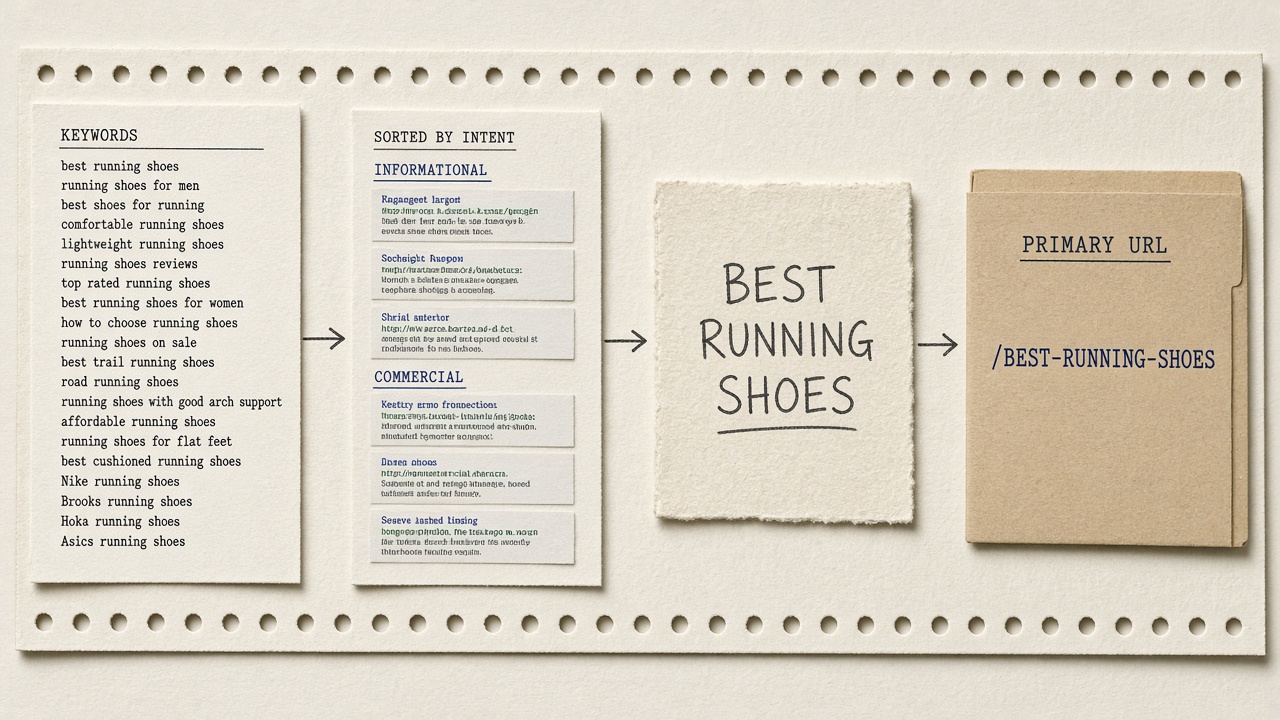
Once you treat clustering as “one page for one intent,” the next question is how you actually draw the line. You do not start with a tool dashboard. You start with a pile of related queries, then ask which of those a searcher would reasonably expect to see answered together on the same URL.
That is the logic, not a full operating playbook. You still need a grouping process to score SERP similarity, assign primary and supporting phrases, and decide when two near-duplicates should stay on one URL. The test stays simple: if a reader would feel the page answered the query without bait-and-switch, it is the same cluster. If they would need a different format, proof, or offer, split it.
The test — Group queries when searchers share the same job and the same kinds of pages already rank; split when modifiers change that job.
Keyword lists, keyword clusters, and topic clusters are not the same thing
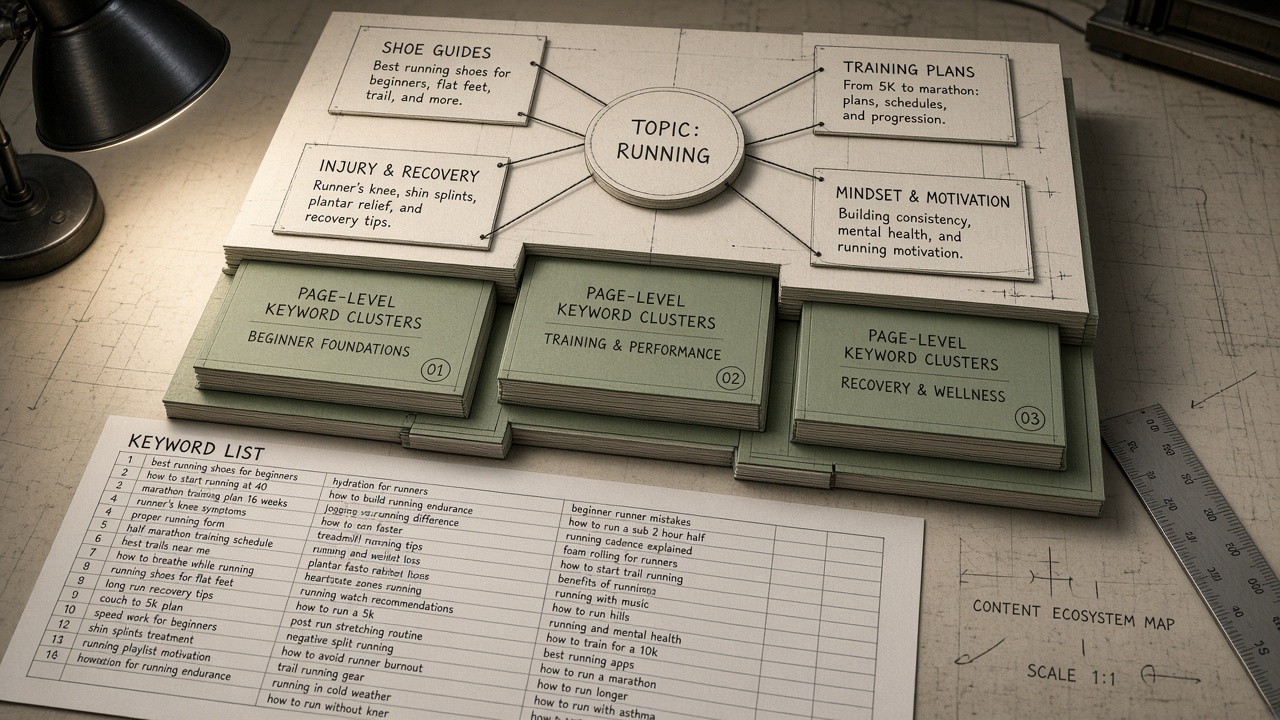
Once you can tell which queries belong together, the next trap is language. People use “keyword list,” “keyword cluster,” and “topic cluster” as if they were interchangeable. They are not, and mixing them is how you end up with either one bloated URL that ranks for nothing clearly or a stack of near-duplicate posts fighting each other.
A keyword list is the raw research inventory: every phrase you collected, unsorted. A keyword cluster is the subset of those phrases that share intent and overlapping results, so they belong on the same page. A topic cluster is the larger architecture: a hub page plus supporting articles that cover a broader subject from several angles.
This article itself sits inside a topic cluster on clustering. Separate keyword clusters—what clustering is, how you group queries, tools comparisons—each deserve their own URL. They should not be mashed into one mega-guide, and they should not be republished as ten thin variants of the same definition. If you need the operating system for grouping rankable topics across a site, use that playbook rather than stretching a single page to cover the whole subject.
Keep the three layers distinct — Treat the list as inventory, the keyword cluster as one page’s job, and the topic cluster as the hub-and-spoke map—so you neither overstuff a URL nor cannibalize yourself.
Keyword clustering examples you can pattern-match
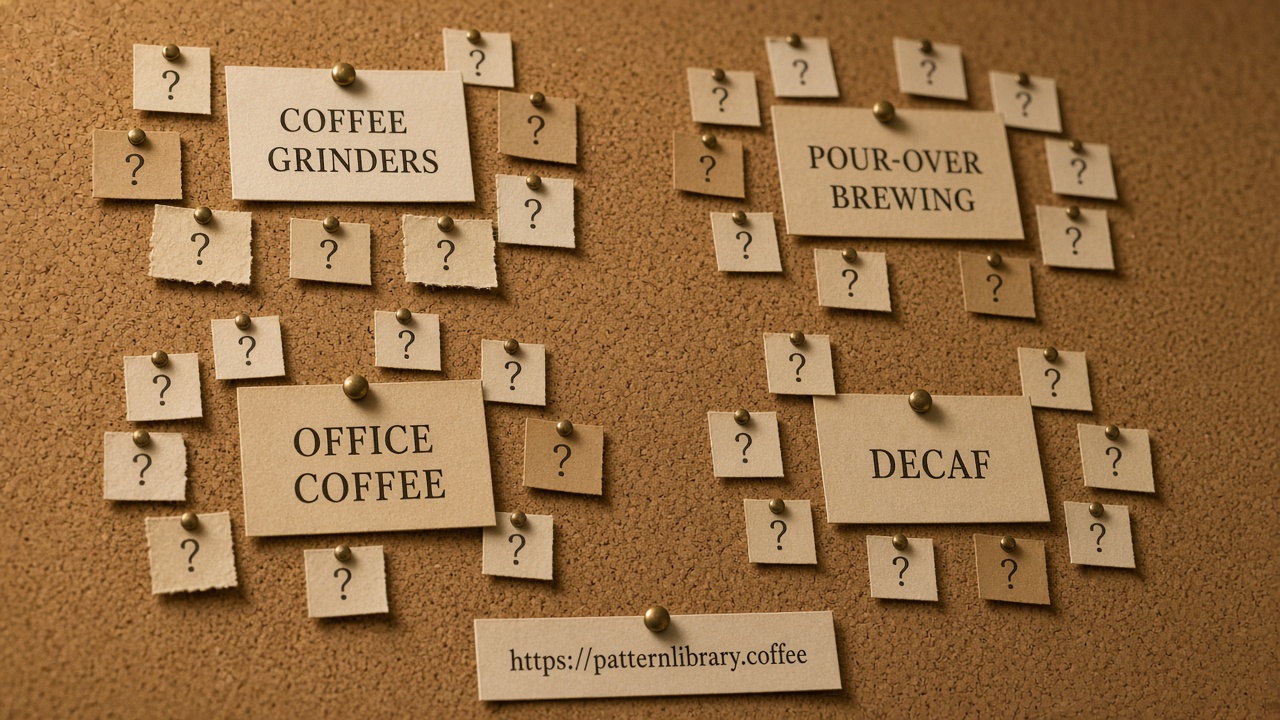
An ungrouped dump looks like a spreadsheet of near-duplicates: definition queries, how-to queries, tool queries, and commercial modifiers all sitting in one pile. After clustering, those rows become a few named groups, each with one primary keyword and a page job that matches what the searcher actually wants.
Informational queries are the cleanest illustration. “What is keyword clustering,” “keyword clustering meaning,” and “keyword clustering definition” belong on one explainer. A searcher who wants the idea does not need a second URL for a synonym. “How to cluster keywords” and “keyword clustering tool” usually do not sit on that same page—they ask for process or product, not a definition.
Same topic, different jobs
SaaS and content teams hit this constantly. “Content calendar template,” “how to build a content calendar,” and “best content calendar software” are three clusters, not one mega-guide. The first is a downloadable asset, the second is a method, the third is a comparison. Stuffing them together produces a page that ranks for none of them well.
Ecommerce follows the same split. “Running shoes” is a category. “Best running shoes for flat feet” is a buying guide. “Running shoe size chart” is a utility page. Local search does it too: “plumber near me” is a find-a-pro query, “emergency plumber cost” is commercial research, and “how to unclog a drain” is DIY help. Different intents, different pages—even when every phrase mentions plumbing.
Pattern — Cluster by the job the page must do, not by shared words. If two queries would not be satisfied by the same URL, they are not one cluster.
How a Cluster Changes Your Publishing Plan
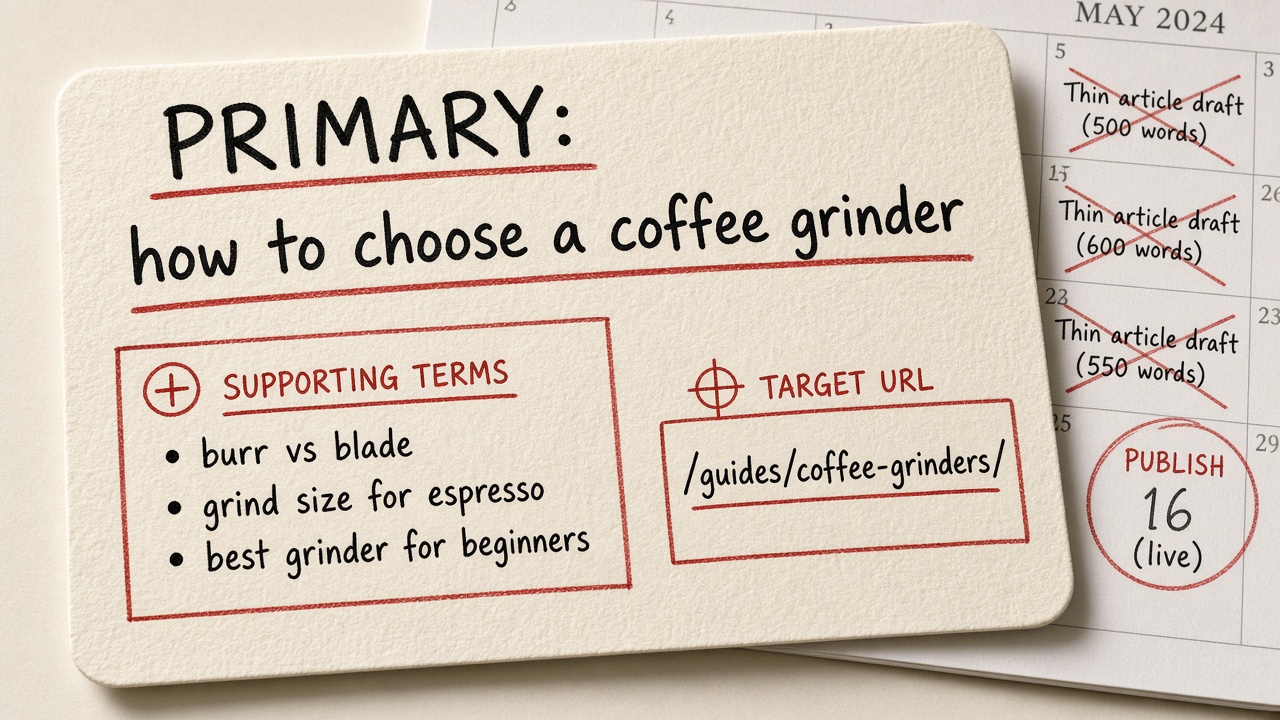
Once you have named clusters instead of a dump of similar phrases, the publishing plan gets simpler: operators write one brief per cluster. That brief names a primary keyword, lists the supporting phrases the page should cover, states the intent, and lists the questions the URL must actually answer. You do not commission a separate outline for every close variant.
The same map is a check before you hit publish. If two live URLs already chase the same group, you consolidate or retarget instead of adding another overlapping draft. Clusters also feed calendars and automated briefs so each slot is a real topic, not a synonym. For lean teams, clustering is a quality gate for content scaling—not a reason to generate more thin pages. Cover the cluster thoroughly, then stop.
Publishing takeaway — One brief and one URL per cluster, used to catch overlap before you publish, keeps scaling from turning into competing thin articles.
Key Takeaways
Map your next keyword list into named clusters before you write another brief so each page covers a real topic instead of competing with itself.